Learn how to succeed by applying principles of quantum physics to business.
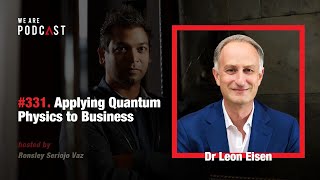
Dr. Leon Eisen, a physicist and serial entrepreneur, describes his "quantum backward thinking" method for business growth. He uses a formula where outcome equals result times alignment times trust, then works backward from a concrete goal through context, resources, and people to build a company.
Chapters
Ladies and gentlemen, I'm joined with Dr. Leon and he is got 20 years of experience in more in leadership and technology. He has written a PhD and he's a mentor at the Israeli Export Institute. He's also on the Forbes Business Council and is a member of the Royal Society of Medicine. He has created this first FDA approved wrist pulse oximetry monitor. I no, we started off a little bit with already the conversation because it was so apt and you were in flow and you were talking about this readiness of a business to accept AI or to accept even mentorship. Let's expand on that. And what are you seeing right now in the entrepreneurship world? What is standing out for you? And you're kind of going, I wish they understood this.
Thank you. And first of all, I'm very excited to join your podcast. Thank you for inviting me and I think it should be very amazing discussion. So yeah, for all your question, really it's very important to understand the readiness of founders to accept your advice. I meet all the time, I meet in our community of mentors and wisers and all the time we care how to deliver value to founders. And it's really very difficult because they don't know what they don't know. In this case, they don't know what to ask and they cannot evaluate the level of advice and how it will help. We know this but so the TR thing we have to build with founders is the trust. If you have trust, in this case, they accept your advice. Even maybe they don't, they're not ready so much. But in any case they could just grow themselves and be and get awareness, I call it consciousness about what happened and how to grow. So this is the most important and trust, I think in the middle of everything I develop formula of performance that is efficiency, you know, outcome divided by result, efficiency multiplied by alignment. People call it focus, I call it alignment and multiply by work by the trust. But if we're talking about a customer, talking about position of the company in the environment, in the business environment, we're talking about trust.
I love that equation. It's so simple. Of course, if you've been in business for even a little while, you realize that when things are going amazing, you're in alignment and you're trusting what's happening. And as soon as you don't trust what's happening, the outfall, you kind of fall out of alignment as well. Like there's an element of that that happens and then obviously efficiency gets hampered. Beautiful. Let me ask you this because just based on even that equation that you just threw out there, just like that. I want to ask you this, just considering the amount of experience you have in business in advising businesses, just like how you gave that equation for performance. I wanted to get some basics and some ideas from you in terms of what is your belief of business and entrepreneurship like, how do you see that from your perspective and viewpoint, how you wish other people saw entrepreneurship.
All these came from my experience because I'm a serial entrepreneur and I started my entrepreneurial journey about 15 years ago in healthcare space. And I'm an inventor of the world pulse oximetry monitor long before any other companies got into this area, into this space. So, and so I, I read $15 million for this company called Oxyton Medical and continue raising and for other companies as well. So this experience gave me a lot of to understand the dynamics of business. And this came to foundation of so called quantum backward thinking methodology that I developed. I am finishing the book around this and this is how I helped start startup and found that not only startups among my customers just grow companies. Not startups, service companies. And this is exactly how to help these companies to grow. And in the benefit of all these, I think the point, most important point is the trust. You can be very much efficient in development of your business. You can be very much efficient in alignment your business with requirements of customers. But if you don't trust, if you do not have trust by your customers, if you do not believe by your co worker in your business, you cannot do anything. This is the common denominator. And when I start to teach you the business about backward thinking, I call it quantum backward thinking because quantum mechanics is my background. I did PhD in optics, quantum mechanics, quantum computer. And this is what I found. I ask people, what is your goal? Okay. And people say okay, our goal is to you. We start from the goal all the time. Without this you cannot continue. My goal is to you to have X revenue, to have Y customer and to be there to be here. And I asked okay, that's good, very good goal. But what is the common denominator? To reach to this place, they cannot ask and then they here. The common denominator is trust. If you have trust, you can build efficient business. You can talk to customers, you can have revenue, you will get money. But trust and trust, usually connected to authority is the most important.
I mean I really want to get into your quantum backward thinking and I really wanted to break that down for us. But before that, you've mentioned trust way too often in the few minutes that we've been talking. So let's talk about trust for a little while before we get into the quantum backward thinking strategy, because I think that's really important. So when you say trust, you're talking about trust in other people. But like physical things that we can do to develop trust, are they things that we can practice? Is there a way for us to kind of change our thinking to be more trustworthy?
I think that it's all about physical and mental health of you and your company. If you know how to serve your clients, you can build trust. Trust is not static, it's dynamic. You can ruin this immediately if you do something wrong. So all what you're doing and if you're doing this with some inner integrity and align with your client, aligns with yourself. It creates trust. So to build trust, you have not only to have some cause and effect based on your integrity, your movement, you're doing your deed, it's also based on the pathetic build and how you align with your pattern.
I love it. I'm so glad I asked that question. That explanation really blew my mind. Gave me an insight that or a perspective that I did not even think of before. So thank you for that. Let's talk about quantum backward thinking, the strategy. You had a really amazing story and explanation the first time we met about the movie theater. And I wondered whether you could explain that to us.
Yes, very interesting. Based on the purpose, you can create a future today. So for example, you have the purpose and intention. Intention is just agenda to get to the goal, go to the cinema or to the theater and you can go. You want to go to the theater tomorrow. So just today you got intention and you're going to create it tomorrow. What you have, you have just believe I can do it. For example, and I'm going online, I want to buy this ticket and I see that, oh, there is no any ticket anymore or only one seat left. So I don't have any free will. I don't have any choice. I have to take this. That's all. No decision. So intention of other people realized before influence on my decision and my capabilities today. Now let's talk about Farfield. Today I had intention and I have the purpose to go to the theater. In a year I'm going online and I found that I can choose any ticket there, any seat, and I choose one. And this is future that already exists because I know exactly where I'm going to be in a year, which place and what time I take the ticket put in my pocket and all other People just lose this opportunity to have exactly this ticket at this time, at this point. So I got the future today. So our world, there are a lot of interesting research about how our world is built. And there is some approach that our world actually is not 3D world, it's a quantum mechanical world. It's the multidimensional world. And we have all opportunities there and we decide and here we can get into the backward thinking consciousness, separation of reality. So when you pull the purpose and then you pull the agenda and intention to reach the goals based on this path. So it's a totally different approach based on understanding that you can create your future, you can separate reality and your consciousness is very important things in your cause and effect dynamics.
Wow, I love that story. I love the way you explain it as well. And again, you know, the way you explain things, it does make it simple to understand what could potentially be quite complex topics. But the question I have on quantum backward thinking strategy is so how can entrepreneurs right now implement this approach to achieve like what you call like 100% predictive results? Like how could we just see this differently in everyday decisions that we're making? Because we're making quite a few.
Yeah, currently I talk with a lot of entrepreneurs and currently what they use the power of imagination or visualization of their future. And it really helps. It helps because it allows to visualize and also separate reality. Because you know your purpose, you know your goal. But the main drawback of this network that it's not enough. You don't have detail of what you're going to build. For example, I wanted to make ipo. I wanted to make a lot of money. I'm going to buy these. I am visualizing my, my new house in two years. This is what all about. And I ask questions, how are you going to reach this point, what you're going to need in all milestones towards your goal? And they cannot answer because they don't know what happened at each milestone. They have some general goal, they visualize, they tune their mental state to implement it. And some entrepreneurs who succeed, they somehow through probability to find this way by others don't. And this is the main difference of how to improve. Like me, I am from scientific family. I didn't think to become entrepreneur at all. But I built entrepreneur inside myself. So I'm today entrepreneur. This is who I am. So this is what helped. So we built this theory that in two years you should identify exactly where you are. So again, you should understand your state, what you're going to have There and understand how pre world is built and how consciousness is built and how it influences on everyday decision and most important on the strategy. You know, strategy settles for theorem. So finally my first course is about how cons connected to 3D world and to love science and how we can use the modern science to apply to the business. And that's why everything was built on probability. But actually modern science teach us that 3D world is not fundamental. Time and space is not fundamental. There is intelligent stage that just reject reality. So local reality doesn't exist. What does it mean? It means you can build your reality. Right. And this is why we're here, why consciousness is here. So 3D World is the projection of something like construction which is much more complex. And 3D world is just projection of this construction that create dynamics of time and space. Awareness or consciousness that you can reach this point, you can create your reality and create second. You go four quadrants, your quadrant called opportunity. There you understand the context today, compare with context tomorrow and create the gap between them. So what exactly you have today? What the market, what's the business, what's the people around you? Then you move to resources. What kind of resources you need to reach to this point. And then you move to, I call it drill engineer the performance, how to perform it, how to make it, what exact agenda, what kind of financial agenda you have to reach this point. And then you move to people that include HR connection. This is the most important because for example, if you're going to hire sales managers, whom you're looking for, usually people go through the TV and looking for some people with experience in sales who know exactly could calculate each step, each decision.
Yeah.
And who can go through the wall? You know, and all the people ask how do I know where I'm going to be in two years? Again start from the, from the trust. How are you going to build trust? How are you going to build authority? Take the benchmark, be in shadow of big companies who build authorities already take part of their authority through partnership with them. So this is all about business. It's a complex system that I teach company in growth stage. I call it how to make winner champions. Wow.
Love it. It's so amazing and we can go so deep into it. I want to shift the focus of the conversation to AI. If you were to look at what you've seen around happening right now in the world of intelligence. I keep saying, and I've been saying it a lot these days in the last couple of weeks, at least that the definition of intelligence seems to be changing every day. We're kind of learning so much, so many new things. I'm keen to see your perspective on what is happening right now and how quickly it's happening.
For me, it's quite, quite easy to understand what is the artificial intelligence. It takes all knowledge of our work, put in one machine, shuffle it and answer any question you ask them based on this stuff. So to me, artificial intelligence, it is not dangerous, it's just new. It's just Wikipedia on a new level. The main thing, yes, they can predict and think based on this knowledge. Like we. But the main difference we have access to conflict and artificial intelligence data. That's why I do some chart around this, that code, that artificial intelligence asymptotically approaches the knowledge our consciousness, but will never cross it. Why? Because when computer dies, computer doesn't watch himself from the ceiling dying. So computer always will follow people roles and finally together people and computer and artificial intelligence will go towards ultimate model.
How are you so confident that that's going to happen? Because if I see right now in decision making, right, if you see how intelligence has changed in the last month, like it's able to take an output and rethink that output and make it a new input and recursively do that, how are we not going to get to a point where it becomes more intelligent than us?
So I suppose to predict this extreme growth when AI come to the market. So how I'm aware because it's a hypothesis, nobody worry about anything, you know. But this is my way of thinking that through my experience of companies, I help as well. So proof, if you think this way and this thinking is based on science. So this is the first step to understand that time and space is not fundamental. Like a thousand years ago, people thought about fire, water, earth are fundamental elements of the design. Then Newton came and the Mendeleyev came and so chemical elements became fundamental elements of our life. And today we're talking about something beyond all this. So not quark, not border are fundamental already in our L3D world. So this is interesting approach and my thinking just aligns with modern science. This is what I believe based on the science.
Fair enough. So let's talk about business owners that are looking at AI right now and knowing it's happening so quickly. How would you suggest businesses right now start to implement AI in their business and start executing AI? Because in the last two months or three months, I've been able to implement at speed and I've been able to ideate at speed, which you know I've never had that kind of luxury before. But I'm keen to hear what your thoughts are in terms of adoption because I still see there are lots of people out there thinking this is a fad or this is a trend that might die. I'm not necessarily talking to those people, but I'm talking to people who kind of see this as, oh yeah, I know that I've got to get involved, but I don't even know where to start.
Yeah, very good question. To my opinion. First of all, it will equalize in people and between people. So people who didn't have access and even didn't have any capabilities to create, AI helped them to create. Because I think that AI is not all about answers, it's all about questions. I know you built a lot of problems. What is it? Prompt. It's a question. So question is in the center of the conflict development, not answered. Right. So if you don't know how to ask, you cannot understand the answer. This is the most important. People will change their mind through learning how to ask correctly, how to shape their questions and will be equalized in their capabilities. Wow.
And just looking at that and just thinking about what you just said, how important does your own voice, when you create content become? Because if content can just be easily generated in anyone's voice and can just keep putting mass amounts of content out there, does it become more valuable, I suppose, to have more personalized voice based content?
Yeah, it's very important because again, AI will become commodity. Today is something, wow, it's new. We're going to try. But finally, like any technology, it'll become commodity. So people will use it all the time, will use this commodity and just will apply all in all areas of their life. So this is how it will work. So, and they, they crystallize. They crystallize. But again, even through the right question, they could realize their own style as well. Because AI definitely could be tuned to their own style. Even to find my style, I cannot say. I, okay, I'm this guy who does this, that working here, working there. Please define my style. I can customize AI to myself. This is what I'm thinking.
Yeah, obviously something that is super interesting that you can replicate styles, you can even merge styles. And I've been playing and I said, can you, do you know who Alan Watts is in the eyes? Like Alan Watts is a philosopher. And I go, Mark Manson. Mark Manson is like, yeah, this. Mark Manson is this person. And I'm like, well, can you create a style that merges Alan Watts's philosophy thinking with Mark Manson's writing style. And it made this whole new style that is kind of phenomenal.
Right.
I want to ask you this question because I think it's important. I mean, you spoke initially at the start of our conversation about quantum computing. How do you think that evolution in quantum computing is going to affect or change the future of AI? And is there any correlation between the two?
Yeah, first of all, definitely there is correlation because quantum computers enable to calculate much quicker than a current computer. But in any case, calculation won't happen with velocity bigger than velocity of light. So speed of light is the maximum in our 3D world. We're not talking about something beyond 3D world where in dogman system they can, they can move information immediately.
So do you think we'll ever, we'll ever cross that speed of light? Maybe that's another whole other conversation.
In our 3D world, we cannot cross piece of light because it is impossible in our work and we cannot prove it sitting within this box. To prove it, you have to get out of this box. But you can, you know that beyond the limit Planck limit of space and time, space is 10 to minus 33 centimeter and time 10 to minus 43 centimeter space and time, it doesn't have any meaning. It's not functioning, nothing. You don't know what's inside. But there is some minimum size in our space and time beyond which we don't know what happens. So if you, for example, take this minimum size, minimum pixel that doesn't have any mean, and build one pixel to another chain, you have the chain that doesn't have any meaning. And then we build our own 3D model work that doesn't have any mini, functional mini. So we're talking about projection of something more, something bigger.
So let's, let's talk about AI influencing inventions. I mean, you're an inventor, you love this stuff. You're in this world. And also considering like you've got experience with the World Business Angel Investment forum, right? You've got all this really amazing knowledge how, what are the key factors that one would look at before investing into a business? Considering now how AI is pretty much affecting a lot of things.
Right. You know, first of all, I think AI will influence very much investment decision as well. Because, you know, specifically I think from venture capital, not for angel investor, because like angel investor, I like to consider and to base on my opinion and my story, my experience and use AI just to help to finalize my experience and my decision and to somehow to give faith to this. But for many companies it's not an issue if you are going to do due diligence. I have the list, what I have to do, what I have to pay attention on and also big number. So yeah, I think our decision making will change about investment. But in any case, team track record and capabilities and opportunities will continue to play very important role in investment decision. So if it's a early stage company, we're talking about team that is the center of decision making if you're capable to build a business or not. If we are growing round A for example, we can think about writing that again, prove the team can build something. And if we are talking about growth stages, here is very important competition and opportunities and market and partners team is not so important anymore. You can change the team, but if business process is already built, partnership is built, opportunities grow, you can continue to grow the company.
I want to land this plane and maybe get into some of the things that you're working on right now. I'm so super curious, Dr. Eisen, like what are you working on right now and what are you seeing is your next big project? What keeps you busy? You're very busy. So thank you for making the time to do this. What's occupying your mental space right now?
You know, for 10 years I managed the company, the growth of the company, like CEO from the idea through the FDA clearance clinical trial, towards the market and sales. And all the time I was focusing on the business but I had a lot of ideas and I had to put these ideas aside because focus is the most important for the business and I just, I have to do it. And then I was released from CEO and became Charmel. It's like a spring. I started to try many different areas, I tried many things and also I tried mentorship to share my knowledge, to share my experience. And after a couple of years of this interesting work, but not totally not focusing, yeah, I understood that what I like the most is mentoring, is teaching, is collaborating, is partnering with young entrepreneurs and see how they grow and help them to grow. This is what I like very much. And so I decided to build all business processes around it. I don't call it business, I call it business process behind this thing. So I tried it. I have testimonials, I have companies I'm working with. And so today I'm building a so called QB key growth accelerator and QBQ Lab QBQ growth accelerator where I invite companies and help them, I give them course about QBQ quantum backward thinking that helps them to grow. It's a 12 week course and they come out of the course in totally different mind state and at the same time I help grow company even who which didn't take this course to grow like a mentor I continue this and puberty lab is what I'm building for a third in quantum backward thinking. So I collaborate with different conscious groups investigating consciousness investigating researching quantum mechanics some how to apply a new modern theories to the business. So I'm trying to build some some laboratory some science around the success not just. Not just visualization, not just meditation around it. I am very much down to the earth and I'm very much practical. I like the order I like physics, mathematics. So we build exact theory and practice how to build company not from A to B from B back to A.
Beautiful. Ladies and gentlemen, all the links to Dr. Leon Eisen's work will be in the show notes. Go check that out. I am so thrilled that I got a chance to record this. Thank you so much for your time and your mind bending analogies because it's. It definitely gave me perspective which I didn't have before. So I'm sure it's going to give the audience the same. Dr. Leon, thank you so much. This has been cool.
Thank you Ronplay. I am very happy to be in your. Thank you.
Thanks. I'm going to stop.









