Prof. Jerome Busemeyer: How Quantum Reasoning Transforms Human Decision-Making.
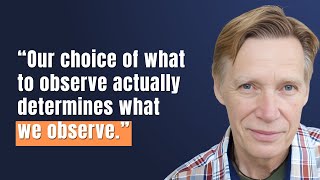
Jerome Busemeyer explains how quantum physics principles like superposition and entanglement describe how humans actually make decisions, not just classical probability. When you judge a movie before and after seeing it, your mind doesn't hold a fixed opinion in between, it exists in superposition. This framework predicts behavior classical models miss.
Chapters
Superposition concept from physics nicely captures this human intuition that we have. The superposition principle also is related to another important principle from quantum physics. How is it that humans are alike electrons? What is it that we have in common? I don't know if it was Wheeler or Wigner once said, what we observe in this world is what we choose to observe and that determines what we do observe. So our choice of what to observe actually determines what we observe. Humans don't reason classically. They often violate classical axioms. And so one reason it's important to think about use quantum reasoning if you're trying to predict somebody else's behavior. If you're trying to predict their behavior, you might make the wrong prediction if you're thinking that the reasoning classically.
Jerome Busemeyer, Distinguished professor of Indiana University of Physiological and Brain Science. He is one of the founders of mathematical models of human judgment and decision making behavior. He wrote the book called Quantum Models of Cognition and Decision. Do you remember when you sense ambiguity about all possible decisions simultaneously or you tried to figure out possible outcomes of something that is just a mechanical cause effect? Today we will ask all these questions and even more to Professor Jerome Woosemayr. Hello. Hello, Professor.
Hello. Hello everybody.
Thank you. Yeah, I'm really happy to have you on my podcast. It's something about science and business and life because I was reading your book and your paper and I was amazed about your approach and in general quantum physics approach to cognition. So I think we can talk about three main components of quantum approach to our brain. It's a quantum brain is quantum consciousness and quantum cognition, which is your main subject of interest. So but in the beginning I would like to give our audience some general view on what. What is it quantum to. To. To our brain and why in general we should apply quantum physics to understanding our consciousness and our decision making.
Yeah. So you want me to answer that?
Yes, okay, please.
All right. Well, I think there's several properties or principles from quantum physics that I think are generally applicable outside of physics to psychology or even economics. And so let me go through a couple of these, several of these principles and then I'll talk about some applications of these principles in psychology and then maybe in business. So first of all, one of the main concepts that really captured my attention from quantum theory was the concept of superposition, of course, force. And you know, so that that concept really related to me because, you know, when we make difficult decisions, we really feel ourselves in conflict and we really feel like we're in some potential to do either action at the same moment in time. It's not like we're in one state at one moment. And another state the next moment jumping around. It's like we're really fuzzy or distributed in our our values about what action to take. And so that superposition concept from physics. Nicely captures this human intuition that we have now. The superposition principle also is related to another important principle from quantum physics. How is it that humans are alike electrons? What is it that we have in common? Well, one of them is that both humans and electrons. Are sensitive to measurement. You know, when you measure the position of electron, you know, you change its state. And so the measurement changes the state of the system. So it changes like a superposition. I guess. An electron could be, like in a spin up and spin down direction. It could be some superposition of those two states. And when you measure it, it collapses from the superposition to a single state. Which then changes its behavior in the future. Well, humans are like that. We're sensitive to measurement too. When you ask me a question. Before I have an answer to it. I might be superposed about that question. But then after I formulate an answer, I collapse and become clear about that question. And so that changes me. So I'm sensitive to the measurement. For example, like, let's say I go to a movie and, you know, some kind of movie. And I walk out of the movie. And my wife asked me, well, did you think that movie was romantic? And, you know, I was thinking about getting a beer at the time. I didn't really have any idea about romance. But then I had to think about it. Well, was it romantic or not? And I come to some conclusion. Yeah, I think that movie was romantic. And so if somebody asked me later on, was it a romantic movie? I said, yeah, it was a romantic movie. So it changes my state. And so both these two things, superposition and sensitivity. Lead to third important principle of quantum theory. And as everybody knows, quantum theory is a probabilistic theory. It's an indeterministic theory. I mean, our behavior is not predictable, perfectly predictable. So just like electrons, you know, when you measure its spin. There's a chance it'll be spin up. And there's a chance it'll go spin down. And you can't perfectly predict that property of the spin ahead of time. And humans are like that. So we are not perfectly predictable. Now, one of the important ideas of quantum theory. That comes from these three principles so far. Is that before you measure the system. It doesn't have a particular state like an electron Is not right before you measure it. It's not in a spin up state or spin down state. It's either one of those states. But after you measure it, it becomes one of those states. And humans are like that. You know, before you asked me this question about the romance of this, of this movie, I'm not in either state. But after you ask me that question, I've become that state. So measurement is not just recording something that existed previously. Instead, it's creating something that didn't exist before. So measurement has this creative aspect to it. And I think, I don't know if it was Wheeler or Wigner once said is what we observe in this world is what we choose to observe. And that determines what we do observe. So our choice of what to observe actually determines what we observe. Now, another very important concept from quantum physics that I think is applicable more generally to human behavior, maybe even outside the economics, Is the principle of complementarity. So complementarity refers to the idea that we have two ways of looking at the world. And they're both required to understand the world, but they're mutually exclusive. So we can only look at the world from one of those perspectives at a time. In the sense that we have to kind of look at one perspective of the world and evaluate it from that one perspective. And then kind of rotate and change our viewpoint to another's perspective. And you can't be, since it's kind of a perspective problem. You can't be in both worlds at the same time. So that's the complementarity problem.
Yeah. So, for example, like, I mean, business. Yeah, actually, yeah. Because usually we have to choose between two sides of the coin. And we cannot see both sides at the same time.
Yeah. Well, it's like if I'm trying to decide what movie good to go to with my wife, I can think of the movie that she wants to go to first. That's like looking from her perspective and try to evaluate that. Then I can turn around and say, well, what movie do I want to watch? And I can't do both at the same. I can't be both people at the same time. I have to put my feet into her shoes. And then I can put my feet into my own shoes. But I can't be in both shoes at the same time. So that's the principle of complementarity. But also related to that principle of complementarity is the principle of non commutativity. So not only are things complementary that we can only look at one thing at a time. The order that we look at these things makes a big difference. So for like a spin, if I spin spin up and spin down and then measures spin left and right, I'm not going to get the same answer if I did those tests of the spins in different orders. Well, humans are like that too. So if I go to this movie and my wife asked me this question, do you think the movie was romantic? And then I make a decision about, you know, romance. And then she asked me, well, did you think it was immoral? And then I have to make a decision about morality. But if I ask those questions in opposite orders, I might come out with different answers. Or like for example, a judge, you know, judging a criminal offense. If the judge has to decide the punishment before judging guilt or innocent, they might come out with a different punishment than if they judge guilt or innocent. And then the punishment. So the order that we ask these questions make a big difference. So that's a really key property that humans have that we share with things like electrons in quantum physics. We have this non commutative reasoning process. And so we need a theory of reasoning that incorporates this feature that we have this non commutative property. I'll come back to that in a minute when I talk more about probability theory. Now another thing that these principles imply, they're not all really logically separate. They're kind of like connected together. Another principle that we buy into once we adopt a principle of complementarity and non commutativity and sensitive to measurement is the uncertainty principle. So how does this happen with human behavior? I mean, we know with particles, if you measure the position precisely, you know, the momentum is kind of spread out and uncertain. Or if you measure momentum precisely, the position gets spread out and uncertain. Well, humans are like that too. So if you become clear on one question, that might make you unclear in a different question. And so what one question might disturb another question, causing some uncertainty. So for example, like on this question of romantics aspect of this movie versus the immoral aspect, you know, once if I, I, if I resolve my opinion first about it's romantic and make that clear in my mind, but then I'm asked the question about, well, is it immoral? And now when I start thinking about the morality and make that question clear in my mind, but once I make the question on morality clear, I might become uncertain about my answer about romantic. So I might initially think, oh, it's romantic, but then I think it's immoral. And then I might think, well, maybe it's not romantic. So answering the moral Question might disturb and make me uncertain about my romantic answer. So that's another sixth principle, basically. And so the last principle that is important in quantum theory, of course, and big, big deal in quantum computing is the principle of entanglement. You know, that's where all the speed of quantum computers come from. But how's that related to humans? Well, yeah, it's kind of a subtle question. Now, like, you know, if we really wanted to see entanglement in a, in a quantum sense, what we do in, in quantum physics, we have two particles collide and they go far, far apart. And we measure one particle instantaneously, has and affect another particle in a distant part of the universe. And so that's kind of the entanglement effect. Well, how, how will we do such an experiment with humans? I mean, we could put two humans in two different rooms in a, in a, in a kind of a game, and one human could be trying to predict what the other human's going to do. But that's kind of like telepathy. And I don't know if that really happens. Some people think so, but I don't know. But that's one sense of, you know, entanglement. But there's a more subtle, maybe even deeper sense of entanglement that's important in cognitive quantum cognition, and that is that our judgments are very contextual. And so the context of questions then can change the answers. Like when you ask a pair of questions A and B, do you think the current president is doing a good job? And do you think the country is going in the right direction? You ask these kinds of questions. Your answer to is the country going in the right direction Might change depending upon if you asked it in the context of also asking the president is doing a good job. And so the answers become dependent upon the context. And in order to explain these kind of context dependencies and judgments, we need the concept of entanglement. So those are several principles, I think, that come from quantum physics, but are applicable outside of physics to cognitive psychology or even economics. And that's a principle of superposition, sensitivity to measurement, indeterministic nature of behavior, complementarity, non commutativity, uncertainty principles, and entanglement. Now, let me say something more, more general about quantum theory and quantum cognition. Now, people have different views about quantum physics. And I don't like to say we're doing quantum mechanics. Quantum mechanics is quantum physics. But what happened in the 1920s when the quantum physicists, you know, Bohr and Heisenberg and Schrodinger and Dirac and everyone, when they invented quantum mechanics and born especially, they invented a whole new probability theory. So, you know, and, and so we have more than one probability theory out there. Most of us are trained in what we call a Kolmogorov probability theory. Kolagorov was a Russian mathematician probabilist, and Kolmogorov actually axiomatized classical probability theory in 1932. Of course, classical theory was developed in 1700 and 1800s by Laplace and other people, but it wasn't axiomatized until Kolmogorov axiomatized it in 1932. Now, about the same time, von Neumann took the ideas of quantum mechanics and axiomatized it and so axiomatized quantum mechanics in terms of quantum probability. And so we had this general theory, two general theories now of probability. There's the Kolmogorov theory that most people are trained in because it's kind of the classical theory. And then we have the quantum probability theory, the von Neumann theory. They're based on different axioms. And so what are the different axioms? Well, I'm not going to go through the details, but the basic idea of Kolmogorov's theory is that we have these events in the world. Like if you purchase this new option for an investment, you know you're going to succeed. That's an event. Korov theory is based upon the idea that events like, you know, your, your investment become successful. That event is represented as a sub subset of a sample space. And so all of Kama Gorov's theory is based upon the logic of subsets. And the logic of subsets is a Boolean logic. And so when you buy into Boolean logic, you buying into a number of axioms. And these axioms include closure. So if A is an event and B is an event, then the conjunction is event. You know, if you invest in here and win, and you invest in there and win, well the conjunction you invest in here and there, that's another event. And that's like the intersection event of the set. And then you also buy into not only closure, but commutativity. So, so A and B is the same as B and A, because that's the nature of intersection. And then you also buy into distributivity, like the event A and B or not B a parenthesis B or not B is A and B or A and not B. So you're buying into all these axioms at once. When you buy in the Kolmogorov theory and I'll maybe make this intuitive with some experimental results in a few minutes. But quantum theory, how's it different? Quantum probability is based upon a different idea for events. So events in quantum theory are subspaces. So subspaces like a plane or a line or a hyperplane. So you have a vector space. An event like being successful in a investment is like a plane in that subspace in that vector space. And so you're buying into the logic of subspaces. And instead of the logic of subsets, and so the logic of subspaces, sometimes we call this quantum logic. Anyway, it's a different, has different axioms. And so in a way, quantum probability is a generalization of classical probability. We relax some of the axioms of classical probability theory. So for example, the axiom closure doesn't necessarily hold. So for example, an example when I was talking about movie and immorality, these two events, the event A, that I think the movie is romantic might be one event. Event B that the movie was immoral might be a second event. But there's no A and B. And the reason why there's no A and B is because they're order dependent. There's an A and then B, but I won't get the same answer as B and then A. So there's only a sequence of events and not a conjunction. So we lose closure because we have to deal with non commutativity. So non commutativity is the second thing. So A and B is not the same as B and A. And third, we lose distributivity. So A and parentheses B or not B is not necessarily equal to A and B or A and not B. And so let's take an example of distributivity. Like this judge, if this judge is trying to think about a criminal, like let's suppose we take the event where the judge is just trying to decide the punishment. Well, what should the punishment be for this crime? Should it be put to death or not? We have death penalty in this country, so it's controversial. But you know, so that when the judge makes that decision about should the death, should this person be put to death or not? That's an event punishment event. Now in quantum theory, when the judge is deciding punishment, he's not asked to resolve the question about guilt or not guilt anymore. So he can remain superposed about those two questions. And so what happens is he can decide the punishment without resolving or become clear about the guilt or not guilt. In classic theory, that cannot happen. In classic theory, if he's got A if he's got to decide the punishment, he's got to first decide whether he thinks the person's guilty or decide whether he thinks the person is not guilty. It has to be guilty in punishment and guilty and not punishment. But quantum theory is not necessarily the case. You can be deciding punishment without resolving the guilty and not guilty question. Or like, I can decide this movie is romantic without resolving ahead of time whether I think it's moral or not. You know, when I decide it's romantic, I'm not thinking about morality yet. And so I can resolve one question without resolving.
If we think about application for decision making, what exactly the difference in a simple explanation between quantum decision making and classical decision making? As I understand, quantum decision making enables us much richer decisions and to have infinite thinking capabilities about decisions. But what exact difference? Why Quantum decision making and people who are successful, I think they apply quantum decision making unconsciously because they are built this way. And some people should learn how to do it in order to uncover some superpower in order to decide in business and in life. So what's the difference? Why it's better to learn about quantum decision making and apply it.
Yeah, well, that's a good question. I mean, we might ask the question, well, why, like, why in this world should people use quantum reasoning when the world we see is classical? I mean, electrons are, you know, micro things. We can't see electrons, but we see baseballs, and we see water waves. And so.
And these are all classical electrons and atoms. We don't see atoms, but we see what result of all these.
Well, that's the point is, is people often say to me, well, the world's. The world we see is classical. Well, the billiard balls in the water waves are classical, but my dog is not necessarily classical when he's chasing the cat. And in fact, humans are not classical because we do experiments and we see evidence showing that humans don't reason classically. They often violate classical axioms. And so one reason it's important to think about. You use quantum reasoning if you're trying to predict somebody else's behavior. If you're trying to predict their behavior, you might make the wrong prediction. If you're thinking that they're reasoning classically, they may not be reasoning classically. I mean, sometimes people do, sometimes people don't. What I mentioned before, quantum theory is a generalization of classical probability theory is a generalization in the sense that in classic probability theory, you have this commutative property. Well, in quantum theory, sometimes events are commutative. So it doesn't matter which order you ask. And sometimes they're non commutative. So quantum probability is a more general probability theory that allows for non commutativity. So for example, if you ask me what's my age and what's my occupation, doesn't matter what order you ask me that I'm going to be commutative. Yeah, but if you ask me about the romance of the movie and the morality, I might be non communicative. And so quantum theory allows for this non commutativity and reasoning and we have to take that into consideration when we start predicting people's behavior. So let me just turn to an experiment. For example. Let's say, you know, let's say this is a real experiment and but I'm going to try to put it more in a business perspective. But this is an experiment done by Amos Dversky and eldar Shafir in 1990s. They, they gave people gambles, you know, and they, they use what's they called a two stage gamble. So this is like making a business investment, right? Yeah, I mean the gambles you win, you win $100 or you lose 50. So I think it's a 50, 50 gamble. So the expectation's positive. I mean if you just go on the expected value, you should choose the gamble. But people are risk averse, so they don't, they don't always do that. So that's not the quantum part, that's just regular economics. But the interesting thing about their experiment is they were trying to test, they were using a two stage gamble because they wanted to test the principle of rational decision making called the sure thing principle. Now in this principle, basic ideas, if under one state of the world you prefer to take the gamble, take this investment, and under some other opposite state of the world you still prefer to take this investment, then you should go ahead and take the investment without knowing the state of the world. That's called the sure thing principle. That's the foundation for Savage's theory of subjective expected utility theory, which is kind of a rational theory of decision making used by economists. Well, Tversky and Shreveer wanted to test that principle. So they gave people this two stage gamble. And so on the first stage it was mandatory, they had to play the first stage. So they played the first stage and then they were asked whether or not they wanted to play again after the first stage. And they had two conditions. Well, let's say three conditions and one condition of the experiment they were told they won the first gamble. Well, you Just won. You won a hundred dollars. Now do you want to play again? And you win $100 or lose 50 now? And when they weren't told they were one, most people wanted to play again. They figured, well, I got extra house money, I can play it again. So then they were another condition. They're told you just lost the first gamble, so you lost $50. So then they asked, well, do you want to play again after you lose again? Most people wanted to play again because they wanted to make up for the losses. But when a third condition, they weren't told the outcome of the first gamble. So they. They knew they played the first gamble, but they didn't know what the outcome was. And so then they were asked, do you want to play the gamble or not now, when they weren't told the outcome, they changed. And now most people wanted to play the gamble again. So most people. Sorry, no. Most people didn't want to play the gamble. So when they didn't know the outcome of the first play, most people didn't want to play the gamble again. So when they knew they won, most people won the play. When they knew they lost, most people won the play. But when they didn't know, they changed their mind and they didn't want to play. So that violated the sure thing principle. And so that's. Now what. How does quantum theory deal with that? It's because when you're. When you're just. I mean, we have a mathematical model for all this. But briefly, intuitively, when you're asked, do you want to play the gamble after knowing your win? So like your first gamble initially on the first stage gamble, you play this gamble, you don't know if you're one or lost. And so you're in a superposition state when you're starting out. But then you're told you you won. So now you've collapsed, so you're. Now you're in the win state. And given that win state, you're masked to make a decision now. And. Or you're in the superposition state and you're told you lost. So you collapse to the lost state. So you're in a win state or loss state. And then you make a decision. So decision is based upon these collapse states. But when you're not asked to. I mean, when you're not told about the outcome of the first play, you're remaining in the superposition state. Now, what happens when you're in a superposition state is you can get these interference terms. Because when you calculate probabilities of Quantum theory, you have an amplitude A plus an amplitude B. Take the squared magnitude and what happens is you get to square the first amplitude, which is the probability that you get if you were told the first outcome. And then you get the square to the second amplitude. Which is the probability that you would get if you're told the second out. But then you get this cross product term which can be negative. And so because you're in a superposition that generates these cross product terms. Interference terms occur from the superposition effect. And then you get this drop in the probability when you don't know. So when you're told the outcome, you're eliminating this interference term. But when you're not told the superposition generates this interference that drops the probability. So this is something to be important to know about when you're making decisions. That this kind of interference can happen when you're making decisions.
I remember one of your talk, I you talk about buy, not buy decision. So you have some two axes, buy not buy and some superposition between them. So I just imagine I'm getting into the show. I didn't decide should I buy it or not or what should I buy actually. And in this case I am exactly in this superposition state of my mind. But interesting, I cannot decide by myself. By the way you mentioned about self measurement problem. I cannot measure myself. I cannot collapse to some decision by myself. So I need sales manager who approach me and start to influence on my cognitive mind which is in superposition state. Or even I collapse. I get with decision. I want to do this. And this is interesting subject because I didn't find some mention of this. And these guys start to ask me to redecide. So I'm already collapsed. And he gonna get me again back to superposition state.
Yeah, that's like the uncertainty principle. Like you could be collapsed just like the romance versus morality question. You could be collapsed on romance. But then when you're asked about morality, you become unclear about the romance. So you can be collapsed upon I want to buy product A. But then the salesman comes over and kind of rotates you away from that answer. And now you're become uncertain about what you want to get. Yeah, so that's, that's an example.
Also you mentioned a role. You didn't name it, but a role of intuition. And we know in business intuition is a 50% of success. So this comes from quantum condition, right?
Yeah, I often think that. Well, we often think that the superposition state is this intuitive. It's kind of like an almost an unconscious Intuitive state, the superposition state. I mean, you might have some kind of vague feeling. But the collapse becomes. When you become conscious, you know, when you. We often associate the collapse with consciousness. So you're kind of in this intuitive. Working in this intuitive superposition state. And I haven't talked about the dynamics. Probably don't have time to that. But in quantum theory, the dynamics. You kind of process many alternatives in the superposition state in parallel. That's where the power of quantum computing comes from. Because it can search many different paths simultaneously. Except you have to ask the right question. Extract the information from the superposition state. But while you're in a superposition state, you're in this state where you can kind of parallel process many paths, explore many paths in parallel. But then when you collapse, you're forcing a decision. And then you're coming out of the superposition state. And becoming more conscious of what action to take.
I'd like a little bit dive deeper into difference between cognitive state and record state. Because it's actually the core of theory. So you mentioned that what we observe is determined what we choose to observe.
Yeah.
So I remember there is also a Russian professor. He wrote a book about how to create a reality. And he guessed that we create reality. So by collapsing our measurement, we create reality. So we live in infinite realities and we create what we want. So I would like to dive deeper into this stuff because it's very interesting. Because if, for example, I think that in the year I will make xyz. And I created this reality in my mind already. So all my decision making is directed, like vector towards this outcome. But outcome, as I understand this is mechanical definition we're talking about. Maybe I was thinking about how to define quantum thinking. And it's a vector. So instead of outcome, we're talking about vector. Maybe strategy belongs to quantum cognition. Strategy. Strategy, because it's vector. It's a set of decisions towards some outcome. And outcome is a pure mechanical style. But the process towards the outcome is a quantum.
Yeah, I mean, I think that's getting more into the nature of the dynamics of quantum theory and quantum theory. It's like when you're trying to make a decision. You're in some kind of superposition state. Where you haven't made up your mind about which one. It's not like you're jumping from, well, I'm going to make this investment to now I changed my mind and make this investment. You're processing both of these at the same time simultaneously. So you're keeping your options open. Basically. And processing both paths in parallel. And it's a vector basically mathematically that's being rotated in space across. Well, in some kind of vector space. Yes, across time. And not until you make a final decision does this vector. Well, it collapsed to another vector. But it collapsed to the outcome of the decision. But before that you're in this superposition state. Which is actually processing many alternatives simultaneously. You're. It's kind of like a way of parallel processing. And keeping your mind open. Rather than collapsing and closing off options too early. I would say that's. I think that's a power. The powers of quantum reasoning is. Is to kind of parallel process ideas. Before you collapse onto a single idea. And get stuck in a local minimum.
And create your reality finally. Yeah.
The questions you ask, the measurements you take in life create your reality. So. Yeah, right. If you don't ask these questions. Then you won't become these states. Then the questions actually generate the outcomes that you observe. So that's an important aspect of quantum theory too.
Yeah. So actually consciousness, what is it? Consciousness is. Is all about creation of our reality. So consciousness. Reality manifests from the consciousness.
Yeah, I mean consciousness, I kind of think of consciousness is when you start to record in memory something in particular. So your memory is a record of what you're conscious of. The superposition state is really pre conscious, I think. So you really got several things in process that are. That are fuzzily and distributed across time. And then all of a sudden one will become crystal clear. Then you record that, you become conscious of it and record that. Maybe even verbalize it to people. So you commit to that decision.
Yeah. You know, I developed so called quantum business thinking methodology. That helps people to be conscious about this consciousness process of creation reality. Because people don't aware it, they don't think, they think, they decided not. I always talk about two people in one body. And these people could be lying and these people could be totally struggling each other. And this is a big problem for people. And how to align these two minds. Conscious mind and subconscious mind within one body towards specific goal. I want something, but subconscious mind doesn't allow me to do it. And this is a big problem. So if I understand and thank you for helping me. And maybe you will help other people from our audience to understand these dynamics. It's much easier to decide and to see and to predict what happens from your decision. Not just cause effect. Okay, I do this, I have outcome like this, I do that, I have out. Usually it doesn't work for me if I apply my logical decision making, I lose all the time. So when I listen to my intuition, this is where I win. So it's very important application. So we are going to wrap up and my last question. Yeah. Could you define what is it? Quantum happiness.
Say that again.
What is it? Quantum happiness.
Quantum happiness.
Yes.
Well, what is quantum heaviness? Well, I mean, maybe. When you can. When you can, when you see different perspectives and freely move from one perspective to the another so you have a better understanding of the world.
Yeah.
Be able to see different people's perspectives and be able to change your perspective and see the world from different perspectives and you might be able to understand the world better. And that'll give you peace.
It means if we can align with our world, this is where we find happiness. And this actually belongs to quantum understanding and quantum dynamics of our mind.
Yeah. Align our state vector with the. The direction that makes us most happy. Yeah.
Thank you very much. Okay. I really happy to. To have you on my podcast and I hope we will meet again because we just talk about some surface of the problems you are solving and I wish you at. Wish you to help us to understand how. How to align our lives with our.
World.
And influence on our world as well at the same time. Yeah.
Right. Okay.
Thank you very much.
Thank you for inviting me.









