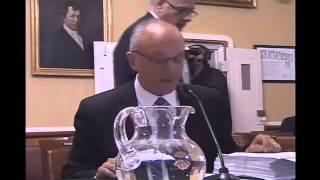
In a hearing before the House Rules Committee, Representative Deutch, joined by co‑sponsors McGovern, Edwards, Sarbanes, Polis, and Hastings, advocates for an amendment to delete Division N, Section 101 from the omnibus spending bill. That provision would raise the annual contribution limit for the wealthiest donors to national party committees from the existing cap to an additional $648,000 per donor—allowing a single individual to inject up to $1.5 million per two‑year election cycle. Deutch frames the change as a drastic rollback of the 2002 McCain‑Feingold campaign‑finance reforms, a “sneak attack” enacted without debate, hearings, or markup, and an assault on democratic integrity in the wake of Citizens United and the Supreme Court’s McCutcheon decision. He condemns the timing and secrecy of the amendment, calls for open debate on campaign‑finance rules, and urges the House to vote on whether to make the system worse, emphasizing the public’s loss of faith in Washington and the need for transparent, bipartisan reform.
Chapters
Thank you, Chairman Sessions, Ranking Member Slaughter, and fellow members of the Rules Committee. Thanks for the opportunity to testify. You testify before you today in support of my amendment that I introduced along with Congressman McGovern, Congressman Edwards, Congressman Sarbanes, Congressman Polis and Hastings as well, to strike Division N Section 101 from this omnibus spending bill. The provision in question would allow the wealthiest donors in America to contribute an additional $648,000 to the national political party and congressional parties every single year. Indeed, this measure invites a tiny sliver of the American population to donate an additional one and a half million dollars per two year federal election cycle. That's the amount per person that that this bill would allow the wealthiest few Americans to inject into our political system. Now, this provision increases the amount an individual donor can give to political party committees by over $1.2 million, an outrageous and exponential increase. The limits done away with by this provision were a centerpiece of the McCain Feingold campaign finance reform laws passed by Congress in 2002 to address the widespread perception of corruption in our political party system. Now, I believe that most Americans would find it downright appalling that congressional negotiators saw fit to chip away at these landmark reforms in the middle of the night without debate and without even fair warning. Now, I know you've heard from many of my colleagues today who are disappointed with how we arrived at this bill. Members on both sides of the aisle, regardless of your views on the policy of these riders, the agreement in question today was struck in the middle of the night without public debate, without hearings, without a markup, and now without apparently an open rule. One explanation provided by some of my colleagues on this committee is that, well, you know, the bill's not perfect. That's compromise. There's some good, there's some bad. That's just the way we need to work together to get things done. I respectfully but deeply disagree with the suggestion that this is just a compromise. It's not compromise. This Congress was not engaged in a debate over campaign finance issues that could potentially lead to a compromise. This was quite simply a sneak attack on our campaign finance system. It's a sneak attack on the American people at a time when poll after poll after poll shows that our constituents are losing faith in Washington's ability to put their needs ahead of well connected and deep pocketed special interests. If this House ever once hosted a debate on which of the McCain Feingold reforms to toss out, which donation limits for millionaires and billionaires should be lifted, which money in our election should be disclosed to the public. I'd have been there. Jim McGovern would have been there. Donna Edwards, John Sarbanes, Walter Jones would be there. Every member of Congress who has worked to restore faith in our democracy in the aftermath of the Citizens United case would have been there. The American people deserve such a debate. Now, the argument that I heard earlier today that these changes to our campaign finance laws, getting rid of these limitations and increasing the amount that can be contributed, that they're necessary because presidential election campaign funds have been diverted to pay for pediatric cancer research. Those arguments are disingenuous and they are offensive. If the majority would like to restore public funding for conventions, then we should consider that legislation on its merits. We've got the time. The next conventions won't be held for roughly 18 months. If funding of nominated conventions is a priority for the majority, then bring it to the floor in January. Let's have a debate and let's figure out how to do it. The American people already feel excluded from the legislative process. The integrity of our elections already suffered an enormous blow in 2014 when the Supreme Court ruled in McCutcheon that wealthy individuals have a constitutional right to exert more influence over elected officials than the people who elect them. We are witnessing an all out assault on what was a bipartisan system of rules to reduce corruption and ensure that big money was not able to dominate our democratic institutions. When we arrive at campaign rules that are the product of secret bargains, it not only substantively contributes to more dominance by wealthy donors, but it proves our point. And finally, Mr. Chairman, you said earlier that because of the timing, we can't do things that are extraneous in this bill. I would submit that this entire process shows us that the system is broken. And I think that the People's House should vote on whether or not they want to make it worse. Thank you, gentlemen, for his time. Gentlewoman, is there anyone on the Democrat side that would seek to question. Gentlemen, I don't have any questions, but I'm a co sponsor of the measures offered by Mr. Deutsch and he has spoken for me. Thank you. Any member of the Republican side. Mr. Witch, your time is well spent. I know you spent a lot of time waiting over here and it took us a long time to go through this today.