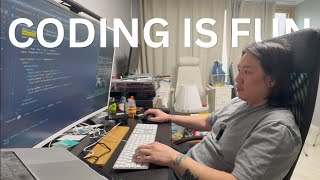
Phil Choi shares how he stays consistent with coding by picking projects he cares about, using community accountability, and gamifying practice with GitHub streaks and Codewars. He built a Discord app and a slot-machine mini-project while hitting his deadlines.
Questions this video answers
Light Social
1888 puzzles
"lead fill" (in all lowercase)
Chapters
Just one hour. Six hours LATER don't let this be you. Hey, what's up? So today I just want to talk about how to make coding fun and stay consistent. Every day I'm gonna break it down into a few key points. I'll keep you motivated and actually excited to code. Alright, let's start with the first one. Finding and building a project that you actually care about. This one's huge. If you're just doing random tutorials or just exercises that don't mean much to you, it's easy to get bored and lose focus. So right now I'm working on this mobile app. It's. It's pretty cool. I thought it's gonna be good for the community at Discord. The Discord community, it's called Light Social. I have to. I'm working on like the forgot password screen. So it's like kind of just like things kind of like keep me interested in the code. Just if you're doing something fun, it doesn't really feel like work, it just feels like you're working on a hobby. So that's one thing that you can do. Next up is accountability. So one thing that we always have is the Discord coding accountability channel. So everybody just types like maybe something they've done for that day. And it kind of keeps you accountable and gamifies it a little bit as well so that I don't think that'll segue into the next one, you know, and if you are not in a community or something, you can definitely join the community. The link is in the description. Just start taking advantage of coding accountability. We also have fitness accountability. Just holding people accountable and telling people what you're doing is really not for anyone else, but for yourself. And that's gonna help you a lot. And we also have leaderboard levels. Levels. Yeah, so in the levels you'll see that you can see other people who has coded the most this month and things like that. And it really helps keep people accountable. So. And like this will segue into kind of gamifying it. I once challenged myself to commit code every day for a month. And honestly, just seeing my GitHub streak grow kept me motivated. So one thing that I really like looking at is, you know, like, even when I was a tech lead and I was hiring people, when people would share their GitHub, the one thing I'd always look at is their GitHub activity. So if you have no activity on your GitHub, it kind of shows that maybe you're not. You are not coding as much or something like that, so. And filling these, you know, activity green marks is really fun as well. Another key thing. Remember why you started coding in the first place. Think back to what got you into this. For me, it was the idea of building my own apps and working for myself one day, which I think I'm doing. So when things get tough, and they will, they really will, remind yourself on why, and it can help you push through and stay on track. Was it because you wanted to build your own app, land a cool job, solve problems that matter to you? Whatever it was, keep that reason front and center, and make sure you're always that person that wants to challenge yourself, learn new things, and solve problems. And those are kind of the three things. You know, learn new things, challenge yourself, and build cool solutions. And, you know, when I first started coding, I really wanted to change my lifestyle. I was teaching ESL at the time. And I don't know if any of you guys have been in Korea, but there's a lot of people here that get stuck in doing esl, like, for a really long time, and I didn't want to fall into that trap, and I wanted to kind of carve my own path. And I think I've. I'm accomplishing that, and I'm. You know, I'm always striving to become better. And, you know, it's really easy to get into what's comfortable and what you know, but, you know, going into those unknowns really push you and put your back up against the wall. And when your back is up against the wall, like, I was. I think I just bent on myself, and I didn't give up, and I just kept on working and trying to get my coding skills up. Still getting my coding skills up, still learning, still. Still absorbing. And now I'm. I'm kind of trying to kind of show little bit more as well of how I did it. And, you know, I always say it in every video, like, if I can do it, you can do it too. And it sounds really cheesy, but I. I really believe that because I'm not. You know, I'll say it one more time. I'm not, like, the smartest guy. I'm not anything special. But I. But I just. I. I know the task at hand, and I know what can change my life, and I hope that coding can change your life as well. And even, like, for the course, like, we're pulling out, putting out really soon. One night, I was just talking to Minnie, and I was like. He was like, hey, build a Casino app. And I was like, okay, I don't really know what casino app is. So we just got into building a slot machine project. I'll pull that up now. Hold on. Code redfill courses web dev course 9 3. And we have a bunch of these little projects that we're working on that you guys can follow along and build with me. Right here I have a nice little go live and it's a little slot machine. I thought it was pretty fun and it has a little bug, but there is a winning condition in the middle that'll work. And I'm still figuring that out, but it'll be done soon and you guys can build this with me soon. And lastly, let's not forget about the fundamentals like Code Wars. I remember getting stuck in tutorial hell until I started doing Code wars challenges every day. It was frustrating at first, but once I solved the problems that I had been struggling with, it felt like a huge win. They're perfect for practicing algorithms and getting good at problem solving, which is super important for coding. Plus they're designed like a game with rankings and challenges. So it was fun and productive at the same time. Spend a little time each day on platforms like that and you'll see real improvements real fast. I do Code Wars a lot. If you guys have not joined, you guys can join my clan. It's in the count settings and you just have to write lead fill in all lowercase here. I'm always like pretty, you know, doing a lot. I've completed 1888 puzzles here. They're pretty fun. They just give you a little bit of a boilerplate or whatever with tests and you just have to figure them out pretty. A lot of they can get very simple or they can be very hard. So just, just take advantage of all the tools online. You know, like the Internet's like the biggest resource in the world, so just take advantage of them and. Yeah. So. Alright, quick recap. Find and build a project that excites you. Use accountability tactics to stay consistent. Game fire coding process to keep it fun. Remember why you started coding and use sites like codewars to nail the fundamentals. If you stick even to a couple of these, I promise it'll make a difference. And remember, if I can do it, you can do it too. Coding saves lives.