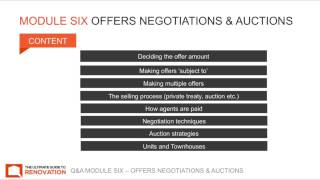
Jane Slack-Smith and John cover property acquisition tactics: structuring offers with subject-to clauses, negotiating multiple offers, and understanding agent incentives. The Q&A addresses lending for self-employed buyers, inspection requirements, and renovation funding options.
Chapters
See that? There's a couple people can hear us. Wonderful. And you can see the big screen. Great. We're going to get underway. Welcome to module 6. Q&A call and as always, I've got John here with me. Hello, John.
Hey, Jay. Hey, everyone.
Pretty exciting. We are sitting in the new studio. We have headphones on which I've just been told are called cans and we have big microphones booming from the ceiling at us as well. So it's all very professional this week.
Yeah. Do we sound any better?
Yeah, let us know, guys, type in and let us know if we sound any better and clearer. But anyhow, this week we are concentrating on module 6 and this is a great module full of tips and techniques for how to acquire a property through using a systematic approach to offers, negotiations and auctions. Which is really kind of exciting, isn't it?
Yeah, I know this money for words.
What did you tell me last week? It was like, with a few words you can save $10,000.
Yeah, where else do you get to do that?
As always, I'm looking forward to answering your questions. And we want to get some quick housekeeping out of the way. If you're on your computer and you're experiencing any problems hearing us or perhaps you can't hear us during the questions or whatever, there is an option for us to call in on the telephone, for you to call in on the telephone. So that would be great. If you need us, we are here. But you're going to find that on the sidebar under the audio options drop down menu. So you can call that number from a landline, mobile or even your Skype account. When you do have a question, please put your hand up. As I said before, we always give preference to those who are here on the call, put their hands up and can have a chat to us. We realise that it could be lunchtime and you might be hiding somewhere and you can't do that. In that case, just please put your question into the box. Or you can do as people have done this week and call our phone line and leave us a message. Yes, it all worked.
It does.
Fantastic. But look, just so you know, that hand does live just directly above the audio tab and it's at the very top of the GoToWebinar control panel. So clicking the hand button will notify me that you have a question. There is no silly questions, remember? And I encourage you to raise your hand and have a chat. So lastly, this is not a technical call. Please send any information, suggestions, improvements, whatever to support YourPropertySuccess.com we had a few suggestions this week. Going to demonstrate one or two.
Well, one of them is up and running, which is the Q and A call section. So that was a suggestion a little while back about having its own little section rather than having the Q and A calls within the modules themselves. So now that's all set up and running. So if you notice there's Q and A calls missing all of a sudden from the modules, that's where they are. It's in the top left menu. And yeah, you can look at the last year's, the spring calls, or this year's, the autumn calls.
Great. So they're all in one place. And so I think that's about it. We might get going with module six. So this week has been a really exciting week. I hope you've enjoyed it as much as we did putting it together. It's kind of about you deciding what is the offer amount you need to put down, how to make offers subject to. And what that subject to clauses might be. Because there's multiple clauses you can put in there, isn't there?
There is, yep, yep. I mean, the first ones are just, you know, due diligence is ideal. You can get that through if they're.
What do you mean by that, John?
Well, it kind of means you can do anything you like, really.
So subject to my due diligence could be if I want to get out of this for any reason or another offer comes in, I can. And most people won't accept that.
No, no. And if you're selling, you'd be pretty silly to. So it's normally subject to, you know, finance or building a pest inspection or something like that to your satisfaction. So you close the gate on them, kind of saying, oh, well, we can get your finance here.
It's only 12%, so it's really important to say subject to my satisfaction so you can decline it. In actual fact, I had a client this week who put in an offer subject to finance. We came down to the finance date and as most of you may have worked out, if you buy in early 2014, with people fixing rates and huge demand, the market banks are taking three to four days just to pick up an application. So if you've got a fake cooling off period, you really want to have every single day working for you. And a client had an offer that she put in and was accepted and the valuation came in $70,000 below. So that was quite significant. And it was in Western Australia. And in Western Australia you actually have to put down the lender on your contract that you're going to go with. So you kind of have to be a little bit more prepared. But also you need to have a decline letter to say that the loan's been declined by the lender to get out of it. Now, they did have two other offers on the table and I wrote them a letter saying that the loan didn't progress because the lender was not going to accept the evaluation from the valuer. And the reason we didn't pursue the decline letter is that we don't want a decline on the client's file. We just wanted to switch that approval back into a pre approval so she can go and buy again. So no harm, no foul.
Now, if you did have to provide that decline letter with the new positive reporting, would that be still around years down the track?
Yeah. And that's just the thing. No one really knows with the positive reporting what it looks like. And I know that the reports that we put up for clients, we can't see that. We can just still see the inquiries that have been made. So I'm interested. I've got a couple of people who are making inquiries on their own behalf at the moment. And usually it takes 10 days to get those reports in the mail, but it would take immediately if they wanted to pay the $35 to $55 for their credit file report. And you do that on mycreditfile.com or Betty Speeders or I'm going to say Dunstan Brand. But there's two ways of doing it. And so, yeah, the inquiries used to fall off after five years, but now we have been told that any current or existing obligations you have will be reported there along with the monthly repayments. Make sure you do it. So if you're one of those people like me who moves money around most months to cover things off and have most of the money sitting in offset accounts, then just make sure that you're not a few days late on those credit cards because it'll pop up on your file and it will start looking bad anyhow. So all very interesting. Back to making offers subject to what's some pretty lenient subject to's. Have you seen.
I haven't seen that. Meg, you have seen far more than me and your game.
But some of the things that you might have is things like I want to make sure that chandelier's there.
Okay.
Yeah. And you want all the fixtures and fittings in place. But mainly, you know, the pest and building is pretty important. And the finance, if you can slip the due diligence in. I've seen people who are going in to do developments to see they can get subject to council approval, which obviously you can't get in five days. So there's some longer kind of negotiations there in place. Might be subject to. What else would you put in? Subject to you selling your house first. Not uncommon, that kind of stuff. So it just depends. In a really hot market, the more subject to, the less likely you are to put it open. Maybe subject to accepting a 5% deposit rather than just.
Yeah, I would always say that I never would pay. So I always try to start at.
1 or 2% and then fall back to 5, 500 bucks. And I guess the other thing is when I put an offer in, I always make sure that I've got a date and a time when it expires as well. And we had in the modules a few little strategies around doing that so that the agent couldn't get back and talk to someone else quickly.
That was another Medine Simmons trick, wasn't it? Who is the crazy lady? Just in case you're wondering if it was Jane, a few people have been wondering if the crazy lady was Jane.
For other reasons.
Yeah, but that's where she puts the offer in. On a Thursday evening, we're in Victoria. That's when the agents are doing all their opens for inspection. So they've got a limited amount of time to shop the offer around and make expire at 9 o' clock the next morning.
Nice. That helps. Get back and talk to your owner. Anyhow, what else could there be there might be subject to? There could be. If you've got some concerns in an area, it could be subject to things like. And you're going to be doing some construction, soil sampling, testing, water sampling, testing, council approval, all that good stuff. So. And then we had making multiple offers. This is one of your favorite. You do this all the time, don't you?
Yeah, it doesn't always work, but I do it all the time.
So how does this work?
Well, it's just a matter of. I guess the first thing you need to know is what the vendor wants, so what's their situation. So all of those things that Jane goes through in this module about trying to get to the bottom of what's motivating the vendor to sell, are they downsizing? Do they need to. Have they already bought another property? Do they need to sell quickly? So then it's kind of making my essentially my highest offer will be the one that most is most appealing to Their situation. My lowest offer is most. Sorry, my. Yet my lowest offer is most appealing to their situation. So it might be a short settlement or it might be the deposit released immediately or something like that. And then yeah, the opposite. So my higher stopper would be the least appealing to their situation. So you can take the money and have the terms that you don't like or you can give me a better price and I'll give you the terms that you like. Essentially the way it works.
Good. Well, I think I always get a lot of feedback on that. People hadn't even never thought about doing the multiple offer. And I think when you talk sales or marketing, you're always taught not to give people a yes or no answer given. Do you want the blue or the red? And that's what these multiple offers get. We put an offer on the table and it's your decision. Did you want blue or red?
Yeah, that's right.
Really good. Great technique. And then we moved on to the selling process. A bit about treaty auctions had people sell their houses in tenders as well, closed tenders. So there's a lot of ways you can sell. People can sell properties and you can buy them. I would normally not like to go to auction and leave it to the final day, but sometimes that's what happens and you just need to know some of the techniques. It's important to understand how agents are paid because I think that's a really interesting video. Just getting an understanding about what could motivate agents and how you can motivate them to work for you. So that's a really good opportunity to have a chat. Now something interesting, John, that I saw this week in the newspaper my husband pulled out for me is a new startup company by two ex McKinsey employees and they've started up a. A referral website for real estate agents. So you can get on and you can rank a real estate agent and rate a real estate agent. And they using this model because if someone walks into an agency and hears that rain and horn in Cremorne is really great. And they walk in and go and talk to an agent about selling my property. Obviously the first agent off the mark there gets the kind of 30%.
The.
Biggest listing agent and hopefully the selling agent as well. But in this case what they're doing is they're actually giving people the opportunities to track down the actual agent by name and say, hey, I want John to be selling my property and contacting John. So it's an interesting model. They get a bit of a commission off the agents for that placement. But it's something to watch. And as soon as I grab that name, which I left at home this morning, I will put it into the Facebook page. But it's a place where you can actually go through and rate agents and agencies. So it's an interesting thing. Now, a friend of ours, Jacob Field from Wrighthouse, has also got a similar type of thing on the Rypehouse model where you can actually see the agents. And he's putting this together. So I don't think it's public at the moment. Actual agents performance, so listing price, selling price, that kind of stuff. So that's always good to know as well.
There is a few tools out there that you can subscribe to which will show you they're actually made for real estate agents, but they'll show you who has the highest number of listings and the highest number of sales within the suburb. So it's something you think about, particularly, for instance, if you were selling townhouses or developments or stuff like that. Normally the guys that have the most amount of sales are normally the townhouse guys or the development guys because they're smaller sale multiples often. But it's not a bad way to have a look and just try and work out who's an effective agent, who's not. It's one of the things I did before I selected an agent for one particular deal.
Great. And finally we went on to negotiation techniques and auction strategies. So lots of fun. And I guess that's a bit of a wrap of module 6. Really exciting to get through to module 6, because this means that we are halfway through the course and we're about to get onto the exciting stuff next week, module seven or tomorrow, module seven, the renovation stuff. So this is great now that we've taken you the whole way through of getting from 14,000 suburbs down to your 3 to 5, down to your street level, down to your property inspector, the property you've put the offer in this week. So we pretty much finalized that whole get the property deal, haven't we?
Yep, yep. All that theory's out of the way. We're headed to the practical, so it's all good.
Well, we've got a lot of people on the call today and I'm hoping that I'm going to see a hand go up very, very soon and we'll start taking some questions. Hi, Lorraine, how are you going?
I'm good.
Can you hear me?
Yes. We got you in real life.
I'm so sorry. I feel like a nutto when I Get on that line and can never. Oh God, it's hopeless.
Anyway, you sounded so professional. Unfortunately no one else could hear you.
I know, I'm just trying to.
I know you've got a few questions. So hit it with us. Land tax, Costa Renaults.
Well, I mean, I don't even know where to start because now we're doing a Renault that we weren't going to do two weeks ago. You know, it's sort of come out of the blue. But that's fine. We're going ahead with that. That's fine. I just, I can't remember what I asked on the question line but in regards to the capital growth, I went and bought the Residex reports from Barbara this week. So they're great. I haven't got them in front of me, but what I was asking I think was, you know, is it bad to look at a 10 year or 20 year and it's like I'll just say 6% and then for the last three years it's been down. Are we supposed to be looking for the down so that we get the rise coming up with the growth?
The past growth is something that you need to be looking at and the reason that you need to do that is that the past growth gives you an opportunity to look long term what has been happening in an area. So it's really important to see that you've had some movement, people want to live there, there's activity in the air. But really when we're looking at the past growth and the future growth, we're really trying to look and anticipate where the future movement's going to be. So past growth is an indication that there's been some activity in the area. When we're looking at that kind of that ripple effect or that flow on effect, triple effect, all of those things. And we're kind of looking at people being priced out of one market and going to the next area. Long term capital growth is giving us the opportunity to look at where we've had some strength in the past in growth and demand, but where there may be in the future. So over the 10 years it gives us a concept of 6% over 10 years. There's been some really kind of average, good, what we would consider average growth in the area and that 6% year on year on year. When we're Talking about that 6% per annum in the last three years there was enough interest and I was really doing some research on looking at areas around there. I'd be looking at maybe you have an area that you know it's taken off. So for instance Dulwich Hill in Sydney. So you pull up Dulwich Hill and you pull up all the suburbs in that area. So you're looking at the other suburbs as well. And when you're looking at those other suburbs, all of a sudden you're looking at things like you might be looking at Canterbury and you might see that Canterbury hasn't had the long term growth that Dulwich Hill has had because Dulwich Hill has had some flow on effect from Newtown for instance, when Newtown was happening in 2002, 2004. And so you're kind of following those suburbs out and that's what the long term growth is giving you that 10, 20 years. And then if you're pulling it back to the three to five years and you're starting to see some movement, that's when you kind of start to see, you might have seen Newtown for instance, that's close to the city of Sydney. You might see 8% growth because it really had a lot of growth and has been sustainable. Then you might see Dulwich Hill that's had the 6% growth and then you might see Canterbury, that's had the 4% growth over that long term period. Now the Canterbury growth over the long term period of 4%, say 10 years, you pull that back to three years, you might actually see that it's done 7% in the last three years where the others haven't been as strong. So you can actually kind of track that ripple effect through. And it's one of the things that John and I have been talking about that we're going to do some, how would you call it back calculations. So we're going to take some current growth figures and then pull them back.
Yeah, reverse engineer it to try and see, get a really good clear picture of how that growth looks over a period of time.
But, but I would definitely move to that three year period when I was starting to concentrate on an area and say, okay, well what's kind of been happening there? And then the 12 month information becomes interesting because the 12 month information and obviously you need to look at other information as well just in case there's been a whole new development of houses and house and land that's come out in the area or whatever. But the 12 month information gives you an idea of how much demand there is now. And that's kind of what we were looking at on one of the real estate websites where we can see that supply and demand as well. And we talked about Last week how some of the websites have changed the way they do things and they're not graphing it now but they're giving you how many people are looking and how many properties are on the market. So you're kind of getting a concept of how much demand is there now. So you get ways to kind of validate that 12 month figure that you're seeing in the magazines as well. So we were looking growth wise, we start the long term growth and then we kind of start narrowing it down to the areas that we're interested in and then we start looking at the surrounding areas and we're looking at those shorter term, five, three year growths and the 12 month growth. So does that make a bit of more sense?
Yes, absolutely. That makes it much clearer. Thank you for that. Can I just ask while I'm on the line if no one's got their hand up. I was just going to say first firstly the course. I've got a cold at the moment so excuse me, but the courses I'm finding is so the information inside it is amazing and like because of my our house in Musselbrook, you know what I've learned from listening to your different modules. You know like I've set up Google alerts for Musselbrook now so I'm hearing what's happening on a daily basis and you know what might be, you know what might be happening in the future. So you know, you know it's really good the information that's coming from the course. Really love that and just.
No it.
Is, it's really good. It's just I'm actually wanting to go back, start on module one and actually write things in a notebook just so I've got it. But that's just me. But the question I was just going to ask was we were in the process of refinancing all our loans because they were all crossed and the broker has said to me do you want separate offset accounts for each loan or do you want to have one super offset? I'm thinking I would like separate offset accounts for my loans. Do you think that's a good idea?
It really comes down to your personal circumstances. I would always put the offset account against my non deductible debt, my home loan. So if you've still got a home loan component, a loan against your home as opposed to a loan that you pulled out to go and buy investment properties with, I would have the funds against that. So that non deductible debt just because especially if you have an interest only loan it's affecting your cash flow and assisting you and you've got your most kind of deductibility that you can have your investment properties. On the other hand, if you don't have non deductible debt or a home loan that you would put the offset against, I would put the offset. I don't think there's an issue in having offset against different loans. And it really does make it easier for money management knowing how your properties are kind of performing. When you have an offset account against a particular property and that's where the rent goes into and that's where the interest comes out of and any additional payments come out of as well. It could be difficult in the sense that you might have to top it up every now and then. And if you do have negative gearing in place or you do have a property that's negatively geared, that is you have to put in money each week or month to cover costs, then you either are putting in maybe $5,000 a year and just every now and then checking on and making sure that all the costs are covered or you might be trying to move whatever it is, 600 bucks a month over. And if that's the case and you've got a lot of properties, it's a lot of management and a lot of time management. So it really comes down to Lorraine, how much work you want to do and if you have a non deductible debt already.
Okay, that's good. Absolutely, absolutely. Makes it very clear what I'll do.
Excellent.
All I've got to do is get my Fulbrook rented.
How's that going?
Terrible. I'm so scared it's going to be vacant for two or three months but you know.
So did you have an opportunity to talk to your real estate agent and see what they thought they could do to improve this?
Yes, I did, I did. And I actually spoke to another agency as well and they just, I tell you, the prices of the houses, the rentals have gone so far down and the people in the area, the tenants, they're getting out of old houses and going into brand new houses for $300 a month.
So.
Yes. Oh, not the month, sorry, 300 a week. I dumped for 300. Now they're in a, a beautiful brand new house for 300. So it is quite difficult.
Yeah, we kind of discussed this on the Facebook page and it's really about. I think there was someone in the conversation this week who had the kind of opposite happened last week when we talked about and they had a new Property in Orange and they were having people attracted to that area. And you were having the opposite effect, which just had one of the older properties and the new properties are taking their tenants. And it's kind of an issue when you have those towns or in particular regional areas where you do have a reliance on one or two industries. If there is a change in the industry, then there are going to be fluctuations. And what you're seeing is your older type property, which is one obviously that has more opportunity for renovation, where we can see equity that you can create and increasing rental use normally is more affected in those type of regional areas where you actually have. If there's a change in the workforce or in industry, they're kind of the first properties that people vacate and go to the newer ones, as you're seeing, at a cheaper price. So it's kind of one of the risks, which doesn't make it nice now because you already have it. And I think some of the strategies that I outlined last week that once again make your agents kind of a bit more accountable, but see what you can do with trying to make the property more attractive. What you could offer maybe some free rent, et cetera. You've already got it furnished, but giving the flexibility to have that or not. Maybe it's a free pizza every Friday night from a local pizza shop, gym membership I've offered in one of my properties. Or maybe it's having a shorter lease or a longer lease with some discounts. The kind of multiple offers on rents rather than multiple offers on auctions and negotiations that we're talking about this week. But I get really heavily involved also in the marketing and the editing and the copy that the agent uses online. So hopefully that helps.
I did speak to her about that and she said that she can't write things like location, location or you know, special wording because yeah, they're just not allowed to. That's what she told me.
Strange. Might be an intern.
I know. Well, that's what she means.
If they own their own website and they can put up their own information on the website, then I wouldn't think that's an issue. As for putting it on the domains and the real estate's got. You have license to do things. I mean, you have a look at what's on there at the moment and maybe send her an example of one that you'd like to have yours presented as and say, could you do this? Because this is obviously in the public domain. It's not something I've seen in the.
Past and that's the thing from doing this course, I probably wouldn't have bought there now, in hindsight, that's value for moving forward, you know.
Yeah, exactly. All the best with the renovation this week.
I beg your pardon?
All the best with your renovation this week.
Thank you very much. No, no, it'll go well. It'll take a few weeks, but I will post pictures up as we do it. But, yeah, it'll take a little while. But, yeah, we'll get it done. But thanks for that.
Okay, bye, Lorraine.
See you later.
Thank you. Bye.
Bye.
Bye. Bye, John.
And Natasha, shall we have a chat to Natasha and take her question? Hey, Natasha, how are you today?
Hear us there, Natasha?
Are you having trouble hearing you, Natasha? I might get you to type your question in. While Natasha's typing her question in, I'm going to take a question from Deborah Smith. Now, Deb, got your name up your hand up. Just have a quick check, otherwise I'll read out your question, which is how do you present your offers? Best, first, all at once or all at once? So, Deb, did you see if we can. Can you talk at all, Deb, or not? Just type in so we can unmute your line if you can. How do you present your office? Best, first or all at once? Well, John, do you want to talk to us about the multiple strategy? How do you present it? Because I think it's. If you're going to do the multiple strategy versus the kind of just one offer, then it's definitely different.
Yeah. And I guess first off, we're talking about a private sale rather than a lot of this stuff you're not going to get through if it's an auction campaign and a hotline. I guess the first rule of thumb is that there's an old kind of negotiation rule which is the person who puts down the first price kind of loses or not losers. But you never want to be the one to put down the first price because they might be miles lower than the price that you've got in your own head. So you always try and get the vendor, if you're putting an offer, to put forward their price first. And then there's all sorts of strategies to kind of shock or have a heart attack, all that kind of stuff, and then come back with something at the opposite end of the section. But I try and put multiple offers in rather than single offers, just because I think, again, you are naming your price in that instance, but you are naming three prices at once. And it's based around what you perceive as the vendor's needs. So that's the most important thing even from the open for inspection time before I'm actually interested in a property. When you're going through you're kind of asking those open questions, open any questions to the agent just trying to neaten him for information about or her that information for what's the vendor situation, what's their motivation for selling? Where are they going? Are they see changes? Are they wanting to settle fast? Have they purchased already that kind of thing?
And I think sometimes too John, people have kind of been pre sold a number in their mind from the real estate agent. So they've got a number in their mind and the real estate agent may not have told you what that number is, but they've given you a range. If you have that number or that range as one of your two or three offers, they can see that, but then they can see the comparable of the better offer that is better for you and better for them as well. So maybe they're thinking they want 460 and you're saying yeah, look I'll give you 460, but I'm going to have a 90 day settlement and I'm going to put down $500 and here's your price or you can have not 460, you can have 440 and I'll give you 10% deposit now that can be released straight away and will settle in 20 days. And they'll go oh okay, geez, I did see a house down the corner. So it makes them think and if you just put in that offer that was hey, he's 440 and they go no way, agent said 460, I'm being ripped off.
I guess the principle here is you try and bring other things in the equation. So you're just not negotiating on price. And the more kind of strands that you could be negotiating on simultaneously the better. If it's just on price, then your offer, all it stands on is price compared to the next offer that comes along or other people the agent's playing off. So if you can present your offer as being more suitable to the vendor's needs, then that's a good thing.
And we covered this off as well. If you put in that one offer, Deb, and you put in the 440 and they've got 460 in their head and they come back and say no, then the tendency, and I would say most of the time what happens is they go, agents say no, they want 460 and you come back at halfway. Okay, 450. And then they go, no, okay, we'll take 458. And you come back halfway at 454 or whatever, and all of a sudden you've gone from 440 to 454. So putting in, let's meet you in the middle. Let's meet you in the middle. It always sounds good when an agent says, I'll look, we'll meet you in the middle. But there's no meaning in the middle when you're negotiating a price.
No. Well, it's completely arbitrary where you start off, and that's why. That's where you lose if you put down. If they were to put down the number, and then you negotiate, you know, from close to that meeting in the middle each time. Diminishing concessions, they call it. You really lose because that initial number was really arbitrary where that started.
So I hope that helps. Deb, thanks. You said, that's great. And this is just about putting offers in, obviously not before auction. I have seen people put offers in before auction, obviously. And sometimes the vendors are really keen and the offer is so good that they just go. And sometimes they take it. But most of the times closer to the auction date, I find the vendors and the real estate agents kind of say, oh, let's throw it to the market. And one of the reasons that you might try to put an offer before auction and give them enough reason not to is that you've got another auction this weekend and this is the following weekend, and you really want theirs. But, hey, here's my number, and you can have this guaranteed, or.
Yeah, it suits what they're after. And it's bird in the hand. But often, I mean, it's harder and harder at the moment, isn't it? It's a hot market where we are anyway. It's a hot market, and no one is in the areas that I'm looking willing to sell before auction. And they'd be kind of mad if they took their agency price, too, because there's so much competition at the moment.
And the only reason they might do it is if they've want to sign up on another property.
Yeah, that's right.
Okay, great. Wonderful. Gabriel, good answer there. Got two thumbs up. Now, Natasha's put her question up here, and she says, let's go back to the finance from last week. I've been set up as a sole trader in my profession, and it seems I can't make a loan application for two years. Is that correct? In that situation, if my husband made a loan application, would I be considered dependent. So Natasha, it's a good question. And back to finance my area as well. The lenders look at people starting a business with a large eye towards risk and I guess that's mainly around the fact that most people have had most businesses within five years. I think the stats are something terrible at 70, 80% default. So there is an issue. And if they're going to project a 30 year loan over the fact that your income is going to be consistent or improve over the next 30 years, then they really need to have some confidence. So from a lender's point of view, you can see what they're thinking. So when they're looking at there's usually a start up period for a company. The first year is not always great. They're out trying to get customers rather than doing the business. So there's that kind of usually slow period and then the second year there's some consolidation and this is really where the business operates. What most lenders do is they do look at the last two years of performance. So that really does mean that you do need to have the ABN registered for two years and you do need to show income for two years. Obviously everyone doesn't start their job on July 1st, so usually that first year might only cover three months or six months or eight months or whatever. So sometimes the lenders will annualise that amount. If you're in one industry and you're staying in that industry, you're an IT guy with Telstra and you become an IT contractor, then there's more of a leniency around that kind of contract than being self employed as a contractor because you're in the same industry and there's a lot of people who go to that kind of model within the same company. So Telstra IT employee, Telstra IT contractor. And if that's the case, usually lenders just go, yeah, we can see that this works. There's history here. If there's more than a 20% discrepancy between two years worth of income, some lenders will take the lower year and some lenders will take the lower year plus 20%. So you know, lenders do assess you differently, obviously. So just being aware of who the right lender would be. If you ask what's important, the other thing is there's usually there's some lenders, Anz if you've had an ABN for two years, Anz will actually only look at the last year, which is great if you're a start up or if you had a really bad year based on gfc because that means that they're only going to look at one year and another lender has just this week announced that they're going to do the same as well and that was Bank Melbourne, St George bank of Melbourne. So that's a handy little trick to know that they're only going to look at one year's financials. So they're going to look at your personal financial tax return, they're going to look at company tax return and the P and L for the company as well. Obviously the P and L for the company covers 10 years so they can actually see what has happened in the previous year. But those two lenders will just take that one year. So that kind of helps. When you look at Natasha, can you get a loan if you haven't had the company within two years or you had a bad week, sorry, about a year for the first year or startup year. But you do usually have to have an ABN for two years. There are some third fourth tier lenders that will consider an ABN for one year and usually you've got a premium interest rates of 1.5% to 2% on top of that. They're just pricing in a bit of risk there. So the next part of your question is if we can't show your income and your husband makes a loan application, are you considered a dependent? Now if you are married, then yes, 80% of lenders will take you as a dependent and any children you have as well. So they will add that onto your husband's servicing. So it will be two adults and a child. For instance. There are some lenders like amp that will, if we can prove that you have an income, they will leave you off as a dependent. Now obviously that proof of income can be a little difficult if you are self employed and you only have one year's worth of data or figures for your company. However, if it's the difference of having a couple and a child at $2,200 a month in living expenses and a single and a child at $1,500 a month living expenses, there's going to be six, eight hundred dollars a month that we would have to show that you could cover. So in theory there could be an argument, especially if it's an 80% loan, that it would be a lot easier argument that would say that if it's only $800 a month and if you can show a minimum of $12,000 in income rather than the fact that last year you did 30,000 and this year you did 45,000 et cetera. Then there is an argument that can be shown that you could be left officer dependent or there could be some of your income could be used for that joint loan. But really they're going to want to see you and they're going to want to see that you're dependent on that application because if something does happen to your ability to pay the loan, they obviously haven't done their due diligence in working through if they're giving you the money and they could come back at you. So there are some issues there. But hopefully does that kind of help you out in understanding how the lenders will look at you as a self employed person? Yes. And a smiley face. Fantastic. Well, we've got Lee here as well. Shall we take.
Yeah, let's give Lee a go.
Lee, I'm going to open up the line and hopefully we can hear you. Hey Lee. I can hear typing. I don't think he can talk. He must be at work. Hi Jane, I'm in a similar situation. My job. Oh, here we go. Can you talk? Lee, we can hear you typing so we can know your microphone's working. Sorry, I'm at work. Okay, we'll take the mute off. Okay. So Jane, I'm in a similar situation. My husband's just quit his job. Yee ha. I love it when people do that. Last week to chase his dream. Even better. Oh my gosh. I'm looking forward to hearing what that is. So would he be counted as my dependent? Yes, he would be counted as your dependent. So if you're borrowing, if you can't prove that he has, he can support himself, that is that 600 to $800 a month, he would be most, as I said, 80, 90% of lenders, especially if there's mortgage insurance involved, they're always going to take your partner as the dependent. So you really, it's kind of that better or worse? It's the worst situation for the bank servicing calculators. And as I said amp and some of the others consider not including them as a dependent. But the reality is if it comes to being that close to servicing and we're talking about the fact that forgetting the fact that you're kind of covering your partner off on their living expenses, then the lenders are going to sit back and go, well how risky is this deal? So they're going to have a look at the big picture. So what's the loan to value ratio? If there's mortgage insurance then they might say look, this is all a bit Too close to call. If it's not mortgage insurance, they might actually pass it through. They might sit back and they might look at the situation and go, well, what's the total position? You've got a very good superannuation. Your partner has given up work, that he's got $60,000 in the bank. This will be able to sustain him and his living expenses for a certain period of time. So it's kind of like constructing the story of why the bank should take you on and how to minimise that risk. And the important thing is, if you can just think risk, risk, risk, and the banks are giving you hundreds of thousands of dollars, then how can you minimise in their mind what the situation is? So you're always kind of looking at the mitigant and the mitigant might be, we've got cash in the bank to cover this. And it's the same way some lenders look at maternity leave. A lot of lenders will say that they will not take any income from. From anyone who's on maternity leave. And arguably you're on maternity leave for. Well, not me, like me, who was on maternity leave for seven days, but you might be on maternity leave for 12 months. They won't take maternity leave into account because they say, we don't know if you're going to go back to work. Which is kind of the opposite of the kind of conversation which is, you know, here's one year's worth of income and we can't project it over 30 years, but you've had trouble years for the company, so it's a little bit unfair. But some lenders will consider taking into account the maternity leave of an applicant. If you can say, well, look, this is the income that you'll go back onto. This is a letter to say that you're expected back in January of 2015 and we've got $80,000 to cover any discrepancies or issues in the meantime. So it's important to just think about it from the bank's point of view. Can you forget your husband, Lien? The answer is no, unfortunately, he will be dependent and he may need to show that he has an income should she get divorced. It's a different type of webinar we'd be doing talking about personal advice.
No, but when does it. So if you're de facto, for instance, when is the point is there where the bank will view you as a dependent or unless you're married to a.
Lot of the servicing calculations actually say, are they a de facto or Partner. So I think you're considered de facto in the eyes of ATO after six months or three months now or something like that. Yeah, so don't tell him. John Leeds got up there and said, I'm going to tell him that. John, you're divorced, but no, you are considered. And you know, one of the funny things is that I had seen previously as well is that if you're paying rent, if you're sharing rent with someone and it might just be a flatmate, but you're the only one on the lease, you're responsible for the lease at 1200 bucks a month. But you always shared and that person's been with you for three years. A lot of the lenders will take 1200 bucks a month because you're the person on the lease. So you're responsible for the repayment of the rate. So you just need to be aware of that as well if you're going to, oh, it's not a big deal. Will we both be on the lease or not? I'd be putting you both on the lease. So just anticipate if you're renting like I did for many, many years and buying properties, just how the lenders might look at your other liabilities. But most lenders are not going to ignore the wife and three kids. If you're saying that it's not the case that you have them. And one of the checks, the sneaky checks that they have is part of your 100 point ID, they look at your Medicare card. So some people forget. I've seen some people forget kids off bank applications, especially when they might come to me and I'll say, look, I can't get you a loan, you can't afford it. And they'll come back the next week and day. Guess what? The bank said yes. How did they say yes to the five kids? They said, oh, they just ignored the kids. Well, we can't do that. That's quite fraud. And obviously with the NCCP legislation, I'm sure the banks don't do that anymore anyhow. But yeah, there's kids.
What kids?
Those ones that are following me around? No, so it's just the chocolates I have in my pocket. But yeah. So if you've got a dependent, you've got to on depend.
Yep.
Okay, who else have we got here on our question line? Anyone else that has a question that we can answer today? Well, that's easy.
Hands up, you can do some Chantelle, won't you?
I can do some Chantal. Show me my share of My screen and I am going to show you a few little things. Nothing too exciting. Okay, no problem. We're just going to show you my screen. Let me know if you can see it. Great. So what I'm going to show you here is just a couple of things. Just wanted to show you where the new Q and A calls are so you don't get lost. So over here, autumn 2014, we can see those calls. So if you're looking for the calls and the recordings, they're right at the top left hand corner for those who are listening to this recording and all the audios for those calls and the actual videos there and you can download those as well. And a nice little tip that Scott sent through this week regarding the budget. So we've had some fantastic feedback about the budget. Everyone knows that we love the budget that is in module five and I'm really keen to hear how some of you are going in actually assessing your properties and potential properties and potential renovations and using this because it really is a fantastic tool. And one of the things he said is around the budget he found that there were so many tabs here on the bottom that he was consistently trying to go to that. If you actually come right over here on the right hand side where you can see the little arrows and you right click, all of the tabs just pop up. Isn't that cool? So right click there on the arrows on the left hand side where you usually move across the tabs. Now I'm not sure how that works on a Mac, but on a PC it's pretty good for Excel you can just quickly jump down to your painting tab and go in there and fill in your details. Painting. So that's a really good little things up there. A little tip for the week. So fantastic. And let's just jump back to the actual course. So this is where we are in Module 6 this week. We've got a few bonuses down here and I think might be worthwhile just having a quick look at that letter of offer. So this is the letter of offer that you would put in to the agent. And as I said, it's just a bit of a guide. Every state's a little bit different. So you need to understand the cooling off period in your state and you need to understand the settlement period as well. So for instance, you might have a five day cooling off period in New South Wales and Queensland they say, well, you've got 14 days cooling off, but you have to settle in 21. So one of the things, especially in this really Hot market at the moment that I'd suggest that you do is that you consider extending that cooling off period or your finance clause or whatever the reason is for the time around it. But I would extend that to at least seven working days, if you can. Because at the moment it's just so hard to get things through with lenders. So this is what that letter of offer we're kind of looking like. You can ask them to keep it confidential. I think everything in writing is always better. And one of the tricks was to write a little bit of a cheque and stable it to the corner as well for 5% or whatever. Just make sure there's no money in the account.
Yeah, I know. In Victoria, I believe they're obliged by law to submit all written offers. I don't know if that's the case in every state.
And sometimes the real estate agent will say, that's such an embarrassing offer, I'm not taking it to the vendor. And you go, well, one stand, by law, you need to.
It's in writing, mate.
So here it is in writing. And so here's the property details, obviously the information. One of the things that this is that multiple offer as well. So we'd see the deposit. So that might be. You know, I've seen people put in an exact same offer as an offer on the table, but with a higher deposit and having that deposit released and they get accepted. And I've seen other people like my sister put the same offer on the table with only a 5% deposit and get it rejected. So, you know, we then have the building inspection. So that's kind of a standard clause in a pest. I really wouldn't be bypassing the pest and building inspection on the house, that wouldn't be part of my negotiations. And if they ran at the one that says we're going to bypass this and settle straight away without an inspection, I'd be even doubly worried, to be honest. So, yeah, be vigilant on what you do right out of, of your offer. Obviously, as I said, subject to finance, that's acceptable to you within a certain period of time. Independent valuation, and that's usually done by the bank. You wouldn't need to be doing that beforehand by yourself. Settlement.
I've done it on a couple of occasions just because it's an off market. And we said, right, as a kind of just what if we get an independent valuation, they could settle, starting point for negotiation. And I'm just remembering the last time I did that. It came with about 150 grand over what I wanted to pay. So I kind of regretted having to put that to iron at Brussels.
That's when you call up the new valuer.
Yeah.
One of the things about valuers, valuers do cost between 4 and $500. That can be quite expensive. What we've seen in the last probably six months to eight months in our mortgage broking company, is that the value a lot of the banks are doing, allowing upfront valuations now. Now that doesn't mean that you can rush out and get your mortgage broker or your bank to order five valuations just based on you putting in an offer. But there are options. I know even with CPA, for $50 you can get a valuer to go and do you pay for the $50 valuation? You can go and get a valuation done. And one of the reasons the banks are doing this is because a lot of the times people say, my house is worth $700,000, I want to pull out some equity. And the reality is it's only worth 500. So they've said, look, we'll get you a valuation up front. Let's find out if it's worth doing all of this effort and all the different people that touch their file and go through the file handling and all of that kind of stuff before we actually proceed.
And you can do that without getting a hit.
Yeah, it's just evaluation and so just ordering evaluation. So there are some opportunities there. Some lenders are doing upfront valuations free.
And do you have to be a customer of the bank already?
Well, it's not something you can order yourself, let's put it that way. It's either your mortgage broker could do it or if you had pre approved with the bank. I can see you just going, give me that portal. Yeah, this is something we just keep forgetting about a network. Not many other people know about this, but yeah, it might be something. And if you're really. To be honest though, if you're really keen on a property and we're talking about going to auction and you have got a pre approval with Anz, for goodness sakes, do not go and get an Anz upfront valuation. Because with the fast moving market at the moment, they'll come back at $500,000 and the next Saturday it's going to go for 550 and the bank will use the valuer's valuation. So you're not going to be rushing out and doing this.
And that's previous three months, is that.
Yeah, usually they'll take the valuation that's on the books that's three months old. Some lenders look at six months. Three months is. I think with that kind of sale information would be applicable. And let's face it, there's not that many banks out there. So if you've got 10 people really keen on a pre approval and five of them are with Banquest, Bankwest is probably going to have the valuation on file or they may have had the previous title evaluation. Anyhow, that's one of the things that like cba, when CBA puts out their report of what's happening in property, I always read them because they actually hold most of the titles. Most properties in Australia, so large percentage, they're actually seeing these revaluations, the sale data, past data and all that information as well. So interesting survey that would be a little bit about if you're doing construction or development or structural renovations.
Yeah, it could be just soil testing if you're doing a structural renovation.
What is soil testing?
Is looking for a structural renovation if you've got. So soil has a class and depending on the makeup of the soil. For instance, where I did my last structural renovation was class H and that was highly active soil. Turns out it was a lava flow from 300,000 years ago from halfway up Victoria somewhere. And it meant that we had to drill down a meter and have.
450.
By 450 footings down at a meter deep, which is quite a lot of. Normally you would just do 600 stumps. So it affects your costs a little bit. But you need to get that soil test before you can build, essentially because that's the first thing the engineer needs.
And this is one of the really important things about doing the due diligence as well is that you know what cost you're up for. So, you know, if you need to get out there and get that soil tested, you can get that result back within five days.
Yeah, yeah.
So, you know, it's. And I think the fastest turnaround that I'm aware of is the pest and building guys. They're usually out in their reports back in 12 hours or so. Those guys. I would normally walk around with them anyhow, so that's all good. There's that due diligence clause. Be nice to say, you know, my due diligence. I've seen someone, I think Rob Lander, the kind of king of clauses has said. He suggested one that pretty much said subject to my lawyer's discretion or my lawyer's review of the contract. And it doesn't mean that they don't need to then say what the lawyer didn't like about the contract. It's just to get out of town and having these cooling off periods being really beneficial. I know that I had a couple of offer on the table once in Sydney and both of them accepted and all was cool. And one came back with a lot of building issues that could go around quite easily but it was good price for and we'd really factored that into the price that we offered. But the other one came back and it was kind of a bit of a real low ball offer and they accepted it. So it was like we're really glad that we had something to get out of. And one of the things that I was I guess more concerned about at the time was that the agent went around with the building inspector and when we said oh we've got some concerns about this property, he said it was all fine. No one told me it was all fine. Like that's why you have to have your building inspector not going through with the agent. Bit difficult because they usually have to.
Let them in the door but they can tell you anything sometimes. We had one the other day we were looking at a couple of. It was a block that actually had plans for three units and one of the cut, a long story short, the agent was swearing black and blue that we were going to get 950 each for these units and that's what we should be doing now, due diligence on. And we're looking at them, we can only see 800, 750 to 800 each unit, black and blue he was saying even though there's not comparable sales, I can tell you there's one being bought at the just around the corner that they're going to be asking 150 to a million. And so we went away, looked at it again, went no, came back and said no, forget it, it's too much, the asking price is too much. And he goes oh no, you probably were. They probably are.800.
Oh well you know sometimes they can be your greatest friends obviously. But he was going to work for the vendor.
Yeah, well that's right. But you certainly can't take them at face value because now he's thinking about what's the next deal they can bring. So he's happy to agree to that. It's probably market value.
There's another clause in here we've got around getting people through. So maybe having tenants through a week or two before you actually take ownership especially there's obviously easier if it's a Vacant possession and easy for the vendor to sign off on. But if you've got tenants in there already and they're vacating on the settlement date then. Or their own occupiers vacating. If this is an easy. Oh yeah, you can show people through. Good deal. I've had properties that have been rented before. I've actually owned the property. So we're all very happy to have handing over the key straight to the tenants on the day of settlement, having access the quotes. So this is kind of more about the agent than the vendors because the agent's usually guy has to let you in. And I know if you're talking about three carpenters and three fitters and fitters do carpenters. She might have an engineering workshop for Sanders. Mind you, I did have a friend who did buy an engineering workshop and move it. Interesting story actually. She bought the warehouse and had nowhere to move. Bought the equipment in this warehouse, had nowhere to move the equipment to. So. So she just hired big, big trucks and had them drive around Australia until she found somewhere to put. Was cheaper than actually storing it. So by the time I got to Brisbane from Melbourne, she'd found somewhere.
I heard a girl recently who bought a big like a five tonne truck to use as storage to park outside of the terrace in South Yarra.
Easy.
Yep.
Well, there you go. I bought my car online at an online auction. Click, click, click. I don't have time to do all these other things. Okay, so mind you, I don't have brand new flashcards either. All right, so access for tradespeople. Back to the topic at hand. You're not going to get three plumbers and three carpenters and three painters through and they're going to kind of lose interest quickly. You can use some of that to your advantage. The last one that I did, the agent after the first year, three traders came through, went, okay, here's the keys, just pick them up, we're all good. It's vacant now. So that was really good. But you want to have these trades through and you want to have this done prior.
Yeah. And try and schedule them together obviously because you might need to get back two or three times after that because something comes up. So keep the goodwill in hand.
So fixtures and fittings subject to maybe please. I want the big pepper tree and all the nice new geraniums and whatever. I did attend a seminar many years ago, 10 years ago, where the lady used to bolt on a bullnose veranda at the front of every house that she sold and then took it off at the end of the marketing period. So that would be something that I would be looking for. And actually my husband and I were just talking about this other day. We looked at a property in Crow's Nest once when we went back on auction day and the dishwasher nearly dishwasher had been replaced by dish leaks on auction day. So you know, your fixtures and fittings might just be that you want the ones that are there on the day of inspection and that's why you need to be doing a pre purchase inspection. So the day that you're settling or the day before you're settling, go in and make sure that everything's there that you want and you don't have a TM in place. If you do need vapor possession because.
That can happen, what do you do? What's the. I've had it before where I've turned up and done my. A couple of days before and everything's still there. There's junk everywhere still. In one case I actually got there, got handed the keys from the agent, went to the house and it was like the guy just gone down the street to buy the milk. Everything was still out, the kettle was still warm and the cups were on the table and all this kind of stuff. But he literally just walked out of the house and left everything in it. So what do you do? Because there wasn't any comeback. But I spoke to my solicitor and my complaint and she said oh well, you could not settle. But it seemed like more hassle than it was worth. What would you do in that kind of situation?
Kind of difficult. It's funny you should mention it because there's a show that I really like watching called Flipman on Go and they had a house this week where it was literally someone was still living there and they waited a day and no one turned up. So they started packing up these guys stuff and by law they had to keep it for 30 days in storage. So there might actually be some legal ramifications there. But you know, I. I'm putting offers for properties that I can. If I've looked underneath the property and I could see that there was a huge amount of let's say excess material I've always had as a subject in my offer that that had to be removed. So at settlement day that would be removed. If you ask for vacant procession, I would recommend you go back and argue the fact that this is not vacant. The property is actually, you know, it still has habitation in it person's materials there. But I guess the cheaper thing rather than going to the legal lines would probably be get a few removalists in and cut it, pick it all up for a thousand bucks and get rid of it. But you might have to check how long you have to keep it for. Now I see Vicki has a hand up. Fantastic. I'm just going to finish off on these clauses approvals so obviously you might want to have some approvals from the council and this is obviously going to take you a little bit longer. Subject to builders warranty insurance. This could potentially be the fact that there has been renovations done in the past and you might want to have some warranty insurance on the renovations that have been done. So, you know, I know some of the renovations that I've had done in the past. I'm going to have renovation done in 2009 on a bathroom and I'm just enacting the warranty insurance. All that with the build at the moment because it's leaking down into the kitchen. So I've gone back and said what are you going to do about it? In theory, if I'd sold that property or bought that property just last year, I'd have no recourse if I didn't have any of that warranty insurance. So getting warranty insurance and works that have already been done important and it also gives you an idea if there has been works done if it is under insurance or there might have been someone who hasn't taken that out.
It's always the biggest claim on, on builders warranty insurance. Water.
Water is the sole biggest problem I have body corporate satisfactory check of their records. Without doubt. That's something I would never sign away either. And that's for people who are buying in apartments or units.
And where do you get that? Where do you get that information?
From the strata manager and usually you have to have permission from the real estate agent to the strata manager to say that you're going to come and check them. Just be aware and I think we've covered this off really elsewhere but you know the strata manager is probably not going to be there. It's going to be a lady at the front desk is going to put you in a Corner, give you 10 years worth of strata report information. So annual general meetings and notes etc. For you to go through. If you haven't done this before, I really suggest that you possibly your solicitors will have a contact of someone who could do it for you and it's probably 2, $300 and they have a really thorough maybe 15 page report and they'll go through and they say, you know, ambience and things like, do the neighbors get on with each other and that kind of thing. And you can use that as a template for yourself in the future. But that kind of body corporate stuff, normally it's a strata manager. You have to go to their offices, you have to make a time to do it. If you want to photocopy anything, they charge a dollar a piece of paper or something. It's horrible. Now we've got smartphones, we can take quick little photos. But on the looking for things like unit 3 above leaks on down and there's been recovery or repairs or there's pointing needs to be done or what the sinking fund's like and who's fighting with whom and did they let. More importantly, anyone who asked for renovations to be done in the past to be done. So that kind of information, spend an hour on that. Your subject expiry. We said that you know, when the actual offer expires and legal advice that was that kind of. It's up to my lawyer to tell me that if he wants to leave, we can leave. So I think it's one of those things where you kind of look at your offer and you turn around and you say, well, what are the things that are going to make this attractive to the person? And as I said, don't offer them the yes, no answer. I'd be going for the kind of, do you want blue or do you want red? So anyhow, we will jump over. I think Vicki's got a question, so let's open the lines up and see what Vicki has to say. Hi, Vicki, can you hear us?
Yes, I can. Can you hear me?
Gotcha.
Yes, great. I was just wondering if you're not physically in the city or town that you're looking to buy and how do you go about managing the due diligence part and also the renovation if you.
Do purchase the property? Really good question. I mean, I think if I was buying in a different town, then I would be the due diligence. As I've said before, you can do 80 to 90% of the actual work yourself online. So you'd be going through and doing kind of the interrogation of where to buy, where the demand is, what people are looking at, the demographics, getting into that census kind of tool and looking at where the unoccupied are, where the renters are, what the streets are that people are in. Then you're narrowing it down to the streets and you're looking at the pricing discrepancy in the streets. With the pricing, maps, etc, etc, you can do pretty much all of that without going to the area yourself. Me personally, I like to get involved and kind of walk around and get a feel for the area and walk the streets and if you've done all of this kind of information, especially price pin that you're going to know these streets names. So actually physically kind of verifying why I did one end of the street street have higher prices than the other end of the street. You can't really, you can get a concept of that on Google Maps and it's not uncommon for people to send me through an address of a property and say, hey, I've just put an offer as a couple people today haven't put an offer on a property and I'll google map the property and have a quick look at it and make sure it's kind of like what we all expect and love. You'll be surprised when sometimes things come up that different, such as client talking. I was talking to yesterday, we had a quick little look online and the nice big fence at the back was actually covering up a huge number of shops. So there's a lot of commercial premises at the back and unless you went a long way around to another street to access it, you wouldn't know that it was all something you couldn't see. So you know, it's just that kind of stuff. But I would get on and I would do most of my due diligence online. I would then go and start ringing real estate agents and asking them, hey, what's happening in the market? What is it that people are after? I'd speak to the actual selling agents because they're always keen to talk to people they think you're going to buy. But I'd also ring the rental managers and say to the selling agent, hey, I'm thinking about renting this out. If I buy this property through you, obviously I want to rent it as well. Can you put me in touch with your rental agent in the actual agency and then have a chat to that rental agent about what the demand is? What are people after? How long do people stay in the properties and get a bit of information about them as well? If they're really helpful, then there might be someone that you want to rent to be your rental manager in the future. So you want to know how many properties they have under rent and all those kind of questions you ask as well. Obviously the easy answer is get a buyer's agent. Get the buyer's agent to do the legwork for you. So if you've actually done that 80 to 90% work and really target it, you can actually engage an agent that might just go and do the negotiation for you. As I said, I would normally visit the property myself. Vicki, does that help you from the buying point of view and I can move on to the renovation?
Yeah, I was actually thinking more about the due diligence of you found the property that you want to put an offer in on and all of those exclusions that you were just going through before in that template. How do you manage February tradespeople coming and going, et cetera, and coordinating all of that?
Okay, so if you go into getting tradespeople to come and do the kind of quoting for you and you're not wanting to upset your tradespeople either, so you're not going to get them to go and visit five or six properties and, and this is kind of the pointing end of we're about to put, we put this offer in, it's been accepted. I've got five days to do these checks. If you are remote and I haven't done this remotely in facilitating this personally, but if you were remote I would be getting that real estate agent on site because they're obviously going to have to let them in anyhow. I think there's difficulty in actually handing over the specifics and communicating the specifics of what you want from a tradesperson and want them to quote on without being there. And it probably something that I would jump on a plane and go and be part of. What do you think, John?
Yeah, yeah, I think so. I mean the important thing is the reality is you can't do it on every property. It's got to be at the ones that you've already got an offer and you're at the point in as you said. So yes, personally I can't do buy or side unseen. I'd have to be there.
If I got down to that level, Vicki, I'd be going and taking a week or a couple of days. Or if you do have a particular trusted via agent who's willing to take on that work, then actually engage them and get them to help you out and pay them the fee to do that. The actual remote renovation, the same thing. You know, I've engaged on one occasion a project manager to manage renovation. But you know, I was probably biggest headache that ever had because I was on the phone and I was wanting photos and I was wanting updates and you know, as if I was there and you know, I flew down twice during that six week period and Checked it out and made sure everything was happening as I wanted it to. So it's not something I personally would relinquish. I know people who done it and done it very, very, very well. And there's quite a few people on the Facebook page, private Facebook page, that have done it. So you can ask them how they've done it as well. But you know, you really have to a trust the person. But when you're getting down to doing your final due diligence in a property and we're talking about, you know, the offers being accepted and you're out now doing that kind of, you know, the real. Okay, is this the deal or not? Whilst your finance is being approved and evaluations coming back, etc. Then I'd be there personally and I'd oversee that personally. Does that help, Vicki?
Yep, that was excellent. Thank you.
Now, has anyone else got a question? Just have a quick check to see if we've got any other questions. If not, I might just had an interesting question this week come up which I think might interest a few people. Let me just see. Got any questions here, John?
Amelia. Let's give Amelia a shot.
Thank you. I don't know if Amelia's question was her actually answering our other question earlier about whether she could hear us. Amelia, do you have a question you want to type in for us? Yes, Jane, it's about the letter of author that you described earlier. Mm. Is that possible for us to have a look at like a sample of a completed one? It's just. I'm finding it hard to picture in my head right now and it's kind of. I'm losing track on it.
Yeah, there's actually, there's one in the course itself. If you, if you kind of pause the screen at that point when that comes up in the module. There is an example there that shows the, you know, the different settlement times and the different kind of prices. High, medium and kind of low.
Yeah, I put a screenshot I'm referring on to the letter that was part of the bonus of module six. The word doc, the word document, letter of offer. It's all blank. Yeah, I'm just finding it hard to actually picture the final outlook. So in the actual video, when we go through this on the screen, we have completed it. So what we'll do is we'll just get a screenshot of that and we'll put it in the Renovator network Facebook page so you can have a look at it there. Does that help? Yeah, that would be. Thank you. I've done the module like over the weekend last week. It's been there and I just totally forgot about it. Sorry about that.
No, no problem.
There's so much to remember, isn't it?
Yes.
If you have any other questions or anything else we can help you with. Not at the moment. It's just when you pull out that blank form, I suddenly couldn't. Yeah. Thank you.
No problem.
Okay. Well, I had two questions this week from someone, two people, and they were similar, so I thought I might address them. And this is someone who's bought a property and looking at renovating and doing quite an extensive structural renovations. So both of them are looking at doing cosmetic renovations that are between 80 and $100,000 that are going to change the internal floor plan a bit, you know, ensuites, opening up lounge rooms, etc, etc, and they're looking at how they're going to fund that. So one of the people said, but Jane, how did you do that? Because you project managed the whole thing yourself and you got, you know, when you talk about your renovations, you talk about you get the three quotes for electricians and plumbers and painters, etc. And then you manage that renovation. And I did do that, but I did that for subsequent renovations when I had the equity to spend from a previous renovation. So for instance, bought my first property and I did a renovation, the renovation. I had a fund with cash myself. So I took a personal loan and I had the $50,000 that I did the internal cosmetic renovation. When that had finished, I then revalued that property, tapped into the equity, paid back my $50,000 personal loan that I had and then went and used that money to buy a property and do the subsequent renovation. So I was always kind of cash flowing the subsequent renovations that I was project managing myself. And the first one I had a personal loan to do and that was a personal, personal loan. It's not like a go to the bank kind of loan. Kind of like doing it on your credit cards kind of stuff, which I don't suggest that you do. But so the question was, well, gosh, I want to, I don't have the $80,000 to do this quite significant renovation. How do I do it? And the reality is you can get construction loans to do all what they call improvement loans to do these type of, of renovations. Now they are, the banks aren't really into renovation loans so they don't really get non structural renovation loans. So they usually want, when they're looking at construction loan, a fixed price contract from a registered builder and they want to have the standard HIA kind of drawdowns, which is 10% at the beginning and 20% at framing stage and 30% at roofing stage, which is not valid for an improvement loan. So it makes it a little bit difficult. So with some lenders, you have to go back to them and say, look, I want to have waived that. I have for $80,000 loan waived that. I'm going to have four drawdowns and you can charge me $300 and send a value around every time there's a drawdown because there's not big structure. They might say, look, we will give you two drawdowns, which means there will be two payments and they're not going to hand over to the builder $80,000 straight up. They're going to give him say $40,000 or he might have a 20% deposit or whatever. So there's that way of doing it. But the important thing to note is that the majority of work has to come under that fixed price contract. With some lenders. They do allow two to three other ancillary type of quotes to come in. So it might be renovate the entire internal house, including everything that the builder can do and manage. And then there might be the pool and the roof and the landscaping that's additional. So you're really probably looking at 2 to 3 in addition max, depending on the lender invoices that they will take on. Now the other important thing is that then you kind of lose some of the benefit of being able to negotiate all these great rates, don't you? Because you kind of, you're not going to the cheapest tiler, you're dependent on the builder's tiler. Now depending on your builder or whoever is project managing this, then they might be happy to take on. You might have got a quote for roofing, for instance, that's cheaper than what he put in there. He might say, oh, look, I just didn't have the time to run around and do all the quotes. That's great, I'll take that on. He might charge 10% for it for managing it, which is not uncommon.
They're more likely to roofing something involves a contractor. They're more likely to do it with stuff like supplies like tiles, floorboards, even kitchens. So you know all the PC items. So because it's, to be honest, you're taking work, it relieves them of having to do a job and it's no spin off their nose because you know they were just going to have to run around and get that pick up that stuff anyway. So if you can kind of deliver it to site, they're normally happy to kind of come to the party with that.
So just confirming that like the PC items, if you've sourced those cheaper, then they'll go, oh great, I'll work those into the price. However, you can't buy them, they're going to have to buy them, put them in their contract for the bank to lend you the money. So you kind of, you know, on one hand there's the, you know, when we talk about take money from your home, get the line of credit to the pay for the deposit the costs and the renovation, you don't need to go and do go to the bank and ask the money. But if you've got no home or you don't have equity in your property and you do need the funds for the construction, then just bear in mind that for that time you probably going to have to be under a fixed price contract if you do need to borrow the money. And different banks have different lending models as well. I saw a policy update that came through from Westpac today that said for a current Westpac client, if you're doing a cosmetic renovation with absolute no structural, that is, you're not going to knock the wall out in the middle, then they would approve that for loan to value ratios with the current value of 80% and with the new loan up to $100,000 without requiring drawdowns and any fixed price contract. So that's pretty good. But that means that you need to have your current value of your property that has enough equity into it that is not going to go over 80% at its current value to be able to pull that money out. So, you know, there's all these little quirky policies banks coming out with all the time, but normally they're going to expect to have a fixed price contract from one entity and that one entity is going to be managing all of those trades and that kind of reduces the ability that you have to go and negotiate on those individual prices. That could be your first one. Go back, get the price property revalued, pull out a lot of money and that money will be what you can have as your kind of renovation slush fund for the next one. Yeah, we like slush funds. So if we've got no more questions, I think we might wrap up for the day. Module 6. It's a good one. It's a fun one.
Yeah, I love what you said. Words can make you money.
Words can make you money.
It's Way better than swinging your hammer or crawling under a house.
Exactly. We talked about that up front. You're making a lot of your money up front. The whole trident strategy, buying below the market. Part of that is buying and being clever in how you're buying and if you can negotiate. Look, I'm someone who's very frugal. And to actually illustrate the point, how I budget. And I've been a really keen budgeter for many, many a year. About three years ago, I walked in and bought some dresses at a shop, which was uncharacteristic of me to buy so many clothes at once. And before I left the shop, Anthony at Crawford Shop, the credit card company rang to see, say that someone had illegally used my card. And I had it. I was like, oh, my gosh, you're right, I spent too much money. And the same thing happened two weeks ago. I went into a shop and I bought four things. And the credit card company rang. By the time I was at Woolworths, they'd frozen my card, said, someone's used your card. I'm like, no, it's me. So why am I telling you? Frugal is that if I'm going to negotiate down $10 off the person that I'm buying something worth $100 from, and I'm definitely going to be having a chat about getting $10,000 off a $500,000 property. So you make money when you buy. That could be two years worth of growth that you've just bought yourself. Fantastic. So, as you said, make money with words. And it's something that's overlooked. And often, if people are so diligent in finding these properties and they're so diligent in doing all this research of getting the suburb down to the street, down to the house, down to the inspection, down to let's do it. Do not relinquish.
Yeah. And you're just leveraging what you've already learned as well, because you've got all that information about the suburb, put comparable sales in front of them, so you've got evidence to back up what you're talking about. And even the agent will probably, you know, cower in the corner by the time you're finished.
Be nice to age it, especially if you plan on buying the same area again.
Yeah, that's right. It's not normally the guys that you sell with are not normally the guys that you buy with.
And the other thing is, we now know how agents are paid, so it gives us a better idea. We're talking $10,000 and I'm talking 50 bucks.
Yeah, yeah.
So it's no skin off their nose. And don't let them know that you know how they're paid, though. So look, if you have any other questions, please jump onto that Facebook group. We've had some fantastic information that's being shared on there.
Congratulations, Lou. She bought a house this week.
It's all happening, isn't it? It's fantastic. So we can't wait to see that. I've tentatively put together a Pinterest before and after board and if people would like to send me some photos or like to put some photos up there, send me an email on support at your property, success.com au and I'll add your email address with the permission to post on that board because I think it'd be really lovely for people to see that. So I don't want to give hundreds of people access if they don't want it. I'm not that good with my IT support. Look, the Facebook page will get that screenshot up there of a filled in letter of offer so that you can have a look at that. Good point. And anyone who has any opportunities for improvement, anything that you can consider, let us know. Spoke to a guy yesterday who's listening to the course whilst he's on the treadmill in the morning. Downloadable audible as well. Audible audio. Okay, so as I said, this call will be up within 24 hours. There's the new Q and A section on the top left corner of the homepage. Go there. Then you'll see the calls from last year and from this year and you'll have access to both of those being part of this autumn 2014 group. And in addition to that, we've got. If you have any issues with some of the personal information that we shared today, please let us know because we'll be pressing record pretty soon and getting that up there. As of midnight tonight, we move into a whole new stage, which is really exciting. We're moving to the renovation component of the course. So module 7 to module 12 is full on, hands dirty and hard hat on.
Yep. Starting with the planning.
So it's all good. So module seven was designed to show you exactly how to plan and schedule your renovation, interview and manage your tradespeople and monitor your budget. Now this is really, really important and I know we did a bit of surveying before this last course and one of the huge things that people said that they just didn't know what to do was how to manage their tradespeople, how to interview them and how to get quotes. So we've really tried to flesh this module out to give you all the answers to those things and yeah, I think it's going to be great. We really look forward to having you back on the call and your questions next week. The ambassador program has started off.
Yes, it has finished and we've got.
Ambassadors have been put into the Ambassador program and we're going to start chatting to them pretty soon as well. So thank you for all those people who put in an application field in the application and we really appreciate you doing that. So all very good. We're not going to reveal their names, are we? All their names, are we? No, we're going to keep those secrets for now. You never know, they might not be told. So it's all good guys. Have a really great week. It's been wonderful chatting to you. Make sure you bring your questions. We are going fast. Nail this phone thing. And Lorraine, please leave us another message there and we're here to play it. So all good and we will speak to you soon.
See ya. See ya.
More from Let's


The Ultimate Guide To Renovation Course - Module 5: Self - Employed Low Doc Loans



Rob Flux Ambush - Convince me I should consider Property Developing as a strategy 3,2,1 GO!

The Ultimate Guide To Renovation Course - Module 4: Recognising a Property's Potential

YPS Club Mar 24: special Guest Peter Wargent describes how Australian properties are so resilient


The Ultimate Guide To Renovation Course - Module 5: Interest Only Lenders Exposure

