The Ultimate Guide To Renovation Course - Module 7: The Budget Spreadsheet
Let's Chat and John walk through a renovation budget spreadsheet that tracks quoted, estimated, and actual costs. They show how spec levels (bargain to retail) and per-square-metre rules of thumb help you estimate quickly, plus how to build in contingencies for the unexpected.
Chapters
Now let's talk about your budget. One of the most important things that you need to consider first. My top tip, just stick to it. It's the Achilles heel for so many renovators. In this section, we're going to look at some of the tools we can use and some of the techniques that we can put in place and to come in on time, on budget. So let's have a look at budgeting spreadsheet. Okay, well, let me show you my screen and give you an idea of what this budget really looks like. I guess we're pretty excited about this. Now, this is a structural renovation. So this here, the project progress is basically all the information from the other.
Spreadsheets, all your tabs across the bottom. So each of your sheets for each section there end up coming back here to the category section. And then when you put in an estimated cost. So when you're doing your costings, that will all come across into the estimated cost column. And then when you get your invoices in and you put those in your individual sheets, that'll update back here at the project progress into your actual cost. And then the profit and loss will tell you how you went. Whether you come in under your budget or came in over or it kind of tracks your progress. So that's kind of not a bad thing to look at as you're doing the job. As the job's going along, you can kind of keep track of how much you've got left in your budget and how you're looking in terms of profit and loss.
As you work, as you work acquisition and finance. As you said, we try to list down as many people as we could think of. Obviously you can add others in finance, costs, etc. Because sometimes you just forget about the costs that are involved. And this total, as John said, jumps through to the project progress section.
You'll find a few less sections on the cosmetic renovation spreadsheet. So this is the kind of.
This is where I got overwhelmed with the feng shui consultants when I came out. Having said that, having a mother who's an interior decor creator used to to feng shui me all the time. She used to put a growing plant in my wealth corner.
Oh, really? You had a wealth corner?
I have a wealth corner.
No wonder you've done so well. My mum never gave me a wealth.
Eldest daughter. Back left corner, wealth corner. Make sure the plant there is not dead. Yeah, so there you go, permits and planning. Obviously in cosmetic we don't need this. And hence my eyes started blurring and I Was like, gosh, this is going to be so good when I can do my first structural renovation. Because I'll actually know what I need if I don't call John first. But, you know, here's all the information you need to think of. I think, you know, for the cosmetic, we kind of grabbed a few of these people, like the interior decorators.
Yeah. So the important ones are still there.
And we just moved them into another section or had them there, the clearance and demolition, you know, once again.
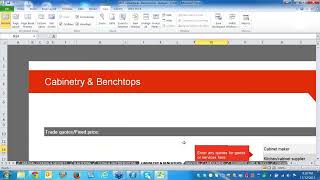
So this is the kind of, this is the kind of template for all of your pages here. So if you were just doing. The simplest way to use this spreadsheet is simply to. You've marked something that requires attention in your property evaluation checklist. You go and get a quote for it and you enter it into the quoted price column at the top of the spreadsheet in the trade quotes and fixed price. And that's as simple as this spreadsheet can be.
Or you can get into more detail and start getting some quotes.
So what we've done there, say for an arborist or a tree remover, there is. I've put in a guide price. That's the price that, that I would typically pay for those guides. Now if you want to use that guide price, all you do is use the spec drop down menu. If you put it onto bargain, you'll see that that unit price continued is literally that guide price. So that's what we're saying is the minimum price that you'd hope to pay the bargain price. But if you put it on average, you can see that that goes up to 165. And then if you put it on retail, up it goes to 188.
What are those percentages that you use?
It's 10% and then 25% on top of that. So that's what we're using. But it checks out pretty well because I've kind of tested it on a few things. So if you really wanted to be conservative, you could run through and put everything as retail, but more than likely you'd probably do your costings at average. And if you can find a cheaper price for a tree arborist, go and change that guide price and then make your own rules of thumb. But this is a way that you can actually, if you don't know the prices of things, you can go through. Because as we go further down the spreadsheet, you'll see we've got this for basically every item.
So essentially you start with the quotes. If you just want someone to Have a quote. If you want to get them by the hour, you go into this section. And if you want to get into some detailed information, you've got some guide price here for things like asbestos, tipping fees and landfill.
Yeah. You know what might be good, Jane? Jump onto something like the painting, which will be relevant to cosmetic renovations. And then that's probably a nicer one to run through.
There's so many tabs here. Painting.
Yeah. Okay, that's a pretty good example. So, for instance, if you've got a quote for the entire job off the painter, obviously you just stick it in the quoted and that's it. And then when your actual. Comes through, when the invoice comes in, you put it in the actual column. And then if you were to go back, we don't need to now, but if we go back to our front page there, it would tell us whether we've got a profit or loss there, depending on if the quota came in at the.
Yeah.
In relation to our estimate. So the top section is just for your quotes. Then you can go down to hourly rate. So this for me, because I tend to hire tradesmen by the hour, I use this a fair bit. So I might go, oh, well, that's, you know, let's say six. That's two days work. So that's 16 hours. 16 hours work for the painter to do this. And he'll probably have his apprentice with him for those hours too. So I might put 16 in for that. And then. Yeah, through you go. And you can do it that way. Or perhaps because often what will happen is I'll ring up the painter and I'll say, how much you gonna charge me to paint a garage? And they go, oh, yeah, it's probably gonna take.
How big is it? 20 meters square.
So that's the kind of thing I'll often use that for, or if I'm using labourers or, you know, carpenters and that kind of thing. But then if you go down further into the detailed costings.
These are the things you need to know that you need if you're gonna do it yourself.
Yeah, that's right. So that's some of the stuff. I mean, even doing a cosmetic renovation, if you weren't hiring everyone, this is all stuff that you would use, like filler and gloves and sandpaper and builders. Bog and again, that's the. Over the years, I've tried to source everything as cheaply as I possibly can. The tightest person builder going around. And so the guide price at bargain, if you can get it for that that's great. And if you can get it lower than that, then tell us where you're.
Getting it, and we'll get a trade discount for everyone.
That's it.
This builder's bog. I always thought if I was a hero, this would be my weapon of choice.
Yeah, builders Bob is fantastic.
I just buy cans of it and keep it around that. And no more gas.
Yeah, it is good. Now, did we skip over the quick. Is there a quick calculation there in this spreadsheet? Just up a little. Yeah. So the quick calculation, if you've got a for instance, now I've got mine as $49ameter. So the last place that I got painted, I got painted the whole interior of the house. And I went back and I worked out, right, so what's the square meterage of the interior of my house? And then I divided. I got my end price, my final invoice, and I divided it by the square meters, and that gave me that guide price. So now I've just got a quick rule of thumb guide that it cost me $49 a square meter. That's in the floor plan square meterage to get my painting done.
And as we said, you know, guys, this is kind of a guide for you. So once you've done your renovation, you can go back and do those calculations. And once you've gone and done those calculations, you can say, what is your guide price? We know that prices change whether you're regional or in different capital cities, so you create your own guide price and make it work.
So each time that you come to do a costing on a property, you don't have to go through and do it item by item. You can just go straight to your quick calculations. And that's where you start to get really good at doing your. Your due diligence on a property fast and working out really quickly whether it's yay or nay.
So we're trying to give you guys the tools and the experience and knowledge by not just giving you the answer, but telling you how you can actually build that yourself and have something that's meaningful that you can use time and time again in the future.
And then, yeah, same thing for your. When you get down to your paints or equipment or whatever, if you don't want to, if you say, oh, no, I can get it for cheaper than that, all you need to do is just leave that set to none, and then you can add in whatever price you would like there. And that just goes across and completely ignores my guide price and the spec column altogether. So that's really there just for. If you don't know the price of something and you don't want to spend the time kind of going and looking for it, you can just use the guide price. Probably a good idea is to use it on average rather than bargain and then if you can get it for a bargain, all good.
Now I really enjoyed some of the things that I looked at and went, this is great. Talk about intellectual property here. You know, tile out hourly prices, you know, the labourer, the waterproofing, that $50 a day and the person charges $50 a day.
No, that should be. Sorry, that's the typo. Can you change that meter? It should be a meter, yeah.
So the tiles and labour per meter squared. Now, you know, things that you had in here, the information about, you know, the cement screed, the tape that's needing for waterproofing, you know, the membrane itself and the name of the membrane that you've used the wall tiles and what you found them for. Now this gives people who've got no idea the charcoal porcelain tiles for the floor we talked about. Well, we will talk about in the next couple modules, the ceramic ones for the walls.
Module nine. Yeah.
So, you know, you're getting a bit of a guide here. Once again, you know, you could go retail on these prices or not, but at least you've got a number here that when you go out to get quotes and they go, oh, I'm going to give it for you, a bargain at 35 bucks a meter, you're thinking, okay, is that realistic or not?
Yeah, actually I just saw there, that's a good example of actually where that really is quite a difficult one to get. I think if you're going to like your tile marts and that kind of thing, you're still probably going to find 26 bucks a MET difficult to get. A lot of these prices were not the bargain and probably for stuff like tiles, it probably get caught out a little bit there. But a lot of these guys are Chinese importers and they're kind of dodgy little places at the back of a row of factories and that kind of stuff. I mean, they're not dodgy, they're legitimate businesses.
But you have to do some looking.
You have to do some looking to find and often you don't get the same stock the next time you go around. Next renovation I roll up and they haven't got any of the same products they had last time, which is a.
Really interesting point in actually calculating the amount that you need for tiling what kind of extras do you add? 10%?
Yeah. 15, I think. Yeah.
15% for tiling? Yeah. Because you find the color matching is an issue so you want it from.
The same batch and you're best off spending a little bit extra and getting more than you need and then just flogging the rest on ebay.
And I think I share one of my little secrets of using the kickboard under the kitchen for putting all the extra tiles in and things under my rental property so that the rental manager says there's a tile that needs to be fixed or whatever. I actually have them on a few extras. I have a few extra oyster lights there as well.
That's great.
I know he's got the kitchen. Well, if you think of that kickboard.
It just flips and flips off.
So I keep heaps of stuff under there.
Yep. Right.
You can't really fit a tin of paint. But I have the same color paint for everywhere, so I kind of like. Yeah, but anything you need for touch ups, you might just have a screwdriver and a paintbrush and you know you can run into a property and you.
Know, I like the. I've got a mate that for his rental properties he just uses white paint. No tint, not whisper white, not antique white. And that way he can just.
It'd be like an asylum, wouldn't it?
He can just walk into any shop, anyone wants a white paint and just pull a tin of white paint off and it's always the same.
Now look, I love what you did here, John, with your costings on the cabinetry and you know, giving people a bit of an idea of what it costs. And for the installation, delivery handles. Now I have to say I'm going to ask you, where do you get your handles? Because boy, I did this kitchen and I think you'll probably see photos of it later on that had I did great big drawers so that I could have used it as a pantry and everything because I didn't have storage in the rest of the property. And I had something like, oh gosh, 30 or 40 handles and 20 bucks each, you know, I was up near a thousand bucks just for handles that I hadn't really considered. And at the time when I was talking to the kitchen guy, like, seriously, you got to go with mine because they've been galvanized, whatever it is, they're not going to rust. A year later there they were rusting. It took me six months to get the guy to come change the handles. The exact same handles, a lot like these the exact same handles on eBay.
Six bucks. Yeah.
So.
Well, that's. Yeah, I find a lot of guys from. And I'm trying to think of the name. The last guys that I'm using. Yeah, they're an ebay store, the guys that I'm using at the moment.
Are you using Renault D?
I use Renault D too.
And then this is, you know, here's for you. Here's a colour, the Osprey look, you know, stone, granite, 500 bucks a meter. The cutout, which you don't think about, for the sink. And if you want to have one of those little handy holes for your bin and anything special that you're adding in, this is gold, guys.
Gold.
And what was the other one that I really liked was where we got into the electrical appliances. Electrician per hour, apprentice per hour, reworking, rewiring the mains per meter squared, the exhaust fans. You're actually going to the Ixl tastic. Three in one, four in one. So you've got some costs here. So a lot of the stuff does translate to the cosmetic renovations. The pendant lights. These are some of those fabulous lights that you used in that last flip that you did, aren't they?
Yeah, the habitat ones are those. Like. They're not a bird's nest, but they're a round kind of black.
Yeah.
You would have seen them in the rooms of the. And I think I got a feeling they might even just came from.
Either ikea.
Yeah, ikea. Yeah.
Yeah, that's what I've seen. And, you know, see, I've got a question for you. Down lights.
Yep.
Last time I put in down lights, this guy convinced me that I needed to have a power plug next to pretty much every down light, so that if I. They weren't in series, so if one blew, I didn't lose the light and I could replace them easily. Which meant that I had a ceiling full of power points and costs. Yeah.
I reckon you could have replaced them for a couple hundred years and still come ahead of that in terms of cost.
I felt a little duped at the time, but it sounded so compelling.
Yeah.
Which happens at doing renovations.
Yeah. Look, the cheap lights do go out all the time. I've had them that I've used one brand and they didn't even make it through. I couldn't even have them on for the length of a open for inspection. So I think there's something going on.
About downlights at the moment. There's a special going on.
I know we've changed. They've changed all the rules around down lights. And I was speaking to builder the other day about it and he was saying he, he's not. He won't even go there now. He uses these ones. They're 16 bucks each. Take it or leave it.
Yeah.
Otherwise they're off his builder's warranty.
Fair enough. Hey, Klipscal Satin. Oh, mist. Double PowerPoint. These are a whole lot more expensive than the norm.
Yeah, they are special ones. They're like that. You know how you have all that home automation C bus stuff?
Yeah.
So they have these really pretty switches which have got like, they look like they're a little glass panel and then you've got the little silver switches. So they're those just. They're the same switches they use in that home automation.
So we're talking high end structural innovation. We're not talking a $300,000 property.
No.
That's a regional town.
Yeah. And you can see the price there reflects that. Yep.
So, yeah, this gives you things like.
Two gang and so on. That's just electrician speak. So you kind of need to know that when you're ordering. So two gang is just a four switch. So it has four switches on it. Yeah, Gang is just the mechanism.
Data points. Dishwasher. The old Omega 450. The standstill cooktop. You know, you've even. Gold, guys. Gold. Get into this. Get excited. We've got a question here that says, where do you put all the extras? Well, we've got an opportunity here to put some contingencies in. And there's extras pretty much in.
There's other, other, other at the end of. Yeah. And you can add a row there as well.
So this is your spreadsheet. We're not going to treat you like idiots and lock it down.
I'm not going to be able to give you a supplier for everything in there because otherwise I'll never get any work done. So you can maybe do a Google on them at some stage we might try and put together. Well, we're trying to put together a trade list. So at that stage, hopefully there'll be some things we can add in there that beat our control price and get down even lower.
Yeah, we were talking to someone about getting a group discount on national suppliers for many of these items as well. So stay tuned. We're actively working for you. And yes, those people who I met.
The bonus spreadsheets for the course.
And to those people who are asking about our advanced Excel skills. Yes, that's us. With some help from Lou.
Yeah, that's right. Sorry, Tracy, I don't know what that means. The bonus spreadsheets for the course.
Oh, isn't that nice? The best they've seen. We're getting lots of feedback here saying they're pretty impressed with our budget. We're pretty impressed, too. Seriously, guys, get into it. Until you've either done a renovation or you attempt to kind of cost out a renovation, you won't fully appreciate the incredible thousands and thousands of dollars of time effort that this will save you. And look, I have to say, John, the effort that you've put in, putting some of those extra. Gosh, the intellectual property. What did you say to me yesterday? The price alone of the course is worth the list of the plants that you can use in the landscaping. After what, 20 years of trial and error of what the landscaping can look, you've actually listed the actual plants names that people can walk up with their little list and go, here it is. This is what I want.
Yeah, well, it serves as that too. It's a bit of a guide to which kind of items that have worked for us in the past we like. The landscaping is a good example. We spent time kind of, you know, I'm not a landscape gardener, but I've hired landscape gardeners and just, you know, grabs what. What has worked and put that in my budget and kept those plants. And it's all those architectural plants like cordylines and yuccas and all that kind of stuff all in there and the grasses and that kind of stuff.
So, you know, guys, I really encourage you to grab jump in there and have a look at that budget because as you probably won't appreciate this and for those experienced renovators, I'm sure we're going to get a huge amount of feedback because it is by far beyond any renovation budget that I have seen in any course across Australia. And in actual fact, someone was telling me about a course that's come out recently and they've got a budget estimator without actually having any real costs in there. And they estimate that budget to cost cost $1,500, if you want to download that yourself.
I showed it to Craig today, actually. He's in the middle of a renovation. Craig Trethway, who we were just talking about before, and he loves it. He's going to be using it on his next one. Sometimes it's not until you actually put it into use that you appreciate the.
I don't know how to actually rave enough about this for people to really realize the value, but just take it from us. Go and check it out. It is by far and beyond one of the best tools that you will have and be able to use in the course.
More from Let's


The Ultimate Guide To Renovation Course - Module 5: Self - Employed Low Doc Loans



Rob Flux Ambush - Convince me I should consider Property Developing as a strategy 3,2,1 GO!

The Ultimate Guide To Renovation Course - Module 4: Recognising a Property's Potential

YPS Club Mar 24: special Guest Peter Wargent describes how Australian properties are so resilient


The Ultimate Guide To Renovation Course - Module 5: Interest Only Lenders Exposure

