The Ultimate Guide To Renovation Course - Module 2: Suburb Selection
Module 2 (Suburb Selection) is a lecture on how to evaluate suburbs for property investment and renovation. Key factors covered are rental yield (annual rent ÷ property value), total yield (rental yield plus capital growth), future growth risks, and pricing disparity between renovated and unrenovated properties — including examples comparing suburbs and guidance on where renovators may find opportunity.
Chapters
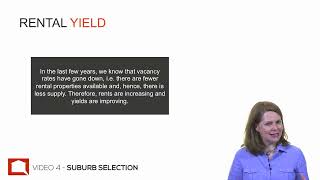
So that brings us to suburb selections. Specifically, you need to know the following about the selections of suburbs you decide on. What you want to know is the yield, the rental and the total yield. We're looking at the future growth, we're looking at pricing disparity, we're looking at demographics, supply and demand. So let's have a look at rental yield. Rental yield is calculated by taking the annual rent and dividing that by the property price. So for instance, $15,000 per year in rent divided by a property price of $300,000 means the rental yield is 5%. In the back of the property investing magazines, this is where you're going to find this number reported. However, like we found with all the figures we've used in our research, the final product is not always as simple. Imagine if you negotiated the property down to $250,000. Then for the same rent, your rental Yield is now 6%, which is a lot better than 5%. If your rental yield is 6%, then what are your costs? If you look at this graph, you will see that the 10 year average interest rate in Australia is about 6, 7.3% and 8.5% for the last 20 years. So if you're earning 6% rental yield and the interest rate is 7.3%, then the extra you have to make up each week out of your own pocket. And this is less if you are earning 5% rental yield. That is you are earning more rent to help you pay for the interest payment. But remember, there are additional costs of owning a property as well, such as insurance, maybe body, corporate maintenance, rental management fees, the list goes on. So you need to allow between 20 to 30% of the rental income to cover these costs. You also need to factor in depreciation factors which will determine the after tax return. This is going to be covered later. There are also other considerations you need to factor in when you are analysing the rental yield. Lets look at the equation ourselves. Annual rent divided by property value is rental yield. Let's look closer at the variables that can affect the rental yield. If the demand from tenants increases, then the rent may go up, which means the rental yield increases. But if the value of the property increases, the rental yield decreases. Although eventually rental yields will probably trend up. Usually it's the tenants who determine where they want to live, which in turn will have an impact on where you consider buying. Thus, if you're watching a few suburbs and you find that the rental yields are going up, be aware that one of two things could be happening. If we look at our formula, either the rents are going up or the property prices are coming down. In the last few years, we know that vacancy rates have gone down. That is there are fewer rental properties available and hence there is less supply. Therefore, rents are increasing and yields are improving. This can actually be a great indicator that property prices might increase because more investors will follow the better yields and hence property values will increase following that. So if you can read these signs and get in early, you can ride that capital growth wave as more and more investors drive the price of the property higher and higher. However, keep a watchful eye on the figures. And just because the rent goes up does not guarantee you've found your very own hotspot. Rental yield is only part of the story. The total yield is what really counts. That is the rental yield plus the capital growth percentage. Many investors are willing to sacrifice high rental yield for capital growth. For example, they might accept a rental yield of 4% if they know the capital growth will be 10%. Some argue that you can have both, and some would rather have a higher rental yield than capital growth. So the weekly out of pocket costs of holding their properties is less. So let's have a look at future growth. We're back to crystal ball gazing again. Who knows what really lies ahead? We could be in for another global financial crisis, earthquake, flood, fire, or government policy change in the future. Really, the best we can do is look to the past, do our research, and factor in risk minimisation strategies to protect our investment. Let's have a look at pricing disparity. This is really the key to renovation success. In short, pricing disparity is assessed on what the average renovated house price is compared to what the average unrenovated house price is. Without pricing disparity being present in a suburb, adding equity in the short term through renovation may not be viable, even if some of the other indicators we are looking at are present. Regardless of if you have a buy and hold or flipping strategy, the ability to add value and create a property worth more than what the cost of the property is essentially pricing disparity. Pricing disparity between renovated and unrenovated houses differs from suburb to suburb. Consider this a suburb in Brunswick, Victoria, we have an unrenovated three bedroom weatherboard house worth $800,000. Now, a renovated three bedroom weatherboard house is $950,000. In a nearby suburb, Moonee Ponds, an unrenovated three bedroom Weatherboard house $850,000. Whereas a renovated three bedroom weatherboard house Is $1,050,000. That's a huge difference. The inner suburbs of Sydney and Melbourne have experienced enormous interest from home renovators due to the fact that older style homes abound in these areas and are therefore prime candidates for renovators. Renovators delights attracted premium prices, meaning the disparity between unrenovated and renovated properties closed, leaving a smaller margin. Although the times have changed since those heady days of 2001, 2003 and 2006 to 2008, unrenovated properties in some areas still sell for the same amount as slightly dated properties, but require a lot more work. So be clear on this Unrenovated does not equal value I know we're all into renovations, but sometimes you have to stop stop and think about this. People often make the assumption that because a property is unrenovated there must be opportunity to add value. This is often not the case. If pricing disparity is not present within the suburb, then even a minor renovation could result in over capitalisation. Pricing disparity can be elusive and time consuming to track down. Unfortunately, you won't find it listed in the back of the property magazines. It is displayed discovered only through analysing sale data for an individual suburb, past sales and those of properties on the market, and then categorising these as renovated or unrenovated. More tools for this later. In some of the exercises. Pricing disparity is often dependent on the position a suburb holds in its life cycle. For example, a new suburb presents few to no opportunities, whilst older suburbs are likely to present better opportunities. Renovators need to be on the lookout for suburbs with a broad spread of values for renovated versus unrenovated properties. In my experience, the suburbs that have the most pricing disparity present have one of two characteristics they are more likely to be suburbs with a high median price or they are suburbs that are undergoing change. As a rule of thumb, the higher the median price of a suburb is, the more likely it is that pricing disparity is present. This is increased further in high priced suburbs that have other drivers present, like a demographic that demands renovated properties. These demographics, such as family home buyers, often on second and third home purchases with a good job and equity behind them, are looking for a long term already renovated family home. They are at this stage in their life cycle where their children are approaching secondary school and they wish to live in proximity to highly ranked schools. Remember that website? In this scenario, good schools are a major driver of area demand. It's also true that demand for unrenovated properties is less in higher priced suburbs as the would be DIY buyer is priced out of the market. Unfortunately, if holding is your strategy, such areas, that is High priced areas, while normally offering steady growth, offer very little in the way of rental yields. They may be 2% and as such are a far off distant prospect of ever becoming positively geared. While these suburbs can represent the best opportunity for pricing disparity, if you are just starting out as a property flipper, then this is a high risk strategy because you'll be putting significant money on the line. Is it worth risking everything on your first renovation? I suggest not. You'll be better placed to start lower in the market, gaining experience through multiple transactions and improving your systems and technique as you go. So let's look at changing suburbs. The good news is that the other major drivers of pricing disparity may be in place already. They are the ripple effect, suburb gentrification, population demand, and changing infrastructure. These are all responsible for increasing pricing disparity at least temporarily. During this period of change, as the median price rises within a suburb, the breadth of market expands before slowly contracting again as the unrenovated prices also rise. This is why it's critical to do your research and choose suburbs that have the right characteristics present for driving capital growth. More practical steps to identifying pricing disparity in some of these exercises.
More from Let's


The Ultimate Guide To Renovation Course - Module 5: Self - Employed Low Doc Loans



Rob Flux Ambush - Convince me I should consider Property Developing as a strategy 3,2,1 GO!

The Ultimate Guide To Renovation Course - Module 4: Recognising a Property's Potential

YPS Club Mar 24: special Guest Peter Wargent describes how Australian properties are so resilient


The Ultimate Guide To Renovation Course - Module 5: Interest Only Lenders Exposure

