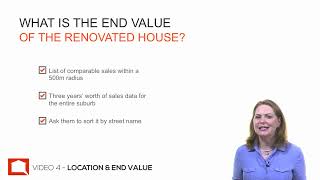
This module (YouTube video transcript) guides buyers on evaluating residential renovation targets, focusing on location desirability for target demographics, zoning and regulatory checks, estimating end value via comparable sales, and calculating renovation costs to derive a purchase price. It emphasizes thorough due diligence before offering and next steps of validating costings and finance.
Chapters
A desirable location. Is your property located in a desirable location for your demographic? So what do you look for? Well, that depends on what your demographic is and these are some of the things that they may be looking for. Local employment, proximity to transport district, distance to schools, shopping centre nearby, close to freeway access and some great parks and recreational areas. What is the location like at different times of the day? Like night, when all the kids are home from school? Is there a housing commission close by? What does your target market want? Where do they want to be and what could their expectations be for the area? Here's a quick tip. Real estate agents will use in their advertisements to see descriptions like on the right side of the highway, in the Golden Triangle and so on. So if you don't know an area, you can quickly work out where the right side of town really is. So let's look at zoning. If you were doing structural renovations, you would be trawling council websites looking for their heritage overlay plans, their zoning and any other relevant restrictions on how much of the property can be taken up with buildings. Your solicitor or conveyancer can also help you with this, but it's a good idea to perform these checks yourself first. So what is the end value of the renovated house that you're looking at? Ask the listing agent's opinion of what a renovated house at this location is worth. Now, obviously it's in their interest to quote a high figure, but then ask if he would mind putting together a list of comparable sales to back that up. I also ask that this list be within a 500 metre radius, so it's close by. In my experience, agents at this stage in the process are normally pretty happy to help. So I also ask for three years worth of sales data for the entire suburb. This gives me good data from another source which I can work with. It also keeps them on their toes with the first list of comparable sales. Ask them to sort it by street name for the easiest pinning on your map. So back to the fundamentals again. What is the current market value of the property? What will be the realistic resale and revalue price? What will be the total renovation costs including fees? And who is the demographic that will buy or rent this property? If you know the end value and the costs, then you know what you need to buy the property for to make it work. In other words, take the end value minus the cost, minus the profit you want to make and that leaves you with the purchase price. Then it's time to put in your offer. As you've seen, property due Diligence can be an in depth process. That's why I only carry out a full property inspection evaluation and even get the building inspector involved after I've had my offer accepted, after I hear you say, why do all your research after they've agreed to sell it to you? Remember, you've done so much research to get to this point, more than most people. Getting your offer accepted is just part of the process. But sign nothing. You're just putting in an offer. However, I don't want to give away everything that I reveal in the negotiation module. So let's look at what we've looked at so far in this module. In this module, we've gone into some detail on how you can take the suburbs you've selected and get down to actually putting in an offer. We've looked at your inspection checklist and how you can use this to assess properties. And then we've looked at what you need to look for when assessing a property for renovation potential and all those hidden costs. Then we've looked at the four fundamentals that you need to consider before any property purchase. So the next step. What now? So if you assessed a property, we now need to go and get our costings validated and look at our finance. We need to know that we can afford this property, including all the renovation costs. So let's get going to that next module now.