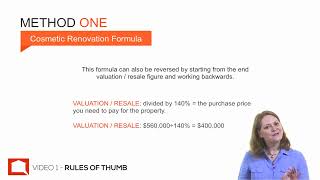
Learn how to price renovations using percentage formulas: cosmetic work runs about 10% of the property value, structural work about 40%. The module walks through real math with a $400k property, showing how to calculate your target sale price and work backward from profit goals.
Questions this video answers
Seven days.
Approximately 10% of the purchase price.
Approximately 40% of the purchase price.
About 6% of the purchase price.
140% (i.e., purchase price × 1.4).
Chapters
In this module, the only way to get an accurate picture of exactly what your renovation will cost is to carry out a comprehensive evaluation inspection. Using the Property Evaluation Checklist, I document all the work needed to be carried out. Due to the amount of time taken, I prefer to only conduct a property evaluation of this kind after I've had my offer accepted. Although this may not be possible if placing an offer prior to auction, but we'll go into that in module 6. Offers negotiation and Auctions I normally will make an offer subject to a pest and building inspection to my satisfaction or if I get away with it, subject to due diligence, which is a lot more general. Essentially, I want an opportunity to get get out of the contract. If I decide I don't want the property, then these clauses just give me the opportunity to do that. Depending on negotiations with the vendor, I normally ask for seven days to complete this due diligence task. In this time I also obtain access to the property by appointment to get quotes from the tradespeople as well so let's look at costing your renovation. How much will the renovation cost? We'll have a look at some rules of thumb. Costing the renovation and knowing what to spend is difficult as everyone has a slightly different strategy and a different end game. However, after teaching renovation as a money making strategy over the years, I found that everyone needs a rule of thumb. So let me give you one. Many people have different ways of working out the rule of thumb of how much you should spend on your renovation and they may all be right. So. So for what it's worth, I'm going to work through some general rules of thumb for your cosmetic and structural renovation, assuming that you will not be selling the property at the end because these bring in additional costs such as capital gains tax on your property sale and selling costs. While these are useful tools for quickly assessing the potential of a deal, they are by no means a substitute for the full costing that should be carried out prior to any purchase. This is not a scary prospect. This can be outsourced. Many buyers, agents and organisations like Archicenter will conduct this renovation costing and end value for your renovation. However, let's push on so how much will it cost now for a cosmetic renovation? As a rule of thumb, a cosmetic renovation should cost around about 10% of the purchase price. Now it's a lot more for a structural renovation. As a rule of thumb, for a structural renovation it should be around 40% of the purchase price. You need to know your total cost. Your total property costs is the purchase price plus the acquisition costs, plus the renovation cost, plus the holding costs, and then any selling or refinance costs. So how much should you be buying the property for if based on the rule of thumb allowances for renovations. Let's have a look at a couple of methods. Method one, the cosmetic renovation formula. First of all, we have the purchase price. Now, let's just say that's 100%. Acquisition costs represent about 6% of the purchase price. Renovation costs, as we discussed for a cosmetic renovation, 10% holding costs. Now look, this is really based on the interest rate, the time the renovation is going to take. The. So let's allow 5% and selling and refinance costs anywhere between 0 and 4%. If you're having a really schmick marketing campaign to sell the property. So what next? Don't forget your profit margin. Let's allow 15%. So the total percentage of your purchase price as a new valuation figure is 140%. So our formula is the purchase price times 140% is the resale or revalue price that you need. Now, you can change any of those numbers as you like, but that's how you build up your own rule of thumb. Using this formula, if a house is $400,000 in value, you need to revalue or sell that property at $560,000. So those numbers, the purchase price 400,000 equates to 100%. The acquisition cost, 6%, $24,000. Now that's legal and stamp duties. Renovation costs. Remember our 10%, $40,000 holding costs here. Look, I've allowed $20,000. You might be a really quick renovator, and it could be a lot less your selling refinance costs, lets say $16,000, and your profit margin 15%, which is $60,000. So your revaluation or resale figure is around about $560,000. So our formula is the purchase price $400,000 times 140% equals $560,000. Now, to do that on a calculator, 400,000 times 1.4 equals 560,000. That's your number. Now, you have a rule of thumb that you can use. So this formula can also be reversed by starting from the end valuation or resale figure and working backwards, this will tell you exactly what you need to purchase the property for in order for you to make a profitable renovation. So let's start with that valuation resale figure. Divide that by 140%. So that figure divided by 1.4 equals the purchase price. You need to pay for the property. So let's have a look at it with our example, $560,000 divided by 140% equals $400,000. So now let's look at the structural renovation calculations. First of all, we start with the purchase price. Once again, let's make that 100% acquisition costs, they don't vary 6%. The renovation cost does 40% of the purchase price. The holding costs, once again, they're dependent on the time and the interest rate and your borrowing cost. And we're going to allow 8% here. Your selling refinance cost, 6% and a profit margin where we want a healthy 20%. So the total percentage of purchase price as new valuation figure is 180%. So our formula is purchase price times 180% equals the resale price needed. Using this formula, if a house is $400,000, you need to revalue or sell it at $720,000. So let's have a look at that. The purchase price, $400,000. Remember, 100% acquisition costs 6%, which is $24,000. Now the renovation cost for a structural renovation, 40%. That's a whopping $160,000. The holding costs, we're talking about $32,000. Because remember, it's going to take longer. The selling refinance costs $24,000. In this case, selling costs, profit margin. Hey, here's a great figure, $80,000. So when we're looking at your valuation or resale figure required, it's $720,000. So our formula is purchase price $400,000 times 180% or 1.8 equals $720,000. This formula can also be reversed by starting with the end valuation resale figure and working backwards. This will tell you exactly what you need to purchase the property for in order for it to be a profitable renovation. So the valuation Resale divided by 180% equals the purchase price you need to pay for the property. So let's have a look at our example. The figure $720,000 divided by 180% equals $400,000. So how do you know what the resale figure is? Just ask the agent of the property you're interested in if they could provide you with a list of comparable sales at the resale level. I also asked if they would provide me with three years worth of sales data for the whole suburb. It's always worth asking. This also keeps them from cherry picking the high price comparable sales when they're giving me the comparable data you need to check and recheck your comparable sales and be objective. So let's work backwards again from that resale price. It is worth going through this again as it will allow you to quickly assess the price you may offer for a property. Let's say that conservatively, I estimate my resale revalue figure at $535,000 and I'm going to be doing a cosmetic renovation. So here's the formula. The resale amount divided by the cosmetic renovation of 140% equals my buy price. So $535,000 divided by 140% equals $382,000. That's how you build up your own rule of thumb.