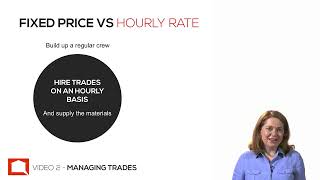
Managing tradespeople means clear communication, set expectations, and prompt payment. Pay invoices every Friday to keep trades motivated. Start with fixed-price quotes and supply materials yourself to control costs, and use small rewards like vouchers or beer to build goodwill.
Questions this video answers
May 10, 2024
Pay all invoices each Friday; if an invoice is received by Friday lunchtime it will be paid into their bank account by end of day.
Chapters
A good trading but some fantastic tradesmen are not always blessed with the best time management and customer service skills. Now, while this can be frustrating, it's part of the territory for me. It's preferable to pay the going builders rate for quality work. Overpaying a premium for customer service just doesn't make sense, so it comes down to you managing the people properly. Things you need to keep in regular contact for updates prior to the job starting make it clear that if its start date is to be delayed, it needs to be flagged as early as possible because there's a flow on effect. Create a schedule for each individual tradesperson and send it to them by fax or email if they have it. Make them aware of who is scheduled to come after them and whom they will be affecting. The two traits that I most value in a tradesperson are someone who takes pride in their work and someone who has a can do attitude as opposed to someone who constantly puts up roadblocks as to why something can't be done. The rest I can manage around. However, as I said, it is important that you set expectations early on, particularly particularly around schedules and returning phone calls. If you want to know how to motivate tradespeople to pick up the phone, Become a good payer. Pay on time when they put their invoice in Remember, you want to be paying for someone who has the skill set. Maybe not someone who has the flash customer service, but someone who works for a builder at builder's rates that can be $10 to $15 an hour cheaper because they just want to come in, do the job and get it done. They don't necessarily want all the flash stuff that comes with dealing with customers. So It's a mugs Game the building industry is often described as a mugs game and for good reason. Every tradesman has a story about being ripped off. Most have been ripped off several times. It is what every tradesperson fears most, and even the suspicion of its potential can cause a breakdown in the relationship very quickly. At the time of quotation, clearly agree on exactly how much will be paid, how it will be paid, and when it will be paid. In my case, I make it clear to the tradesperson that I will pay all invoices each Friday. If they have an invoice to me by Friday lunchtime, they will be paid in their bank account by the end of the day. I do this for quoted work and hourly rate. This definitely makes you a good person to deal with and adds to their commitment. But I also make it clear that this is on the condition if any problems were to come up with their work after they've been paid, they agree to rectify them straight away. Problems have come up and I haven't had someone let me down yet. So that brings me to fixed price versus hourly rate. If you're just starting out, I recommend you get fixed quotes for everything, but where possible I recommend supplying the materials yourself. Sourcing materials well and for the right price is an important part of controlling your budget. Because I've built up a regular crew of tradespeople over the years, I hire many of my trades on an hourly basis and I supply the materials. This is not without risk and relies on trust as well as knowing how long a particular job should take. If you're paying based on a fixed price quote and time, then it may make you more comfortable knowing what you're up for and you won't get anxious seeing everyone sitting around at lunchtime or running off to do another quote for another job because you know that they're committed to finishing on the time frame that you've agreed to as long as you have that commitment. One way of ensuring this for big projects is including a liquidated damages clause. That is, if this is not done by this specific date and my project is held up, then you pay the market rent that I'm missing out on. For instance, the reality is any fixed rate quote will include a buffer for something they haven't planned for, and this is where you're paying a little bit of a premium on the fixed quotation option. Which brings me to owner builders and homeowners. Some tradesmen avoid working for owner builders and the homeowners directly because of past bad experiences. They'll often load a quote that is they over quote to compensate for the predicted pain in the butt factor. Tradesmen complain that some homeowners have limited building knowledge combined with strong opinions and are often suspicious of taking advice from the experts. High on the list of complaints being treated like second class citizens, client distrust of advice and feedback, multiple changes in the work, unable to visualise what is on the plan and debates around paying for those changes or variations. When the architect or builder or project manager is present in the building process, there is a buffer between the client and the tradie. The tradesperson does not have a customer service role and simply is responsible for their work and most prefer this buffer. As a professional renovator, you need to position yourself in the role of builder. Find out as much as you can about the process and learn to speak the lingo you need to ask advice. Be big enough to ask for advice. There is no harm in asking silly questions, particularly early on. Ask for help in planning your schedule. You will lose far more respect on site from pretending to know something you don't know. Tradesmen are a great source of information and even when I am obtaining quotes, I am taking the opportunity to learn as much about the task at hand as I can. I do this even when I know the answer, because I want to find out what they know and how they intend to carry out the work. You need to Recognise a job well done on completion of a particular renovation project, I presented my head Carpenter with a $250 gift voucher for a good local restaurant. He had been a real asset on the job several times, going above and beyond in to meet our targets. His reaction was surprising to me. He said that in all of his working life no one had ever given him something like that and he was truly grateful. I learned a good lesson from this. Small rewards create tremendous goodwill. I have continued to do this with my regular crew and new trades to recognise work well done. In most cases this takes the form of a box of their favourite beer placed on the back of their ute with a note attached thanking them for another great job. But not everybody drinks alcohol, so keep your ears open for what they like. Here's some gift ideas. Maybe an itunes voucher Gold class movie tickets go over well Sports mats tickets Scratch and win lotto tickets.