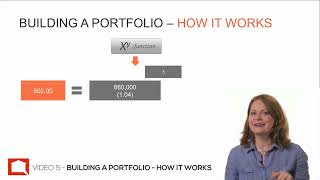
This YouTube module explains how property capital growth, renovations, leverage and compound growth build equity over time. It uses a worked example (purchase at $500,000 with $400,000 mortgage, valuation to $660,000) to show accessible equity, annual compound growth calculations at various rates (4%–13%), and strategic implications for selecting suburbs, holding periods, and combining flipping with buy-renovate-hold approaches.
Chapters
Building a portfolio how it works let's assume you have a property that you've owned for three years. You purchased it with a 20% deposit and you paid $500,000 for it. Your mortgage is $400,000. You bought well, given that you purchased in a suburb that has been going through some gentrification and continues to do so. Rental demand is high and auction clearance rates in the suburb are higher than average. Now you go and ask your local agent to assess the value of the property with a view of potential sale. In his opinion, it's worth $660,000. Now that's handy. That's a 33% rise in three years. You do need to take into account the improvements you've made. Say, for example, it was somewhere between a repair and a rejuvenate type renovation that cost around 5% of the purchase price, for a total of $26,000. Now, after allowing for acquisition costs and renovation costs, you have a gross profit of roughly $110,000. This is conservative. You should actually be getting more value than the dollars that you contributed. That is the $26,000 in renovation. And you could add maybe $50,000 worth of value. Does this all translate to equity? Yes. But can you use this equity? It all depends. It depends on how effectively you help and inform your valuer. A successful bank valuation should give you close to the agent's valuation of $660,000. Your potential accessible equity would be $660,000 times 80%, that is 0.8, leaving 20% equity in your property. That's to keep with the bank's policies. So that leaves us with $528,000. But remember, you already had a $400,000 loan. Hence you have 128,000 now available to you for this scenario, let's say the capital growth in our suburb is 7%, which is the historical average rate of capital growth in Australia over the last hundred years. We would then use this formula. The property value times 1 plus 0.07 equals the new property value. Or $660,000 times 1.07 equals $706,200. Now, what do you think the property value would be in five years time? So we know that the property value times one year at 7% equals the new property value. That is the net gain. So that $660,000 times 1.07 got us to the 706,200. Now the net gain is the difference, $46,200. So would the formula be five years times $46,200. That is 231,000. Totally. Well, no, not quite. It's actually better than that. We have forgotten a little something called compound growth. The good news is that it's not the original property value of $660,000. That's multiplied by 7% each year. It's the new improved value each year of the compounded amount. As you can see, each year the property value goes up by 7%, and then the new amount in turn goes up by 7%. So let's look at how that works. In year one, we have the property value of $660,000. Times that 7% capital growth, or times 1.07, we end up with $706,200. We then times that by 1.07. So in the next year, we have $755,634. And we go forward and forward and keep multiplying that amount by 1.07. So the next year, we end up with $808,528. The following year, $865,125. And then finally, after five years, we're talking about $925,684. Now, over that five years, that's a net gain of $265,684. Now, it's a little bit different to just timing 7% by the 660. In actual fact, it's $34,684 in extra equity, thanks just to compound growth. In fact, there's a fancy function on your calculator. It looks like this X to the power of Y. So an X with a little Y at the top. This allows you to work out the formula quickly. It is the N value equals the initial value times 1, plus the percentage growth to the power of the number of years. That is on the calculator. In our example, that would be the end value of $660,000 times 1.07. And then push that X to the power Y button 5, and you end up with $925,684. So if you want to quickly work out what the value would be if the capital growth was, say, 4%, then this is the calculation. $660,000 times 1.04. Then push that XY button 5 equals $802,000. So you can see that even over a short period of time, with modest capital growth, how efficiently your capital can be worked, generating you more equity. So how does our scenario look over 10 years? By choosing a suburb that has just 1% more capital growth. So let's start with a property worth $660,000. In year one, it would go up to $712,800. Year two, $769,824. Year three, $831,410. Year four, $897, $923 and year five, $969,757. Now let's just fast forward to year 10 when it becomes $1,424,890. Wow, that's amazing. That's a total gain of $764,890 after 10 years. So let's have a look at that comparison over 10 years. If you bought in one suburb with a 7% capital growth, you have 630 $38,320 in equity. But if you could actually get an area with 8% capital growth, that's $764,890 as your inequity, that extra 1% equates to $126,000. That's $764,890 made just from holding the property for 10 years and an additional $126,570 just by selecting a suburb with a growth rate that is 1% higher than the historical average. Now, as it turns out, we're not just looking for suburbs with average growth prospects. We're looking for the ripple suburbs that are going to grow up to 10% and even higher. So let's take a look at the scenarios that we're aiming for. Here's a comparison over 10 years where we're looking at a 9%, 10, 11 and 12, 13% capital growth in the areas. As you can see, the values are quite substantially different. So I know we're talking about buy, renovate and hold here. And I've told you flippers out there to stay tuned. And this is why I want you to do that. How would you like to have over a million dollars in equity created from holding just one property for 10 years? Now, it sounds pretty good, doesn't it? And this is the wealth building power of using leverage and capital growth. We shouldn't forget to thank suburb and property selection here as well. Now imagine if you have the ability to buy two properties now, how much have you got? We could go on and on. So you bought below the market and created instantly, say $50,000. Then you added $60,000 from a renovation. That's The Trident strategy, it really starts working for you. It's true that flipping can get you some short term gains, but the power of capital growth really skyrockets your return. Obviously, a portfolio that could combine a few strategies, maybe flipping and buy, renovation and holding with some positive cash flow properties in good capital growth areas is fantastic. So let's have a look at it a little closer. You want a million dollars in value so you can sell up and put the money in the bank. How much do you need to start with and how long until you want that million dollars? Let's say you want that in 15 years and you're targeting areas with a 5% capital growth. So we need to work that equation backwards. The end value equals the initial value times one plus the capital growth to the power of the number of years. The initial value equals the end value divided by 1 plus the capital growth to the number of years. So the initial value equals a million divided by 1.05 to the power of 15. That's $480,000. $480,000 times 1.05 and on and on and on equals a million dollars. However, your original loan might have been 80%, that is $384,000. So you need to reduce your value by the loan you need to repay and also selling costs, which, let's say 2% of a million dollars and capital gains tax. As you can see, you possibly need, let's say as an approximate $1.6 million in property to end up with a million dollars in the bank. So how do you do this? Wait longer or have more property at the mercy of the market forces and in particular have a higher capital growth rate. As you can see, there are only a few ways you can affect your outcome. You can affect it on one side of the equation or the other side of the equation. So let's go back to our goals. So now, how far are you off from your long term goals and the time frame you wrote down in module one to achieve them? This recheck is important for you to continue doing throughout your property portfolio management. You need to monitor against your goals regularly. Especially if a property is not performing to your expectations, you need to consider to ditch it, or more politely said, evaluating it in line with your portfolio, that is go and ditch the dogs.