Learn how to price an offer on a renovation property. The instructor teaches a formula: divide your estimated resale price by 140% to find your maximum offer. Make offers conditional on a solicitor's review, and understand how agent commissions work so you can negotiate better.
Chapters
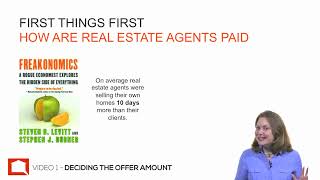
In this module, we'll look at the techniques, tricks and strategies to secure the property that will help you achieve renovation success. Personally, I'm not one to employ any sneaky tricks in the negotiation process, as many would prescribe. The real skill in the negotiation that leads to a win win outcome is for me, one where I not only get the property I want for the price I want to pay, but also ensures there are clauses in my offer that give it a distinct advantage. Let's do a quick review of what we've covered so far in all the modules. At the very start, you assessed your budget and the funds available to contribute to a purchase and renovation costs. You've established your property investing strategy and your buying criteria. You have assessed all of the areas and suburbs within your budget and made a short list of two or three. You've identified the pockets of potential within these suburbs. Then you've found a potential property that stacks up using the Property Inspection Checklist tool. Now you've carried out a comprehensive costing using the House Evaluation Checklist. But wait, we missed a step. As we learned earlier, the before we carry out a comprehensive evaluation, we should put in an offer and get it accepted first. This is not always possible if it is an auction campaign, but more on that shortly. As we learnt, a comprehensive evaluation takes time. Not only my time, but also the time of the tradespeople who are providing the quotations. So how do you decide on the offer amount? Remember, I have already completed a property Inspection checklist on the property, so I've obtained a list of comparable sales from the real estate agent and compared this to my price pin map off the street. This, combined with my knowledge gained from my suburb's due diligence, means that I'm confident in knowing a potential resale figure using the appropriate formula. I simply work backwards from the figure. Let's say that conservatively, I estimate my revaluation or resale figure at $535,000 and I'd be performing a cosmetic renovation. So the formula goes like this. I'm looking at the resale amount and I divide it by my special figure of 140% for cosmetic renovations and this is my buy price. So back to the example. If I'm looking at a revaluation number of $535,000, I divide it by 140%. My buy price is $382,000. So I I've made my offer of $382,000. But most importantly, I've done this with the help of my solicitor. I've made the offer subject to due diligence so I can do a comprehensive evaluation. However, firstly, we need to understand the selling process so we have a complete picture of what we're up against. But first things first. How are real estate agents paid? Now, there's a fascinating example of how real estate agents are paid from a documentary and book, Freakonomics. Check this out on YouTube. The video is hilarious. Essentially, they showed that on average, when real estate agents are selling their own homes, they have the property on the market for an additional 10 days than if they were selling a property for their clients. Why? Well, the explanation comes down to how they're paid. For someone buying or selling a property, knowing this may answer a lot of questions. So how are they compensated? Let's take a $300,000 property and assume the vendor is paying 3% commission to the real estate agent. So the commission is $9,000. However, the agent doesn't get all of this. The actual principal or owner of the agency where they work could get up to 70% or $6,300, while the sales team, the selling and listing agents, get 30% or $2,700. Usually they divide this 50 50. The selling agent is the person who successfully introduced a buyer to the property as opposed to the listing agent, the one who convinced the vendor to list or sign with the agency over other agencies. So the agent may end up with 15% of the total commission, or $1,350. So let's assume that an agent is both the listing and the selling agent and receiving the full 30% of the overall commission. So a $10,000 difference in the offer is actually only a $90 increase in the commission for the agent. So the argument goes that for them to get the sale done and to get on to the next sale, then persuading the vendor to accept the lower offer is in their interest. However, when it comes to their own home, we're not talking about an additional $90 in commission. We are talking about the full, full $10,000. So how does this affect you? You might consider telling the agent that you have a property you're looking at selling, that is that they could be the listing agent for your property and the selling agent for this one. Now, they're really working for you in theory. However, you could just befriend the agent and say, look, here's my offer. There are other properties in the area that are comparable and just list them. They'll know what the competition is and it shows that you're serious and tell them that it's in everyone's interest to move this along quickly.