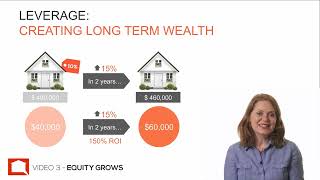
Learn why holding renovated properties builds more wealth than selling them. A $400,000 property that rises 15% to $460,000 gives you 150% return on your 10% deposit. The module covers leverage, equity lines of credit, and the three ways renovation creates value: buying below market, improving the property, and choosing appreciating areas.
Chapters
Renovating to Rent Unlike the renovating to sell strategy, the profit of your renovation is not going to go directly into your bank account. For most people, there is at least one step that you need to do first. You need to gain access to this new value and more than likely you will be limited to the 80, 90% of the value that you've added. However, unlike the renovate to sell strategy, you won't be up for the additional sales fees such as agents, commissions, stamp duty, local taxes and capital gains tax. Also, you will only be able to access this profit if you can afford to service all the debt. But more on this shortly. So let's take a closer look at the Renovating to rent, which is really buying and holding now. This is for flippers too. Even if flipping is your immediate strategy, I really encourage you to stick still. Stay and watch this information in the next section. When we get to the end of structuring your finances component, I'll prompt you and give you the option to skip forward to Renovating to Sell section. So sell or hold for the most successful property flippers I know it's not a case of either or. Building a portfolio of properties is also their end goal too, because they recognise the massive wealth building benefits of which can only be achieved through leverage and compound growth. So let's talk about leverage Creating long Term wealth if you want to create wealth, you need leverage. Putting aside the Trident strategy for a moment, if you put 10% down as a deposit on a $400,000 property that goes up in value by 15% in two years, the property is now worth $460,000. You get the leverage not only on your $40,000 deposit, but also on the remaining $360,000 that you've borrowed. You're essentially leveraging $360,000 worth of other people's money. Your $40,000 has earned you $60,000. That's 150% return on your investment or ROI in two years. Now that's leverage. Some may think that this is an optimistic scenario, but it does underline the leverage principles. When you're able to buy real estate for little money down and it goes up in value, you've created a return on leveraged capital. That capital is where accessing equity comes in $100,000 into $1 million. In the space of 10 years, it is possible to turn $100,000 of equity into a million dollar portfolio using the equity created to buy additional properties. The original properties are not sold because they will continue to grow over the long term Finance is used to release equity, usually through traditional finance mechanisms like a line of credit. Obviously, you need to be able to service this debt in the eyes of the lender. Over time, it's assumed your income will increase and so will your rents and your personal debts will decrease. That is your credit cards and personal loans, or even your home loan if you're paying principal and interest. During periods of rents rising rapidly and a growing shortage of property as a result of new construction being beneath the demand for housing, rents will continue to rise, making it possible to finance additional purchases. Can you really make money out of thin air? We understand that if we add value to a property by a smart renovation, we're going to create equity. This method is the second quickest way to add equity immediately to a property. The quickest way to add equity to a property, as we learnt in module four, the right property is buying below the market value. If the Property is worth $450,000 and you manage to secure it for $400,000, like magic, you've created $50,000 in value. Remember, you need to have the valuer acknowledge this. Not specifically, but in their end valuation, that is you don't want them adding renovation costs to the purchase cost to the end valuation. So buying below market value to start with and making $50,000 up front is much faster than a four week renovation and all the work, planning and stress that goes into it. Actually, we're talking about two or three ways to make money using the Trident strategy. Buy below the market and adding value. And we already have the third covered as we know from module 4, where to select the property so it goes up in value.