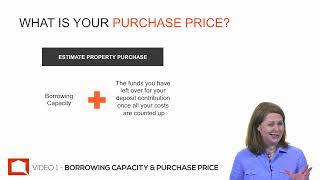
Learn how to figure out what property price you can actually afford by combining your borrowing capacity with available funds, then subtracting transaction costs like stamp duty and legal fees. A mortgage broker helps determine your lender's limits, and you'll want to budget an extra 10% for renovations.
Questions this video answers
Over 45% of the Australian population.
Less than 20% of the purchase price.
Estimate 10% of the purchase price.
Allow $750.
yourmortgage.com.au
Chapters
As we noted in module one, you need to work out your goal and property investing strategy to achieve your long term goals. In particular, we looked at specific renovation strategies. However, there is no point in having a grand plan without knowing how to execute it. This module is going to get more specific for you. Now you need to locate the area where we're going to start looking for the property, which will allow you to achieve your goals. But first things first. How much can you borrow? In order to work out where we can buy, you must first know how much you can borrow. We need to start with what you can afford, that is what funds you have to actually buy a property and what you have to actually pay for the property on an ongoing basis if you'd like the running costs, for instance. After all, there is no point in doing all of this work if you can't afford to keep the property, even if it's just through the renovation stage before you sell. This is where it's necessary to consult the first professional on your property team, the mortgage broker. They'll tell you what the lenders will lend you, how they'll assess you, and which lender policies are suited to your income and your investment situation. And that's important. Each lending institution will have their own criteria and this is why a professional can be so important, as it's their job to keep up and navigate with all the changes that come through almost daily in the mortgage lending market. I recommend you use a mortgage broker. Now, I don't just say this because I have a mortgage broking business, but over 45% of the Australian population uses a broker. And the reality is, if you're treating your property portfolio as a business, you want to work with professionals and concentrate on what you are good at, where your skills are and. And as we know, time is money, so leave it to the professionals and get on with finding the right property. Brokers work with lenders and their changing policies and this can happen daily because they're across this, they can quickly assess what works for you and specifically your investing strategy. Now, financing and renovation will be covered extensively in Module 5, Costings and Finance, but for now you need to work out firstly how much you have to contribute to the purchase and the subsequent renovation in terms of actual funds available. And then we work out what the purchase price is. So what is your purchase price? Look, in general, any purchase will be limited to one of two things, how much the lender thinks you can borrow and how much you have to contribute. For most, you'll be limited by one of These things. That is if you have a huge deposit but the banks won't lend you any money or your income is such that the lenders are happy to lend you money but you don't have the funds to contribute to actually purchase the property. That is the minimum funds, the deposit, stamp duty and costs associated with the purchase. So work with your mortgage broker to determine what your borrowing capacity is so we can concentrate on the second, the specific costs that you'll incur to determine the estimated property purchase price. Now, the estimated property purchase is your borrowing capacity plus the funds that you have left over for your deposit contribution once all your costs are counted up. Confusing a little bit, isn't it? Let's have a look at that. The difficulty is that the first three costs that you'll need to calculate are are actually based on the end property purchase. Yes, the one we're trying to work towards. So we have to start with an estimate of the property purchase so we can estimate the costs. At the end, we just refine those costs a little bit. So let's work through this together. Step one, I want you to write down what you can borrow. Now, this is based on your income and your current debt. Get your broker involved now, or use an online borrowing capacity calculator or use this really handy calculator that I have for you in the bonus section. So let's move on to step two. Now I want you to write down what funds you have available. This could be from savings or equity in a current property. If you don't understand what the equity comment means, just write down your savings or skip ahead to module five to learn about that. Now, now we're up to step three. I just want you to add these up. This is definitely going to be higher than what you can afford as a purchase price, but it allows you to be conservative in estimating your costs and above all gives you a starting point. So now it's time to start to deduct all the associated costs. So let's look at the costing calculations. Firstly, use the different state and territory calculators provided to work out the following. The stamp duty on the land transfer associated with this purchase. Then look at the stamp duty associated with the mortgage. Now, technically this is zero, but some lenders will still charge it and then refund you after settlement, only because their systems don't seem to have caught up with the legislation yet. Then there's legal fees. You need to decide whether you will use a conveyancer or a solicitor. Then there's disbursements. This can be a bit of an unknown until you've found your property, but you should find out what council rates are applicable in the areas you're considering and when they're due. For strata fees, you can look at a few units for sale and compare these fees. Once you've done this, you'll then be able to look at how many months into the rate period you are and use that balance as a guide to what fees you might be up for Water and sewerage rates are usually paid quarterly and will be a small smaller cost, so leave those out for now. The mortgage transfer fee and land transfer registration fee Any lenders application fees if you choose to pay LMI and not put it on the loan, then include this cost. You may choose to do this as some lenders charge higher interest rates. When you capitalise the mortgage insurance, that is put it on top of the loan and then there's your renovation or improvement costs. Lets estimate 10% of the purchase price. If you are planning a renovation that is cosmetic then there are incidentals such as strata searches, pest and building reports. Renovation or building reports. You might allow $750. Then we need to add all of these together to get your total costs of purchase. Now take the funds available, less these total costs and you end up with the funds available for your deposit. The funds available for your deposit plus your borrowing capacity is your purchase price. Now we refined the purchase price that we came up with in step one. Now that we have the purchase price to work with, here is a calculator that's targeted towards people buying their own home. However, it's also a good guide for investors to use. You can check this out@yourmortgage.com au and it gives you some costs associated with with the purchase. Now for a critical step determining whether you need lenders, mortgage insurance or lmi. You will need to factor this into your calculations. What you need to know about LMI is that if you have less than a 20% deposit that is 20% of the purchase price, then the lender will take out insurance to protect them in case you default. Now based on their years of statistical data they see that there is not a huge risk that the property market will drop more than 20% and leave them exposed with your loan being higher than your property value and then you decide to default on your repayments. Hence they take out insurance. If you have less than 20% of the money to contribute and they charge you a once off fee to protect them, yes you pay their insurance premium if you do default and the property is sold for below the mortgage payment. The mortgage insurance provider compensates the lender and passes on your debt. They can chase you for this debt. So let's continue. Now take your borrowing limit and divide it by the property value. This is called the loan to value ratio, the LVR. If it is greater than 80%, you will need to factor LMI into your calculations. Now depending on the lender, they may have to use the lender mortgage insurers provider's calculator, which is usually a lot more conservative than their own and it's going to give you a lower borrowing capacity. This is going to throw out all your calculations. If you need lmi, it's a good idea that you work with your mortgage broker who will help you determine which lender is going to serv your circumstances. So we've looked at a lot of costings here and basically what we've determined is what your purchase price is, but we don't really know what that looks like as a property. So that's what we're going to go to next. There's a lot of research coming up, so don't be worried. I'm going to take you through it step by step and in actual fact, there's tutorials for all of it in the bonus section so you won't be left behind. So let's translate that property price into a property for you.