Unit 3 AOS3 Economics - Lesson 3 Net Foreign Debt Terms of Trade
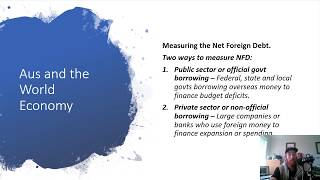
Australia's net foreign debt measures what the country owes abroad versus what foreigners own here. The terms of trade ratio of export to import prices shifts with demand and exchange rates, directly affecting the current account, aggregate demand, and living standards.
Questions this video answers
Over $1 trillion (speaker's statement).
Speaker referred to 95.4 (earlier) and 95.2 (more recent) and noted ToT above 100 is favorable, below 100 is unfavorable.
Chapters
All right. Hello, hello everyone and welcome to the third video in our five video series about Australia and the World economy. Unit three Area Study three. So far we've looked at what international transactions are and how they impact on living standards. Then we've looked at the balance of payments and the current account and the sub accounts make that up. So we looked at the current account with net goods, net services, net primary incomes and net secondary incomes. And then we looked at the capital account and the financial account and what makes up those. Today we're going to be looking at net foreign debt and the terms of trade. So where that shows up in the key knowledge is the composition and cause of net foreign debt and net foreign equities, terms of trade, the meaning and measurement and factors that may influence the terms of trade. And then we're going to briefly touch on the effects of movements and in the terms of trade on the current account balance, the domestic macroeconomic goals and living standards. But a lot of that will come up more in the practical application. So let's get to it. Alright, so first up we're going to talk about what net foreign debt is and then how we measure it. So first up, net foreign debt is the balance of all of the money we owe overseas countries against the money that overseas countries owe us. And there's two ways that we measure this overall. So we look at the public sector or official government borrowing. So we look at the federal, state and local governments borrowing overseas money to finance budget deficits. So whenever the government is financing a deficit, which means they are outlaying more than they're receiving, it means they have to get that money from somewhere and most often they get that money from overseas nations which is foreign borrowing which makes up our net foreign debt. Currently in Australia we owe over $1 trillion in net foreign debt. And so that is a large, large debt to owe. The interest repayments on that are mind boggling. But as far as first world nations go and having a net foreign debt, it's actually pretty low compared to if you look at America and a few other countries where they net foreign debt is so much higher than ours that it's terrifying. Then we've got private sector or non official borrowing, so large companies or banks using foreign money to finance expansion or spending. So a lot of the time like sometimes interest rates overseas are lower than interest rates in Australia. Like for example, there was a point where parts of the world had a negative cash rate. So there was a lot of borrowing happening from other countries where the interest rates were lower and For a long period of time, Australia had relatively higher interest rates than the rest of the world. So a lot of private businesses and private sector companies would use foreign borrowed money to finance their expansion. And these are the two ways in which we look at net foreign debt and how it is equated or added up. So then we also look at net foreign equity. So net foreign equity, so debt's all about the money that's owed. Equity is all about the balance of assets owned in Australia versus so assets owned in Australia by foreign entities versus assets Australians own overseas. And so net foreign net equity obligations stem from the foreign ownership of Australian assets, such as property and shares, minus the Australian ownership of foreign assets. So in simple terms, it's the difference between the value of Australian assets owned by foreigners and the value of foreign assets owned by Australians. This is an interesting one because part of the reason that for a long period of time, housing prices were skyrocketing in Australia was because of this whole foreign ownership of Australian assets. We had a big, big issue with Chinese investors buying a lot of land and property in Australia to which they actually introduce taxes to try and limit that, like acquisition of foreign equity in Australia. So there is a tax, which is a weird thing to say, but my favorite tax, because it is called the ghost tax, where if a foreign investor owns property in Australia and they do not occupy that property for at least six months of the year, they have to pay a higher rate of tax because that is property that could be owned by an Australian and used by an Australian and improved living standards. But because they're using that property for wealth purposes, and them owning that property means property is more scarce in Australia. It drives up property prices and makes living standards in Australia worse. So this is all about the balance of assets owned in Australia by foreigners versus the assets owned overseas by Australians. Then we look at the terms of trade. So the terms of trade is a tricky thing. For some reason, a lot of the time, students find it more complicated than it really is. It's something that is kind of tricky, but not tricky. Overall. I think the hardest thing about it is that it's a little bit. Although it is directly influenced by a lot of different things, knowing the actual measurement of it can be tricky for some people. So the terms of trade is all about a ratio of average prices received for Australian exports relative to the average price paid for our imports, and is measured using an index of export and import prices over a number of years. So when you look at the equation here, so if we were to draw A big circle around this equation. The biggest way that people struggle with this is they think it's export prices over import prices. And that's not actually the case. It's also not the value of our exports versus the value of our imports. It's kind of the value of our exports relative to the value of our imports. So our imports are exports appreciating in value compared to the amount we import. How many exports can we get for a given import? And so this becomes relatively important when we're looking at our aggregate demand because if we can buy more exports per unit of import, that's favorable because that means we're going to be getting more injections relative to leakages and greater levels of aggregate demand overall. Also when we look at things like our current account balance and the balance of payments, it means we are getting more credits into Australia and less debits going out. And so when we look at the terms of trade and all just about that relationship between the export price index to the import price index, which is all about how many exports we could get per given unit of import. So things that cause the terms of trade to change. So changes in levels of demand for imports or exports can be massive. So during the mining boom, our export price index was quite high and terms of trade was really significantly high because our exports were really valuable. So we could. Our exports per unit of import were really high because we're exporting more than we're importing. Our exports are really valued. Imports were quite cheap. The Australian dollar was high because of. That goes on to the next point. Whereas at the moment we are in a pandemic, our exports are becoming less valuable because people do not want them because they're not doing that much production in their country. And so in a pandemic it can, and it looks like it at the moment. Our terms of Trade was above 100 at the end of last year because our exports were valued higher than our imports. But now starting to fall, it was at 95.4 last time it was measured. Which means when it's below 100 it is unfavorable for aggregate demand. When it's above 100, that is favorable for aggregate demand. There are a few tricks that come up in multiple choice questions that we might get into in a future video where we might look at a similar technique about answering VCAR style multiple choice questions. But for now we'll just focus on that. So below 100 is bad for aggregate demand. Above 100 for the terms of trade, very favorable for aggregate demand. Other Things that affect it are changes to the exchange rate. So this one's a tricky one because when the exchange rate depreciates, there's a higher demand for our exports and that can often lead to our exports increasing in value. And so often when the exchange rate depreciates, we're also purchasing less imports. So when the exchange rate falls, it's often favorable for our terms of trade. When the exchange rate appreciates, it's unfavorable because the value of our exports falls because people do not want them anymore. We import a lot more and imports rise in value. And so if the exchange rate depreciates, that is favorable for the terms of trade and if it appreciates, it's unfavorable for the terms of trade. So then lastly, effects of changes of the terms of trade on living standards. So this little graph at the bottom here is the current terms of trade. It clearly points out that I was so close on my statistics before, but it's actually 95.2 more recently, not 95.4. As you can see in recent times, we just look at the trend. Our terms of trade was actually moving quite favorably to the start of this year. And then we started to get hints of pandemic and we were falling significantly. And I feel like we are going to keep falling in the short to medium term. In the long term we might be okay because we've avoided the extent of the pandemic that other countries have suffered, like China and America and a lot of the uk. We might actually come out of this pretty good. But at the moment I feel like our terms of trade is going to keep falling. So increases to our terms of trade is seen as great because more than 50% of our exports are commodities. And therefore an increase in the value of the terms of trade is a great demand side condition. If the terms of trade increases, that usually means there's more jobs in areas that export commodities, so mining, etc. And that's great for incomes and material living standards and therefore non material living standards. And more than 50% of our imports are manufactured capital, which means we get in a lot of our technology and machinery business from overseas, which is relatively inelastic in demand as it's not available in Australia. So that means that when import prices fall, it's greatly beneficial to our production costs and supply side. So when imports are cheaper, it's really good for us on the supply side because all the technology we need to produce efficiently is a lot cheaper from overseas and we can buy more of it. Because of that. So when we're looking at the terms of trade, because it is about a ratio, when the terms of trade improve, it's not always because exports are more valuable. Sometimes the terms of trade will improve and become higher than 100 because import prices have fallen, the value of imports has fallen and therefore the index is better overall. So when imports get cheaper, it's really favorable for Australia because of that imported capital that we use to produce. Alright, that is it for this video. We may do another one pretty soon because I think the application of terms of trade is where a lot of the problems come up. Hopefully you've understood it from what we've done so far. As always, if you have any questions about anything we've spoken about, leave a comment below or send me a message, start a chat, send me an email. Any way that I can help you. I'd love to be able to help you. The next video we look at is going to be all about. I've gone blank on what it's about. I'll tell you about that. You'll see when it pops up. But make sure you keep watching them, make sure you keep asking me questions and thank you for watching and I'll see you next time. Bye.
More from Let's


The Ultimate Guide To Renovation Course - Module 5: Self - Employed Low Doc Loans



Rob Flux Ambush - Convince me I should consider Property Developing as a strategy 3,2,1 GO!

The Ultimate Guide To Renovation Course - Module 4: Recognising a Property's Potential

YPS Club Mar 24: special Guest Peter Wargent describes how Australian properties are so resilient


The Ultimate Guide To Renovation Course - Module 5: Interest Only Lenders Exposure

