Unit 3 AOS3 Economics - Lesson 5 Trade Liberalization
A lesson on trade liberalization covering protectionist tools like tariffs and subsidies versus free trade, with Australian examples including the automotive industry's exit and Qantas ownership restrictions. The video explains how productivity and exchange rates affect competitiveness and evaluates impacts on jobs, prices, and efficiency.
Chapters
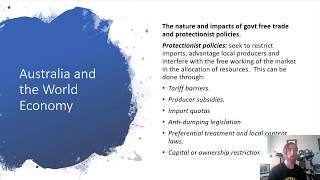
Hello. Hello, everyone, and welcome to what will be the last part of our PowerPoints about Australia and the world economy for Unit 3, Area Study 3. Today we're going to be looking at basically the move towards free trade protectionist policies and the advantages and disadvantages of them. It's actually, when we've talked about this in past years, it's been interesting because it's been all about why free trade is the best thing that every country should be doing and every country should be moving towards, and the whole world is moving towards it. But this year it's kind of interesting because there's far more of a pushback towards having less free trade and being more of a protectionist kind of nation because of all the things happening around the pandemic. So we're going to look through this, talk through that. There's a lot, a little bit extra with it now that could end up coming up later on in the year in the far CPA exam. But who can really predict that VCAR is going to do what VCAR is going to do? So let's start off with what we're looking at in the key knowledge. So factors that may influence Australia's international competitiveness, including productivity, production costs, availability of natural resources, exchange rates, relative rates of inflation and the effect of these factors on domestic macroeconomic goals and living standards. So with that key knowledge, all it's really talking about is how various things within Australia affects how well we're able to compete with overseas competitors, which for the most part, other than the availability of natural resources, which we're still doing good with, for the rest, we kind of struggle a little bit, especially with production costs and productivity, and we look at the effect. Mainly what we're going to look at is the effect of trade liberalisation on Australia's international competitiveness, domestic macroeconomic goals and living standards. So let's get straight into this. So the nature and impacts of free trade and protectionist policies. So there's a lot of discussion happening at the moment in the media about protectionist policies, which is policies that seek to restrict imports, advantage local producers and interfere with the free working of the market in the allocation of resources. And this can be done through a few different things. So tariff barriers, that's all about taxes on trade. If you've ever seen anything with Jerry Harvey from Harvey Norman, he loves to talk about these, always wanting to have. He's been the one that's been pushing for GST on imports, which now occurs on certain imports over a certain value. But he's been A big arguer for a long period of time about the fact that cheap imports hurt his business in Australia. Which is kind of ironic because in my personal opinion, Harvey Nelman's very expensive for what they are. And if they wanted to be competitive, they've probably got enough leeway to cut prices and be more efficient and productive in some ways to be more competitive with countries overseas. But their solution, or Gerry Harvey's solution is to try and tax imports so people won't want to buy imports and then they'll come buy his more expensive goods and services which will make more profit for him and make him richer than he currently is. Below that, we've got producer subsidies. So there's been a big push for this in recent years through car manufacturing. As you hopefully know, the automotive industry in Australia no longer really exists. We used to have Toyota producing in Australia. We had the Ford and Holden manufacturing plants. And all of them now have either moved offshore or do not exist. For example, like they're not making Holden cars at the end, from the end of this year, which is a big, big change. And with the automotive industry, they spent a long time trying to negotiate with the government to try and get subsidies so they could continue producing in Australia. The main issue with this being in automotive. Other countries were producing such high quality cars at so much cheaper of a rate and so much they had so lower production costs that it wasn't really worth bailing out the automotive industries in Australia. So they ended up closing down or moving offshore. But by providing subsidies to producers, they can continue producing in that country and it keeps their cost of production down so they're profitable enough and they're able to continue producing and being more competitive, keeping prices lower in that way. Another thing is import quotas. So this is. Some countries limit this certain amount that you can import of certain goods or services into a country. It could be a dollar value or an actual amount. This just means that it keeps local businesses being able to compete because they are still going to get a certain amount of business. Anti dumping legislation. There was an example of this from many, many years ago where part of the reason this came into play was there were issues with countries that just have too much of a certain good or service would just dump them all into a foreign market at a ridiculously low price and it would destroy local businesses there. I believe the example was like Italian tinned tomatoes. And they put them into a foreign market charging a ludicrously low price. And of course consumers are going to buy the one at the low price and then it damages local producers and local business because people aren't going to buy the more expensive ones that can't compete with that because they were selling the tinned tomatoes at a price below the cost price of our local producers. And therefore it's just impossible to compete with and it's going to put businesses out of business and that hurts local businesses. In Australia, other protectionist policies are things like preferential treatment and local content laws. One example that I used to really like with this is that. And it doesn't seem to exist as much now, but it was really interesting. I spent a lot of time in my late teens, in my 20s, either working or going to a lot of different gigs, music things. And then there used to be a law that if an international act toured in Australia, there had to be at least one Australian artist on the lineup. And that's kind of a protect. That is a protectionist policy. What it's meaning is it gets exposure to those local acts who are going to be hopefully performing long term in Australia, paying taxes, etc in Australia and doing really well for the Australian economy. And so that meant that no matter what, if you're going to a concert, the support acts were going to at least one of them be from Australia. And therefore that would, that's kind of protecting Australian talent in that way. We also have capital or ownership restrictions, meaning that in some cases only a certain percentage of a company or a certain percentage of certain things can be owned by foreign owners. So one key example of this is Qantas. It's actually federal law that Qantas can only sell 49% of their ownership to overseas countries. 51% must be maintained as Australian only, which keeps the business like focused in Australia, keeps a lot of the profits in Australia and it means in the long term they're going to be protected in Australia. So all these protectionist policies, they exist to protect local businesses so they don't go out of business if they can't compete with overseas countries. And the push towards them now is that as we're going into this pandemic, there's a lot of worry about the fact that we have run out of a lot of goods and services from overseas and it's hard to source them at the moment. And if we made everything in Australia that wouldn't be an issue because we'd have them all, we'd have access to them all. And by putting in more protectionist policies after the pandemic, we will be self sustaining in the long term. The downside of this is that the main reason we get things from overseas is they have a competitive advantage. They have economies of scale. They are just way more efficient at producing that good or service. So, of course you're going to buy it from them because we can focus on areas we have a competitive advantage in. And you can actually waste a lot of resources and not have an efficient allocation of resources. Like, we'll lose that technical efficiency, potentially losing out in allocative efficiency as well, because we won't have the. Well, they're trying to achieve allocative efficiency, but the prices might end up being higher. It's a tough one, but you definitely lose that technical efficiency that you would have by getting these cheaper imports, by using protectionist policies. So the nature and impacts of government free trade and protectionist policies. So these policies and other forms of trade protection have used to focus on four main advantages. So one good thing for protectionist policies is to protect and help infant industries. So young businesses. Preventing big businesses that exist overseas from just destroying them instantly means they've got time to develop a client base and grow and hopefully become a strong performer for defense reasons. So if war breaks out, the first thing to happen is trade windows just close and trade channels close. And so this means that if a global war was to ever break out, would have everything we need in Australia to improve economic stability. So kind of on the next point as well, of maintaining jobs, ironically, Donald Trump was a big proponent of this, of bringing car manufacturing back into America. It looks really good from a government's point of view to create jobs in a country. And if we are producing a larger variety of goods and services, there are going to be more jobs in the country and they're going to remain even if things change overseas, because we're going to need those goods and services in Australia. So lastly, to talk about free trade. So free trade is when there are no restrictions in place that alter the international flow or movement of goods, services and capital between countries. So making sure there's no taxes, no tariffs on trade with you and another country. Australia has free trade agreements with a lot of other countries, which is really positive because it means, for the most part, because we use so many imports as part of our inputs in production, it lowers our cost of production a whole lot compared to the loss of not being as competitive. So advantages can be greater efficiency, greater economic growth and incomes, because suddenly we're going to sell a lot more exports as well. Increased international trade, which is good for our exports, can be bad for imports when we look at our Current account and aggregate demand with the leakages, etc. Can lead to more jobs in employment and can also lead to lower inflation, which is. And more choice for consumers, which is really great too. There's just things like little examples where in Australia, because we're a smaller market, if you look at like for example for me buying runners, sometimes it's a very like minor thing. The more choice comes into account when you look into an overseas market, like you look at the USA or America where you want to buy a pair of runners and there's like 20 different color options available, whereas in Australia there's only three. And that more choice makes a big difference if you're wanting to like feel good about your purchase. Lower inflation as well, because part of the effects on aggregate demand partly effects on. So less demand inflation and also less cost inflation because cheaper imports means that we can produce at a cheaper rate which is going to keep inflation down by having free trade. If we don't have freer trade, costs are going to go up, therefore prices are going to go up and there's going to be more inflation. So free trade tends to be usually looked at as being a very positive thing because it can bring prices down overall, create more jobs, does create more structural unemployment through business closures that can't compete with overseas countries, but also more economic growth. So free trade tends to be very beneficial to our three domestic macroeconomic goals. So lower prices because of cheaper imports and more competition, making us more efficient. And lower prices, more economic growth because we are exporting more, therefore we can produce more overall and more jobs because there is more demand for our goods and services, there is more employment available and therefore we are more able to achieve that goal of full employment. Alright, so this is a pretty short one. Overall it's a relatively simple thing. Protectionist policies are just tariffs, taxes and other protections put in place to protect local Australian businesses so that overseas competitors do not destroy them. And free trade, kind of the opposite. We remove all of those protections so that trade can happen without any barriers which can. And they both have advantages and disadvantages. One of the key things you need to know when talking about these is it's like kind of a discuss, evaluate type question. Like evaluate the benefits of free trade or evaluate the benefits of protectionist policies. You need to be able to talk about the good and bad or strengths and weaknesses, advantages, disadvantages of both of them and come to some kind of well, logic conclusion about whether they should be in place or not. If you can do that, you will no doubt do very, very well. So thank you for watching. Thank you for making it all the way to the end. If you have any questions at all, leave me a message, send me an email, etc. This is if you've met to this point, this is the end of Unit three of Ekin.
More from Let's


The Ultimate Guide To Renovation Course - Module 5: Self - Employed Low Doc Loans



Rob Flux Ambush - Convince me I should consider Property Developing as a strategy 3,2,1 GO!

The Ultimate Guide To Renovation Course - Module 4: Recognising a Property's Potential

YPS Club Mar 24: special Guest Peter Wargent describes how Australian properties are so resilient


The Ultimate Guide To Renovation Course - Module 5: Interest Only Lenders Exposure

