$77M Raised to Build Gen AI Apps Faster and More Efficient | The SaaS CFO | Fireworks AI
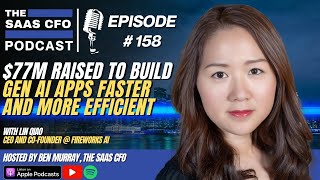
In this interview, SaaS CFO host welcomes Lin Qiao, CEO and co‑founder of Fireworks.ai, to discuss his background, the company’s mission, product stack, market focus, technical and business challenges, go‑to‑market strategy, fundraising history, and future plans. Lin describes his PhD research in distributed systems, his work at IBM Research and Meta, and how that experience shaped Fireworks.ai’s three‑layer architecture: a high‑performance inference engine built on PyTorch expertise, an adaptation engine for model fine‑tuning, and a "Compound AI" assembly‑line that lets developers and enterprises compose AI building blocks like car components. He explains the target customers—startups, digital‑native firms, and traditional enterprises—highlighting use cases from consumer‑facing apps to internal workflow automation, and stresses the importance of latency, GPU cost, and scalability for GenAI applications. The company, founded in October 2022 in Redwood City, now has ~30 staff, double‑digit ARR, and notable customers such as DoorDash, Uber, and Upwork. Fireworks.ai has raised $77 million total ($25 M Series A in 2022, $52 M Series B in 2024) to expand hardware partnerships (NVIDIA, AMD), data partnerships (MongoDB, Databricks), enhance the Compound AI system, and grow the team. Lin shares the key metrics he tracks—developer engagement on the self‑serve platform and enterprise customer growth/impact—and teases upcoming product releases in the Compound AI space. The interview concludes with a call to action to visit fireworks.ai for models, APIs, and enterprise solutions.
Chapters
Greetings everyone. I'm excited to welcome Lin Qiao, CEO and co-founder at Fireworks.ai. Lin, welcome to the show.
Thanks for having me.
Hey, great to have you here. Let's dive right in. Tell us a little bit about your background.
I started my career as a researcher after I got my PhD in distributed systems and database management systems. And as a researcher, I started to work on the new state of art in like very early stage of the big data, data processing ideas. And, and the research idea got published in the top-tier conference, but also at the same time became 3 IBM products. I was working at IBM Research Lab, and that makes me super interesting because this kind of path is very interesting because it's not just a research project, becomes a real impact to the world. So I, I was working as a software engineer for many years and I find I really enjoy being a software engineer. That's why I moved to, later I moved to Facebook, now Meta, to, to drive the direct impact in the consumer-facing part.
Okay. Yeah, that's exciting. Yeah. Turning your research and ideas into, into products at a large global company like IBM and then on Facebook. So appreciate that intro. So let's talk a little bit about Fireworks AI. Tell us the products and their services that Fireworks AI offers.
Yeah, in general, at Fireworks AI, our, our mission is to bring years of experience from working with thousands of, uh, engineers, infrastructure engineers and machine learning engineers to build this infrastructure into the industry where the application developers and product engineers, they can onboard and drive their most innovative idea building on top of GenAI technology. Not in 5 years, but in 5 days without an army of thousands of machine learning and infrastructure engineers they have to recruit and hire. So that's our mission. And the product specifically have multiple layers. The bottom layers, and when I talk about those layers, maybe we can, we can draw analogy to building a car, assembly line of building a car. Any car need to have an engine. Same. We have a very fast inference engine, but inference just means you ask a question, we give the answer. And this inference engine is built based on our years of experience working, building PyTorch, which is a leading AI framework in the industry, dominating models, current new, new models in the industry. We have been building and deploying PyTorch models at Meta. For 5 years, we are really good at operating with extremely high performance and cost efficiency. So that's what we do. So we started there by building this engine first, very fast and cost efficient, but just have an engine like a car, just have an engine doesn't bring you from A to B. You need to have the, let the driver come in, right? And then you need to build interface that driver can operate. And a lot of time you also want to customize. Not everyone has the same height and same, you know, other things you have to justify. So we have an adaptation engine where we let enterprises or developers come in and adapt the quality, the quality of the models towards their needs. And they can customize and specialize the quality using our SaaS platform. And then like any car, you have a lot of parts. It's not just one engine is the only part. You have many parts. You have the wheel, you have driving wheel, you have the tire, you have the brake. You have to piece these together to be able to drive, to be able to drive at various different speed. At the same time, you also want to protect the driver or passenger when going in. So a lot of stuff need to come together to solve a complex problem. So similarly, in the AI space, a lot of business tasks are complex tasks. So we also offer a compound AI system. The goal here is kind of help you build the assembly line to put all these building blocks and parts and pieces together. And, but provide a super simple interface for you to use. And then, and then you can, you can build your own car. You can build your own car from this assembly line. You can build your own application. You can build your own product from various different building blocks of GenAI technology and to disrupt, to innovate. So that's kind of the high-level description of our product. I'm just kind of interested in hearing your thoughts and any other areas I can dive into deeper.
Yeah. So building this, say, GenAI car that they can build. And I like the car analogy, engine and building that car. And then who tells, like, who are you after? What kind of industries? I assume like tech, but who is, what kind of industries are using this product?
That's a very interesting question, right? Because in my mind, I have my hypothesis when I just started this company. My hypothesis is this is yet another new technology-driven industry transformation, and we have been through those kind of waves before. Uh, for example, cloud-first transition, right? Going from on-prem or mainframe only into how flexible infrastructure on the cloud is very flexible, um, and economical. So that's a massive movement, a lot of business opportunity got created to mobile first. We used to kind of glue to our desktops, workstation to do things. Now we can use apps everywhere through our mobile phone, and that's a huge change. And, and through that wave, a lot of innovative product got created like Instagram and Uber. DoorDash, so many of them. So this is yet another technology-driven industry transformation wave, and this wave probably will be even bigger in terms of the impact because we have never seen a technology that can emulate what human can do or even beat what human can do in generating all kind of contents. All the way from writing the essay to images, describing what you want to, image you want to create, you create image, describe what kind of video you want to create, create a video, like emulate the avatar, like simulate, you cannot tell the difference whether it's real or it's actually generated, to generate code, right? Because software engineer has been kind of the high end of complex work, but it can be automated a lot more these days. To automate business workflow, to make your business operation much more efficient, to automate away very expensive lawyers' fee and kind of because there are mundane processes that humans shouldn't even do. And also to automate many things like address the severe shortage of nurses and doctors in the task force and you can get support from medical assistants. So there's so much innovation that's happening right now, and we are working with digital native enterprise and traditional enterprise all at the same time. So that breaks my original assumption is I'm gonna work with startups first because they're the most brave embracing the newest technology to digital native, that tech forward to, uh, traditional enterprise. They Typically they want to make sure, hey, this is really solid, it can really work to solve that problem. But now it's all happening. We're working with all the companies from startups who are creating brand new product experience that never exist before to digital native company. They are using GenAI to revamp their product experience to traditional enterprise. They are using GenAI to significantly improve productivity within their companies.
Yeah, and that's interesting. And to pause there because, you know, it sounds like both, like, say startups, I'm building an application, I need some GenAI in my app, or maybe it's gonna be a GenAI app. Also say I could see a large global consulting company who wanna improve their internal workflows. So maybe not customer-facing, but in the end it kind of does because it helps their processes. So it sounds like both internal and external.
That's right. Absolutely.
Okay.
Okay. But fundamental reason, like this generative technology, there's one thing that's gonna shift massively is the B2C and the B2 developer market, right? Because at the end, it's kind of making the content much more high quality, much more efficient. And much more interesting. So that's why B2C, that's why B2 developer. And because of those, this, the innovation space that's going to happen, it kind of impose very unique challenges before and after GenAI, right? From application product development point of view, the unique challenge is, I mean, as an app developer, I don't care. Like I just want to give the best experience, right, to the end user. And the one thing I want to make sure is it's highly interactive because my customer, I don't know if you notice, like I think now we are less and less patient. We just cannot wait for more than 1 second. If there's nothing come back, there's something wrong with this app. So, so we're kind of going into a high velocity of interactiveness and that's kind of more engaging. So latency is very important. And, and this is, but it's very hard because now with GenAI, you can generate very interesting experience, but the latency is very high because the model is much bigger, right? This new technology also have to run, it's kind of on the highest end of the model size. So that's very challenging. The second challenge is that doesn't exist before is before, uh, application products are built on top of CPU. CPU is heavily commoditized. And so when you scale, you find a product-market fit, you scale, you can scale quickly without worrying too much about cost because CPU is so, so cheap. But if you build on top of generative AI, it's interesting. The cost, your cost structure completely changed. Generative AI model has to run on GPU, especially the large ones. And GPU is very expensive. GPU is power hungry. Power is expensive. Power requires cooling. Generate heat, so that requires cooling. Cooling is expensive. So all the whole entire infrastructure operating GenAI inference is very expensive. And, and that just means, hey, from your business operation, cost eating into a lot. If you're not careful at small scale, you're losing money and you actually hit a product-market fit. You, you can scale quickly and then you basically bankrupt quickly. So that created a very interesting dynamics that didn't exist before. And cost efficiency is on top of every single app developer's mind when they have a viable business, right? So what we are trying to do is, coming back to analogy, right? So we are building this engine that is the fastest and most cost efficient because this engine is kind of very expensive part of this car. So we want to take care of that first. But at the same time, we also want to simplify the app developers like go-to-market, right? So accelerate go-to-market. So that's why we're building the assembly line for them to build their own car so they can move really fast. Not just providing engine, we're providing the assembly line.
Yeah, no, that's really interesting. You definitely caught my ear as a CFO with, you know, scaling these apps with GenAI and just the infrastructure needed and the resources. And then that can get very expensive if you're not careful. Even just, you know, sometimes with traditional apps, you find your hosting bills this really large. So really interesting. So let's talk some stats and figures here. So what year did you found your company?
Oh, we founded October 2022.
Okay.
Almost, almost 2 years.
Almost 2 years. So October 2022. And do you have a headquarters location or are you virtual?
We, our headquarters is in Redwood City.
Okay. And then what's your current team size?
We about 30 people.
30 people. All right. And then anything you want to share around revenue ranges, ARR ranges?
I will say we are double digit.
Double digit, double digit ARR.
Double digit annual revenue.
Yeah. Okay, great, great. That's great. And then tell us, you know, so you're targeting, you know, startups, digital native enterprises, traditional enterprises. And then tell us a little bit about your go-to-market motion here. I mean, how are you finding these people and who are you reaching out to? Who are you prospecting to, to try to land a customer?
So, as I said, the market is moving really fast in this space from the application development and product development across the board, across startups, digital native and traditional. And we have been talking about our product, our focus, our value add to our customers. So we get a lot of inbound so far. Our go-to-market is heavily extracted from inbound, and I'm super interested in speaking to your audience here to let them make sure they are aware of what Fireworks can help them accelerate their GenAI strategy and execution. So, so right now, as you can see from our website, we have landed many customers all the way from rising, rising stars of the startups to very great brand of digital native companies, including DoorDash, Uber, Upwork, to traditional enterprise from health, health insurance to healthcare to insurance companies to other finance institutions. So yeah, so that's a very interesting market right now. And then we'll, we'll be super fast to help many different companies across the board to to execute and bring business values out of GenAI tech.
Yeah, and I saw a lot of brand names on your landing page, which is really cool. And then let's switch to the fundraising side. Looks like you've raised a decent amount of capital. How much capital have you raised to date?
I've raised a total of $77 million.
Okay. And that looks like you had a, what, a Series A of $25 million and the Series B of $52 million.
Right.
Okay. And those were at least what I saw as far as the dates were both this year. When did you raise the Series A?
Oh, we raised Series A in 2022 when we started.
Okay. Okay. All right. So Series A right from the start in 2022, and then the Series B was this year?
Series B was this year. We just finished.
Okay. All right. Series B in 2024. So really interesting. A lot of capital at play. And tell us with that Series B raise, you know, what, what's the difference, you know, in your journey from Series A to Series B? You know, what led you to that Series B or, or what did you see milestones, triggers that said we're ready for that next round of capital?
Right. So I think Series A is mostly used for finding a product-market fit with high confidence. Um, and, uh, and that's kind of the main purpose. And then Series B, we are going to use the funding in the following way. One is significantly expand the engine, the kind of quality of the engine by building it on top of various different hardware, right? So I think interestingly, both NVIDIA and AMD are investors in Series B. and we are working with both of them to enable the best and newest hardware on their offerings. And we are also using Series B to expand the partnership with key data providers. MongoDB is also one of the investors, and Databricks is our Series A investor, and, and so on. So I think generative AI, like overall the AI world is powered by data actually. And the close partnership with the data provider is critical when to solve a complex enterprise problem. The second critical part is we are using that funding to significantly expand our product offering in the Compound AI system. Remember, the Compound AI system is to build the assembly line, right? So, and automate the application, like automate as much as possible and simplify the application development on top of the individual models I just mentioned. So, so that is a big product direction we're pushing on. And, and that funding will be used for that. And the third part is, of course, as we're growing our business, we need to grow the team all the way from engineers to researchers to the go-to-market team and so on. Especially we're very customer obsessed. So we want to grow the team to support and help our customer to be more successful. We, I firmly believe only if our customer successful, we will be successful. So yeah, so that's how we're going to deploy and use the funds.
And what were, how are the conversations different at a Series B raise with those investors versus Series A? You know, what, how is that different than, than when you went through the Series A?
I think our series, both fundraising were pretty fast for us because of the credibility of this team that they both leading investor knew us from before, our track record and our team's caliber and the deliverables we have before we started this company and also the, you know, the impact we have made. in current company. So, so because of that, it has been pretty smooth for us, the whole entire process.
And, and for those Series A founders out there listening right now who are thinking about that next raise, that Series B, any lessons or, or thoughts that you can pass along to them as they're considering that, that B round that may come up?
So I think my, I, I don't have much advice to share. It's just the way I think about it is actually not think about it. I was only focused on business metrics and product market fit, and that's my only goal. I think in my mind, if I take care of those, the rest will follow.
Perfect. I love that because it's a great transition to my next question. You know, at this stage of your company, you raised a lot of capital. Do you have a favorite number, numbers or metrics that you're focused on to guide the business?
I have two metrics for like each represent one part of the product. So our product is multi, multi-folds. One product is developer-facing self-serve. The other product is enterprise-facing with all the enterprise features. Um, so while we're driving, usually these two motions won't happen at the same time. I have seen many companies. Start one, then start to transition to another, or, or the other way. But we have to do both at the same time because this market is moving really fast. And we see a lot of common shared features and requirements across two, two sides. And, and as a matter of fact, when, when it comes to enterprise, a lot of, a lot of engagement is happening with the developers in the enterprise. So that's amazing. It's amazing market, amazing time. We want to make sure we build this platform not just for one side, but for both. So that's why I really care about developer engagement, their satisfaction, and their, just, just their activities happening on our platform. And on the enterprise side, it's the company shares is also their happiness. Are they growing? Are we helping them grow? Helping them land big impact, but also kind of how many enterprises are we kind of, how fast we are moving to onboard them and, and yeah, and, and drive the impact with them together.
Yeah, but I appreciate that, that insight. So Lin, as we wrap up here, what's coming up next for Fireworks AI?
I think what's coming up next, you will hear from us, we'll talk a lot more about our product offering in the compound AI system space. That is the assembly line we built for all of you. To accelerate your own application development and product development, whether you're a startup pushing extremely innovative ideas or you are a developer inside an enterprise or you're an executive inside the enterprise to make massive changes built on top of GenAI. I think that's where we want to work with you to make you very successful in this journey. So stay tuned for product releases and launches coming up soon.
Yeah, we'll definitely stay tuned. So Lin, really appreciate your insight, sharing your journey so far. If listeners would like to learn more about Fireworks AI, where should we send them online?
The best way to go easy, go, please go to fireworks.ai. You hit our landing page. For developers, please continue to go into /models where you can play with our models. We have a playground built for you, and we also releasing a lot more self-serve features there. You can directly use our API to do inference, to fine-tune, customize, deploy your new, your own models and so on. So we have various different deployment models. You can use our hosted inference API, or you can do on-demand, like you manage your own schedule when you're up, how many resources you want to use, or you can work with us to get to the best, best performance, scalability, reliability with our support and so on. For enterprises, we, you can also use our dedicated hosted API with enterprise support, but we can also deploy into your cloud for the best protection of your data, privacy, security, and so on.
All right. Well, appreciate that. So listeners, if you'd like to learn more, check out fireworks.ai. And Lin, really appreciate your time today and sharing your journey.
I'm, I really enjoy this conversation and look forward to get connected with all your audience here.
Sounds great. Thanks, Lin.
More from Lin









When Will Inference Feel Like Electricity? Lin Qiao, co-founder & CEO of Fireworks AI

