Webinar: Protecting What Matters: Estate & Property Planning for Immigrant Families
This YouTube webinar, hosted by immigration attorney Lorena Rivas, Esq. of Rivas y Asociados and featuring estate‑planning specialist Brittany Littleton of Littleton Legal, delivers practical, culturally‑sensitive guidance on protecting immigrant families’ assets and loved ones. The session opens with introductions and an invitation for live questions, then moves through a structured roadmap: (1) guardianship nomination for minor children, emphasizing short‑term vs. long‑term options, the role of citizenship, and the risks of leaving decisions to a judge; (2) durable financial and healthcare powers of attorney, highlighting their urgency for detained or incapacitated individuals and the fact that immigration status does not bar their creation; (3) wills versus trusts, probate risks, payable‑on‑death designations, and tax considerations for non‑citizens; (4) property‑ownership strategies, warning against simply adding names to deeds and presenting Transfer‑on‑Death deeds as a safer alternative; (5) an emergency‑planning checklist (organizing IDs, immigration papers, deeds, account information, and contact lists); (6) how to avoid notario fraud and verify attorney credentials; (7) common misconceptions about marriage, age, and who can serve as an agent; (8) handling assets located abroad and the need for parallel estate plans in multiple jurisdictions; and (9) the most critical first steps for families with no documents—durable POA, healthcare POA, HIPAA authorization, and an advanced directive. Throughout, Brittany stresses that legal fees are often lower than the cost of probate or guardianship, and that virtual appointments are available across Oklahoma and neighboring states. The webinar concludes with contact information for both firms and a reminder of attorney‑client privilege.
Chapters
Rivas y asociados, abogadas de inmigración, empoderando inmigrantes, construyendo futuros. Hello, welcome everyone. Thank you so much for joining us today. for our webinar with Brittany Littleton from Littleton Legal. I'm excited to introduce everyone to the space. I know that we'll have some folks trickling in, so feel free to check out some of the features on the bottom. If at any point throughout the presentation you have any questions, please throw them in the chat. There's also a Q&A feature. If there's— we have any Spanish speakers on the call that would like anything, you know, kind of translated while we're also going through the presentation, I can also support. So feel free to ask. I do want to thank Brittany so much for being with us today. She works in estate planning, which is something that at Rivas We get a lot of questions about, especially with what we're seeing right now in immigration with detention and deportation. People need a plan when, when something like this happens, and it's great to have somebody that can kind of give us that guidance and let us know what those options are. So I do want to introduce Brittany. She is the owner of Littleton Legal, which is a law firm helping Oklahoma families and business owners plan for the future. Her work focuses on estate planning, such as wills and trusts, and legal support for entrepreneurs and small business owners. Brittany has lived in Chile, Venezuela, and Argentina, and tries her best to speak Spanish conversationally. She is the former board president of the WYCA Tulsa, which provides free legal services to immigrant and refugees— refugee families. Her own family includes people who have gone through the immigration process firsthand and are still navigating it today. Brittany cares deeply about making legal planning clear and accessible, no matter where someone's journey started. And she believes that every family deserves a plan that protects what matters most— their loved ones, their businesses, and their future. She's always looking forward to sharing tools that you can use right away. And so I wanted to thank you, Brittany, so much for being with us today. I sincerely appreciate your time and all the great information that you're gonna share with us. Thank you. And so I also want to pass it over to you so that, you know, you can share your presentation. And again, just remind viewers, if at any moment you have a question, feel free to drop it in the chat or in the Q&A, and we'll be sure to answer it either towards the end or if it's a part of, you know, what we're currently Speaking on, we'll try to put it in into the conversation. So thank you so much, Brittany. How are you doing?
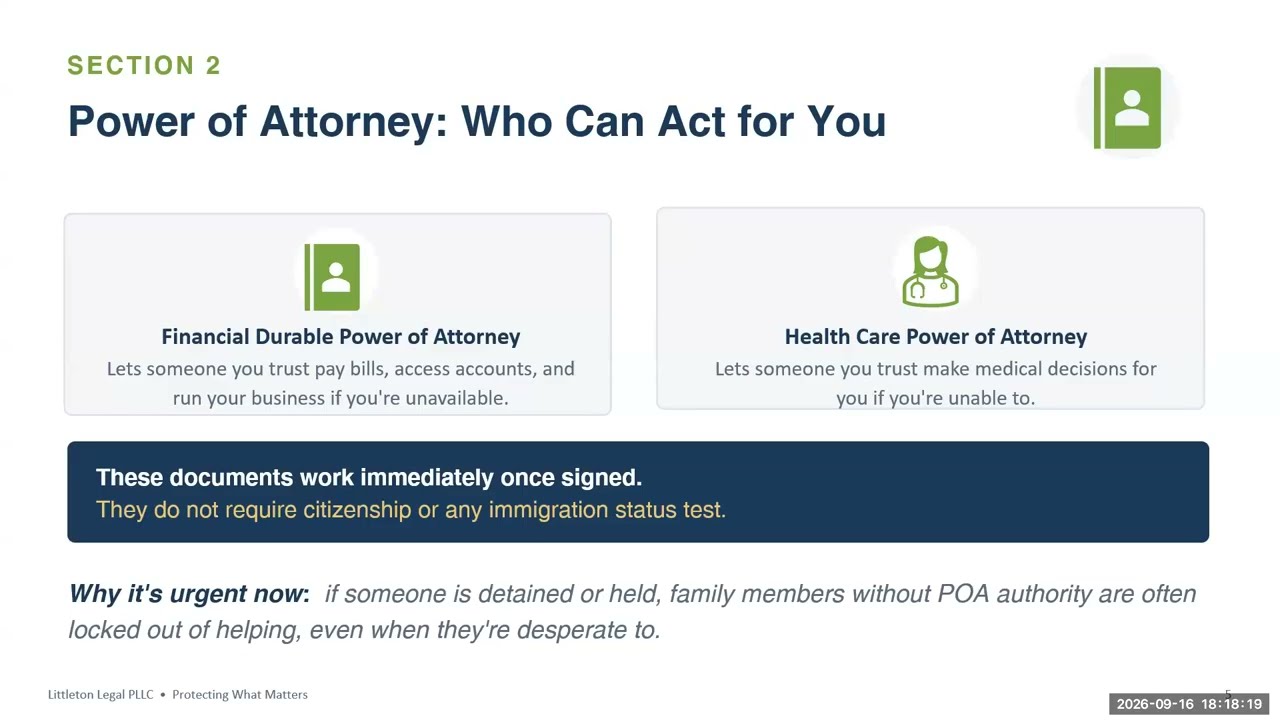
I'm doing great. Thank you so much for having me. I really appreciate you giving me the opportunity to speak to your, your friends and clients and colleagues. And this is an important topic to talk about, especially today and in the current climate. And I'm happy to get to be a part of the conversation. I'll go ahead and share my screen. I think once I do, it might be difficult for me to see the chat. So if you see any questions, please feel free to interrupt me with the question. So again, I just want to say thank you to Rivas and Associates and to everybody who's taking time out of your evening to talk to us. with us today about this. And a lot of people think that estate planning is only for wealthy families or only for citizens, and neither of those things are, are true. So my goal tonight is to make sure that everybody who's listening understands that no matter what happens to you, the people you love can be taken care of, and somebody that you trust can be in charge, and I want to help you understand the pathway to make that happen for your family. Let's see. So again, I'm Brittany Littleton. I own Littleton Legal. There might be people on this call who are from places other than Oklahoma. My practice is limited to Oklahoma, although I have attorneys on staff that can also help people in Texas, Arkansas, and Florida. But if you happen to need assistance on estate planning matters, Lorena is probably a good person to connect with for a referral. And we also have colleagues outside of the state of Oklahoma that we could direct you to as well. But I have been practicing for almost 20 years in estate planning and business law. I formed my my law firm over a decade ago, and my mission is to help families and businesses thrive. And one of the ways that we do this is by hopefully compassionately and, and definitely thoughtfully helping our clients navigate holistic planning decisions that provide peace of mind that loved ones will be taken care of, give individuals a sense of preparedness that they'll have some control And minimum inconvenience for their agents if there's ever an emergency, and that we're creatively using legal tools that preserve family relationships, pass on family values, and protect assets. And the— just to give you a little bit of a roadmap of what's coming tonight, many people worry about what happens— what would happen to their kids. their home or their business. And for families going through the immigration process, that worry is heightened because they're, they're adding to that the fear that somebody might be suddenly detained or deported, in addition to probably already worrying about what happens if, if somebody became incapacitated or passed away. So we're going to talk a little bit tonight about Guardianship, powers of attorney, wills, trusts, and property, adding family members to deeds, avoiding scams, and, and an emergency plan that you can put into place immediately. So estate planning is, is not really about being wealthy or planning to die. It's really about protecting the people that you love, no matter what happens. And again, if, if regardless of your immigration status, you have the right to decide who takes care of your children, who can act on your behalf, and who inherits what you've built. So while this can be things that sometimes feel people avoid thinking about, My goal is that you feel empowered by having information that gives you some control and some preparation so that you don't have to lead with fear in navigating this conversation. So first, I wanna think about if something happened to you and your spouse at the same time, or even if you're not married, if you're a single parent or raising children with a partner, but if you couldn't take care of your children Who, who would take care of them for you? And if you don't have an answer in writing, a judge who has never met your family is who will decide this. And so what, what we like to advise our clients to do is to nominate somebody who would be appointed as the legal guardian of their children if the parent was not able to act on their behalf. So this can be a separate legal document called a guardianship nominee. In Oklahoma, though, we typically name this person in the event of death. We might nominate them in our last will and testament, or in the, in the event of incapacity, we might nominate them, this person, in what's called a power of attorney. But either, either way that you do it, a guardianship nomination names your choice for who would raise your child if you couldn't act on, on your behalf. And judges rely on this pretty heavily in appointing who would be the person. This matters even more for mixed status families because if both parents became unavailable at the same time, a court would decide unless you have name somebody to nominate them. So in the absence of a family member who's local, or in the absence of clear direction, sometimes this is a stranger, and this is how children become placed in, in the foster care system. You can nominate a guardian for your children regardless of your immigration status. It's your right as a parent to do this. And you can make what's called a short-term guardian or a long-term guardian. So a short-term authorization can let a trusted person step in immediately in a crisis. For example, if a parent was detained, even before a court was to get involved. And a long-term would be for a more prolonged period. So sometimes who would make sense immediately, might not be who would be in the best interest over the child's long-term care. So ask yourself the question, if somebody, something happened to me and my child's other parent at the same time, who would raise my children? And just remember that without an answer in writing, a judge ultimately is the person who decides, and they may or may not pick And, and often would not pick the same person that you would pick because they, they don't know your choices. They don't know your family situations, and they, and they don't know what would be best for you. A few questions that I, I often receive when I am— when we're talking about this is if the guardian needs to be a citizen. And the answer to that is no, not necessarily. But a court does have to approve that person that you nominate, and the noncitizen's overall situation will be taken into account. So the judge will look at what's in the child's best interest. Are we moving somebody into a stable environment where their needs will be taken care of? And another question that I receive is if I can name somebody outside the United States. That's also a possibility, but it obviously adds some complexity, complexity to the situation. So that's definitely something you would want to discuss specifically with your attorney to talk through what the logistics of that would look like. And that's also a good example of when you would probably need somebody if your long-term solution was somebody outside of the country. You would probably want to have a short-term solution, even if it was a family friend of somebody within the country while those things are navigated. So the next thing to talk about are powers of attorney, and this is really legal tools that talk about who can act for you if you can't act on your own behalf. So imagine a situation where a spouse is held Even for a few days. Without a document like a power of attorney, the spouse's partner may not legally be able to do things like access a bank account, pay rent on their behalf, make a medical decision for a child. And powers of attorney are a very simple legal tool that you can have in place to solve for that problem. And there's 2 kinds of powers of attorney. There is a financial power of attorney, and that lets somebody you trust pay your bills, access your bank accounts, and even run a business if you can't act on your own behalf. They do things like file tax returns, navigate government benefits. They can deal with things like your utility companies or your cell phone bill. Basically all the day-to-day business things that you might do on your behalf, the person that you name in your financial durable power of attorney can make those decisions for you. And I, as I mentioned earlier, this is also the legal tool where, at least in the state of Oklahoma, we would nominate a guardian to take care of our minor children if we couldn't act on our own behalf during our incapacity. An incapacity could be You've had a medical crisis and you're, or you are aging and ailing and not able to act on your own behalf. But it could also be like legally, if you are detained, you could be considered incapacitated for these purposes because your, your action, your ability to act on your own behalf is limited. So the other type of power of attorney is a healthcare power of attorney. And this lets somebody make medical decisions if you can't act on your own behalf. So this can be everything from choosing which doctor cares for you, authorizing a medical procedure, maybe picking up medicine at the pharmacy, hiring and firing healthcare workers, or arranging for long-term care. And, and sometimes it's the exact same person who would make your financial decisions. Sometimes it's a different person. These can be 2 different skill sets. So especially if you are a single person or you are choosing who would act on your behalf among adult children, perhaps you might think about who has what specific skill set, because the person who's managing money and navigating finances on your behalf might be a different person than you would want to advocate for your healthcare or help make you comfortable at the end of, end of your life or during a medical crisis. And both of these documents are especially urgent right now. If somebody's detained or held, family members without a power of attorney don't have the authority to help regardless of how much they want to. And so this, this just helps, helps somebody else navigate the logistics of your day-to-day life on, on your behalf. And these documents go into effect immediately once you sign them. They're— my recommendation is always to have detailed ones where the powers reflect what you actually need and you understand. But typically there's a state statutory one that you can access for free online to at least have something to give you a minimum power of attorney. And they do not require citizenship or any sort of immigration status to have these in place. Everybody can have one. So the other thing I want to talk about are Wills and trust and property and who inherits what. So if you own your own home or your own business and you don't have a will, you're not the person who decides who inherits it. If you pass away, then your estate— and your estate is just all the things that you own, your money, your personal property, your clothes, your your business interests, your vehicles, your home. But that, that those things collectively are your estate. And your estate might be very small or it might be very large. And you, you can say who gets to receive your estate upon your death through a will, or sometimes a trust is a better fit for that. And those are 2 different legal tools Where you say, here's who gets what when I'm gone. If you don't have one, then the state where you live has a plan for you, and it's called the intestate statute. That means the law that applies if somebody dies without a will or trust who designates who gets what when they're gone. So the state has default rules Where they say, okay, the spouse gets this percentage, kids get this percentage, etc. And for most people, it doesn't reflect their expectations or their wishes. So a simple will that says, here's who I want to get my things when I'm gone, is the— is a real straightforward way to at least designate who receives your things. It doesn't always avoid court interference though in a probate proceeding. For many people, a trust-based estate plan is more appropriate. And this, this for tonight's purposes, we probably won't get into the difference between wills and trusts, but I just want you to know that, that those are 2 options. But, and I also just want you to make sure that you know That again, your immigration status is not a barrier to whether you can have a will or a trust. Generally speaking, noncitizens can own property with most of the same rights that a citizen can. They can also inherit property, and they can be named in a will or have a will themselves that says, here's who gets my things. This definitely is a more detailed conversation than we would want to have tonight, but I do want to just make a note that sometimes there's different tax consequences when you inherit for a noncitizen than a citizen. So, especially if you have significant assets, that's something you would definitely want to talk about with your estate planning attorney, because there's specific things that you would want to do to plan. To make sure that as much of your estate as possible goes to the people that you intended without paying taxes that you otherwise could legally avoid. But the bottom line is, if you own a home or a business and you don't have a plan, then the state has a formula for who gets your things when you're gone. And it's most likely not what you would want for your family. So think about if a will or a trust is something that, that makes sense for you to have in place. With your financial accounts, often you can avoid court interference by having what's called a payable-on-death beneficiary. Basically, in the paperwork that you fill out with the bank account or with a life insurance policy or retirement account, There's typically the option to name somebody who receives those things if you pass away. If you wind up doing a trust-based plan instead of a will-based plan, we often do something different just in case your payable-on-death beneficiary is not— does not survive you to receive the asset. Or if the person that you would want to receive the asset is needs to receive it in a protected way. Maybe they're a minor child, or maybe they're elderly, and, and then we usually would direct it to a Trust. But at a minimum, if you have bank accounts, you want to confirm that you have a payable-on-death beneficiary, and your account will go to whoever you name, even if you have a Will that says something different. So that is typically What— where you want to think about, does my will align with the account designations? And if it's different, is that actually my intention? And then make adjustments accordingly. But if you don't have the will, you don't have a trust, and you don't have payable-on-death beneficiaries, when you pass away, all of those things become a Part of your estate, and then they pass to your heirs through a process called probate. So speaking of, of kind of the probate process, so probate is the court process of supervising the administration of somebody's estate upon their passing, and most people want to avoid it. It's public, it's not private. It requires you to disclose the name and addresses of your family members in public records. And so people want to avoid it. It's expensive and time-consuming, but for, for many immigrant families, they have a very natural fear of being unnecessarily involved in court processes. And so one of the things that people often do as kind of a quick fix to circumvent the need for estate planning is they want— if they own a home, they want to add other family members to their deed. And adding a name to a deed is a quick, you know, almost free fix. But it— or at least it feels like that. So the instinct can be, be strong to, to add your kids or a friend or sibling to your home in case something happens to you. But please talk to an attorney before you change anything on your deed, because it— this is a plan that can often backfire. One, if you add somebody else to your deed, you've actually made a gift to them. Regardless of your intentions of an interest in your home. So, so you lose the ability to completely control who owns your home and when it can be sold. You can't sell it or refinance it or take out a loan without the other person agreeing. And then also their problems become your problem. So if they go through a divorce, if they're detained, if they become incapacitated, If they pass away, if, if they're sued and in a lawsuit, if they just have ordinary creditor problems and, and they have a lien against their assets, your home can be exposed to their liabilities. So regardless of your intention, even if you're naming somebody for convenience, legally this is a gift to that person. And so it's a not— it's not a good shortcut as a substitute for more thoughtful estate planning. Also, it can trigger gift tax reporting requirements. So it opens up the door for the government to say you're not complying with our laws, you're not paying taxes that were due, and that's not an argument that, that you want to invite. And it If, if you're adding your children thinking, well, that's who's going to receive it when I'm gone anyway, there are additional tax consequences even for citizens where your children who inherit that property and they get a what's called a step-up in basis, meaning they're going to pay less taxes when your house is sold because they received their interest at your death. If they received their interest through a gift during your lifetime, they're going to pay a much bigger tax bill when the house is sold. The other thing that happens is sometimes people say, okay, I'm going to put my oldest son on the deed or my daughter on the deed, who— she's the one who's here, she's taking care of me. And then when I'm gone, she's going to sell my things and divide it among everybody. But she might, but she also might not. Legally, she doesn't have to. And legally, when she does do that, it's not actually a gift from you. It's a gift from her. And maybe, maybe they want to do that, but they're prohibited from doing it. Maybe they're married and their spouse won't consent to it. Or maybe they have creditor problems and aren't able to transfer property without there being consequences of that. So, so it's just, it's just rarely a good substitute. Often though, people say, well, I can't afford a will or a trust, and so I'd rather do that than risk doing nothing. And, and for, for that person, what is a good Band-Aid solution in between? is what we call a Transfer on Death deed. And that is a document that's found in the— filed in the county records. And most states have this option available to them, where if you fill out the— an affidavit in a specific way that complies with the law, you can say, upon my death, this is who I want to receive my home, even though I haven't put it in a trust yet. And so, so the goal is you hopefully avoid probate, you designate it to somebody.
This is—
and then during your lifetime, you keep full control. This is not as good or as comprehensive of a solution as a trust, but it's better than naming your children on the deed during your lifetime. And it's a good stepping stone solution if you need something quickly and relatively inexpensively that an attorney can help you with. Okay, so, you know, we talked about the legal fees of putting together an estate plan. You know, it's a big reason some people don't plan is because they think they can't afford to do it. And that may or may not be true. You might meet with an attorney and find out that it's actually more cost effective to get an estate plan in place than you thought it would be. It's certainly more cost effective to do proactive planning than it is to pay for a probate or guardianship proceeding. It typically costs much less than that, but even if it's true that, that you Can't budget right now to hire an attorney to help you with an estate plan. And even while you're looking for, you know, low-cost alternatives to hiring an attorney, maybe using an online provider or free statutory forms that do the basic minimums, something you can do tonight without a lawyer is you can Start working on your in-case-something-happens plan. And here your goal is to at least start putting together the information that would help your family act in a crisis on your behalf. They might be using this information to navigate a guardianship or a probate process. But at least they would have it together and be organized, and they would have a head start. So I would encourage everybody who's listening tonight, if you haven't done anything yet, to go home, get a folder, and start putting your important documents in one place. That alone will put you ahead of most people. And when I talk about important documents, I mean your ID, your immigration paperwork, copies of any deeds of real estate that you might own. Maybe a list of where you have bank accounts or insurance or retirement accounts. If you have things like a safe deposit box or a safe, you might be storing it. You might be notifying somebody about that and then letting them know where could they find the key to your safe or how they would access That in a crisis, you might make a list of emergency contacts, who needs to be contacted to act on your behalf. This might be your doctor, your attorney, your kids' teachers, but it could also be friends and family members, both within and outside the country, that you would want to be notified so that the people that matter to you and that will support you are able to be informed and receive information. And then you'd want to tell a trusted person where all this information is. Maybe that's an attorney or an accountant. Maybe it's a friend or a family member. And depending on, on how detailed that information is, you're probably going to want to, you know, use some discernment. And who you're sharing this information with. But the important thing is that in a crisis, somebody has a starting point of, of how to take the next steps. The last thing that, that I want to talk about is avoiding scams and choosing who to trust. So, especially in the Hispanic community, notario fraud is a serious and common problem. And in the United States, only licensed attorneys are allowed to give you legal advice. So, before somebody is asking to do legal services for you, you might want to verify that they're actually qualified to do, do them, and it's not just a scam. So you might ask them for their bar license, and then you can go to your state's bar association website and verify that they're actually an attorney, because a real attorney has a law license and is easy to verify with the state bar association. That's the professional organization That governs your profession and makes sure— or governs our profession and makes sure that we, that we practice according to the law. You'd also want to make sure that you have an agreement in writing about what you're hiring somebody to do for you. And so, so it's a red flag if somebody is only doing business with you verbally. And Also, if they're only accepting cash, that's a red flag for legal services. Also, you want to make sure that they're not guaranteeing any specific outcome. Most of the time, an attorney can't do that. They're legally prohibited from doing that because there are, are facts that are going to vary in every scenario that might change the impact. Their job is to give you guidance and tools to navigate the court system or avoid the court system, but they, they can't guarantee the outcome. They guide you through the process. So if somebody is asking for cash without getting something in writing, without and they're not an attorney and they're asking to do legal services for you, or hold money on your behalf, or transfer assets on your behalf, just know that that is a common scam that people lose property. And it can be very convincing, especially because in other countries, the who is able to do these legal services for you is different. So that they basically— the implication is they're using names and processes and procedures that apply other places that don't apply here. So it can be very confusing. So one thing I want to just keep at the the front of your mind before we move into answering any questions is none of this has to be figured out alone, and none of it has to be perfect on the first try. So remember, we talked about it might be the case that maybe the best case scenario for you is that you need an estate plan that's a trust or a will. But maybe right now you want to start with powers of attorney and a transfer on death Just know that, that an estate planning attorney can help meet you where you're at and start with where you're ready to start. And tonight the goal really is to help you take the first step in understanding what options are available to you and what rights that you have. I know for our clients, the first conversation that we have isn't even really trying to sell you something. It's just trying to find out Are we a good fit to help? Help you? Can are we? Do you live somewhere where we're allowed to help you? Are you asking for a service that we provide? And are and if not, can we help point you in in the right direction? And so look for other people who are helpers in the community and who are approaching it from from the same perspective. And but if it does turn out to be the case. that somebody like us can help you navigate this decision. We're happy to have a free consultation with you, especially if you live in the state of Oklahoma. And for us, you can go to our website, it's littletonlegal.com, and you can click at the top link where you can schedule a free appointment. And maybe all you're asking is, hey, do you have a referral in the state that I live in? And, and make sure that you let us know that you were on this, this webinar, and we'll check with Lorena and her team or our network of people and try to point you in the right direction. If you do know that you're local, we can, we can set up a meeting to help talk about which one of these tools are most appropriate for you. And how to implement them. And, and we have that consultation at no cost. So you're able to know what you're signing up for before you get too far down the process. And most estate planning attorneys act similarly. It doesn't have to be us. Our goal tonight is just to share information with you. So that you feel empowered to start thinking about what's best for your family and who you might ask the questions of. But with that, we'll all— that's all I have to formally share, but I'm happy to answer any questions that anybody has. Do we have anything in the chat to go through?
Thank you so much, Brittany. Not just yet, but I do have some questions that we get often at the firm, and that I prepared. So thank you so much again for all that really useful information. You know, one of the ones that we get the most is absolutely about, you know, the guardian appointee, the— your beneficiaries. Do they have to have status? And from the presentation, you know, it seems that, you know, there are ways to, you know, that person doesn't necessarily have to have status, but there are complexities to it, you know, when it comes to taxes, when it comes to, you know, going through the court, getting something approved. So I really appreciate that.
I—
one that I did that I don't, I don't think we talked about was, you know, some people might assume that because they're married, if there is a detention, if there is some kind of deportation, that, that, that is like a protection. Would you say, you know, as far as when it comes to You know, the guardianship, the power of attorney, the transfers, and the trust and the wills does, you know, should people be cautious about, you know, because, you know, they think that maybe they're married or, you know, that's my child.
So being married is not a substitute for estate planning. Now, if you have children that are from the joint marriage, that both of you are the parents of the child and one of you is detained or deported, then the parent that remains is likely— is going to be able to proceed as the sole legal guardian. But if it's a stepchild, they're probably going to have to go through a formal guardianship proceeding. So you would probably want to nominate them as the person that you would want to be legally appointed, especially if you would want them over another biological parent. You might need to clarify in that document why that would be in your child's best interest, because the child is— the court is always going to favor as a default the biological family of a child, and sometimes there's real reasons why that doesn't make And you have to— it's important that somebody knows who can advocate for your child's best interest why the default should be ignored. The other thing that is a very common misconception is if I'm married, my spouse can make all my decisions and my spouse gets all my things. And that's just not true. When you own things jointly, for example, if you have a home that you own jointly with your spouse and you pass away, then your spouse does remain the owner of it. And so then you don't have a probate problem until you're both gone. But if you own that home in your individual name and you pass away, then that— your spouse doesn't automatically inherit the home. It depends on if you have kids. It depends on if those kids are from your marriage to your spouse or from a prior relationship. It can depend on if you have parents, and it depends on what state that you live in. That's where the state's default rules come into play. The other thing is that a spouse does not automatically have the right to make your financial and your healthcare decisions for you. Often they are who by default does make them if there's nobody contesting and the path forward is obvious. But often that's just because the people that you're working with are kind of taking a common sense approach to the situation. So there's going to be limitations to what other people can do in a healthcare emergency and you don't have a healthcare power of attorney. At, at, in a crisis point, somebody is going to probably look at the And, and allow them to, to consent on the— on your behalf, because they don't really have an alternative. There's an emergency decision that must be made, and so they're acting in, in good faith in that moment. But in an ongoing long-term situation, you're probably going to have to have a guardianship over even your own spouse if they're incapacitated. Unless you have a power of attorney, you're, you're not going to be able to access a bank account in your spouse's name when you're not a co-owner on that account, even though you're married to them.
Thank you. That definitely answered that, and I appreciate that. I think, you know, I've even heard that misconception a lot. So thank you for clearing that up.
Yeah, my pleasure.
For these documents, how does age play a factor? I know that, you know, sometimes you want to leave like maybe your oldest child. When, when does age become something that, you know, they have to be over 18? Yes.
So, so a guardianship for a minor child is necessary under the age of 18 if you can't care for your parent. Once your children are over— or if you can't care for your children as the parent, once your children are over the age of 18, you don't have to name a legal guardian to care for them. The court will not supervise their care unless that child happens to have special needs or not be able to be independent. But anybody who's over the age of 18 needs those powers of attorney that we talked about because Anybody could have a healthcare crisis that meant they're no longer able to act on their behalf. They might need to apply for Social Security benefits or have somebody advocate for them in a legal proceeding. So you don't have to have significant assets to have a power of attorney. But often people want to put their children as the agent on their power of attorney. Or their healthcare decision maker. You know, technically, as long as somebody is over the age of 18, they can be that decision maker, but many instances it doesn't make sense. So if your child is still financially dependent on you, if you're still helping your child make their own healthcare decisions and guidance, they're probably not ready. to be the person stepping in and make those decisions for you, especially in a crisis. So in a perfect world, I typically recommend that my clients don't name young adult children in those roles, even if they're very responsible, very mature, financially stable. Their brains are still developing until they're 25. And, and they're also very young in their lives trying to navigate how to be their adult selves. So typically I say, you know, start thinking about moving your old— your adult children who would otherwise be a good fit. Not every adult child is a good fit for these roles, maybe once they're in their 30s, but for sure after, after You know, 25, late 20s, kind of depending on the family situation. It's very case-specific.
Thank you so much for that. I think, yeah, that's really good to know. For people, you know, we have a lot of immigrant families that maybe one of the parents owns a property abroad in their home country. How does that play into, you know, the, like, the wills and the trusts, even though maybe they're in the United States currently? Is that something that can still be included?
So you can communicate what your wishes and intention would be in your United States estate plan. But estate planning is something that's not even a federal law. It's, it's, it changes by state to state within the United States. And every country has its own default rules and requirements. So, so typically if you had property in more than one country, you're going to have an estate plan in both of those countries that govern your assets in those estates. Sometimes countries have treaties with each other that will impact how your US-based estate plan can be interpreted in another country. But in most instances, you're still going to be coordinating and working with a local lawyer in that country. And the default in Latin American countries in particular, there are certain defaults that are required under the law that we don't have in the United States, which is one of the reasons I think that fraud is so abundant Is because the expectations of what is normal are different because the default rules are different. That is so good to know.
Thank you. Let's say that maybe somebody has— is currently detained or is already in deportation proceedings and they have not yet touched any of these documents or You know, didn't plan any. Is, is there ways to do this while people are currently in detention or in proceedings? Does the family have any authority if there isn't anything in place just yet?
I think your, your best case scenario in that situation is going to be to be appointed the emergency guardian of the person who's detained. So if you're not able, if you're not in a situation where you're able to get legal documents to that person for them to execute, and sometimes depending on the circumstances, an attorney can communicate with somebody who is detained about what their wishes are and might even be able to coordinate coordinate getting those in place. But if, if that's not the case, what's going to happen is a— you're going to have an adult guardianship put in place over that person, appointing who gets to have authority over their assets.
Thank you. And I think that kind of leads to the question that I kind of would love to close this on, unless we get any more But, you know, I just asked what happens if you're already in detention, it's already happening. We don't want to get to that point where we don't have anything prepared. So what would you say is maybe like the best first step for families that have not yet had these conversations, don't have these documents yet? What is Maybe like the most basic document that you can start with, with before it's too late. And I know there's, you know, so many things that you can have to protect your estate, your properties. Yeah. Where do you start?
So, so obviously we care about what happens to our things when we're gone, when we're gone. But what in a crisis while we're living, we care about who can act on our behalf while we're alive. So thinking about those emergency decision documents, a durable power of attorney, a healthcare power of attorney, those are probably the 2 most critical tools to get into place if you are worried about anything immediate. I also consider a HIPAA authorization. That's something where you have access to medical information. And an advanced healthcare directive, that's an end-of-life directive. So in my office, we put all 4 of those documents in place at the same time. We call them our emergency decision documents, and they're the legal tools that we think anybody who over the age of 18 can benefit from having so that somebody can act on their behalf if they can't act for themselves, whether it's because they're voluntarily out of the country, Visiting family members and business needs to happen, whether it's because they had a short-term accident and are unable to act on their behalf, whether it's because they're a senior who now has dementia and needs somebody to help them, or whether they're detained and just limited in their ability to manage their personal Affairs because of those difficult circumstances.
Thank you so much for that. And we have also your phone number on the screen, 918-608-1836. If, you know, if there's any questions, we're gonna put this up on our media as well, so other people will watch, and in case You know, they they have other questions. You know, well recommended estate planning attorneys with Littleton Legal, and I also can't stress enough how important it is for our immigrant families to have an attorney that understands their situation because it's already hard to maybe have these conversations. And so I definitely appreciate the care and the sensitivity that you bring to the topic because it's not always easy to. to talk about, to reveal where you are in your journey with your status. I definitely appreciate that and I appreciate your time, Brittany. Thank you so much for being with us.
On that note, I do just want to add quickly, your attorney has— when you speak to an attorney, you have what's called attorney-client privilege and you can tell them The, the facts about what your circumstances are, and they, and they have to protect them, those, your confidentiality. So, unless you are getting ready to harm somebody else or harm yourself, they have a professional duty to keep your conversation confidential, and they're able to help you so much better if they know the real facts that, that you're working with. That said, it also is helpful to talk to somebody who understands where you come from and, and shares your values and isn't maybe influenced by, um, unfair biases or perspectives. So be mindful of, of who, who you are seeking for advice, um, but know that Regardless, that, that the information that you share once they're your attorney is confidential, and they can't help you unless they have adequate information, because the facts— if the facts aren't what they think they are, their advice might be different.
That is, that is so good to know. Thank you. I, I really appreciate that because, you know, our— as you mentioned, with all of the things on You know, how some of our families are sometimes, you know, in these situations where they don't know who to trust. It's very important to know what your rights are when it comes to that.
Yeah, the fear is real and valid. And but there are people out there who want to be a resource and who are a safe place to seek advice and guidance. So seek them out.
Absolutely. I really appreciate that. And if people are interested in a, maybe in a consultation at Littleton, do they have to live in Tulsa? Do you guys do also virtual?
We do do virtual appointments. Estate planning documents typically have to be witnessed and notarized. So sometimes if you're not local, there's some logistics that have to work— be worked out. And for some people, they'd prefer to work with somebody in person. So if after having an initial conversation, we determine we're not the best fit, we'll help point you in the right direction. But we regularly serve clients all over the state of Oklahoma. And as I mentioned, we have attorneys that are licensed in Texas and Arkansas. And Florida currently on our team as well. So, but they're all based in Tulsa. So in those other states, we're working with you to kind of navigate witnesses and notaries in those other states.
Fantastic. Is, is there anything else? I'm, you know, going to thank everybody for coming. Is there anything else that you might want to share?
Just thanks again to you guys for facilitating this conversation and being such an important advocate and ally in the community. You guys are doing hard and important work right now on behalf of your clients, and you're really going above and beyond to provide additional resources to them. And so I appreciate knowing that people like you are out there and fighting the good fight. So thank you. Thanks for having me and letting me be a part of it.
Absolutely. Thank you so much. And you as well for bringing so much really good resources that our community needs. If there's anybody that is, you know, needing any support from Rivas, feel free to give us a call at 844-942-0354. Always love to help, um, and can definitely get you connected with Brittany as well, our friends at Littleton Legal. Um, and so thank you all so much for joining us tonight. I hope you have a good evening.
And yeah, absolutely.
Thank you, Brittany, for being with us, and have a good rest of your night.
Thank you. Bye-bye.
Rivas y Asociados, abogadas de inmigración. Empoderando inmigrantes, construyendo futuros.