A CBS Sunday Morning cover story (report by Martha Teichner) examining Latino immigration in the U.S., mixing on-the-ground march footage, personal family profiles (the Barajas family, Louis Barajas, Maria Cruz, Alex Vega), expert commentary (Harry Pichone, Henry Cisneros), and statistics about population, language assimilation, and undocumented immigrants. The piece explores assimilation patterns (English use by third generation), economic contributions (Latino-owned businesses), political incorporation (elected officials, rising civic power), and the contentious public debate over illegal immigration.
Chapters
Good morning. I'm Charles Osgood, and this is Sunday morning. Irish need not apply was a common help wanted at in my grandmother's day. Yet almost all of us are the children or children's children of people who came here from somewhere else to build a better life in a new world of freedom and possibility. Now we have yet another wave of immigration, and as before, it isn't easy. Today we march is the rallying cry of some of these new arrivals. As for tomorrow, we shall see. Arthur Teichner will report our cover story.
Talk about wake up calls.
Hundreds of thousands of Latinos in the.
Streets this spring marching for immigrant rights.
And they were a small fraction of.
The 40 million in this country. For anyone alarmed at the thought of the creeping Latinization of America, we thought we'd zoom in for a closer look at the Americanization of Latinos.
I'm seeing that the hungriest people to succeed in the United States are the immigrants.
Later this Sunday morning. Latino immigrants. They're here. So what now?
Today we March is a motto that's inspiring many members of America's rapidly growing Latino population. Still, those words alone hardly begin to suggest the multitude of paths these immigrants are following. Our cover story is reported by Martha Teichner.
Latinos.
By the year 2040, there will be.
60 million of them in the United States.
All they had to do was take to the streets together this spring to force the question yet again in our immigrant history, is it different this time? Is this invasion a threat? Will we become them or will they become us?
Happy birthday. Happy birthday to you.
Meet the Barajas family.
Happy birthday to you.
Happy birthday was in English. The name on the cake was Bobby, not Roberto.
They gathered at the house in East Los Angeles where Luis Barajas and his brother Bobby grew up.
Everybody's parents were immigrants.
Everyone. There isn't a friend that I have that doesn't have parents that came from.
They are the living, breathing embodiment of a statistic. Immigration analysts consider proof that Hispanics are assimilating into American life. From Lewis, parents to his 13 year old daughter, Aubrey.
I talk to my parents in English. I talk to my grandpa in Spanish.
By the third generation, the vast majority of Latinos, nearly 80%, speak English. Many speak no Spanish at all. So the good news is that if.
You look at those numbers, it's clear that Hispanic immigrants are no different from the immigrant groups who preceded them to this country. But depending on your viewpoint, that's also the bad news, because anxiety over Hispanic immigration is all about numbers and Their impact on American culture.
There are 40 million Latinos in the United States. 14% of the population.
Just turn on the television.
Spanish language broadcasting is a multi billion dollar growth industry. Look around at the nation's construction workers, janitors, lawn crews, restaurant staff, Latino faces everywhere.
People always emphasize the Latinization of America and they don't. Look what's happening to the Americanization of Latinos.
Harry Pichone is president of the Tomas Rivera Policy Institute at the University of Southern California.
If you look at where do loyalties lie?
40 Latinos are Medal of Honor winners. 14% of Marines in Iraq are of Hispanic origin. So where is this Latinization going on? It's not a one way street, it's a two way process.
This White House photo op last week said it all. The three soldiers wounded in Iraq that the President swore in as U.S. citizens, two Mexicans and a Dominican.
I live a moment.
Immigrants.
These folks had to rip themselves up from another culture, from their family, from work, in order to achieve a better life. They have voted with their feet and have the faith of the converts.
But there is a danger they will.
Not be able to assimilate without help. According to Henry Cisneros, the son of a Mexican immigrant, Cisneros was U.S. housing secretary and Mayor of San Antonio.
We need to create institutions at our churches, at our neighborhood groups, at our community development corporations, and yes, sometimes government. That is the schools, right, that offer an Americanizing curriculum that says, this is the way you become an American.
Our friend Luis Barajas thinks Latinos ought to be doing the teaching.
And probably this session, next session is what's the most important part of financial planning.
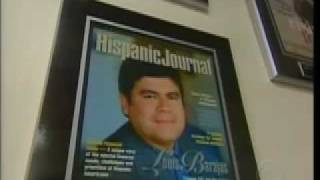
He went to UCLA on scholarship, got an MBA and went to work doing financial planning for Anglo millionaires. So tell me about your book.
Well, this is the ten steps.
This is what a genuine American success story with books and a lecture series to prove it. He decided the rich didn't need him. Immigrants did.
What I learned was that to become successful in America, you had to have a specific mindset, a different mindset. I thought, you know, I pretty much had mastered that and I wanted to teach that to the Latinos. Not just financial literacy, but changing the way they think.
Maria Cruz is his client. One of nine children, she grew up in Mexico.
We were very, very poor. You know, we didn't have enough.
Food to eat.
She came to the United States at the age of 18.
At 38.
She owns three WIC stores in the Los Angeles area. Depots where low income women cash in vouchers for food.
There are more than a million and.
A half Latino owned businesses in the United States, injecting well over $200 billion a year into the economy.
I want to be better, always better. Never say, I'm fine, this is good enough.
And just ask her about the juice bar she's opening.
Oh, I'm very excited. It's something that always dream to do that now.
A U.S. citizen, Maria Cruz was an illegal immigrant.
Until after World War I, there really wasn't such a thing as illegal immigration in the United States. Millions of immigrants just showed up in great waves, mainly Europeans escaping poverty and politics. The United States has always been schizophrenic about Latinos, especially Mexicans, over and over again, inviting them in to fill labor shortages. And then when times got tough, throwing them out for more than 20 years. There was even a guest worker program. It ended in 1964. But the migrants came anyway, many illegally, their numbers multiplying exponentially ever since. Today, an estimated 12 million are here illegally. A CBS News New York Times poll found that nearly nine out of 10Americans consider illegal immigration either a serious or very serious problem. And an open wound exposed during the recent Capitol Hill debate over immigration reform. Congressman Virgil Goode.
The position of the Senate needs to be there will be no amnesty, period. If we took that position, many of those here illegally now would march on back to Mexico.
Let's be practical, get over it. Let's think it through in a practical way. First of all, they're really not going anywhere.
Alex Vega isn't going anywhere.
Born in Mexico, he has been in.
The United States undocumented, under the radar more than half his life.
I'm a ghost, and I'm still a ghost. I don't exist. I'm 45 years old, I got 10 children. I have a business, I own a house. But nothing is in my name.
In April, Alex Vega defiantly showed himself.
We not criminals.
He marched through downtown Los Angeles for immigrant rights. One of millions nationwide who understood what it meant to be seen and counted for the first time. Within five years, all 10 of Alex Vega's children born here, US citizens will.
Have reached voting age in 20 years. Then we're gonna run the country. Right now, we're running the cities.
So little by little, we are writing the show little by little. So the sleeping giant is already awakened.
Last year, Los Angeles elected Antonio Villaragosa as its first Hispanic mayor in more than a century.
Tonight, I really love LA.
He joins three US senators and something like 6,000 other Latino officeholders at all levels of if that scares some people, it reassures others.
Yes, he'll change the country. But I believe fundamentally, it adds to the richness of the country. And more importantly, this is a population that understands the basic credo, the basic core of the American idea.
They want to be part of the American dream.
Lesson one in the how to manual goes like this. Today we march, tomorrow we vote.