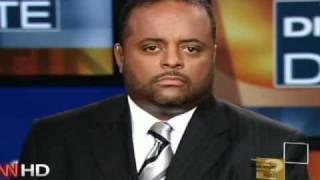
Roland Martin and Louis Barajas discuss the 2008 financial crisis. While policy debates focus on Wall Street, ordinary Americans worry about heating homes and losing them. Barajas warns that over 100 banks are at risk and people might wait six months to two years to access deposits.
Questions this video answers
2011.
Around 2045 (as stated in the transcript).
The FDIC (Federal Deposit Insurance Corporation).
He suggests it could be about six months to two years.
Chapters
With us that are 25, myself, a homeowner, I'm not quite making six figures. What about me and what am I going to see in this new crisis?
I spent debate night in Washington D.C. at the Congressional Black Caucus foundation. And folks, I got to tell you, when it comes to bailing out Wall street, there not a bunch of heavy campers there or across America. Now, since McCain and Obama danced around how the bailout will affect ordinary Americans, we've got someone who can give us real answers. Louis Barajas is from the Los Angeles area and is a personal wealth advisor as well as author of the book Overworked, Overwhelmed and Underpaid. My wife says that all the time.
Yes, sir.
Louis, you said that was a glaring omission from the debate.
There's a glaring omission from everyone besides the debate. What's happening right now is everybody's worried about the 401ks, the market and the 700 billion dollar debt that we're going to get into. Nobody's talking about how it's going to affect the people that are not putting, putting money in the 401s. And that's Social Security issue. And everybody's going to dance around that because that's a highly, you know, high important topic that everyone's got to get.
Yeah, but you got boomers coming along in three years. I mean this is major.
2011, most boomers are going to start reaching age 65. Most boomers are not putting money in the 401k. They're going to depend on Social Security. How is this debt going to affect them? Let's hear them talk about that.
Now when you say let's hear them talk about it. But what do you want them to say if you even admit that it's the one topic politicians don't want to touch. Why should they?
Because people like us people, you know, they're talking about Wall street and Main Street. I'm talking about talking about people on my street and people on my street, they want to know about that because they're living on Social Security. They're not putting that money away. You know, they're not putting money away in the 401k. It's not affecting them.
Well, first of all, man, a lot of people are sitting here nervous right now in terms of what I do with my money. I mean, I know it's a joke. I tell anyone, don't do it. When we start hearing people say I put my money under a mattress or, or trying to hire us somewhere, they are afraid of what is going to happen to their money?
That's right. And the fear is causing paralysis. That's the problem. You know, people are angry right now. People are angry at the government. What people need to do is they need to take action not to be paralyzed by this fear, but they need to start putting money away. But again, we need to talk to our politicians and ask them they need to be accountable about what's going to happen with Social Security.
Well, we should talk to our politicians. I'm going to speak on that later in the show. But right now, folks, we have a phone call from Linda in Factoryville, Pennsylvania, battleground state. Linda, how are you?
Hi, I'm fine, Roland. Thank you for taking my call. I'm on Social Security and like a lot of other people have, have only one income coming in and they, well, they want to bail out CEOs and all these other things. People on my street, as the gentleman just said, and I want to know how I'm going to heat my house this winter. I don't really care about the CEOs of these banks that have got their pockets lined and don't have to worry about it.
All right, Linda, I certainly appreciate your phone call. Thanks a lot, Louis.
What?
A lot of people are saying the exact same thing she just said.
Yeah, they don't have to worry about right now, but what's going to happen is the future because again, we're running out of money in the Social Security. I mean, when you look at your Social Security statement, they tell you you're going to run out of money like the year 2045 or something. They're telling us that. So how is this debt going to affect this. This lady right now, I can understand her worry because again, you know, a lot of people are living just on.
Social Security right now. Folks, we got a phone call from Doug in Marietta, Georgia. Doug, what say you?
Well, thanks for taking my call. I appreciate it. I think just about everybody I've heard tonight has been very unrealistic in expecting either Obama or McCain to have a plan number one on how to deal with this incredibly complex crisis that we're in.
Okay, so you say unrealistic. What is realistic then?
That's why you've got the brilliant people in specific areas. That's why you've got a Fed chairman. That's why you've got a secretary of the Treasury. We all agree. Obama, McCain, everybody, everybody out there in TV land, we've got to do something to keep the country from collapsing financially. Exactly how that's going to happen. Obama doesn't know. McCain doesn't know. That's got to be figured out.
Okay. All right, Doug, thanks. A bunch of lawyers. I keep hearing that, well, Obama doesn't know. McCain doesn't know. You don't know? I don't know. Well, then who knows then?
You know, the markets know. That's what capitalism is all about. Let the markets work themselves out. We need the help right now. You know, we need help because the small person is the one that's getting hurt. Nobody's talking about the people that have lost their homes already. They're talking about the people who are going to lose their homes. We've had millions of people already lose their homes. Where are they living? You know, can you imagine what's going on in their household, what they're talking about? You know what the number one reason for divorce is? Financial stress. Can you imagine? That's what's affecting my street.
Now let's talk about this whole issue of banks failing. What happens when my money's in a checking account, then a bank fails, and I want to all of a sudden go down and get my money out? There's some problems there that people aren't necessarily discussing.
Okay. When we've got one or two banks failing or. And it happens regularly, it doesn't just happen. You know, it's happening right now. But the problem is the FDIC came out last week and I heard it on CNN saying over 100 banks right now are in jeopardy and they may not have enough sufficient capital to pay all the depositors.
In fact, with a member of Today say there's one bank teetering on the brink could collapse Monday.
Right. So if all that happened all at one time, if just it were to happen, you know, they're going to give us our money back. But it's not. It's not if they're going to give it back, it's when they're going to give it back.
So we say when. What does that mean? Like two days, three days?
Okay, it could be like six months to two years. And here's the problem. The problem is the average person doesn't have $100,000. They have $5,000, maybe less, in their checking account, in their savings account. What are they using that money for? They're living paycheck to paycheck, month to month. They use to pay their rent. They pay the utility bills to pay the water. What's going to happen if they all of a sudden just kind of shut it down for a while?
All right, Lewis Going back to the phone lines, folks. Vincent from Woodbridge, Virginia, another battleground state.
Vincent, how will this affect the future generations with this bailout? I mean, you know, I'm upset about it, just like the other people in my neighborhood.
Great point, Vincent. Thanks so much for your phone call. Louis, I have nine nieces, four nephews. How does this affect them?
Okay, well, how it affects them is that they need to understand that they need to take personal responsibility for their own finances. The reason for that, because nobody knows what's going. We can't pick, you know, we can't play the victim. What needs to happen is we need to teach them financial literacy. High schools don't have financial literacy. The government has SBA locations all over the country. Have you seen a financial planning location that they're helping us teach our kids how to improve their lives or how to create a better infrastructure?
Great point there. And again, basically, what you're saying is don't depend on the government. You better depend on yourself.
Take some personal responsibility.
All right, Lewis, thanks so much. I certainly appreciate it. The candidates spent a little over half of their debate talking about foreign policy. Iran, Iraq, North Korea. Hello.









