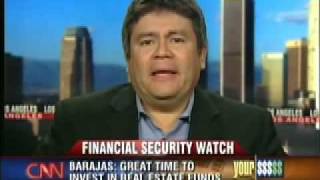
Ali Velshi and Christine Romans talk to CFP Louis Barajas about surviving the 2008 financial crisis. Build an emergency fund of 2 to 6 months depending on your job security, use any stimulus money to pay down high-interest debt or boost retirement savings, and look at REITs and real estate instead of panic-buying gold.
Questions this video answers
November 18, 2008.
"Anywhere from 300 to 800" (US dollars).
They said the Dow "fell the lowest in 10 months."
He suggested considering roughly "two to three, four, five, six months" (i.e., 2–6 months or more) of living expenses, adjusted for industry risk.
Chapters
And we welcome you back. We've been talking a lot about what should be in an economic stimulus package. The President has different words for it. It's more of a growth plan, I think he's calling it. In the end, it's all the same thing. It's probably not a good idea, though, for any of us to sit back and wait to see what the President's going to do or what Congress is going to do or what kind of plan they're going to come up with. I mean, in the end, it's kind of like that famous JFK line. It's not what your country can do for you, it's what you can do for you.
What he said, or something like that. Because, listen, what you got to do for yourself now is pretty important stuff because the week, this week the Dow fell the lowest in 10 months. The Russell 2000 is in a bear market. What's the Russell 2000? It's a, it's a gauge of 2,000 different stocks. And some say that kind of can be a little bit of a leader because they feel the pain the first, those smaller companies, you know. But don't panic. There are definitely things you could do to beef up your own finances to, you know, increase your own financial security and to recession proof your own portfolio. Certified financial planner Louis Barajas suggests creating an emergency fund that you can tap into if you lose your job or you get hit with unexpected expenses like medical bills. Louis, how much money should I put into a fund like that, especially at this time?
Well, you want to make sure that when you put money into an emergency reserve that you don't follow the rule of thumb, what everybody says, you know, two to three months of living expenses. Take a look at what industry you're in. I mean, if you were to lose your job in a recession, is it going to take you two to three, four, five, six months to find a job? You know, you need to start planning now. And that's one of the things that we're seeing. I'm starting to see people panning and I tell them, don't panic. You need to plan.
Let me ask you about any kind of a stimulus plan. If there is an individual tax rebate check that comes out that they can agree upon in Congress over the next 30 days, and that can get to people by June or July, say it's anywhere from 300 to 800, who knows? What should a savvy investor do with that money? Should they go out and spend it on discretionary purchase?
Well, what's Happening is right now we're looking at short term consequences, long term permanent pain. I think that the stimulus package is short term. You know, people are going to go out and again, you know, I was talking to somebody and they're telling me, the stimulus package, I hope it gets here before the super bowl so I can go buy a flat screen tv.
I mean, it won't be here before the Super Bowl. We can, we can pretty much of all that. I don't know about what that's going to look like. I know it's not going to be here before the Super Bowl.
No, I know that. I'm just saying, I'm kidding around. And they're saying that, you know, what happens is they want us to spend money to stimulate the economy. I go back and we have to make sure that people focus on their financial fundamentals, on their foundation, take that money and add more money to their 401k. You know, this is a time where people need to be proactive, not reactive.
Well, let me ask you a question. I'm going to interrupt you just for a moment because there are a lot of people listening to you right now and they're saying, okay, that sounds like a great idea, but I got a lot of debt. I got credit card bills and I got credit card payments and maybe I should pay those suckers down before I start thinking about doing what Louie told me to do. Are they right?
Yeah, absolutely. What's happening is that we want to do that, but at the same time here we want to do. We want to start flexing two muscles. Even if you can take a couple hundred dollars and open up a savings account somewhere and start putting some money away and pay some of your credit card down, that's at 15, 16, 21%. I agree with you. You're not going to earn much in the bank, but at the same time, you got to start developing good habits. And most Americans, we've been at a negative savings rate for the last couple of years. It's not helping anyone. And you're right, everyone is in deep. A lot of debt. I'm seeing a lot of debt with our clients.
Talk about some of the investments people have been making. Last week we had somebody on this program who was recommending gold. This week I read a story that the housewives in India are selling their hair. They're selling. No, they're selling their gold jewelry, which to me is a sign of a top in the market. I don't know about all of those things, but are you hearing people talk about Getting into more defensive places or.
What do you think what it is that we always want to hear? Recession or impending inflation. Everybody goes to gold. And again, it's that irrational exuberance. I want to make sure that people don't jump into any type of investment where it's being blown out of proportion because there's fear in the market. You know, I'm telling people right now, hey, if you got some extra cash, I deal with the middle America, with the average investor, right now is a good time. If you were thinking about buying a piece of property, right now is the time to start looking. That's where you want to go. You don't want to go where things are really already been over inflated or overgrown.
Do you like real estate? Real estate funds? Real estate. What kind of real estate?
You can go in the REITs Real Estate Investment Trust. You can buy property. I've got a client who's also right now looking for their first home. And I said, this is a great time to start looking. We're going to see values come down a little bit more.
Again.
This is going to be. And when we look at long term and take a look at, for example, like an Ibbotson chart, where you see the stock market chart, what's going to happen is you're going to see this as a great opportunity to get into the stock market and to get into real estate.
Louis Barrajas, you're good.
He is good.
That's why we like to have him.
You know, it's interesting. I mean, if you listen to Bernanke a couple of days ago, and if you listen to what the president said yesterday, you get the sense that they want people to go out and be urgent about this, whatever the stimulus package ends up being. And what he's saying is you should be. You should make the money work for you right away.
Bernanke, though, did acknowledge, he said there are some people who are going to need to pay down some of their debt because, you know, what's good for the overall economy might not be necessarily what's good for you or for me.
Well, we thank him and we thank you. And we want you to know there's a heck of a lot.