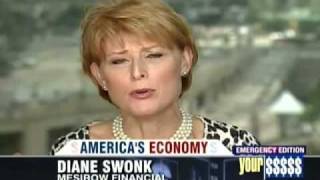
Louis Barajas joins economists Mark Zandi and Diane Swonk on CNN in November 2008 to discuss the Wall Street collapse. They identify housing as the root cause and warn against fear-driven investing, arguing the crisis, while severe, won't match the Great Depression if government action restores confidence.
Chapters
Is your money safe? Is your job safe? Can our next president do anything to turn this economy around? We have a team of top experts here to help you make sense of the Wall street collapse. We'll sort through the panic, the mess on Wall street and offer real answers for where we are and what you can do right now, this very moment to protect yourself. Joining us now for this special emergency edition of your money, Mark Zandi, chief economist at Moody's economy.com Diane Swonk, chief economist with Mesero Financial. And Louis Barajas, personal wealth advisor and author of the soon to be published book Overworked, Overwhelmed and Underpaid. Let's start with you first, Mark. A historic week. Will there be stability now in the financial markets and can we get the economy moving in the right direction again?
Yeah, I think so. When policymakers act aggressively, at least historically it works, they convince people that they're on the case, that they're going to do the job and that restores confidence and we're off and running again.
We can't say the worst is behind us. We can say that it's the beginning of the beginning of the end.
Yeah, that's the way I would put it. You know, if you put it in baseball metaphors, I think this is the sixth inning of a nine inning game and it's not a doubleheader. This is, this is three innings to go. It's going to be painful. We've got, I think a tough economy ahead of us, but I think the worst in the financial markets is over.
Louis Brajas, you are a personal wealth advisor. Everybody wants to know this week we've had emails, we've had call ins. What do I do with my money? Is my money safe in the bank? Is my, are my investment safe? Is my foreign 401k safe? Is my money market safe? What have you got to tell them?
Well, what I've got to tell them is that their money is not safe if they're acting on fear. What got us into this problem was greed. We all know that. And if we're going to make decisions now based on fear, our money's not going to be safe. And so the problem is right now we're seeing a lot of people who are going to prey on the vulnerable people who are saying, your money's not safe. Move it into gold, move it into this. And then we lack diversification. Keep your money where it's at, keep it consistent. What we need to do is take a look at ideal outcome. Why did we invest the money where we have it now in the first place.
Louis, let me ask you this. If you've got a little money to put away right now, if you were smart or lucky enough to have some money sitting aside that's not getting hammered, you know, has lost 25% in the stock market, should you be buying?
You should be buying. If you're buying with a goal in mind, with a risk tolerance, with the time frame, you know what the money is going to be used for, not just to speculate. And that's what gets us in trouble. It's a speculation.
Diane Swonk, you have been following the economy for a long time. It occurs to me that an economist might be looking at this from a 50,000 foot view and say it's serious, but these are economic cycles. Is this very unusual? Is this something that's going to come and go and we'll be okay? Well, how do you see it?
Well, it is serious. There's no question about it. I echo Mark's comments earlier that this is a major turn in events and confidence. Unlike the real economy, in financial markets perceptions can become reality. And the panic that had taken over was extremely important to address. And I think the fact that we had a coordinated effort from finally from the government, it may not be the best plan. That's frankly irrelevant. We'll fix the problems with it later. The fact that people now understand their money safe and they can move forward with some sense of certainty about how actions will be held handled in financial markets going forward is very, very important. So this is the worst financial crisis since the Great Depression. Nowhere near the severity of the Great Depression. And I think the difference between that is a very important difference and the idea that people are being preyed upon like the Great Depression is we don't want to go there. Remember, that was a time when there were shanty towns where people who didn't have homes ended up living in shanty towns and tents. 25% unemployment rates. And frankly, people who lived on production line, worked on production lines could lose their job in a second and have someone replace them. That is not the world we're in today. We are in a global world where now everybody in the rest of the world understands they need us even more than we need them. And all of our oars are now in the water. We're all in the same boat. We're going to reach land.
Let's listen to what Treasury Secretary Paulson had to say Friday about this crisis and about what they're trying to do about it. And then Mark I want to get your response.
This is what we need to do because for some time we've been saying that the root cause of the problems in our economy and our financial system is housing. And until we get stability in the housing market, we are not going to get stability in our financial markets. We've worked with Congress on a number of steps, all of which were important leading up to this. But this is the way we stabilize the system and get at the root cause.
So the housing market, it's all about the housing market here. And we're still seeing you can't get a home loan in many places. You are still seeing that kind of seized up. And we know that housing prices are still falling until they stop falling. Can we turn anything around?
No, I think that is the root cause. Prices are down 20% from where they were two years ago. They're going to continue to decline. But I think by these kinds of actions that are being taken by the government, and it's not just this setting up an entity by mortgage loans and mortgage securities is all the different things that they're doing, I think it's going to put a floor under prices. And so I think that's very, very positive.
All right.
We've got a lot more to discuss. Mark Zandi, thank you for joining us. We appreciate that Luis Brajas and Diane Swung. Hang on, because we're going to come back with some more ideas and some more questions for you.
All right. Thousands of Lehman Brothers employees cleared out their desks this week. Their jobs are now in the dustbin with another half a million jobs lost this year. Find out how safe your own job is when this emergency edition of youf Money Comes right.