Wealth Gap Warriors Episode 14 with Joelle Martinez and Harry Hollines
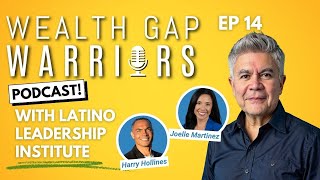
Joelle Martinez and Harry Hollines run the Latino Leadership Institute, which has trained 800 alumni across 30+ states. They focus on scaling Latino businesses from $100–250K toward $1M in revenue, targeting the missing middle where fewer than 3% of Latino founders reach that milestone.
Chapters
Foreign.
Hi, this is Luis Baragas, the host of Wealth Gap Warriors. And Wealth Gap warriors is the podcast to introduce you to heroes working in organizations that focus on helping eradicate financial injustice and economic disparity in underserved communities. And today, we have the privilege of meeting with Joel Martinez and Harry Hollins, who are run the Latino Leadership Institute. But first, the purpose of this program is to really get to know and have some context of the leaders behind these organizations and how they got here, because it's not an easy road. And so we love sharing their personal stories. And we're going to start with Ladies first. We're going to start with Joelle. Joel, tell us a little bit. Give us some context of where you grew up, how you grew up, and I've heard a little bit about the background of your grandmother there in Colorado, so we'd love to know a little bit more.
Well, thank you for having me and thank you for providing this important platform to talk about wealth and wealth creation, particularly for our communities. I am a proud 9th generation Coloradan. I have deep roots here in Colorado and am very blessed to come from a wonderful family that from a very early age taught me the importance of community service, leadership, advocacy, entrepreneurship, and even the importance of having a good relationship with money and wealth creation.
My family, in particular, are really just extraordinary leaders, and I stand on their shoulders to do the work I do today. As you mentioned, my grandmother was the first Latina president of the Denver City Council. And the reason she got into public service in the first place is because she was passionate about the education that my dad and my aunt and uncle were receiving. And she felt like zip codes were going to determine your access to quality education, to quality of life. And she wanted to make sure that they had an advocate at the table. And that's what got her involved, is advocating for her kids. I thought it was totally normal that families would talk about, you know, social justice and economic justice on Sunday dinners. I didn't learn that until I was older, that that was just unique to my family. And so I think it was absolutely destiny for me to follow in my family's footsteps. And for the first part of my career, I dedicated.
The work and really serving in the public policy space and working on campaigns and really working to get candidates elected that reflected my values and ultimately what I believe would reflect better outcomes for, for the community. And to be honest, I thought I was going to stay in politics the rest of my life. I really did enjoy it and had become kind of a national leader, especially around Latino issues and the Latino vote. But I have, you know, I left D.C. at a time when I really felt like voices weren't being heard, bipartisanship had fallen to the wayside, and we were missing the boat on really good policy, in large part because Latinos weren't at the table. We were in elected positions. And so we're left on the menu. And so when the founders of the LLI 11 years ago know presented this idea to me that instead of working to solve community problems through policy, that we really needed to make sure that those creating the policy were reflective of the community. It set me on, I think, a new course, a course that I have enjoyed being on for 11 years and that is unlocking Latino potential by helping to identify, support, and elevate Latinos across every sector and industry so that we can be in those positions of power and influence. And over the last couple of years, really expanding our work and mission to include wealth creation through entrepreneurship. Something that is near and dear not only to my heart because it's part of my family story, coming from a family of entrepreneurs, but because through Harry's partnership and leadership on this issue, really knowing that we can change outcomes through entrepreneurship. And while I talk about my grandmother on the Denver City Council often, it's important for me to talk about my other grandmother as well, because she was really the one who taught me about the importance of money and wealth and having a good relationship with it. And she was a bank teller, and my grandfather was a janitor at his high school. So they did not come from. From great means. They did own a small home in north Denver. But from the time I was born into the time I went to college, for every holiday, for every birthday, I got what I thought was the lamest gift any child could ever get. And instead of opening Cabbage Patch Dolls and Ataris, I opened a card with a savings bond in them. And my mom would take the savings bond out of my hand and go and put it in the safe deposit box back when everyone used to have one of those. And I didn't realize until I was about to go off to college in LA the value of that, because when I had to pay for my books, I was able to go to my mom's bank and take out all of those savings bonds and cash them. And my grandmother told me that it was really important, that she wanted to plant the seeds that it's important for us to be part of where capitalist society, it's important for us to participate in that. It's important for us to save. It's important for us to understand how things like stocks and bonds work to create generational wealth. And as I have aged and as I've reflected on that, I've realized what a blessing that really was and how that those lessons in my life, both about civil justice and economic justice, that I learned from one set of grandparents, and then the value of a dollar I learned from the others, I think, combined, have really led me to where I am today.
Wow. What a way that you're honoring your family, right? Your grandparents, your parents.
And you've learned and you've taken all those life experiences and stories and leveraged all that. And I think that's what part of the Latino Leadership Institute is trying to do as well, Right? To take a lot of information from a lot of other people and then help them who maybe haven't had the same privilege or the same access that you did. I'm seeing some of the work that you guys are doing, and it's phenomenal. Harry, we'd love to hear a little bit about your context, your background. What's led you here? I know that I think you're living in the USN and Puerto Rico, right? You're going back and forth, forth. And that's a Mexican from Bo Heights. Tell us a little bit about you. We want to know, you know, not only that, again, more of your background. Tell us some family stories, how you got here.
Yeah, no, happy to. And then such a enjoyable and honor to be on this podcast and be on your show. Louis, I kind of, you know, my background's interesting. I kind of describe it as a collage of experiences. I'm a. I'm a native, born and raised in Denver. I grew up in a very interesting part and section of Denver. I always kind of called it the Bridge growing up. And there's a part of Denver where historically it was a meeting of the black and Chicano communities, and I grew up in both. And I had so this rich tapestry of experience, Chicano on one side, black on the other side. And then I meet my wife, Niezposi Boricua. I met her when I was a teenager, and she came. Her family came from New York. So you had nuecans coming in. And I had. So I grew up with this just rich tapestry of experiencing cultures, Chicano, Puerto Rican and black. And that really kind of shaped who I was. I mean, those, I always say, are the communities that actually built me. And they built me to be able to move and operate in the spaces that I did. And then of course, my parents, who always worked in the community. And in fact, my mom worked in banking, and she always worked in the community. And one kind of interesting tidbit that Joelle and I didn't find out too much later is actually Joelle's mom and my mom worked together. And what I understand, they were hellraisers in making sure their communities were not only represented within the banking industry, but also working with young Latinas, young black women to help progress their career in banking. So that was always inside of me. And my dad is really known in Denver on the athletic side. My dad's considered probably one of the top 20 basketball players ever to come out of Colorado. He was All American at University of Denver and played briefly with the Phoenix Suns. And after his career, he returned to the same neighborhood he grew up in. And that's a neighborhood I spent a lot of my time in. And so I always say, those are the communities that built me, that shaped me, that I always felt a need and a responsibility to give back to. And so I kind of put that on one side. And then as I started my career, started in the law, went to law school, started working in mergers and acquisitions. Then I pivoted over to corporate development, working more on the strategy and finance side. And having made that pivot, my experience was very different from how I grew up. But the first time I started to see big gaps and disparities in wealth, in opportunity, it's the first time I kind of saw wealth and understanding, as Joelle said, how certain zip codes get tools and resources and others don't. And so that became a part of me as well as. As I progressed my career, you know, I made it to the C suite, and I was always kind of a goal of mine. But I also had to grapple with the fact that inside that C suite, no one looked like me and came from where I came from. So I really was the only one in the room. And I kind of took all of that together, and that was kind of what shaped me, what kind of got me going. But I do remember vividly a moment where I was sitting on a panel and someone asked me, what is it like being the only one in the room? How do you navigate that? And I don't remember my exact response, but I do remember it. I said, you know, I'm able to move in that space because my communities built me for this. And then after the panel, I was driving home, and it dawned on me that because I can operate in these spaces and the community built me to operate in these spaces, the question I had to grapple with was, am I giving back to the same level that the communities gave me, that put me in this position, that gave me this opportunity? And there was a time where I had to finally say, no, I haven't. And it really was at that moment that I kind of re. Pivoted it. And I said, I don't want to start my career over, but how do I take what I've been good at? I've been good at returning investment returns for investors, I think good at scaling companies. How do I take that skill set and work it into our community so that our community start to benefit from it? And I think from that point in life, you make these kind of mental, psychological pivots, and then doors start to open. And it was very soon after that that I got introduced to the Latino Leadership Institute. I get introduced into Joelle, to the team at lli. I joined the board, and then ultimately I get the opportunity to join the team under Joelle and work in the space of creating wealth through entrepreneurship, which is completely leveraging my background and working for the communities that I. That I hold very dear to my heart.
That's phenomenal. And so, Harry, are you full time with the organization? Are you there or you're.
You're there? I. I so am.
So this is what I kind of see, as I've interviewed so many people now on the podcast who are leaders in. In communities of color who are really shaping those communities, is that they have a special heart. Because all the three of us here could be also earning a lot more money, right? We're doing a lot of work. I've done a lot of work here for. For the. What I call the L. Barajas brand, in which we really kind of. It's almost a nonprofit. We're not a legal nonprofit, but I would say we're almost a nonprofit. But both of you could be earning a. Twice as much as you are now. But again, there's something with all your intelligence and experience and, and networking and people, you know, probably could be earning two or three times what you're earning now. Yet your love for the community, and it's not easy, right? You love for the community, and to help, to help the people around you is something that I think that most people just kind of take for granted, but they don't realize the hardships that you have to go through. Because also, as your organizations, you have to raise money and you have to find the. The. The right people. And sometimes because even the Organization doesn't have enough money. You have to find people who are willing to take less, who have heart in that community, which is a little harder to find the right people to grow the organization. And then we sometimes run into political headwinds in which it make things a little bit more complicated or difficult. And then what happens also sometimes within our own community, because we have certain mindsets. Um, you know, we said that most, you know, we're. We're a certain way because we think a certain way, you know, where sometimes our organizations, we don't get together as often or don't help each other out as much because we're all struggling just kind of to survive. So I would love for you guys to not only share with me, you know, and you can speak with, you know, Joelle or Harry is tell me about your organization. Tell me what you guys, you know, from nuts and Bolts, instead of like real strategic, big picture. Tell me that if you're out there, who is part of the Latino Leadership Institute? I mean, what person would go there? What kind of help would they get? What kind of results? Have you seen? What is the good work that you're doing? And then also mention, what are some of the heartaches that you have? What are some of the struggles that you're dealing with? What are the things that you still have to overcome? And then I will ask you at the end, I mean, how can we help you? Right? Because again, the goal is for us and for people around us to. To hear you, but also try to help the organization. The other thing is, I will share with you that I've already interviewed people who, early on in the very first podcast, who've listened to other people like you that I've interviewed after. And you guys give other people inspiration because they're. Even though they're leaders and their organizations, they're struggling, and they see you and you inspire them to continue the fight. Because again, you know, when I talk about wealth gap warriors is that I've been working in the wealth gap area for 40 years, and it doesn't seem to be getting any better. In fact, the wealth gap keeps widening. And I think that we have to approach things differently, and I think we have to work together. But sorry for me rambling on. I would love for you to share what you guys do, how you do it, and any frustrations you have. And anybody, Joelle or Harry, you can answer.
Thank you for the opportunity to share a little bit about the important work that we do here at the lli. And it's it's, it's one similar to many of the folks that we work with. There's chapters in an organization and there's a life cycle and a journey that we're on. And when we started the institute 11 years ago, we were focused in on professional development and really working with mid career Latino professionals, emerging executive professionals across every sector and industry. And we actually started in partnership with the University of Denver for our first eight years. And then we expanded and we grew our professional and leadership development to a national level where I can proudly say today we have, you know, 800 alumni in 30 plus states and seven countries. And that work was so critically important because we have to be reflected in leadership positions for decision making, for spending decisions, but also as it relates to wealth, increasing income and also access to benefits in retirement. So our work from day one, while many would say it's a professional development organization, is it was always a wealth creation organization because the goal was to unlock Latino potential as they elevate in their careers, as they serve more on boards and as they begin to become more, more wealthy through income. However, you know, I think to, to Harry's point, a few years ago we really understood that to change outcomes and to really change what the trajectory of our community will be. I have a saying that demography is not destiny. And despite Latinos being the second largest fastest growing demographic, despite the fact that year after year our GDP and our consumption is outpacing that of whites in America today, those statistics don't mean much to me. If we continue to grow the wealth gap and we continue to leave our community behind. And so our next chapter as an organization will really be to double and triple down on creating wealth through entrepreneurship. We really do believe that we're going to change outcomes and we're going to leave the world better than we found it is that we are going to have to help our community really change their financial situation. And the way we do that is through entrepreneurship. So our next chapter will be one of really helping entrepreneurs get to that million, that important million dollar milestone that less than 3% of our community get to. It will be helping to work in public and private partnership to actually change the flow of money so that our under capitalized businesses have the right kind of capital to grow and scale their businesses. And I think answering your question is such a valuable one because what we are going through right now is both a journey, a cycle of our organization, but it's also a reflection of the realities that we are facing. About a year ago as an organization, many of our partners began to do some risk mitigation. And risk mitigation in a way that having Latino part of your name, having a Latino focused program actually was seen as a potential risk. And this was long before some of the political policies and executive orders. The environment that's out there today means organizations like ours that were focused in on a community or communities underserved and under invested in more broadly are now at great risk because funding is really slowed down, if not all but disappeared because there's a risk assess associated now with the type of work that we are doing. But yet I need to be very clear that this work, this work that we are doing today is an economic.
Imperative. Because if we don't advance our community forward, the economic vitality of the country is at risk. It will be on our backs. It will be through our consumption growth, it'll be through our small business growth that we are able to not only see ourselves through what could be a potential recession, but continue to grow the gdp. If you remove Latinos from the US gdp, you would not have seen the growth instability that we have. And so it's really an imperative for us to make sure that we don't let the kind of chaos and uncertainty of the moment and the vitality of the moment stop us from what our ultimate mission is. And that's making sure that our communities are whole, that our communities can unlock their potential, and that our communities can actually benefit from the contributions that they are making to the economy. And so our work will continue to be to focus in on how to get, you know, financial literacy, wealth creation and entrepreneurship growth as, as our main tenants of work. But Harry, you're right there alongside with me and I know you'll have some things to add as well.
No, I think it's like what you talked about. I mean, we always talk about, at the end of the day, it's about access for our community and what's wrapped around that. Access is a kind of interconnection between wealth. And we talked about the zip codes and you follow it through and you look at wealthier zip codes and what do they have? They live longer, they have a better environment, they have a thriving small business. They have more parks, they have more trees. They have everything that's in there and sitting in the center of that is higher incomes and a thriving small business community. And I think what you touched on, Joel, is a big one we talk about, and we unapologetically talk about it, and that is wealth and creating wealth and what wealth is. And we Spend a lot of time focused on the intersection of where it's created, where it's creating your career, where it's created for a small business. And as you all said, less than 3% of Latino companies make it to a million dollars of annual revenue. And it's about that time that you start to have the characteristics of an entity and a company that can have massive impacts. And what I mean by that is on one side, it's about the time you start to talk about multiples, meaning what is your company worth? And if your company is worth something, then your ownership interest is worth something. But the structure of a company to reach that has a workforce. And what we know is when there are Latino founders, Latino CEOs, we average about 60% of that workforce is diverse. We also know the dollar circulates in the community because they actually start to build a supply chain in the community. So now every, so now everyone in the community is benefiting. And then when we step back and say the larger and for the entire country, it's absolutely true. For this economy to continue to be a leading GDP in the world and be a consumer power of which is about 70%, it requires thriving communities. And this is where the demographics actually do matter. They actually do matter because you're going to have to have an equitable relationship between demographics and economic contribution of this country. So I step back. Everyone wins when you do that. But we are hyper focused on what does it mean in our community. We're unapologetically talking about wealth and where wealth is created and not mixing up wealth. And Louis, you talked about one of the things we deal with is even within talking to our community and outside of our community and those that are in our ecosystem, not everyone understands wealth and not everyone applies wealth the right way. We come and I'll give you an example, we'll talk about wealth and someone will say, well, we're going to make sure there are a lot of entry level jobs making $15 an hour. We need. Don't get me wrong, that's an important part of it. It's. And that's not where wealth is created though. Wealth is created. That's where you start your career, you start to build an income. That's not where wealth is created. And we want to make sure that that gap in the middle between income and wealth is where we want to play. And we want to help both individuals, companies and our communities actually build wealth because they know what that means in the larger sphere of things.
Well, Herring Drew, walk me through. Right. So I'm now someone who's listening to this podcast. And so I'm right now googling. I'm on my computer, listen to the podcast, and I've got, you know, my browser up and I'm putting Latino Leadership Institute. And I'm an entrepreneur. And as most Latino entrepreneurs, you know, they, they create jobs for themselves. That's why they have a hard time to scale, right? Because what happens is they're constantly can't find a job or they have this wonderful idea or they work harder than most people, so they say, you know what, let me just start off on my own. Or they just don't have the opportunity, so they create jobs for themselves. And to go from being self employed to being a business owner requires a complete different mindset.
And at that point, the problem is that they've tried, they've tried adding employees and it doesn't work out because they don't have the proper systems or the proper structure. They're not willing to release some control for them to grow. It's a catch 22. Or they reach what I call the ceiling of complexity. They're just doing too much. It can't handle it anymore because they are growing. Because I always tell people the problem that you're going to have if you're really good at what you do is you just can't help but grow. And that's going to be your problem eventually because at some point you're going to reach a similar complexity. So now I'm watching this and how do I apply to your programs? But what do you teach me? What am I going to learn? Do I pay for them? Is it. Where's your funding coming from? Because at the end of the day, what you guys are providing is, as far as I'm seeing is, and without really understanding the nuts and bolts of what you're doing, is that mindset shift from being self employed to becoming a real business owner. That is going to grow. And then so now their business can run without them. So now there's value and now we're building wealth, right? And we're hiring more people and more people in the community. Tell me exactly, walk me through, how do I apply? What does it cost me? What do I get out of it? Do I meet other entrepreneurs that are going through the same thing? Walk me just through, you know, quickly how this works.
I'm going to turn it over to the absolute architect of our, of our programming, and that is Harry, because he truly has architected what I think is a game changer for what we call this missing middle that we keep talking about this high potential, established business working hard, but not yet at that million million plus mark. And so Harry, please, because you are the architect, I would love to.
So first of all, our program for entrepreneurs is free of charge. We don't charge for it. We get funding from public, private sector foundations actually support our program. And we do have, we run a cohort a year of Latino entrepreneurs. We've graduated two cohorts already. We have a third cohort that will launch in Q3 this year.
Where we play and where we focus is on entrepreneurs that have launched and are starting to generate revenue. So we tend to have entrepreneurs generating between 100 and 250,000 of revenue. And as backstop to get there. We have a pretty healthy ecosystem in kind of the metro Denver area for taking your idea and getting launched. We're focused on, you got launched, you just started to get customers, you're starting to get some revenue. How do you scale and grow? And to your point goes, we do a couple things. One, on the mindset, we actually start to talk about what's possible. And not only do we talk about what's impossible within, we have entrepreneurs that have scaled from 250,000 to over 2,003,000,000 of annual revenue. We introduce entrepreneurs to them. There is no more powerful story than to actually see someone who's done it, who understands your journey, been in your shoes and has done it and how they do it. That's valuable. And then also expanding your network and having a CEO peer network that you can lean on and you can talk to as part of your journey and when you have opportunities and challenges as a business owner that you could go to. So we bring that the one uniqueness that we bring to the table. And a lot of it goes back to my work in both the startup environment and the private equity space is when you just started to generate revenue and now you talk about scaling to a million dollars. There's a lot of complexity and components to it, but the most important part in that phase is revenue growth and customer traction. And to build a revenue plan and to build customer traction. There's some real science to it. It's a science and an art, but there's a lot of science. And what I mean by that is those that actually scale have a sales process, a sales methodology, they understand kind of the neuroscience of buying behaviors, why decisions are made. And that has been out there for a long time. A lot of your major sales methodologies have been out there for decades where they haven't been is our community with our founders. And that's what we have brought into our program. I don't know of another program and there may be others. I just don't know that focus as much as we do on growing your revenue, obtaining customers and keeping customers controlling your churn to actually grow. And the reason I say this is important is, and as you know, as you start to get around a million dollars, things start to look a little different. Yes, you have more complexity in your business, but now you have revenue sometimes. A lot of times you have collateral. Getting access to loans, access to investors is a little easier. And while you have complex back office, there are those that we can introduce to you, that can help you there. We actually want you to have those problems. They're not problems yet. To move from a solo entrepreneur to start to hire employees and build revenue, that's that gap, that missing middle that Joelle talks about. We hyper focus on that. We spend a lot, I'd say 80% of our program time on your revenue growth, your customer attainment, your customer traction, controlling your churn. And when you leave that program, we expect you to be at or on track to reach about $1 million of revenue. And I can tell you from our last two cohorts as business owners, their access to what they need starts to really open up.
Yeah, what a, what a valuable, well, what a valuable mindset shift that is right. For the people coming in. Because my experience has been the same in that there's this gap where I've always said, just because you know how to do something, sell something, create something, provide a service doesn't mean you know how to run a business that does that and so. And how to grow it. Right. And that's been the problem within our community where we haven't gotten the education or did we have parents that did that and we're trying to figure it on our own. So again, people who are listening, if you started a business, if you're you, you know you're having trouble. I mean go to the website, take a look at what they're doing. I need you to understand that we need to build wealth. Latinos need to be built wealth in their communities. We're not going to do it by being self employed people. We have to build businesses. Joel, I am sorry I cut you off. You were going to say something.
Amplify. Thank you. Said something. And this is true in the fellowship program and our leadership development program in our businesses. So much of the barriers that we face around technical access to financial Capital. It really does come down to mindset. And, you know, one part of the story I think is really important is when I started the lli, my grandfather told me something that's really important, and I think this is a, this is a mentality standpoint. He said it wouldn't be enough to convince everyone else that we belonged on the board as, as founders that reach 3 million, you name it, if we ourselves did not believe that we belong in those spaces. And we've done so much research over the years in our work, and working with now hundreds, if not thousands of Latino professionals and business owners and Latinos in general actually fear success more than they do failure. It's a mindset of, you know, we fail to have this mindset of abundance. And part of it is there's not enough Latino business owners that have reached a million dollars. So it's aspirational at best. One of the biggest things that we have to do as a community and is, is really begin to have this abundance mindset, to really begin to feel comfortable with things like success, to be able to feel comfortable with things like wealth. You know, there's a lot of guilt and shame that is associated when you have wealth still in the, in the community. There can be judgment on you that, that somehow you've. You've left your community behind if you become successful. So in addition to the programming, I think that's what our organization has always done really well, is that we really make sure that that mindset of abundance and success and really to unlock Latino potential means that we have to believe in our own potential first. And a lot of what we around social capital, putting you in rooms with others who understand your journey, who have maybe already succeeded and can give you that support, but or maybe on the same path and just want to help you along. I think the game changer at the end of the day is going to be around social capital. It's going to be around us working together, supporting one another, because it's the only thing that I've seen to really shift that mindset that we have and you can aspire for business success or wealth creation if you don't have a mental model for it. So I really hope that when people go to our website or they listen to us talk or they hear from our alumni, that what they really hear and what they can really talk about is that they know their value and then will accept nothing less, because that's when we know we've succeeded as an organization, because that's when we've made those Mindset shifts and that's when we can actually support these businesses and these professionals to unlocking their full potential. I just think it's a really important step. I never want to skip over.
That's fantastic.
We were on the same vibrational frequency. I believe exactly the same thing about the abundance mindset. And when, once as a community, when we believe that there's more than enough, we're willing to share that with others and we're willing to bring people up and with us because they're not going to take our businesses, they're not going to take our clients. We can't handle the amount of customers that I couldn't handle another 50, 60 clients right now. So the thing is that there's more than enough for everyone. Okay, so we're ending. We've got maybe another five, ten minutes. I would love for you to share for, for the other CEOs, presidents, executive directors, listening. What are your biggest frustrations right now? What have, you know, the things that, that we're all in the community. I mean I, you know, I had my life learning lesson. I left a big high profile firm working with multimillionaires and billionaires. I went back to the body of Boyle Heights. And you know, my biggest frustration I will share with you is that I saw people in need who I could definitely help and needed the help, but weren't willing to accept the help because they weren't ready for it.
They didn't want it, or maybe they had been taken advantage by somebody who looked like me, another Latino. And so the thing is, here I'm coming back into this community trying to help them because I had so much, you know, I'm considered one of the first Latino CFPs and certified financial planners in the country. I've been on every national board. I came in with a heart to work in that community and yet I just couldn't help certain people who weren't ready yet. And so then I learned my lesson, right? I said, I made myself available, I provided access and said when you're ready. Like they said, when you're ready, the teacher will appear. My biggest frustration, what have been your Harry's and Joel's, your frustrations working in the non profit world or working in our communities or what do you wish that if you could wave a magic wand that you can get rid of certain things that are maybe sabotaging or stalling our progress in America?
Joe, in and of itself, this conversation, listen, the world, it has changed. And I think one of the things I talk about a lot is that I think many of us thought we were further along in, you know, kind of closing opportunity gaps and really propelling our communities forward. And I think if we've learned anything over, and it's not just the last few months, really over the last couple of years, is that there's just so much work to be done and we have to have a real recognition that those opportunity gaps not only are persisting, but are actually widening. And that can be very frustrating when you look at, you know, only 3% making it to a million or Latinos facing the largest leadership gap of nearly 450%, meaning that our demographics continue to grow, our consumption continues to grow, but we are not benefiting from those things. And two things are true. Number one, it is a mindset. And Latinos really do have to do the hard work of, you know, creating this abundance, success driven mindset and be okay with success. But number two is that these systems were never built for us to succeed. And now those systems are crumbling and they're under really high pressure. You now have messages and policies that are going to potentially stop this really important economic prosperity, wealth creation work in its tracks. You have funding that has stopped at the federal government level and now taking out national foundations that are under investigation and some of that money is stopped. And then at the local level, companies, corporations, individuals are even a little afraid to invest in this work. I do believe that this is an inflection point for us. What we do now is going to have a ripple effect for generations to come. And I for one, am someone that when, you know, the cards are stacked against me, my back is against the wall, that's when I dig in even more. That's when I go on to think bigger and do more and more. And I think in this moment of inflection, since the systems are broken and not made for us to succeed, why not be part of creating new systems, new opportunities that are actually going to work for the community. So despite all of the volatility, despite the chaos, despite the narratives, despite the real barriers and risks of this work, I for one keep hope front and center. Because I believe actually now with this reckoning, that maybe things weren't as good, as well off as we thought they were, is actually our opportunity to collaborate, to work together, build systems that will actually work for our communities to advance. And so it's a yes and approach. I acknowledge the challenges and I believe now is actually the perfect time to build a better pathway forward. And that. Harry, what about you?
No, you know, Liz asked that I was, you know, every piggyback on what Joe said. Everything's true, and there's new walls being put up, new barriers put up. Where I have frustration, but I have hope. And they go together is in what we do have control over.
And what I mean by that is we are a major, and I mean major economic contributor to the U.S. economy. We just passed $4 trillion.
Just recently here, and about 70% of that is consumer buying power. That's real today, right in this moment. But that number is just a number. It's just a position unless you do something with it and you leverage it. So both my frustration and my hope is that we start to recognize the power that we have and what you can do with it. Where we buy, who we buy from, how we buy is absolutely direct in our control. And it is a massive leverage point to the point if you removed it, the US Economy wouldn't go into a recession, it would go into depression, it would go over the 10% mark of dip in the GDP. That's how big we are. But we do have to control on where it is. And it is something as simple as this why I get hope. A little frustration is individually for each of us.
When you buy single items, where are you buying it? Can you go buy it from someone in our community? Can you buy it from a Latino business? Can you make another trip back to your neighborhood to make a purchase? The accumulation of those single behaviors have a massive impact. And so while I get frustrated with everything happening around us and in the world where my hope is, we actually have this power, it's fragmented now. We need to pull it together, and no one can pull it together but us. And that work needs to be done internally, and that's for all of us. And that's where I also have a lot of hope.
That's amazing. And I'm 1000% behind you. And again, until we can all create this mindset that together we can do a lot more than separately. And I see the same thing happening not only with individuals, but with organizations. I think at some point we need to help each other out. And we're in a critical point now where I think that what I tell people is that some of the biggest businesses were started in a recession. Some of the biggest opportunities were started when we were going through difficulties. And so, you know, we're not considered in a recession yet, but we're heading into one. And at the end of the day, for example, I'm a wealth manager, and I have been looking for opportunities. We're right now investing money, we're putting money back in the market, buying stuff at a very big, deep discount because we know that the market's turned around the same thing. Right now there's a lot of opportunity. I want to leave our listeners with.
A bit of no understanding. What is your vision? Where do you personally see yourselves, you know, in a couple years or doing what are some of the things that right now you haven't done that you still want to do?
This is on a personal level now, not with the organization. I would love for you to tell me what your vision is of what changes do you see happening in your life, you know, with it, as also an executive director, what things that do you still have yet to do? And Joelle, we'll start with you.
So much, you know, lately we, you know, we've been working on an AI powered app called Kumbre Connect. And you know, lately I've been really inspired. Kumbre, for those that don't know, is Summit in Spanish. And you know, coming from Colorado, it is both, you know, reaching the summit, continuing to climb, finding the pinnacle of your success and your potential, but also the other summit of coming together. And my hope is that five years from now that the actions and the strategy and the big vision, the bold vision that Harry and I and the team are going to put forth is going to have such an amazing impact and serve as a model for how we really did build an ecosystem that allows our community that I hope five years from now, maybe I'll have enough time to sit down. And I had been playing with the idea of writing the Kumbre Mindset. You know, what does it take to come together as a community? What are the ways and the things we had to do and learn to overcome some of those barriers of collaboration? But also what are some of these success stories that we can amplify as this Kumbre mindset because of the work that we are committed to doing for the next five years. So that's my, that's my big bold vision as we will actually be able to tell the story not of us or our organization, but through the successes of those that we were able to help starting today and moving forward.
That's fantastic, Terry.
So I'm putting that out there in the universe, I guess.
I, you know, I already, I've already, I'm going on Amazon. I'm going to order the book in advance. I want the five year advance copy.
You'll get Kumbre mindset, you know, 1.0 Kumbre mindset entrepreneur and some high Rise perhaps.
That's fantastic. I'm working on right now, actually, I'm revising the 25th anniversary of the Latino journey to financial greatness. So this shares with you. Same thing as on the mindset of the Latino. Overcoming limiting cultural beliefs about money. Harry, what about you?
You know, I think where my dream is. Joelle and I have talked about it.
Let us kind of figure out how to get there by always. I'm an optimist. I think we will. I want to have more control over the flow of money and I want us to be direct lenders into Latino businesses. But I also want us to create the kind of revenue that builds wealth and also the kind of re. I'm sorry, the kind of money. Money that's being provided to companies that help them grow, build revenue and actually not take wealth away from them. Meaning that I want to provide non dilutive capital resources to Latino businesses. Revenue based financing loans that make sense for where they are in trajectory understanding. We don't always have collateral because at the end of the day, we're always going to come back to access to capital and we have to deal with the fact that we don't have friends and family in the way that term is used. I know you know what I mean by that, Louis. We don't have those kind of friends and family that can write us $100,000 checks, $200,000 checks. I want to be front and center, and I know I speak on behalf of Joel for this. We want to be front and center on redirecting that money directly to our companies and making sure that it's not done in a, you know, inequitable way that's actually taking away ownership in their business so they can create the wealth that we talk about. So long way of saying it, I want to be able to actually be a money source for our Latino businesses.
Phenomenal. Well, listen, we've run out of time. This has been a really powerful podcast. I hope that if you're listening to our podcast that you share it with other friends, family members, want to be entrepreneurs, people in your family who are thinking about starting the business because this is the place to go to get help. Please, Joelle and Harry, tell us, how do we get ahold of you? If somebody's listening to us right now, they want to help out, they want to reach out to you. What's the best way to reach out to you?
Harry and I are both very active on LinkedIn, so I would definitely recommend finding both of us on LinkedIn, our organization on LinkedIn is very, very active. We have one of the largest Latino groups on LinkedIn today, so it truly is a community. And then our website is latinos lead.org and you can find information about the work. We're doing, a lot of research and information that's out there as well that I would really encourage you. Harry and I are very active on LinkedIn. You, you can private message us, you can reach out to us if you're a business owner, if you're someone interested in learning more about our work, helping fund us, because that is absolutely needed at this moment in time, as funding is disappearing. We are, are here and in partnership and in collaboration and in solidarity of supporting our community.
Thank you guys for blessing us with your time. Thank you so much for your commitment to our community. Thank you for honoring the people before you and thank you for helping the people that need that they're going to take our community to the next level. Like I said, we're all basically planting seeds across the country to help this growing community. I think we're supposed to be with almost close to 30% by the year 20, 50, 30% of the U.S. population. And I said it doesn't make sense whether we have $4 trillion in spending power. We need to have the money in basically investing power in businesses, because we all know that money talks. And until we have that, people won't be listening to us and politicians won't be paying the attention that they should be paying attention to us at this time. Thank you so much and we'll see everyone soon. Please follow us on Spotify, on LinkedIn, on every platform, and we'll see you next time.
Thank you for having us. Take care.









