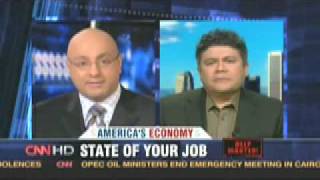
News-style panel (Your $$$$$, 11/29/08) focused on jobs during the 2008–09 recession. Panelists (Lakshman Achuthan, Sonia Alleyne, Louis Barajas) discuss the recession stage and pervasive job losses, geographic differences, short-term outlook into early 2009, and actionable guidance for workers: assess skills/value, manage perceptions and networks, and prioritize cash flow and creditor communication if laid off.
Chapters
Welcome to a special edition of youf money jobs 2009 help wanted.
This hour is not about how bad the job market is. It's about solutions, understanding the current environment, and how to take steps to make sure you are employed for years to come.
And we're going to identify specific areas that need to hire people right now and how you can get those jobs, plus careers that will be hot for the next 1, 5 and 10 years.
So grab a pen and paper. We're about to empower you. This next hour will contain some critical information either you or most likely somebody you know is going to be able to use.
But before we can get to the job opportunities that are out there, we want to understand the current climate.
Brass is a personal wealth advisor. Sonia Alleyne is the careers editor for Black Enterprise. And Lakshman Jason is managing editor of the Economic Cycle Research Institute. Welcome, everybody. Lakshman, let me start with you. Where are we right now in the job situation? Give us the big picture here.
Well, we are probably in like the second or third chapter of a recession. It's been going on all year. It's intensifying as we speak. And you're seeing that in terms of pervasive job losses across the country and across different industries. It's not affecting just one industry anymore. It's pretty much affecting all of you.
Brought along some, some great charts that show kind of where we were in January 28, interning jobs loss, the blue, the blue is job gains. Then when you look back toward, you know, later in the year, you can see that that blue is starting to.
Evaporate, turns to red. You go from a sea of blue to a sea of red. Red is bad. That means you've been losing jobs for the last six months. And that red is probably going to persist for a while. You're seeing the weakness s in from the coasts and the center of the country is kind of hanging in. We know why. It was because oil and farm prices were up and so they hung in there. But we also know that those have weakened. So that might turn a bit more red as we go forward.
For those of you who have not lost a job, we owe, many of us live in fear that that kind of thing could happen. And we've really discussed how it is that you, you maintain your value to your company. But Sonia, it's important to do that, to figure out your value to the company and to realize that if your job is eliminated, it may not be about you.
Yeah, it's, it's exactly right. It's you can't take it personally. What most employees need to know is the function of their job, of course, and how to do that well. But you also have to understand what value that brings to the company. But there's a second part to that. There's the job that is valuable to the company. But then you have to look at how valuable you are.
Right.
To the companies or someone else who can do your job well. And so that talks to how well you're managing your profile in an organization.
Which is you think you're doing a really good job, or you think that your image of yourself in the office is different than other people's image of you. And that's something that's important to think, especially in a time like this.
It's very important. That's why you have to get support or advice from people outside of your immediate circle. And so perception is reality. So whatever other people are thinking about you is actually true. And so you need to talk to your mentors, your supporters, your advocates in the organization, or even have honest conversations with your managers to find out exactly how they really think about you and the job you perform.
Louis Brajas is a personal wealth advisor. Louis, you know, if you are either in a position where you've lost your job or you think you might one of those who've lost your job, obviously your personal finances become a major, major issue.
Absolutely. What happens if you've lost your job? You've gone from crisis, and we have to build confidence. So the first thing you really want to do is figure out what's the minimum amount of money you need to spend per month, and then create some kind of plan to, you know, pay that off again. If you've been laid off or let go, you got to take a look at what unemployment you're going to be able to have, what resources you have, maybe using some, you know, some of the cash from your cash value policies. There's a lot of stuff that you can get done to prepare for something like this.
Let me ask you this, Louis. In many people's cases, when they lose their jobs, many people live very close to what they earn. They spend very close to what they earn. So in a layoff situation, even if you're getting unemployment benefits, bottom line is you're probably bringing in less money than you were and some of your expenses are not going to be met. What's the first thing you do? Do you have a conversation with your creditors and tell them you've lost your job and you may be having trouble paying? Do you Go into your retirement savings if they're in a 401k or an Iraq?
Yeah, absolutely. What you do is you have to talk to the creditors first, you have to talk to the landlord. But what you want to do is you want to use your equity lines of credit, your credit cards first. Because if you also use your, for example, retirement plans, it can be rather expensive. Now we're nearing the end of the year. What we also want to do is start preparing, get ready. I mean, start preparing all the stuff for your tax return. If you're going to get a refund, get them done as soon as possible. There's ways to start figuring out how to attract cash flow into your life because that's what you're worried about when you've lost your job. It's all about cash flow.
I want to talk a little bit about the emotional side of this a minute, but I want to ask you about where, where it begins and how long it happens. I mean, job losses, once we start seeing the job losses, it's really almost worse than that because people have already been cutting back hours. Right. They've already been cutting back on temp workers. They've already been not filling positions that were open. By the time you start seeing the big heads rolling, it's really already a pervasive situation.
Absolutely. I mean, the same way that you would cut back at home if you, if you had cash flow problems, businesses cut back and they look at people in many ways as a cost and they see the sales are down, so they're cutting back on people. This is a real problem for the next couple of quarters, at least, at least into, you know, the first half really of 09, because job growth will lag, whatever recovery there is. And we have all of this effort to kind of stimulate the economy, but all of the business managers are saying, I am not going to hire more people to the, you know, I'm going to try to do more with less, just as any household's trying to do, they're trying to do.
Which means when things start coming back, not everybody's going to jump to hiring new people. And Sonia, one of the things that you have to deal with if you've been laid off, but as you mentioned, even while you're employed, is get very aggressive with your networking at this point, whether it's people inside your company or outside, you need to be prepared. All of us need to be prepared for the inevitable.
Exactly. So if you are laid off, this is a really good time to self assessment in terms of what your skills are, what your talents are and what you can bring to the next organization that you join.
Well, we're going to talk a little later in the show, as we do almost every week now, about the things that you can retrain into if you find yourself in that position, because that's an important one. We've said many times, Christine and I have said that for those manufacturing jobs that have been lost across the country, there's really not much chance that those jobs are coming back anytime soon, not.
In the form they were before. However, there's this idea. Recessions essentially do creative destruction. Whatever didn't work before is going to probably go away permanently. However, in that space, new ideas, new types of businesses are going to form. And if you are keyed into that, you can do quite well on the upside. So that's the opportunity out of this crisis.
All right, Black Jason, thank you so much. Sunny, Elaine, we'll talk to you soon. Also, Louis Barajas. Okay, how are you about to lose your job, how to read the writing on the wall if you are, and what to do.









