Is Your Marketing Organization a Mess with Maarten Albarda
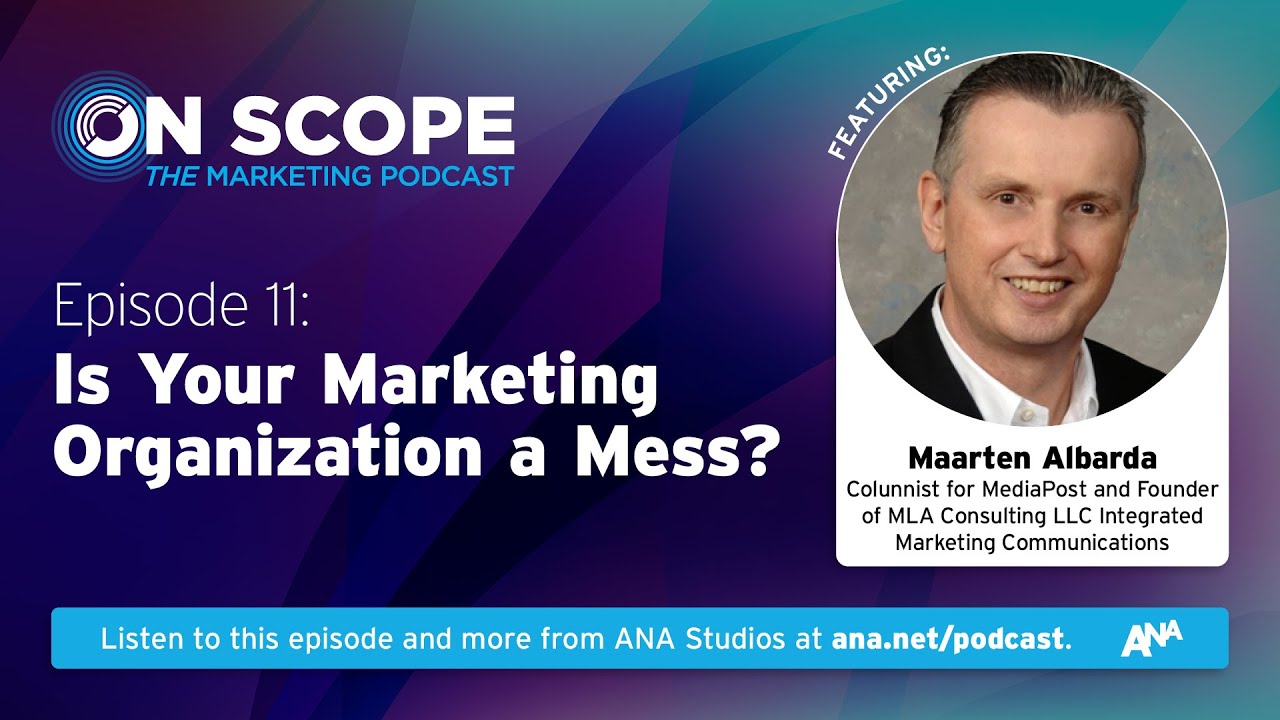
In this episode of the ANA’s On Scope podcast, host Mike Berberich and producer Ryan Dinger interview Maarten Albarda, Media Post columnist and founder of MLA Consulting. The conversation moves beyond the usual “why” of marketing to explore the often‑overlooked “how” – the operational, structural, and cultural elements that enable or hinder marketing effectiveness. Albarda describes a diagnostic approach that starts with surface symptoms (e.g., agency complaints) and drills down using the 5‑Whys to uncover root causes. He stresses the need to design a future‑ready organization by asking where the business will be in three years, aligning structure, capabilities, and agency ecosystems with that vision, and ensuring any change fits the existing cultural DNA. Implementation is framed as a three‑stage consulting process (beginning‑analysis, middle‑plan, end‑implementation) and is highlighted as the most challenging phase due to long timelines (6‑18 months), metric mis‑alignment, and human resistance. Albarda also critiques hour‑driven consulting, warns against swapping agencies without addressing underlying issues, and advocates embedding measurement into the marketing workflow rather than treating it as an after‑thought. The episode closes with a plug for the 2025 ANA In‑House Agency Conference and ways to connect with MLA Consulting.
Chapters
The views and opinions expressed on this podcast are those of the speakers and do not necessarily reflect those of the ANA or its members. On today's episode of On Scope, Media Post columnist Maarten Albarda and I discuss how you can make your marketing organization work for you, not the other way around. Also, Mom, I'm internet famous! All that next on Scope. Welcome one and all to On Scope, the marketing podcast brought to you by the ANA and powered by Audacy, a leading audio streaming app. You can get all your favorite podcasts, music, and entertainment on the Audacy app. I am your host, Mike Berberich, and with me as always, Ryan Dinger, producer of On Scope. On Scope. Ryan, how you doing, buddy?
Hello, Mike, I'm doing great. How are you, buddy?
Well, you know, I'm really, really waiting on the end of New York winter, and it doesn't seem to be coming, but we're gonna keep smiling and keep on keeping on.
We're only in April, you know, it takes some time. Yeah, some time.
Patience. Patience is a virtue. But you know what, I've got something to keep me going today. We're gonna skip our usual marketing news you might have missed because there is a news item that no one should ever miss. Brian, let them know what I'm talking about.
That's right, Mike. An interesting development a couple weeks ago at the 2025 ANA AI and Technology for Marketers conference. Our editorial team has told me that there has been a mention of the podcast. Yes, that's right, Mike. One, Greg Verdino, I hope I'm saying that right. If I'm not, I apologize, Greg, but I believe it's Greg Verdino. He is the Chief Operations Officer and founder of CognitivePath.
Ah, and my new best friend.
Presented at the conference. Let's take a look at what he had to say.
Two of the important things in that first bullet for me are the idea that you create new value for your customers. There was a recent ANA podcast with David Edelman, who had been CMO of Aetna, and he's got a recurring role in this presentation. And he had been at McKinsey and stuff. And I believe he might have used a bad word, but in the quote that I'm thinking of, but he essentially said, if your AI initiatives are not creating value for your customers, don't do them, period. Right. So customer centricity is vital.
So there you have it, Mike. Greg mentioned the podcast at a conference.
I am beside myself. Like, this is a thing now.
It's pretty cool.
It's super, super cool.
I did have one problem with Greg's mention of the podcast, though.
I mean, he could have said how much he enjoyed that episode, but like, you know, he was trying to keep it concise.
That's not it. That's not it. Really? He didn't mention the name of the show. He never said On Scope. And I'm wondering, as awesome as it was for him to mention the show, Do we now need to ban Greg for not mentioning the name of the podcast?
That seems a little—
I'm tinkering with the idea. I'm tinkering with the idea. I think maybe we might have to.
We just— this man just became my best friend. And now you want to tell him that we have nothing to do with each other?
I'm not saying that, but it would be important to say the name, don't you think? Listen.
Could have helped.
We are really trying to get out there in every corner and not gonna lie, could have helped, could have helped. But I don't know, man. We didn't say any— he didn't know. He was just bigging up. He was inspired by some great conversations and felt compelled to share them with a room full of marketers.
Very true.
I think we need to be a little more judicious in our approach, at least this time.
You said something there that has me doubting myself. You said he didn't know, and that's very fair. We've never made this rule. Yeah, we've never said this outwardly, but I think we can make a rule now. So here's what I'll say. Hit me, Greg. You're good. Thank you for mentioning the show.
You're the best.
Thank—
we really honestly do appreciate it. Yeah, but if you're somebody who's presenting in public in any forum going forward and you want to talk about the show, which we appreciate— yeah, please do. Please, please talk about it. If you do not say the name, You will be banned from On Scope.
You're cut off.
Is that fair? I think so. We'll let it slide with Greg. Yeah. But we're going to use this as a learning opportunity.
There you go. Keep our names in your mouth. How about that?
I love it. So, Greg, thank you again for the mention. Super cool. Honestly, I was really happy they did it. Yeah, I'll put it aside. You know, I'm glad that we don't have to ban him.
No.
But we will ban you going forward. You know what?
Tough but fair.
That's how I try to operate, buddy.
And speaking of operations, a brilliant segue right there.
Yeah, fantastically done.
Uh, I—
You're getting better.
Yeah, we're crushing this. Um, our guest today is a Media Post columnist. He is the co-founder of MLA Consulting, and he's here to talk to us about operations and organizations and how they should be empowering the marketers on your team, not getting in the way. My conversation with Maarten Albarda is up next. Welcome back to On Scope, the marketing podcast. We talk a lot about in this industry, we like to focus on the why, you know, Simon Sinek gave us that, that beautiful little follow the why. But I think one of the very most important things gets lost a lot, and that's the how. And I have got the perfect guest to help me unpack the how of marketing. So I am so happy to welcome to On Scope Maarten Albarda, the founder of MLA Consulting. Maarten, coming straight from the UK, thank you so very much for being a guest on the pod.
Yeah, yeah, thank you for having me. And yes, from the UK right now, but that's not my home base, right? So I'm actually here visiting, but we're doing the— technology is wonderful, we're doing the interview as it is. And so hopefully the Technology won't let us down.
I have every confidence and really do appreciate you talking with us. I know you are a busy man, so let's jump right into it. As I said at the top, we are talking about the how of marketing, and that is really where your, your business sits. You help brands figure out the how of marketing. Can you unpack that for our listeners?
Sure. Yeah, as you said in your introduction, we, as an industry, we spent an enormous amount of time, and rightly so, on what we're going to say, where we're going to say it, how often, how much, etc., right? So we spent a lot of time and effort and money on figuring all of that out. And in 2013, when I left corporate America and started for myself, I really had this idea about one thing that sort of often is forgotten is, but how do I make sure that what or when or how much I do this whole sort of marketing strategy is, is right, is rightly organized, that I have the right structure, I have the right resources, I have the right way of working, I have the right external agency ecosystem set up for what I need or what I would like to accomplish. And that was really so like the start of the idea of focusing on the how of marketing. And today we're finding ourselves in a world where that is maybe a little bit more common, but it is still something where a lot of marketers do not spend a lot of time. And so 10 years ago it was completely kind of unheard of. We now get a much more willing ear. But it is still a place where marketers tend to not spend a lot of time thinking about sort of how do I make sure that I'm set up for success?
Yeah, and that's a shame because it's sort of the foundation of the house, isn't it? It's really upon all other things, you really need a sturdy foundation and an organized approach. So I'm very glad, like I said, we're having this conversation. Now, we spoke earlier and you kind of took me through some of the experience experiences you've had walking into a brand. And to me, it really likens itself to a doctor where a patient comes in and they feel this and they're a little tired and this is kind of achy and those are the symptoms, but it's the doctor's job to see through that and beyond it to the root cause, because that's the only way we're going to make that patient better. So how, what line of questioning do you use when a brand comes in and they, they say, this is what's wrong. And from your experience, you can tell, I think that's just the tip of the iceberg.
Yeah, no, it's an apt comparison. And very often people come in with either vague complaints, right? And that's probably something a doctor would see as well. Or they have— they think it's one specific thing that's sort of bothering them. My doctor always tells me, stay away from Dr. Google, right? Because it never tells you really what's going on. And then you think you have something and it really— you really don't. But, but yeah, so what, what for me, what is really important is to start to start to understand and start to dig a little bit into, but what is really going on, right? So, so some, sometimes people approach me and say, oh, my agency sucks and they're so terrible and it's never right and it's too expensive and it takes forever and it's, they don't listen or whatever, right? I mean, there's a whole, this whole sort of complain scenario about agencies. And then as you start asking questions, is that, well, yeah, maybe your agency sucks, but maybe it's because you suck a little bit as well, right? Because you're always late or you're always changing the brief or you're not clear in your briefings or, you know, any number of other kind of reasons what sort of leads to an agency not being able to perform at their best. That's one example. It could also be that within your own structure, you incentivize for things that you say you do not want, right? So when you say I'm not really always interested in the lowest cost, but you incentivize an agency for lowest cost, then that's obviously the first motivator that they're gonna work on. And so then, you know, you create your own environment that is not optimal. So the way to go about it is that Yes, let's start with that thing that you think is ailing you or that thing that you think is not working. But then let's really understand sort of the deeper sort of issues. And the way I do that is my son is now 24 and he's a working young man. But when he was about 5, he went through that phase where he just asked why about everything, right? Can you go brush your teeth or did you brush your teeth? Why, right? Did you do this, that, or the other?
Why?
Everything was why, right? I mean, it's a phase that kids go through, but I thought it was very illuminating. And there's also this idea of the 5 whys, right? Or the peeling of the onion, et cetera. But I do think there is a lot of power in the question why, right? And so digging from the outer layer of, you know, the first indication of we feel like we need to talk about something to really understanding, well, why is that happening? Or why is that happening? Or why is it not happening, et cetera? I feel that there's a lot of power in that line of questioning. And that usually brings you to an understanding of, okay, I'm beginning to see what maybe some of the issues are that we need to work on. And it's seldom just one.
Oh, absolutely.
Absolutely.
Oh, and I should also say it's seldom just the agency, right? Maybe, maybe. But it may also be, like I said, right, that the issue with the agency is not actually the cause, but is a resultant of.
Yeah, absolutely. And also you mentioned that when you first approach brands, when you first begin to work with them, a lot of their view is in the present, obviously, but looking backwards, and that's not always the easiest way to kind of start to work on the solution to their problem. So is there another level of questioning that you approach after you've kind of broken down that why to its core essence?
Yeah, it's a really important point because we have a tendency to try and solve for what is problem right now, right? So we tend to solve for the thing that is right in front of us. But when you start thinking about process, about infrastructure, about organizational structure or capability development, et cetera, all the things that you need to do in order to maybe address some of the issues that you're suffering from today, is that it is really important to do that with a forward view, number one. So I tend to ask what is gonna be important for you over the next 3 years, right? Because it might be that today you're organized for— I'm making it up— buying lots of media. But what you really need is creating lots of content, right? Right. That then gets placed in that media. And so that is an evolution of your needs today that you can see happening, that you can see coming, and you're not set up or organized or structured or in any kind of way ready for that or not ready enough for that. So that, that is really important. The other thing that comes with that, so not only looking, let's say, 3 years out, is to also really be honest with yourself about the fact that what I have today may not be perfectly suited for what I have tomorrow. When I talk to CMOs or other marketing leaders, it is very often clear that if I would give them a blank sheet of paper and say, design the best organizational model and the best process for that organizational model that you think would be most suitable for what you need, they 9 out of 10 times draw something very different than what they have today, right? And, and so what most marketers have is what is sort of organically grown into what it is today, right? Influencers become important. So I'm gonna hire myself an influencer agency or set up an influencer group within my, within my marketing department. A new type of measurement becomes important. Well, let's make sure that our insights people have somebody for that, either externally or internally. So I liken that to the Christmas tree, right? We keep on hanging more and more ornaments into the Christmas tree, but at some point it just becomes a jumbled mess of a tree, and it really sort of is no longer really sort of capable of carrying its own weight, and it just looks like a mess. And so then you need to sort of say, okay, You know what? I'm putting everything to the side. I'm buying new lights. I'm doing silver and purple baubles only, et cetera. And so you basically organize it, reorganize it for its new purpose. And that's what is really important to sort of think through as well.
Yeah, I absolutely love that analogy because, you know, you can understand it because change happens so quickly that the idea of reorg— reorging every time a new shiny object pops up is a little terrifying, but that's not really what we're getting at. So, so now we've landed at the diagnosis. We've gotten beyond the symptoms. We're seeing kind of the root cause or causes of the problems. What are the next steps you take?
Yeah, so for me, when I started this business, and again, my business is very closely associated with Flock Associates out of London. When I initially started, I helped set up the US business for Flock Associates and helped us sort of lift off. And one of the, there were a couple of key principles that we felt were really important and that are very near to my heart to this day, which is number one, I don't like the idea of a consultant, a consultant's role whose main target is get as many hours as possible, get a foot in the door and stay in, right?
Yeah.
For me, there needed to, and I was at the receiving end, right? When I was a marketer, I was at the receiving end of lots of different companies that, you know, consulting firms that came in and they were really good. But, but it, their main objective was a bit like a law firm, right? We want to write hours. So I'm not happy with that. So one of the things that we chose as a principle is there needs to be a beginning, a middle, and an end. And the end part is the most important part because that's where you make it happen, right? The beginning is the analysis. The middle part is the plan and the end is the implementation of that plan. And so at the end of that plan, something needs to have happened. I need to have a different org structure. I need to have a different way of working. I need to have maybe a different agency exist. Something or a couple of things need to have changed. And that then needs to be the new sort of the new now, right? So for me, that process to get to an end product with an end deliverable and then sort of being done and be out of the door is really important. And I also say that because I've been at the receiving end of some really smart analysis from major consultancies, but they couldn't and they weren't involved in the implementation. It was kind of like, well, here it is and good luck, right? And because we have a day job, 9 out of 10 times those plans ended up in a drawer somewhere because it was a brilliant analysis and potentially some good suggestions, but I don't have the time and the bandwidth to go and do all of that. So again, making sure that there's a beginning, a middle, and an end. And the end part is the most important part because that's where you make the actual change. I also tell clients that when you go through that process, you go from hard to harder to hardest, right? It is hard to be honest with yourself as an organization and to say, okay, here's what's ailing me, right? It's a little bit like an AA meeting, right? Hi, I am advertising so and so, and my problem is this, right? So It can be sometimes a little confrontational, right? So, and we always say, look, again, you are where you are because of, you know, maybe a decade or more of choices that you made. And you've now actually come to the realization that it's no longer fit for purpose. And that is a good thing. That is a good realization. So don't feel guilty about maybe what is all wrong, but feel excited about we're doing something about it. So, so that's the hard part, right? Then the harder part is to actually figure out, okay, so now what are good solutions? To address some of these problems. And that's a little harder because now you're talking about, you used to do this and now maybe go do that, or you used to work with this group of people or this group of resources externally or whatever. And maybe we need to change that to that, right? There's, there's some pain in that, right? There's pain in maybe saying that, that you need to let go of some things and, and build some things. And then the hardest part is actually doing that, right? And to be honest, I see it most often struggle in that third part, right? The first part, relatively easy, right? The analysis part, because people like to talk about their problems, right?
So exactly. It's like those first 3 weeks of therapy. You're just like, this is great.
You sort of lay it out on the table and it sort of feels very cathartic and they're like, oh, thank God. It's, you know, we're finally talking, right? Yeah. So that's good. And then the second part, you know, gets a little harder, but, but still people can sort of because, you know, people like to problem solve. So there's usually some decent enthusiasm about doing that part. But then the hard part is, oh, oh, oh yeah, now I actually need to go do this thing differently or work in a different way or find a different partner to do this work with. And that is obviously the hardest part. And that's where I very often find that the struggle is the hardest.
That makes a ton of sense, and we're actually gonna dive into some of those complications when the rubber meets the road, right after this. Ryan.
Yes, Michael.
I've been watching you attentively during this episode, as I'm known to here on Scope.
It's very unsettling.
Yeah, it's the atmosphere I like to cultivate. Anyway, I'm wondering if this conversation has you thinking about the structure of your marketing org and how to fix the inefficiencies of your agency relationships or improve your in-house Mike, to be perfectly honest with you, I'm constantly thinking about the structure of my marketing org and how to fix the inefficiencies of my agency relationships.
It's keeping me up at night.
I can read it in your eyes, man.
Oh, you know me too well.
Yeah, and I'm very happy to tell you that I've got a solution for you.
Thank goodness.
We're going— yes, you're taking back the night. You're gonna rest easy.
The day I've been waiting for.
Well, this is it, buddy, because The 2025 ANA In-House Agency Conference is almost upon us. It is happening June 11th through the 13th.
Wow, right around the corner.
Get this, in Nashville, Tennessee, and virtually, but who's not gonna want to take the trip down to Nashville?
Nashville, one of the most underrated cities in America, I believe.
Absolutely.
Very fun, big for bachelorette parties, even better for ANA conferences.
Yeah, absolutely. And there are so many reasons to head down to Nashville. Amongst them is hearing from top in-house leaders from— this is a murderer's row of brands we've got here— Coca-Cola, Bayer, Progressive, Wells Fargo, Delta Airlines, Molson Coors, Newell Brands, Edward Jones. This is like everybody you want to hear from in the same building across 3 days. You really need to get yourself there, especially if this conversation is resonating with you. You know, if there— you've got to get your infrastructure working working for you, dog. You know, not the other way around. And this conference is where that happens.
Yeah.
So if you are like Ryan and this has been plaguing you, take a deep breath and check out the full agenda and register by visiting ana.net/2025in-house. And now back to our show. Hi everyone, we are back with Maarten Albarda, the founder of MLA Consulting, and we were just talking about how the 3 steps of really diving into the how of marketing and fixing some of the organizational or partnership ailments of a brand goes from hard to harder to hardest, and here we are at the implementation stage. What are some complications and barriers to implementation that you've seen that might not be so obvious to marketers? I'm sure a lot of our listeners have bubbled up a few obvious barriers to the implementation, but what are some things that you've seen that have kind of thrown you a little bit for a loop?
Yeah. So, so one thing that I see happening a lot is that these things take a little bit of time, right?
You can—
a complex change process. And it's, again, let's not over sort of— let's not build the fear factor up too much. But it is more complicated than just, you know, doing a fairly simple sort of change in sort of like an ad campaign or something like that, right? Or tweaking a search campaign. So these things take a little bit of time. The fastest I would see some of that change happening is 6 months. It can also take 18, right? Depending on scope and scale and how many markets or how many brands or et cetera, right? And so, so that, that, that will determine, uh, the time it takes. 18 months or even 12 months in marketing land is an enormous amount of time, right? Yeah. If you're, if you're lucky, you're still with the same, same CMO, um, and, and some of the same brand managers, but maybe not, right? And, and that can happen fairly quickly. And so what we've often seen is that the time that it takes, the length of time that it takes can work against the implementation of the plan because people in marketing especially, they live on sort of very short sort of timelines. So making sure that an organization understands we're gonna have to sort of stay the course a little bit. And make sure that no matter what happens, we sort of, we do this thing is one of those things that makes it challenging. And I've seen it sort of go wrong on that point because, you know, changing the organization in terms of personnel and then sort of appetite changes or the new person coming in has new ideas about it. And that can, you know, the problems are still usually the same, right? I mean, if there's a new CMO or a new senior vice president of brand category XYZ doesn't make the problem go away. It just means that somebody else now leads the, the quest to sort of address it. But anyway, so, so that, that's, that's one area. I think a second area that I find, and, and I refer to it briefly earlier, is that sometimes your own metrics or your own way of measuring success as an organization stands in the way of bringing the change that you, that you tell yourself you want, right? I gave the very simplistic example that for instance, if, if in media or in creative production, your goal is to always get it at the lowest cost, right? Your agency partners will be aware of that, right? And they might even be incentivized on that, right? In their agency evaluation or in their bonus structure, you might incentivize them or your own people on delivering at the lowest cost. And then if you're at the same time, if you're, if your marketing problem is all about brand awareness or brand reputation or whatever, well, that has very little to do with lowest cost. It may be, it may be supported by something that is cost efficient, but cost efficient is not necessarily lowest cost. If you incentivize whatever part of the infrastructure is on lowest cost, guess what? They'll chase the lowest cost first before they do something else, right? And that can work against you. So it is really important to figure out, well, how do you make sure that your organization is sort of pursuing the things that you say are important to you and is recognized for doing that so that they feel like, okay, there's incentive and there is, there's reason to, to, to pursue those, those changes because it will help me to be recognized as a productive member of the, of the team. Those are two, two things that we see a lot as a challenge. And then there's, of course, there's all sorts of other sort of more practical challenges, which I alluded to, right? If the organizational structure is really kind of either bloated or out of shape or whatever, sometimes organizations have difficulty right-sizing or restructuring that because loyalties, because fear of the unknown. There's a number of it, but that can get in the way as well. So if you need to do something fairly dramatic in either internal structure and therefore people's roles, right? We're talking about human beings that can get in the way as well.
Yeah, absolutely. And you mentioned something in a previous conversation that that once you step back and think about it, it's very obvious, but it doesn't really hit your intuition, is that you have to work with the culture that exists. I know a lot of time people start like, well, then we need this culture, this culture, that culture. If you're working to make organizational, significant organizational changes, you need to do so within the context that exists. You can't really be aiming to, you know, slay that double-headed dragon at the same time. Is that right?
Yeah, no, it's very true. And again, especially in that sort of first phase of the project when I always call it, let's say, uninformed optimism, right? So people think, hey, we're finally, we're going to change and we're going to do this thing and it's all going to be better. And it will be, right? I mean, that's the goal, that's what you're trying to do. But especially in that phase, people tend to sort of be maybe sometimes a little overly optimistic in terms of how quick or how much they'll be able to do. But having said that, they sometimes then also ask for things that are just a poor fit with who they are as an organization. So again, I use very simplistic examples just to make the point. But for instance, if an organization is structured very much as a top-down decision-making organization, then building a bottom-up solution that might be sort of answering some of the other sort of pain points that the organization is struggling with is just not gonna work, right? Because it goes so counter to how this organization is sort of organized, so much counter to what is in their DNA that it's not gonna work and vice versa, right? I mean, if the organization is very much kind of like a bottom-up organization, don't come in with a solution that is very much a top-down kind of eat it or die, right? And then it just won't work. So I always say, yes, stay somewhat within the, let's say, the cultural DNA of how the organization functions. But at the same time, push it out a little bit. My analogy that I use is running shoes, right? I mean, the organization typically, you know, they're running in their running shoes and they're comfortable with those running shoes, right? They, they are nicely supple and smooth and they've had them for a while and it feels like I'll put them on and yes, these are my shoes, right? It just feels good. But the, but the results are sort of not great with the shoes anymore. So we'll design you a new pair of running shoes. When you put those on for the first time, it will feel a little different, right? Because it's not your usual running shoes. It might, it might feel a little different.. But my promise is that if you sort of really design those running shoes for exactly what kind of new goals you've set yourself, you'll be running in those new running shoes much better than you will in your old running shoes. And so yes, it might hurt a little bit the first couple of rounds, right? Or it might feel a bit pinchy or whatever, but they'll be your best new running shoes ever. That's at least the goal. And if they're not, then you need to take those shoes back into the store and say, hey, that didn't work and we need to do something different. But that's also the example, right? So if I would not design running shoes, but I would all of a sudden design a pair of very comfy beach flip-flops, that's completely counter to what you're trying to do, right? So it needs to be the right— it can hurt a little bit. That doesn't matter as long as we don't design something that is completely unfit for purpose or takes it way too far outside of, let's say, the area of comfort, because it will— it's just going to be counterproductive to what you're trying to accomplish.
I love that. And like I said, it's, you know, when you take a step back and look at it, it's not the most revelatory thing in the world, but I think it's something a lot of folks tend to get wrong or tend to assume that they can just kind of change everything in one fell swoop. So I'm really glad that you, you touched on that. I appreciate it.
It's very true. And, you know, we see it especially with agencies, right? So clients get frustrated with their agency and again, you know, Very seldom is it just the agency that is the issue. But, but okay. Right. So, so, but they, but they get frustrated with their agency. So then they come and say, well, we want something completely different, right? We've always had the big networks. So find me some funky new sort of independent agencies, or we've been with sort of tech-heavy agencies. So now find me something that is, is not about tech, but it's all about creative and or whatever, right? They're looking for something, let's say, the opposite or far away from what they have. And while I understand that question, very rarely is that, let's say, at the far end of where you are today, is that there is a doable solution. Because I can guarantee you that if you would find all of a sudden that very different agency, but you do not address some of the fundamental issues that are maybe at the core of what is really sort of causing the frustration. 18 months from today, you'll, you'll again be very unhappy because now you've got an agency that is very unfit for your purpose. And it's just frustration on both ends and it will usually, it ends in tears and it wasn't the solution. And so, so it is much better to find something that, okay, so let's find that, that other or that different, but within the confines of the DNA or the soul of your culture.
1000%. Yeah, I love that. And I love the idea of pushing it out and kind of breaking in the organization to a little bit of newness. I just absolutely love that. Now, you touched on measurement before, especially in the agency brand partnership area. You know, I think legacy has a lot to account for with these kind of off-the-mark measurements. How would you suggest marketers kind of rethink or assess what they're measuring right now when what they really should have their focuses on?
Yeah, for me, again, I focus with, with that on how, right? So what you measure, I cannot really determine what, what is a good measurement for, for a marketer. I mean, I will have an idea and I'll certainly won't be shy to, to talk about that. But, but it, for me, it is more about how do you make measurement part of your sort of integrated DNA of how you do marketing. What I see way too often is that we spend enormous amounts of money on the ideation, the creation, the production, and then the implementation. And we spend maybe 10% or less of our sort of marketing budget on finding out Well, did it actually work? Right? One of the worst things that as a marketer you can say is that was great. Let's do it again, but bigger. Right? There's so many decisions in that, in that simple sentence. And you hear it a lot, right? Something was potentially great or it was at least perceived as great. But let's define by what it was great, right? So let's understand what would, what, what would make us say that, that we actually feel like, yeah, it was great. And because here are the 4 or 3 or 10, whatever key metrics that we were trying to influence. And look, they all moved in the direction that we wanted. Great, right? But also let's do it again. It's a huge decision, right? I have worked with marketers where they were doing something and they were like the first ones out of the gate to sort of find this new or different or innovative way of connecting with consumers. As a result, if you are that first one out of the gate, very often then a lot of your competitors will follow, right? They'll do something similar or they'll, they'll, they'll react or respond. And so the, for, for next year, it may not be that unique or innovative or new or different thing so much anymore. So let's make sure that we really evaluate how we do that work and then make a decision about whether that is still the right thing to do again the next time around. And so let's do it again is not necessarily a given for me. And then, but bigger is usually also something, right? If it was deemed a success, then we want to do more of it. Well, but sometimes the way you did it is actually why it was successful and more might not lead to more success. And sometimes maybe you need to conclude, well, let's do it again, but maybe a little smaller because either there's more competition now or maybe with a little bit less, it doesn't have to cost as much time and effort and to get it done, et cetera. So, so yeah, measurement is really important. But what is important to me for measurement is that you build it into your process as a step and not sort of, you know, do some casual, let's do it again, but bigger at the end. But let's, let's have a structured end sort of step in your, in your work process where you do the measurements, have set goals against which you will determine your success, and then have as part of that step also a discussion and a decision about do we do that again, do we do it bigger, do we do it at all, etc.
I love the nuance of that because you're so right. It's— and a lot of this is now, it's occurring to me, a lot of this is impulse control. You know, you see success and yeah, hit the button, hit the button, hit the button. But you really need to know the contextual nature of that success. Maarten, that was just brilliantly put. I really do appreciate it. Before we wrap up, if people are having as great a time— and I feel like this is one of those episodes that my marketers are going to have to just run back and listen to a second time because there are just too many gems times lying in the conversation we just had. Before we wrap this up, how can people learn more about MLA Consulting and more of what you're up to?
Sure, all you need to do is just Google my name and you'll find me. I have a website, I'm on social media, I'm, I'm all the usual, uh, channels. I, I write on media posts every other week, so you'll find me. Just Google my name and you'll find me, and, and we can get in touch. And as you can probably notice, it is a topic near and dear to my heart, and I, I can talk about it for hours. And, um, I feel very fortunate that I can help marketers figure stuff out, untangle and rewire the Christmas lights. And yeah, so if you want to find me or you want to come and have a chat about it, I always like to talk about it. So come and find me.
Excellent. And I can vouch, Maarten and I have had several conversations right now and it really is the passion you bring to it, I think, is part of the reason that you're so successful in getting big organizations to kind of follow you down this path all the way to implementation. Speaking of passions, let's close out this episode. Maarten, could you share something with us that's got you excited, that you're passionate about? And I mean anything, anything professionally or personally. What's got you excited nowadays?
Yeah, so professionally, I always, always enjoy a new challenge, right? So whether it's learning a new industry or a new business, you know, a new client or whatever, I always enjoyed because I learned something every time. I've been fortunate in the last 10 years to work literally across the spectrum of business to business, business to consumer, fast-moving, high-end service, financial. I mean, it runs the gamut and it has been fascinating because what is really cool about it is that you get to work with usually pretty smart people, right? And really interesting brands and businesses. And I love to learn. I always say that, you know, I'm eternally curious. And so that gives me opportunity to help people with that. At the same time, I also really enjoy figuring it out, right? And trying to really be purposeful in what the solutions might be because I feel they need to work, right? If it's just, you know, empty words or half a plan, then for me, it's not been great. And so I really enjoy the the really making something happen and hopefully giving people something that they feel better about. So that's professionally. Personally, I am looking forward to the year 2025. I will say I'm looking forward to it with both excitement and trepidation. It is going to be a, in many respects, a very new year in a very kind of new world. And so So on the one hand, I'm excited about to see where that is going, but I'm also fearful for what it all might mean because it's just a big unknown and I'm as human as the next person, right? Ultimately, humans don't like the unknown, right? And that's also why change is so hard in a marketing organization because yeah, it may not be perfect how we're doing it today, but at least, you know, we're still getting shit done. And so, You know, that's also a little bit about how I feel about sort of the world around us at the moment. Yeah, that may not be perfect, but, you know, we're still getting shit done. And so I'm kind of curious to see where that is going. And then on a very personal level, it's, you know, we've just as a family gone through some profound change. Son has left the house, is now literally standing on his own legs. And so we're excited and interested to see how he sort sort of forges his own path in the world now as an educated and employed young man.
Well, with your guidance behind him, I have every optimism. Maarten, thank you so much. This has been such an incredible conversation. It has been an absolute pleasure to have you on Scope. Well, friends, here we are, another episode of On Scope. OnScope, the marketing podcast in the books. I'd like to thank my guest, Maarten Albarda, for helping me break down the how of marketing, a critically important piece that we do not talk enough about. As a reminder, if you have an idea for a guest or a topic, we would love to hear from you. Our email is onscope@ana.net. And finally, Your moment of marketing meditation. Take a deep breath, relax your shoulders, and consider the following words from artist Tanya Allison: Being organized is all about the ABCs: Awareness and Action, Balance and Beliefs, Choices and Consistency. Think on that, and we'll see you next week.
Week.