Manish Chowdhary Speaker at University of Bridgeport Innovation Series
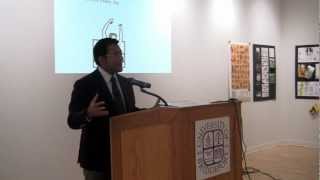
This is a YouTube video titled "Manish Chowdhary Speaker at University of Bridgeport Innovation Series" recorded in October 2012. The content features a keynote-style talk by Manish Chowdhary at the University of Bridgeport's Innovator series event, where he shares his entrepreneurial journey, lessons learned from failures, business strategies, and insights on leadership and company culture. The event includes introductions by Carolyn Conant and Marijane, with Manish Chowdhary as the main speaker addressing an audience of students, faculty, and community members.
Good evening. This is Carolyn Conant. On behalf of Go E Cart, we're here at the University of Bridgeport for their Innovator series event, Tales from the Crypt. This evening, our featured speakers will be our very own Manish Chaudhary as well as Neil Rosen. Both men have been in the software industry. They are established entrepreneurs, and we're looking forward to hearing their wisdom, advice, knowledge, as well as, of course, their tales from the crypt and events and things that they have learned from the audience. This evening will be a healthy mix of students, faculty, as well as community members. Following the featured speakers event, we will have a networking hour, and we're looking forward to meeting a lot of great community members this evening.
Manish Chowdhury with us, who is a UB alum and started his business, Go E Cart in a dorm room here at ub. So we, like, totally own this guy. We're not letting him go anywhere. And thank heavens he hasn't. His business is in downtown Bridgeport now, and his partners are two UB alums. It must say something pretty decent about this guy that after all of these years, he's got the same partners who were roommates and friends at the University of Bridgeport. I'll let him tell you the meeting part of the story, but welcome.
Well, thank you, Marijane. Welcome, everybody. So I did indeed start. That's a true story. We did start a business at the University of Bridgeport, bodine hall, room 816. And Edina is there somewhere in the crowd. She can vouch for it. That was about 12 years ago. And eventually the way the business started was we started selling computers, assembled computers on campus. Back in those days, there was a market for assembled computers. Students wanted cheap computers, and we built them, went every Friday with a friend to the computer store. The computer fair got three computers assembled. It sold it over the weekend, collected the money, and then we collect orders for the following week and come back and do the same thing all over again every weekend. And the reason why business was born because we were selling quite a few of these, and all of a sudden, people demanded receipts for their computers that we had never, ever produced. They're like, they wanted printed receipts. So we started printing them, and then we were told that we're supposed to pay sales tax to the state of Connecticut. I'm like, wow, now that's a new problem. Now we have. That's the way how the business began because we had to pay taxes. So now you know you can never escape taxes. And that's why I'm here today. Second, I used to come to this particular building for my music class about 12 years ago. I think partly because it was Wednesday, 8am early morning. Back in those days, I thought 8am was really early, or maybe the professor liked me so much, or I just couldn't make it at 8am on Wednesday as frequently as I was supposed to that the professors actually compelled me to attend the same exact class the following semester. So I thought, practice makes perfect. So I will attend it one more time in a subject that wasn't one of my favorite. What I discovered later down the line was that practice actually makes permanent. Practice doesn't make perfect. And what makes perfect is continuous learning. And the topic is great. From failure comes the opportunity to learn. And opportunity to learn allows us the opportunity to apply that learning towards something that we can eventually succeed with. So that's my story that I wish to share with you today. There's a number of different failures, you know, starting from Ub, right? We. I had no idea what I was going to really do except to dream, you know, and I think that's very important because it turns out I didn't know that back in those days that you have to start with why that turns out to be the biggest areas of motivation, not with what or how. Example, I could say, we build computers. Our computers are great. Would you like to buy one? That's one way of doing it. The other way of doing it could be we wish to challenge the status quo. In order to challenge the status quo. We build beautifully designed computers that are simple to learn and easy to use. We happen to make computers. Would you like to buy one? So that's the Apple story, right? The reason why everybody's proud to wear that white headphone coming out of their sweatshirt is because they want to look cool, not because they want an MP3 player. And it took me a long time. I mean, I'm still learning to recognize that that's the learning as an entrepreneur that we have to go through. You know, what Ub gave me was knowledge. What internships and my previous jobs gave me were skills. But what you have to bring to the table with your own efforts is wisdom. And that's something that applying your knowledge and skill and applying your layer of judgment is what we need in order to succeed. And that wisdom is a self learning, continuous learning prophecy that I have. I'm still on the journey and I think it's going to continue forever. I don't think it's ever going to stop. So some of the mistakes that we made for Example, what are failures? When we started, you know, we thought we could change the world. You know, we really thought that, you know, this was back in dot com, 1999, 2000. Everybody was getting funded. We thought if we had a great idea, which we did. But we had no experience, no management team. We didn't even know how to write a business plan. I'd never attended a business course. And so we thought, we'll go head in. We started doing research and we started putting together this business plan. We went and developed this great software in our head. We applied for a patent. We eventually got that patent many years later. That's one way of doing it. Today's way of doing it is slightly different. In fact, there's a whole concept of what we call minimal viable product. What would I do today? A lot of great stuff that Neil said I would not build a product first. I would actually go and sell the product before I build it. An example of that, I don't know if you know the story behind Diapers.com these group of people, basically what they did was two founders on the kitchen table. They found that it would be really cool to sell diapers. That's a big pain. They were newly. They became new parents and they found that the whole diaper business was broken. You know, they. People didn't like to carry these bulky stuff coming from their shopping trip and so on. And they felt that they could deliver this product cheaply, better, cheaper, faster online. So what they did was they built up this website on GoDaddy, $7 a month, put up every brand of diapers out there, start collecting orders, $7 a month. They built this website. They told a couple of their friends, they loved it. Friends started placing orders and they started getting. Every evening they would go and go to the local Walmart. They'd go pick out the exact product that the customer bought, came back, packaged it $6.29, take it to the UPS store out the door. I mean, they were losing money on every one of those shipments. Just say, is that a great business or What? So from 10 orders a day to 100 orders a day to 200 orders a day. And they were now going and clearing out the entire shelf and the entire neighborhood. There were no diapers in the entire town that they lived in. That's the new way of doing business. What they did was they proved their market. They basically confirmed that the market existed for their product or service. I didn't do that. I went and built the product the way that I was taught or I thought was the right thing to do. And then we spent years trying to fix it. That's wrong. It's completely upside down. Why would you spend all the time, energy, resources to build something in your head? So the new way, if I were to do it today, I would actually go and sell the product, what the customer is willing to pay, and then go and build the product. And it's the concept of minimal viable product. And it's a continuous, you know, selling is part of the product development process, customer development process. So that's kind of the business model, strategy over commitment. That was one problem. Because entrepreneurs, we think we are superheroes, right? You know, everybody thinks that they can do everything. And I thought exactly that. You know, anybody comes to me with any idea, yeah, great, you know, we'll try something with it. Bad idea. Really bad. You know, what happened was then I found out like a couple of years ago what Warren Buffett says, the difference between successful people and not so successful people is successful people say no to almost everything. So I think that's the concept of being super focused. And I think as an entrepreneur, just because it's in our DNA to think that we can do everything, that was one of the things that I learned. Now I don't shy away from saying no. Hiring and recruitment, that's another big area of challenges that. That I faced early on. Made terrible mistakes, a lot of them. Recruitment and hiring. That's basically. You can only take the business so far on your own. Ultimately, you need people to execute. And it's not the problem with the people. You know, the problem is people always complain that I don't have the right people. No, the real problem is, and I'll use none of this, is my saying, by the way. This is all 100 years of management science that I have just gathered a few nuggets. In the words of Jim Collins. Collins, who's a very popular author, you got to first get the right people on the bus, the right people, the wrong people off the bus, then put the right people on the right seats, and then you figure out where to drive it. The people that got on the bus simply because where the bus was going, they're not the right people. If the friends that got on with me thinking that I was going to do IPO four years down the line, and when it didn't materialize that way, they went off the bus because they didn't join me or they didn't get on the bus knowing where we. They got on the bus knowing where the bus was going. And if There was a detour or there was a change of plan. The people, the right people are the people that get on knowing who else is on the bus because they trust and believe in those people. Because they know that if I'm with those people, eventually we will get someplace great. We don't know when or how, but I trust these people. Those are the people that are going to stick to thick and thin. So those are some learning that I never had, which I realized later. And that plays a great role in your culture of your company. Culture, and it's a big word. You know, we hear culture, the books written about it. Culture is you. This basically comes from the founder, comes from the founding principles of the organization. It's what you believe in, what you truly believe in. It took us a long time to realize to be comfortable in our own skin. Comfortable, me, comfortable in my own skin. Because as a young guy there was always pressure to be somebody else because those are the great successful people. So it was always about how can that person, or I want to model myself after that person. No, I think we got to model myself after me. I'm going to learn from that person. But that's very hard to come through that grueling process of getting comfortable and knowing what you truly believe in. And then you hire the same people that believe in what you believe. When you hire the people that believe in what you believe, I think you get their passion, you get their energy. There are a lot of other stuff. Founder versus CEO. I don't know how much time we have left. Okay, two minutes, maybe one. So that's another founder versus CEO. I mean, one thing I learned was a great product does not mean a successful company. And that's a mistake that we all often think if we build it, they will come. Now we have to. A great product does not translate into successful company or we might have some early luck, we might be able to sell a few. But when you try to grow this business and scale, you're going to run into a lot of growth challenges. So you have to take the time up front to figure out what are you building, what's your end game, what's your exit. You got to think about that very, very early and then build accordingly and then play to your strength. I mean, this is one thing that again, I have every possible self improvement book on my bookshelf. But what I realized that if I improved in every area that I was weak at, I'd be at best mediocre. But if I improved even 10% in the areas that I was great at I would be unstoppable and so I think there's try to limit the areas that you constantly try to overcome but I think I'll encourage because we are reaching an area of extreme specialization. You know we are getting away from the generalist world that's my and you'll have to bring in people that complement you don't try to do everything that's. I've tried it for a long time, it doesn't work, at least not for me. And finally it's about being remarkable, being thought provoking. Today we are bombarded with media been bombarded with just about everything. There's very low attention span and if you try to be another me too there's just too many of them out there. The world is flat at least in my software technology just about anywhere what I do can be done from any corner of the world anywhere my competition is anyone even people that I don't know about. The only way to rise through that is to be absolutely remarkable and outstanding and find that niche super focused and be thought provoking. Thank you.










