Manish Chowdhary Speaks to the 2013 Inductees into Phi Kappa Phi Honor Society
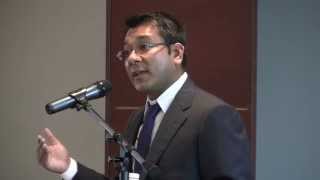
This is a YouTube video titled "Manish Chowdhary Speaks to the 2013 Inductees into Phi Kappa Phi Honor Society" containing a keynote speech delivered by Manish Chowdhary at the University of Bridgeport in 2013. The speech addresses the inductees of the honor society, focusing on themes of dreaming big, setting lofty goals, perseverance, alignment of strengths, and the importance of mentorship and preparation for success. The content includes an introduction by a university representative and a motivational talk by Manish Chowdhary, a successful entrepreneur and alumnus of the university.
This is our favorite time of the year at the university, as Leon Ostrich said. And it's because after working very hard and watching people work very hard, we have an opportunity to step back, catch our breath and honor, recognize and honor excellence. When a community takes time to have a ceremony like this, it does not just confer honor on those people who are being recognized, but in a very profound way, it reminds the community of what the purpose of the academic community is. To cultivate, pursue excellence on a continuous basis. That's important to the parents who are here, who are probably hoping that the graduates will soon begin earning a paycheck someplace. I want to say something very practical. In a period of sustained economic downturn, the job market is still very competitive. You need every edge that you can get. We have in the last several years advertised for a few positions, extremely average positions, and very often there'll be hundreds and occasionally over a thousand applications. How can you distinguish between them? Particularly when the times are tight, People will. You don't even know if they're applying for something they're really interested in or they're just applying for everything they see. I used to be a heart surgeon, but I always wanted to be a janitor. You know that that person's not going to stay with you as long as you suit. When you send in your resumes, if you can say, I'm a member of Phi Kappa Phi, I belong this or that organization. If you can include letters of recommendation from your faculty, from your advisors, and as I've said to every graduating class, I am happy to write letters of recommendation for you. You email me, make it clear what the point of the recommendation should be. You don't just say so, and so is a very nice person. That speaks perceptive. It gives you an edge. I know in our HR department, if they get 500 resumes, they may pick 40 that they're going to look at, and they'll be the 40 about which there's something special. Somebody spoke up. Somebody made a phone call and said, I know him. Give them a look. He won't be sorry. That's all it takes. So you've done a very, very important thing, and I know you'll have a very successful career. Today we are here to honor you. Tomorrow we'll graduate. We'll be honoring everyone altogether, and we look forward to hearing of your successes. And please stay in touch. And you're about to hear from someone who can talk about their successful life after they graduated from the University of Bridgeport. Thank you very much.
Thank you President Salone as he just mentioned, we are about to hear from an individual who is a graduate of the University of Bridgeport and has in the 10 short years since he's been out in the field, been a leader in his field of business. Our keynote speaker tonight is Manish Shahari and he's the Founder and CEO of Goekart which is a leader in on demand e commerce solutions. Go E Cart's mission is to empower small and mid sized merchants with cutting edge commerce technology that allows them to compete and win in the most competitive online markets. Manish provides business and technology leadership to Go E Cart and its clients. He is an innovative business leader and a visionary who creates and executes revenue producing strategies by developing and launching new solutions to address market needs. Manish is a recognized expert in his field and a sought after public speaker on topics such as e commerce, entrepreneurship and online marketing. He holds a BS in Computer Engineering from the University of Bridgeport. We are very proud to call him one of our own and many patents in collaborative commerce. Please join me in welcoming Manish Kaudi.
Thank you Adina. Thanks for the extraordinary honor. Most of all, I'm a graduate of the University of Bridgeport class of 2,020 and I founded my company Go E Card, a computer software company in bodine hall, room 831 in fall of 99 and finally incorporated in 2000. So as I started really thinking about what a great responsibility this is to deliver this keynote address and I thought to myself what better way than perhaps looking back at my own induction ceremony perhaps. And then I realized that I didn't do quite as well as you guys did and I wasn't just as bright so I never actually made it to the induction ceremony. And since I wasn't quite so, this is the closest I've ever been to an honor society induction, then I had to dig deeper because I said if I can't collect anything from there, perhaps I got to go back to my commencement ceremony and after really racking my brain for a long time I could not remember who was the commencement speaker. Then I tried to actually google for information, let alone that I remember any words from that commencement ceremony I didn't even remember. So that was a very relieving experience. And it's a huge relief because I realized that I can now proceed without any fear of inadvertently influencing you in any way, shape or form to abandon your promising careers in any form of study that you've chosen to pursue a journey of pain and suffering as a die hard entrepreneur. So Today I'm here to talk to you about just two things, just two simple things that I have learned. That's it. The first is dreaming bigger than you can possibly ever achieve. And that's something that most people would laugh at and say, that doesn't make any sense. Why would you ever dream and aim higher than anything that you can possibly ever achieve, possibly in your lifetime? We'll call it your bhag, as Jim Collins would call it big hairy, audacious goal. And why you need your bhag is because first, nothing happens unless we dream. And as you know, in our dreams. Imagination is the only limitation as to what dreams can be. And if you can imagine something to be true, it will become true someday. And therefore, it's very important that the goals, the vision that you set is larger than yourself. And I'll give you a very simple example to start out with as to why that is so important. Bill Gates had a vision of putting a computer on every desk in every home. And that vision was realized about 10 years ago. And you can see, once that vision was realized, Microsoft as a company hasn't quite performed just as well because that vision was already accomplished much earlier than he probably ever thought it was possible. And that is why I believe it's so important that if we aim higher than we can possibly achieve, we will actually do much better than perhaps setting our sights on what we feel our maximum potential can possibly be. Your goals may change over time, but your vision should not. And success might appear different to different people. Perhaps success to some people might be holding down the 10 shots of tequila in a night to perhaps finding your first job to some might be finding the H1B sponsorship, to others might be securing that paycheck that Dr. Salana spoke about, or buying a house, getting married, or perhaps even building the first human time travel machine. For me, I never ever wanted to be a good man. I wanted to be a great one. And that was really scary. But I remembered that every great thing starts out a little scary. And the folks here, when we go out, we are perhaps considered underdog because we are competing against the likes of graduates from Harvard and Yale and Stanford. However, believe it or not, there are some surprising benefits of being an underdog. And one of the benefits that I had personally experienced is other people tend to underestimate you, but you tend to overestimate yourself. And what that makes you do is you try harder than everybody else. And I really had to think really hard and long for what was my vision going to be. And fortunately, for me, after doing a lot of soul searching, it really came down to I wanted to leave a legacy behind. Something that I would be proud of, something that would be larger than myself, something that I possibly could never achieve in my lifetime, something that possibly might become a generic one day, perhaps like what we call Kleenex for tissue or Google for verb. That's a very, very lofty goal. I don't know if I'll ever make it. However, I know that in order to get there, I will have to constantly try. And if we shoot for the sun and the stars, we have a much greater likelihood of reaching the moon. And that's really very important, especially in today's environment. And one of the other benefits that I found of setting those huge and lofty goals, even though people might laugh at you, people might think that you are completely out of your mind, which has happened to me on several occasions. But you don't tend to take any shortcuts. You tend to differentiate between a task, a project, a job, a goal, and your vision. Vision should not change. And you have to keep learning and improving because you're. Your sights are so high, you will never stop learning. You will maintain good integrity and you'll maintain great character because you know you will have to face those people again in your lifetime. It's never a transactional relationship. You will not settle for less. You will not compromise. And I realized that as lofty as my goals might be, if I don't take risk and I do nothing, I'm most likely not to get anything. So talking is easy and talking is cheap, and people talk a lot about luck and timing. That is another thing that I have. People say if you are at the right place at the right time, you're much more likely to succeed. I would actually, to me, that's a bit like playing roulette on color, red or black. I think it's more to do with preparation, adaptability, and execution. Because in today's world, that is moving so fast, we can never count on luck or timing. The only thing we can count on is our preparation and our ability to adapt and quickly evolve and to execute on the direction that we choose. As we celebrate your academic excellence today, I want to congratulate all of you for your academic excellence and for all the hard work and sacrifices that you and your parents and family has made. However, what I've discovered, that talent alone is not enough. In fact, something that is greater than talent, something greater than intelligence, and that is hunger and hunger for more. And it goes back if your Goals are very high, greater than you can possibly achieve in your lifetime. You will always stay hungry and you will encounter a ton of disappointments. I guarantee you if anybody says that's untrue, they're lying. But remember that the true definition of failure, or the only real failure, is the failure to try. And your biggest success, as I would like to urge you to consider, is your ability to cope with disappointment and to deal with them and thrive. As there is a saying in India, everything is going to be all right in the end. And if it's not all right, it's not the end. I wanted to I really racked my head asking for some advice from friends on what should I talk to you more? And I said, what would you like to have heard from your speaker when you were as an inductee? So I reached out to one of my fellow UB alums and my dear friend, same class of 2000, Amit, and this is what he had to say and I want to read it aloud for you. The day I graduated, I was happy. I had a job offer in hand. Sure, I had a big goal to get an H1 visa sponsorship. Back then when somebody asked, where do you see yourself in five years? I had to quickly make up an answer. And not just any answer, something really cool. I, however, never had a long term goal. Five years out, I didn't know what I wanted to do. The following week I was ready to take any job as long as I paid the rent and supported my love for half a pint of Black Label every evening. In 2005, five years after my graduation, and by failing repeatedly at attempts to be a good software programmer, my manager, who later became my mentor, made me realize I sucked at coding. That was a sad day for me. I remember thinking to myself, what am I going to do now? What am I good at? This is all I've done. I knew what I was not good at. I went back to my mentor and asked for help. How do I know what I should do next? After a lot of soul searching, I realized I was good with people and I could somehow manage to get them to work together and get them to do things. Aha. That came to me. I should be a project manager. I tried it and it worked. Fortunately, 12 years after my graduation, I'm doing exactly what I wanted to do. But I did not know at the time when I graduated. If there's one thing I could go back and change in my first few years, it would be to seek guidance and coaching. So while we have these Great, lofty dreams. We've got to be practical. And the second thing that I want to talk to you about is alignment. It's very important for us to recognize what our strengths are, our true strengths, our two weaknesses. What is our personality like? What do we thrive in? And what conditions do we succumb? What are things that come naturally to us versus the things that our parents want us to do? And that's a very, very important discovery that I would urge you all to think and make. Fortunately, there are many tools out there today that would help us accomplish that. I would not like you to go through those same five years that my friend Ahmed did. I want you to get an early start on your lifetime journey of your bhag, so that you can get there sooner. There are some practical tools in today's world that I have used personally. Things like disc, which is a personality tool that allows you to discover what is your personality like, what occupations you will be a good natural fit for versus what you will actually struggle, or it will not be as natural. By aligning your strengths, by aligning your knowing what you're good at and what help you need, you will have a much greater likelihood of reaching your goals and your dreams. And furthermore, in addition, it's also important, as Amit said, to seek guidance and seek help. While you may have a great lofty goal, do you know who your role models are going to be? Who are the people that have walked that path before you to get to the same goals? Because we have the benefit of looking at their lives and learning from that rather than making the same mistakes over and over again. So seek out those role models, study their life, figure out what made them successful, what they did, and how that aligns, and are you doing the same things? Additionally, everybody needs a coach. Even though Kobe Bryant is the greatest basketball player and so is Derek Jeter, they all need coaches. They all need mentors. So find your mentor. That's a great step towards getting to your goal. Somebody who can assist you, guide you. A mentor doesn't have to be somebody who is super accomplished, just like all coaches. As long as that person can help you get to your final goal, it's a very important step in the process. That's all I have for you today. One last time. And to conclude, dream bigger than you can possibly achieve. And remember, the only failure is the failure to try. And the biggest success is how you cope with disappointment. And don't forget, it will be all right in the end. If it's not all right, it's not the end. Thank you.










