UGLY TALK: BUILDING PROFITABLE ECOMMERCE IN A DOWNWARD MARKET
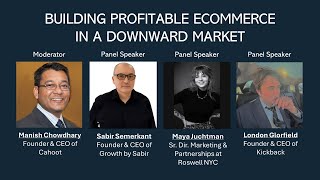
Manish Chowdhary moderates a panel with London, Maya, and Sabeer Samarkand on running profitable e-commerce when markets are down. They discuss AI's role in marketing, spreading sales across channels, managing inventory, and shifting consumer behavior.
So if you need a place to work, stay focused, consider NomadWorks. Next, I want to introduce a good friend. I can't think of anybody else better to navigate the conversation the discussion tonight. Who is our moderator? He is the founder and CEO of an amazing company that does the one of the most comprehensive post purchase logistic platform for E commerce brand. He's also the Winner of SaaSdaq USA Global Pitch Competition and he's got hands.
Together for Maneesh.
Intimate moment.
Thank you Anson, the stage is yours. Thank you. Thank you everyone.
Thank you.
Thank you for coming. Pleasure to be here. My name is Manish Chautri. I just want to set the stage of what's happening in E commerce. For a long time until very recently we were in the zero interest rate phenomenon and money was easy, money was flowing. When that happens, fundamentals go out the door which means weak businesses thrive or appear to thrive. There are 10 e commerce darlings and I'll just name a couple that you would have thought I want to be just like them. And today they say to themselves I don't want to be just like me. Examples are Stitch, Fix, Grove Collaborative, even some of the very prestigious brands like Olaplex are penny stocks. They probably won't be trading on the New York Stock Exchange for much longer now. Second part is the trade winds. The trade shift that's happening. Tariffs. This is completely reshaping supply chains. What used to be simply advertising and marketing and customer acquisition. Today your cost structure is completely transformed and that is completely changing the landscape. Now when you read the news say Yahoo Finance in July the news says retail spending is up. So a lot of the e commerce brands and operators are like oh great, you know who says there is possible slowdown? So that report came out in August. That July retail sales are up so everybody should be celebrating. And then August we hear the consumer sentiment very very sharply down because July had a lot of pull forward effect like Amazon Prime Day, all of those things. What that means is if you're a founder, you're an operator and you're operating strictly based on one piece of the news, you're missing the picture and that's what's happening for an hour. Talk about advertising and marketing. Everybody knows about what's happening to organic traffic down 40% this B2B SaaS companies Monday.com their stock down 40% they're a billion dollar per year sales ARR average annual recurring revenue 40% down and largely contributed to organic traffic. What's happening with Facebook, paid media and advertising is Another story. So what is happening today is a great reset. Whatever you knew about E Commerce five years ago, you need to rethink that. And it's not all doom and gloom. That's not what the message is. But if whatever strategies and playbooks that you were adopting or using and succeeding with are changing and changing very fast. So what I've done is assembled three amazing speakers who have practical in the trenches experience every single day. They're working with E commerce every single day that can help us navigate this great reset. You have to adopt new strategies, otherwise you will be disrupted. It's not the question of if, it's just a question of when. So with that, I'd like to invite my panelists. Please come on in. So these guys are some of the best in the business. Let them introduce themselves, starting with our amazing founder, London. He runs an E commerce brand like many of you.
Sure. Thank you. What's up? I'm London. I am a former recording artist at RCA Records and currently building Kickback, which is a screenless electronics brand. So we build tech that does its job really well and then leaves you alone.
Awesome. And next we have Maya.
Hi. I am the senior director of marketing and partnerships at Roswell nyc. We are a full service e commerce agency. You name it, we do it. We work with cool brands like Brixton, Skyler, Perfume A and E Hyperlite and more.
And Sabir, last but not least, founder.
Of Growth by Sabir. I'm Sabeer Samarkand. I've been in E commerce since the birth of E Comm. So very long time. Over 200 plus brands have past my desk, I guess grown over a billion dollars in incremental sales in E commerce and currently running a program called Rapid2X. And actually one of my brands is right here. Sitting right there. We are actually meeting for the first time. I always do because I have worldwide brands. I always do just zoom. So this is the first time I'm actually meeting one of my Rapid 2X brands here.
That's awesome. So Sabir, since the birth of E commerce, right? Last 18 months, a quick stat, everybody thinks that E commerce has boomed. And in the COVID time you must have heard that E commerce accelerated by a decade in one year. Have you heard, did you all feel that way that E commerce was just booming? And today we got the data which is E commerce penetration as a percentage of retail is right now as a percentage of retail is at the same exact level as it was five years ago. Q2 2020. So it's about 10%. So this is live data that is fresh that it's so easy to get lost in the stories of yesterday. And so Sabir, since you've been there, since the early, since the birth of E commerce, let's talk about what has changed in the last 18 months specifically.
Well, everybody talks about AI, right? So that's AI definitely has created a dent in traffic, right? If you look at organic traffic, where you focus so much on Google search engine optimization and other things like that with AI, with AI mode that has started taking a lot of traffic away from those kind of strategies, if you were doing it. Because the frank truth also Manish, is that even though I'm saying this, I do want to balance it with the fact that the reality on the ground is that most brands, they're so obsessed with paying meta ads and Google Ads that they're not focused on the organic strategies where they need to be developing. Especially AI SEO is a thing right now where you can package your content and actually feed it so that it can get discovered by AI engines. Because that's where we are going. And if you are optimizing your business based on what worked in 2022, that was a different world at that time. It doesn't exist. That world doesn't exist right now. The realities of that, you're coming out of the pandemic. It's a different environment, right? And the fact that AI adoption has become so prevalent, you really need to focus on what's, what's real today. But the fundamental strategies for business don't change that. You still the foundation. You still need to focus on your foundation. Because if your foundation is not right, if your gross margin is not right for your business and you're discounting to hell, you're not going to succeed. You're going to go bankrupt. You know, most, most econ businesses go bankrupt. 90% of them by like the E comm businesses that exist today, 90% of them are going to go bankrupt by 2027. 90%.
So right before this, were you going to say something? So it is true and we were talking earlier.
I have a question to follow what you're saying. So how do you feed it into AI with your organic content? Or.
Let'S say if you're on Shopify, there is an app builder that has built an AI, you know, a plug app in the Shopify store. You can just install it. What it does is it collects your product catalog, blogs and stuff like that to package it so that the LLMs txt gets pulled up very Similar to what Robot Txt or sitemap XML works very similar to that that and you.
Can also just go into the different AIs and actually put in the prompt. So like let's say you were your customer and you're like hey what is the best skincare for dry skin today? And see what's coming up, ask for the sources and then look what AI is pulling from and then from there like either build an affiliate model to work with those publishers or build lists similar to those and put them on your website in an affiliate link so that you are also being tracked and searched in that way. Cool, that's smart.
So Maya, I know you deal with a lot of email, right? Email is probably considered the lifeblood of E commerce, right? Not a single e commerce website that I've visited that doesn't send me more emails than I want ever. So tell us a little bit about what's changed because email has changed dramatically as well.
A lot has changed recently. Some of you may be on Yahpo email and SMS and are having to make that migration right now because they just stopped and so you're choosing between attentive klaviyo. There's a lot of options omnisend the thing to also consider and I just looked at a few accounts recently that their deliverability horrible but they came to me and they were like oh I'm seeing 35% Oprah rates, 30% open rates, that's 5 fine right? Actually no, if you're sending to list and you're not doing exclusions and you're not like actually thinking about Apple privacy which auto inflates so those numbers, that open rate that's not real, that's Apple privacy, Google and Hotmail inflating that. So your open rate is actually probably going to be more like 10 and you're not and people will think like oh I'm going to send mass emails. Incorrect. You should be tightening it down thinking about it like truly engaging with people that want to hear from you so that they engage with your emails so that you become warmer to the Googles, the hotmails and you build a better reputation with them. Otherwise you're actually getting into less inboxes by sending bigger sends. You need to be really strategic about it. Go into your deliverability tabs, look at where you're standing. Build exclusion segments. Not every segment is the same, not every campaign is the same and that's a common mistake. People will just say oh oh I'm just going to send to this one every single Monday, why it's not working. I'm going to send to like this list, I'm going to include this giveaway list for 2022. Why they're not engaging with you, they're not purchasing. And that attribution rate that you're seeing, that's inflated. They may have purchased five days ago, but if it's in their inbox and it's an auto open, they maybe didn't even see it. So you really actually have to think about it. It's not just set and forget. You have to really massage it and look at it every day.
That's great. I mean, what I heard was you cannot email marketing used to be, you know, you have your campaign and all you were doing is changing. Swapping out the product the same 20% to everyone every Monday at 9am that's not going to work. In fact, it's going to radically take a nosedive. Your deliverability. And London, I know you're doing something very different that things that don't scale. There's a whole terminology in the startup world do things that don't scale. And you told me when we were chatting earlier about how you're engaging with your community and your customers in a way that most people would not even think. They'll be like, hey, I'm just going to spray my 10,000 people every Monday with 20% discount with a different product. Tell us about your approach.
Yes, I'm gonna agree with what everyone said. One thing I would add kind of, I guess in lieu of what you're saying is like just give value to the customer. Right? This is like big picture, broad. But I mean, most of our emails are text blasts, they're not promotional. I mean, we're a music audio company, so we'll send out weekly playlists of our favorite music. We actually really, really go hard on building a cult like community around what we're doing. You know, getting a customer has just become harder and harder getting a new customer. So when a customer's in the door, we treat that person like God, like that's, you know, so, so everything from, you know, any marketing channel we do use, like we really try focusing on actually deriving value and giving value. And then on top of that, I mean, we do stuff like we do physical mail, which is, which sounds crazy, but it's like, you know, it has a 90% plus open rate like physical mail. And you know how much it costs to send like a letter to a customer? Less than a dollar, so. Or I guess a dollar. Yeah.
Or are you doing it like manually manual mail.
Yeah.
Oh, so you're not doing like a direct mail tool like Post Pilot.
Oh, well, yeah, sorry.
Yeah.
Yes, yes, yes.
The price of the stamp keeps going up every. Yeah, but every, every quarter, more or less.
But the thing is however, about to just add on to that.
Yeah.
Because I've been part of this history. So in the past, I would say about two years, Direct mail is cheaper for you to send a postcard to your customer in the United States, including the postage, including the increased postage. It's cheaper to send that than for you to get cost per click from meta ads or Google Ads for the first time. It has shifted over and. Well, here's the greater part of that. A response rate conversion rate from a postcard campaign is between 14 and 20%.
Exactly. Yeah. It's so impactful. I mean because it's meaningful. Like when you get a, when you get a physical piece of mail that a brand doesn't need to send you but chooses to send you and it's actually thoughtful and on brand and like why you're into this brand from the get go. I think it's really meaningful. And we see, I mean it's hard to know the exact conversion rate, but we see amazing second time buyers through this.
But with that note, it's being thoughtful about it. It's not just staking a QR code and a discount and being like here's the product. It's doing it to your community.
I mean with our top like couple hundred customers every quarter. I mean I'll even go in and like physically write cards sometimes. I mean this stuff, like this stuff. I think small things go a long way, especially in difficult environments.
So do things that don't scale. The size of your list is immaterial. If the deliverability sucks, if you're not tweaking your campaign and optimizing, you're just fooling yourself. And Sabir was telling me or teaching me about you got to manage your E Commerce business like your Schwab, your Charles Schwab or Fidelity account. Which was very insightful. Sabir, if you want to touch on that.
E Commerce from my experience, requires money management skills. Right. Just like you would trade on a Fidelity account or Schwab, you would trade with stock market. If the stock is going up or down, you need to trade it or you want to buy options. The same applies. Where's the attention? On which platform? What sort of content would bring more attention? Which one is not working? I need to change or I need to eliminate Come up with a new content, right? It's about that, you know, and not about just. And especially you know, and I apologize, I know your agency, right? But if your agency doesn't have money management skills, pull your money out, pull your brand out of that, out of that facility, right? They need to have money management skills. They need to understand what your gross margin is. Because the thing is you're going to be scaling your brand. Where is that money going to come from? Either it's going to come from your cash flow because the roas is working gangbusters or you're going to go to the bank and beg for money and now you have the debt on your hands that you need to pay off. And eventually if you don't manage that debt properly, right, good, there's good debt, right? If you don't manage that debt properly, bankruptcy, right? And this is one of the reasons, if you have noticed that in December Black Friday sale we had gangbuster of a holiday pfcm, blah blah blah come January bankruptcy filing, right? This is the reason behind it. Because people don't. If you don't have the money, money management skills, proper money management skills, you think top line revenue is the money in the bank. It's not. Your cash flow is. And if you don't have cash flow, you don't have business. That's it. Period.
So what I heard was treat it like your Schwab and Fidelity, you need to have a plan. And Maya, you were telling us even before you launch, we'll come back to you in just a moment, you have to have a plan even before you launch. In fact, London was telling me even though he sells these amazing vintage equipment and recording and all that cool gear, but your real business is content. Content production and excitement. Can you talk about that? Which is most people think that they are in the E commerce business to sell widgets, but we have an E commerce founder that doesn't believe that in fact that is not his strategic competitive advantage. It's competitive competitive advantage. Something else.
Yeah, and I actually think it's the case with like most iconic brands in history is they're just awesome storytellers. So I mean we just approach that as like our, you know, our top job and we spend most of our time thinking about how to stand out in a super saturated market. And that is a content business. But instead of selling content, we're selling, you know, these electronics that we design and that's like ultimately what it all comes back to. But I mean content top of funnel organic content is Everything to us.
But you're also using your community to design your next product.
Yes.
As opposed to whipping that in your head or even chatgpting it. I don't know if that's a term but. And Maya was telling us earlier, which I'm going to come to Maya in just a moment. London, how are you using this computer community and doing things that don't scale, which is so different than everything we heard maybe two years ago? Go and burn your cash on Facebook or Instagram and hope and pray. And since you don't know what your true cost is, you don't even know you're making money. But the bank will give you a loan at zero, close to zero. And investors will fund you. But things have changed. Tell us about how you're engaging with community that most people would not even think about.
Yeah, so we've benefited from the fact that our company started in 2024, so we never really got to reap the benefits of like ZIRP era funding.
So you have no bad habits?
Well, we've just had to be scrappy from the jump. So we were like, okay, building a brand that isn't profitable makes zero sense to me. So I can't speak to like that version of company building. But we do things like our top thousand customers, like we have on a Discord channel and like I'll go in and chat with them sometimes for hours and hours on end and just like hear, you know, what do you love? What should we do more of? What do you absolutely hate? Where are we? Like just sucking and we're super, super candid with our customers and communicate like constantly with them in all these different forums. We do. I'll do one on one FaceTimes with customers who are like, if customers spending $1,000 on kickback, like, I think that deserves a 10 minute call. I want to know why they're spending so much money on us. And you can just get these like anecdotal insights that are incredibly valuable. So I mean we, and I guess like one more thing I was adding to this is like, you know, a huge bonus of building these relationships with our customers is it's also this like content machine. So most of our customers are kind of exactly like models that we would hire. Like they look like our ideal customer. So if they're, if they feel closeness to us, like the chance of them making just organic content is so much higher. And we don't ask them to do that, but they do. And that drives a ton of traffic for us. We don't spend any money on apps.
So you're asking your customers to shape the future as opposed to ChatGPT.
Oh yeah.
ChatGPT is not buying.
When we were chatting earlier is that the future doesn't belong to the past and ChatGPT doesn't have the answer which you said. Could you touch on that? Meaning you said that to create the next version that doesn't exist. You can't get the answer because that answer doesn't exist because what has not been created is not in the ChatGPT database.
Yeah. So I'm gonna also touch on the community stuff because I have a couple of really cool examples. But yeah, when you're first starting a business, it's not just chatgpting it because that's everything that already exists, it's everything that the world has already put out. You're trying to create a new solution, you're trying to solve a new problem for you to truly be successful. It's like, what are you coming into this over saturated like industry and offering that no one else is offering? ChatGPT is not going to answer that because ChatGPT doesn't know. It's never been done before. So what the answer is is actually going and asking people, asking people what their experience is like back to the skincare experience. It's like, hey, this person gets eczema all the time and none of these products are solving it. They've tried this, they've tried that, they want to use retinol, they want to like experience anti wrinkle experiences, but they can't because eczema is really prone to it. What is the solution that you're creating? How are you solving that problem that no one else in the market has done? Or if you're not solving a problem, how are you pitching it? How are you marketing it in a way that no one else has done? Graza Grazza is selling olive oil. It's not like a new thing, it's not a new product that they've invented, but the way that they've done it and the way that they've made it youthful and the squeezy bottle, now glass, they're very proud of that is a new concept in the way that they've marketed it. And that's the approach. It's like, how are you changing the narrative and then to the community aspect. Two brands to look at that are doing a really good job of this too. Harley Davidson, they have their HOG program where it's literally like a lifetime membership that they offer roadside assistance for Free for their community. They offer events where everyone can talk to each other. Sourcing, they don't make any money on that. But that lifetime value is priceless. Also Lego, they have product idea submissions on their website, they have competitions. They truly built a community around their product and it shows.
So, Sabir, with channels, there was a time, and it happens every couple of, every 45 days when Donald Trump decides when he's gonna sell TikTok to whom and when he's gonna shut it down. And so a lot of brands are so focused on one channel and they get it to work until it stops working and it comes to a screeching halt. What's your recommendation? Because in this world of massive fragmentation and it's so hard and so difficult to break through, what's your recommendation to brands small and large?
So here's the thing. Don't, don't go with single channel dependency, right? And it's not just TikTok. We love to say, oh, Trump and tariff. And he's changing his mind every day. Gen Z, Gen Z and other types of things, those are. I'll make a comment on that too. Right. What you should do is, you know, because E commerce has matured over time, right? There are certain channels that are organic, there are certain channels that are paid and then there are some hybrid channels in the middle, right? You have to, as a business owner, you cannot, you cannot just say, okay, you know what, this is one of the reasons, like a lot of Shopify brands went under when meta, you know, with the Apple update, with iOS updates that tanked the pixel, they went under because they relied on single channel. It was meta ads. I would pay Meta. Meta is going to give me order and I'm going to send those orders out. They were not even making good money on that. It was just top line revenue, right. And then once the iOS update happened, what happened there? There's no more traffic because even meta did not know how to solve this problem that Apple created with the iOS update. So single channel reliance is extremely a bad idea, right? You would not put like if you are going back to the stock market example that I, that I gave earlier, right? Your friend says, oh, you know what, you need to invest all of your life savings into Clorox, right? Public company. Would you put all of your money, like let's say you have $50,000 or $15,000 in the bank. Would you take all of it and put it on just one stock? Clorox? You wouldn't do that. The same applies to when it comes to the single channel dependency. This is the problem with it. You cannot have that kind of reliance. You have to spread it. Like if you're doing meta ads, do Google Ads also. Because always, there's always something going on with meta, then you can say, okay, you know what, okay, I'm going to shift my dollars until Meta figures it out. I'm going to spend a little bit money, but I'm going to shift it. I was doing 70% Meta and 30% Google. Now I'm going to shift it. Because of this trouble that's happening, 70% of my budget is going to go towards Google and 30%, I'm going to just let it hum around or even lower it even further from there, right? So you have to always think about multiple channels in case of E commerce, right? So that if that, remember that right after the election, right? That weekend there were so many creators in tears on saying goodbyes on TikTok. This was real. If you guys can find me on YouTube or on Instagram, you know, come and follow me there. I'm moving over there. And then that Saturday night into Sunday, it was turned back on, right? So that kind of stuff, your business cannot rely on those kind of things. If that were to happen to me, I would say, okay, you know what, doesn't matter, I'm gonna, I'm shift my attention over here, right? And, and I'm gonna just reallocate my time, my energy, my budget towards this, this other set. I don't have to worry about this one issue that's happening because it cannot, it doesn't have to be a full on shutdown like TikTok, right? It could be just TikTok rolled out an update and there was a problem.
So it's diversify, diversify your channels.
But London, diverse portfolio is a thing.
In Wall street to diversify. But founders, right, London, you are just, everything is so hard, right? You're just trying to catch up and you're just trying to, you know, grow and eke it out. And somebody, a wise person says you got to diversify. How do you balance your time? When is the right time to diversify? And how do you even think about time, resources, you know, attention. And we know that just spraying and praying doesn't work anymore. So you have to go all in. So as a founder, tell us about the hard ugly truth about how do you even think about all this.
Well, I mean I do it poorly. It's not like I diversify my time so well. But I look at channel like I completely agree with Everything you just said, I mean, if you're reliant on one channel, I don't think you have a brand. Like, you're just good at marketing on a channel. So I think of different channels for different things things. You know, I think right now for US at least TikTok is like the top, top, top of funnel. It's definitely the best way that we drive awareness. Virality just exists in a different way for us on TikTok and, and for our customers or affiliates. You know, I look at like, and again, this, this is us. So this might not be the case for a brand. Instagram for us is, you know, if you're following us on Instagram, you're probably a little bit more of a fan of kickback. Like people who follow us on TikTok, like, I assume they haven't bought a product from us. Instagram, it's a bit different. They've taken the step, they follow us there and then, you know, it gets more and more granular. So then we go to email, which like, you're definitely like engaged to some extent if like you're opening our emails consistently. And then we go to our, our discord or our group channels and then all the way down to physical mail. So it's, it's not just like a pure diversification. It's that different stocks do different things, right? So it's like you're gonna have like your growth equities. For us, that's TikTok. You're gonna have your, your S&P 500, which is, which is Instagram. So I. Different channels provide different things. But we're not, we're not so reliant on any one channel. And I think that again just comes down to like, you know, build something that at least somebody actually really wants. And for me it's like this sounds maybe kind of dumb. I just don't think it's that deep.
Always.
Like, if you have a product that people want, you should be able to sell that on Instagram, on TikTok or in urban Outfitters. Like it shouldn't really, really matter.
That's, that's a great point, right? I've seen so many great products fail, right? Because great products doesn't mean commercial success and great product doesn't mean great company. And if you can only know two things. If you think about DTC Direct to consumer E commerce stocks, they live and die, especially startup, by two words, two acronyms. Customer acquisition cost and lifetime value. How much does it cost to acquire a customer and what's the total value of that customer over the life of that customer. And Maya lives that every day, all day long. So Maya, tell us about how do you think about these two things? Because I'll give you examples after examples. You think that Allbirds is doing amazing. Their stock is in the gutter, literally. These are iconic brands that have produced great products and do it exceedingly well. Even Warby Parker is in trouble. These are companies that we know and from a distance they appear so shiny and so great, but the economics are pretty screwed up. And Maya deals with this every day. So Maya, tell us, yeah, I think.
Like example, like Warby Parker, have they done anything new in the last how many years? No, they haven't, they haven't adapted. And so it's adapting to the new market. So two years ago when we looked at cost per acquisition, it was a single number and it was, the goal was always lowering it lower, lower, lower. And now we've shifted that perspective to that of complexity and layering and understanding that, like top of Funnel. So for example, our brand, Hyperlite, the Mountain Gear brand, we understand that when we're doing top of Funnel campaigns that are more like long place because it's a more expensive product, it's a longer play, it's going to cost more for us to get that person and it's more of the experience that we're selling them. But when we get into the retargeting campaigns and the lower funnel, where these are people that know us, we're able to lead with just the brand and just them knowing the brand. And obviously the cost at that point is way lower. And so approaching it with one strategy is incorrect. You should be approaching it with layers of strategy. And with that we were actually able to lower just in the last year alone, Hyperlite's cost per acquisition significantly and get their LTV up by a lot. And so they're incredibly happy with us and only expanded their services with us because we're a partner that see them and understand them and we work with them fully. We understand that one type of content isn't going to work next month. We're constantly testing. We were actually talking about this before that. It's not set it and forget it. Which it used to be. It used to be like, oh, you could have one type of content that would work for a few months and you could just leave. It doesn't exist anymore. You have to be constantly looking at it, constantly thinking, like, how can we adapt? What's the new season? What's the new product? What are other people doing. You need to be throwing stuff what's.
Happening on the Internet like today.
Exactly. And you need to be adapting in that way. You can keep the sentiment of the campaigns, but you do need to shift the content. You do need to shift the strategy to a certain point in order to continue growing and not just become stale.
The answer to every problem is AI.
Right.
Because you can do it with AI. I want to come back to you, Sabir, just because most brands are like, hey, I'm going to use the AI tool and let it do it. And in terms of campaign, whether it's marketing, creative or what have you. And London and Maya both, you were talking about, you know, you can produce crazy amount of content at in minutes using AI tools. But because everybody's doing the same thing, it's not working. And there's a flight to quality if either one of you want to take that, London, very quickly. And then we want to go to Sabir.
Yeah.
More is not good just because you can do more using tool because everybody's doing more.
Yeah. I mean things are just significantly more saturated online than ever by far and away. Right. So for us, like quality content and this is actually a change we've been making. I think we talked about this on the phone the other day. Like, you know, we're taking a bit of a less is more approach as of recent. Instead of just perpetually feeding the beast and posting 10 times a day, like we will sit down and like script things out and actually make again like value driven content. Something that I would watch kind of regardless of the brand and what we're promoting. I think the best brands do that super well. And it's, it's, it's, it's tough. Like it is really, really hard. But it's so vital and AI does not solve that. AIs. It's funny, I mean we use AI a lot, but my usage has really shifted. It's like didn't use it, used it for literally everything. And I've kind of found myself going back to using it a bit less, especially with like the way we communicate with customers and top of funnel stuff because it can be kind of creative. But I just define like people. I mean our customers savvy, they're, they're young teenagers. Like they know it's cool, they know it's not.
I mean from our example, like we produce a ton of organic content to targeting brands and retailers, we just found some great tools, HeyGen, 11 Labs and Avatar and we said, hey, we produce such great content, we can just create video out of that? Yes, we produce 300 videos in a week and we publish that. But the results are pretty dismal. The one video that we took a lot of time and we took two days to produce with custom graphics that has hundred times the view compared to all the others combined. So when you sit back and look at the results, they're like, no, was it worth it? Because you went to the other extreme and pendulum swung that AI is the answer to everything. So back to you. Sabir is less more now that the tam the target addressable market is not the entire world and and lookalike audiences don't work anymore. The Q2 update so what is the new narrative? What should the brands be thinking about today?
So when it comes to AI, right, here's my pov. I work with almost every AI model that's out there, right? And this is how I treat it. This is my way of working with AI. By the way, my background is I'm a computer scientist. So when it was very theoretical, AI was theoretical. And that's what I went through. We didn't have the CPU GPU to actually do the thing we were learning. It was theory at that time. Now it's reality. It's a very exciting time. But the way I treat AI is if I were to hire an intern for the summer from mit, from University of Penn and Harvard and Yale. Really smart, really smart kids, right? Phenomenal. Very intelligent. They have amazing intelligence, but they just don't know how to use it. It's my job to guide them. That's, that's how I literally, that's what I do. I guide them. And the other thing I do is if, if I gave a task and now, by now I know what chat GPT5 is very good at. Even though it's relatively new, I've been doing, I've been working with it since it's came out, right? Or if it's Opus 4.1 from Claude, right? Or if it's perplexity or if it's Grok. I know aspects of it that this one works really great at this. This one does a better job at this. And what I end up doing, I use the best one to produce the best results. I extract the results out and I give it to the other three to find me gaps that it sees or problems with it. So first it complements how great this whatever is and then says oh, this thing is missing from here. And this is what I do. I don't ask the lower LLMs to resolve it for me, I collect all of that feedback and then I just give it back to. Let's say if I was. Opus 4.1 was the solution there, right? I give all that feedback back. Or like feedback 1, 2, 3, 4, 5. I look at that feedback as a human because I have the background, right? I know that, oh, this is a good feedback. This is pretty legit, right? So I select those feedback and then I give it back to Opus 4.1. It goes through the iteration, I take the revised solution, I give it back to the other three. Like, how about this now? And then it gives me that result. Why am I doing this iteratively? It's. You feel like, oh, this is going to be. This is not going to be time saver. However, what I have seen the stuff that I would do. Like I said, I've been in part of this history for a long time. If I were to do the same task, it would take me four to six days to do it. Now it takes me an hour to three hours to go through this iterative process. Is it annoying? Yes. Can I automate it with any 10 or Zapier or whatever? Yeah. But why, why do I need to do that? Right? Because I need to have that human in the mix, you know, And I'm the human in that mix, right? And I get amazing results out of it. Right? And this is why, like when you are thinking about these models, it's not in isolation. Never think of it in isolation. And if you're not building enough context into these AI, it's like, I don't know how many, how many people are fans of the Big Bang Theory, the TV show? Sheldon Cooper, right? Sheldon Cooper, really smart guy, but sometimes doesn't know what he's talking about. Right? So yeah, somebody needs to guide them. There's. There is the empathy part of it is completely missing. There is no EQ there. Right? So that's. Think of it like that. You have to, you have to guide it. You have to. When you guide it like that, you get amazing results. Things that for someone like me, with my background would take me a week to solve. I can get it done in two, three hours with some iterative process. Great. That's an amazing result.
You've got to train your AI like you're training your dragon. I was just thinking that otherwise you're going to get subpar outcomes. And often, let's say you've got everything, right? You got the customer attention and then money's tight. You want to achieve.
Why is the money tight?
Because advertise bad decisions, things don't work, things are hard to track or your new brand. Money's always tight. You know, it should be tight if you're running a good business. Right. So, Maya, the brands tend to turn off a campaign and then it has such a compounding impact or they run out of inventory. You're talking about. Tell us a little bit about this. So you got everything to work and then the wind goes out of your sail. Now you're back to. You start at the back of the line, not where you left off.
Yeah. So as many of you know, ads take a couple of weeks to learn. AI takes a couple of weeks to get to a good point of performance and understanding where it should be. And I find that a lot of starting brands, their first goal is sell out. I want to sell out. I want to be out of product. Okay, what's your plan afterwards? When is the next round of inventory coming? Are you waiting to sell out to get that money to buy the next round of inventory? And is your inventory coming from overseas? Is that going to be three months from now? All that work that you just put in, all that money that you just spent on those ads, all that, you're going to have to do that again when you get that new round of inventory. And hopefully you can build that traction again. Like, hopefully you can get the attention of that influencer, get the attention of that publication again. But if you lose that because you didn't plan ahead enough, it's unfortunately a little bit of a waste.
London, how do you manage all this? Because you have to deal with physical products, not just the AI models, Right?
Well, we've been screwed on this. Like, I mean, it's our own doing. Like, we have like, basically been in a perpetual state of like, selling out, which, like, everyone's like, oh, it's so cool. It's like actually really horrible for the exact reason you said so. I'm probably not the person to speak to this. I think, like, what we've tried doing now is just being super, super candid with like our customer base about where we're at. We're not, we're not trying to use selling out as a free flex anymore. Like, in the beginning we were like, oh, this is really cool. This looks great. Now we're super can about customer to our customers. This is selling out soon. I mean, we are always planning six months ahead now with everything. But those are just like growing pains. I mean, we've lost, we've lost, like, I don't even want to know how much money on potential.
Like, so don't have 16 colors of your T shirt in five sizes.
Yeah, which we never have. But like, even still, it's just, I mean, everything takes longer than you think it's going to take. And when you're working with manufacturers, you know, across the Atlantic Ocean, like, you're going to run into issues, especially like with us. I mean, we're making hardware, so we don't just work with like one manufacturer. We're getting components from like 14 different suppliers. And there's just a lot of room for, for things to go wrong. So that needs to be like, that needs to be accounted for in your planning. Like things are going to go wrong.
So at Kahoot, we work with all these e commerce brands, large and small, and we see all the inventory, their sales, because we help fulfill those goods. And we often see that brands tend to overextend themselves. They want have as large of a catalog. They have 30 orders and 300 SKUs. That is the biggest warning sign. If you can't make your hero product succeed in a big way, these tchotchkeys are not going to save you. That's just a pure distraction. And I can tell you from my own personal experience, we throw away that stuff because nobody wants it. We can't even get pennies on the dollar. The brand may associate such deep emotional and financial value to that, but it has 0, 0, or very little value outside. So you have to be very, very considerate in your product. SKUS collection. Just because one customer says, I want it in small burgundy, that is not a reason to produce that in small burgundy. Supply chain tariff costs. If you don't. Tariff costs are changing every day. If you don't know your cost of goods, real cost of goods, fully loaded, fully landed, what your shipping cost is going to be, what is the cost of the mailer, the packaging? Because if you're operating a small margin, that $1 can change the unit economics. Without sound unit economics, which is going back to Sabir's point, if you don't know how to do the math and you don't know your financial unit economics, it's going to be very difficult to run the ads. Keep it running like Maya said. So now we're going to enter the ugly part. We're going to all. You know, Manish, let me, let me.
Just add on to it, like what you just said about the colors. Having 20 children doesn't make you a great dad or mom. Right? All right. So if you, if you have a brand that you think that, oh, I should have 16 colors. Like, why? Why would you. Why do you care? Right? Why? Why do you think? Oh, because, oh, I did Sam Rush and my competitive Google shopping. My, my intern that I hired gave me this report that we have three colors and our competitors have 16 to 32 colors. On average they have about 24 colors. We have only three. Maybe that's the problem. So, Carlene, let's make 16 other colors to add to our list to be at least in the playing field. It's like having 16 more children that you think that that's going to make you a better parent, doesn't it? Doesn't make you a better parent at all. Right. In fact, to the unit economics to just kind of for you to visualize that, that one extra color that you just added, you have to pay him square footage to put that inventory in his warehouse. You have to pay fuel to get it from wherever it's coming from to transfer it. And now. And what did you do? You took a loan out to buy that inventory. And that inventory is dead. Inventory sitting over there with nobody buying it. Nobody cared. Remember, there's one thing that one great quote by Ford. Right. The car company. Right. The founder of the car company said that the consumers can have any color car they want as long as it's black. That's it. And that was his assembly line. Right. You have to. Yeah, that's how you have to treat it. Like having a billion colors, a billion variations and other sizes and stuff like that. Why? What makes you think that? Always be skeptical of any kind of assumptions. Right. Even if it's established fact. It's not established fact for you specifically.
Yeah. As entrepreneurs, we think that saying yes is a. That's our superpower. In fact, quite the opposite. There is 10 nos for every one. Yes. And that's the discipline that you need to adopt because those other 60, 15 colors are going to drag down the profitability of your one product that actually should work.
And you're going to spend 90% of your time worrying about something that's not selling.
And you're going to put up shoddy pictures for your hero product because you can't concentrate your effort and energy. So it's just being high, hyper focused. Less is more. This is the new world that we live in. So any. We're going to go down just one more round, which is a regret or something that is counterintuitive that you're doing that. You would advise the people in the room that what is non obvious Thing that has worked for you and what you're saying and that you will be implementing for yourself or for your client in the next nine months to 12 months. Something that is will. Will be oh geez, that I didn't think of that. Or it is very counterintuitive. Whoever wants to go first? If you want to London, you want to start?
You want to go?
Sure, why not.
So automation is a big word, right? Everybody says oh you have klaviyo email you mentioned, right? Automation, you should automate your card abandons and checkout abandons and people when they purchase and stuff like that, right? But if you are a startup, does it make sense for you to do that as a founder, can you look at your Shopify card abandons and you have the email of the person who abandoned. Can you record a quick video? Hey, I noticed that you, you abandoned this card right here, this product. Let me tell you about this. I'm sure that you have had any kind of questions. You can just press record reply back to me with any questions you have. I'm here, I'm the founder, I'll answer your question. Let's say if you're getting 1015 card abandons per day, can you record with your iPhone that you FaceTime with your family and friends all day long? Can you do that 10, 15 times a day? Right. As a startup, completely not automated, does it make sense for you to do that when you are starting out, you will build that sort of an intimate relationship that London was talking about, right? You can build that. And we have had a lot of brands in my program actually do exactly that. Right? But if you are like but Sabir, that's not gonna scale. I don't want it to scale. I want to know these 10, 15 people you're getting 50 people on your site, 1015 of them are adding to cart. There's a reason why they abandoned talk to them, have a conversation through then it's pretty easy. There's a platform called Video Ask. Like you can you record your thing, you send it to them. They can just press a button and record reply back right? So you don't have to even it costs like $20 a month or something like that.
It also still really surprises people. Like people are just really do take it personally in the best way if you hit them up as the founder.
By the way, I noticed that you did this. I'm the founder of this company. You know, let me answer some of your questions if you had anything. You know, some of some of my customers ask me about this. You have that intimate conversation. It feels very personalized.
Just goes so far. It goes such a long way. I cannot emphasize that enough.
So we're entering a new world, folks. Like, is gone. It's all about love. Hundred raging fans. No, more like button. But, Maya, what's your take?
Something that we've been doing across a few of our brands. I came up with this for Jenny Kwan Designs. It's one of our jewelry brands. So especially, like, those jewelry things like that around holidays. Creating a campaign where it's screenshot or forward this to your loved one and then delete, like, a certain section. So it's like them getting to say, like, I want this item, and so you'll create that kit. So for Valentine's Day, we did, like, a little guide with, like, a few of their favorite products that we saw them shopping. And there's a section where they delete it out and then they forwarded it to their loved ones. And it was actually, like, the top performing campaign of the year for them is just saying being able to be like, here's a quick nudge. And it's cute, it's playful. And we did the same thing with ads where it's like, screenshot this, crop it down, and send it to your loved one. And it's just like, a little graphic that says, hint, hint. Like, this is what I want if you have any questions. And so things like that, like, get a little cheeky, get a little cute. We've been doing that across a few brands now, and it's working really well. You're welcome to steal it as a campaign.
What would that guy do in that relationship? As soon as I know that my wife, my girlfriend likes this thing, I write it down. Okay?
Exactly.
It was size 8. This is the color.
This is the.
All right. Every anniversary, every birthday, I'm buying it. Exactly. I become a customer. A lifetime, lifelong customer. Going back to that ltv.
Yeah.
Yeah.
So it's all about showcase your personality. Let it shine through every campaign, every way. Just meddling or getting lost and being like everyone else. That corporate speak. Corporate speak is not working. And you are completely anti corporate speak. Right. You're the authentic.
Yeah. So much so that we actually, like, love using corporate speed. Because it's funny. We have a lot of, like, revolutionary new product. No, I love what you just said. I totally agree with that. I also. It makes me think just too, like, it's just so great when you can do kind of cheeky marketing things that aren't very, like, markety. You Know where it's like, okay, this is also kind of like, a cute thing to send to my partner. It's like, something that's kind of fun to send. Like, something we've been doing for. For a while, actually. That works super well. We think a lot about, like, what are, like, internal virality loops. So, like, you know, we think of, like, every step in the customer journey is like, how can we maybe turn this into, like, a viral moment? So just a tangible example is like, we have these posts sometimes that go, like, semi viral that are just, like, dumb. But it says, you know, we sell, like, CD players, record players and stuff. So we have. We'll hear in their post, like, a raunchy photo says, like, nudes, send me a mixtape or something like that. And, like, we put that text, like, on our packaging too. So when you open the box, it's this, like, funny moment that's like, nude, send me a mixtape. And like, everyone who receives these posts, it. Cause it's just, like, cute and funny. And it's like, those kind of moments, like, bring us, you know, free value and attention. It costs us effectively nothing to do. It's just getting a little creative and cheeky with it. So we do a lot of stuff like that that I think brings us free value in a world where it's really, really hard to get free value.
Because it's just so hard to break through.
Yeah. Yeah. So once you have the customer, like, utilize them and involve them.
For April Fool's, once I was working at a weighted blanket company. We did a, like, bubble wrap thing where we were told people it was from different places in the world were like, oh, this is from Mount Everest. Oh, this is from Fiji. And it's meditative air. And we sent it fully serious for two weeks to all these influencers, all our top consumers, and you were just getting all these videos of the reactions of people being like, what, like, popping the bubbles? And then obviously, we announced the April polls, and it did well.
It's fun.
Yeah.
So be different. Just like the Apple campaign. Right? Right. So, folks, I think now we'll open it up for Q and A. Let's give a very big round of applause to our amazing panelists. So I know you've been patiently waiting, so first question goes to you, Lisa.
Thank you. Okay, I have a question for Naya and Linden. So will you please share more about thoughtful things or campaigns that you have done with your community of customers that you mentioned earlier? And then another question for Linden, which is when you call your VIP Customers. Do you do surveys like you just straight up call them?
Yeah, go ahead.
I can answer first. I think it's really understanding your community. So there's a supplement brand that I met with this week and we were. And it's actually Bonafide Health and they talk about menopause and like all of that stuff. And we talked to on actually yesterday about creating an ebook but it's working with multiple women's brands to curate the full experience for women and then giving that ebook on Mother's Day and truly providing value because these are people that maybe don't understand certain aspects of their life and then they can give it to their daughter of like, hey, this is like the woman's journey and it's providing and it's like a partnership which also brings you leads because you're working with other non competitive but similar people in the space and it's finding opportunities like that and they do exist like everywhere. So Jenny Kwan designs, they work with Catbird really often. They actually showcase in their shop but they will do like events there. They will feature each other's products. They will talk about minimalism with pet brands you can talk about, you can work with a leash brand and a food brand together and talk about pet care. And if someone's coming to you, they're coming to you for something. They're coming to you because they need you to solve something. Even like a luxury bag. How do you take care of that bag? How do you style it? How do you. What is the next thing that you're going to do? What are the trends that are coming your way? There's value that you can provide that's thoughtful, that furthers the experience. Actually, can I get in on your menopause stuff?
We'll talk.
About London. You want to. And the world has shifted. You know the world. The stat proves it right. People thought that E commerce would just keep going up as a percentage of retail, but the reality is it hasn't moved as a percentage of retail in the last five years. Which might come shock to you and goes back to those hundred raging fans. You can create hundred raging fans for your handbag in New York City in a physical real world space. But the pendulum swung too far to just the meta ads to somebody in Timbuktu because we wanted to be behind the desk. And I think the world has come and people are looking for community, people are looking for connection and less is more the world. I mean I see supply chain every single day. We move goods from all parts of the world. To people's doorstep and you can see what's happening. Car production is coming, coming back to America. Good or bad. I won't comment on that. But things are moving to regional and you got to think that way. If you're still thinking the old way, that playbook is dead. So. But London tell us. Lisa wants to know some answers there.
Yeah, for your second question, which I'll answer first, I don't go in with the script. I just have a human to human conversation always. And then as far as like imperial impactful campaigns, I mean, I'm sorry, I.
Mean do you just call them? You just have, you don't tell them, you don't email them? Oh, do you want, do you have a moment?
Oh, it depends. Like, I mean most of our customers leave their phone number and if I see they're super engaged, like sometimes I'll just like literally FaceTime them. They're like, who are you? But also I will email customers a lot and say like, hey, can we help my qualified five minutes, whatever. So a bit of both. There's no like rhyme or rhythm really to it. But I also like, you know, you just like notice things in data as well. So recently I noticed, you know, a bunch of our sales are coming from Japan and I had no idea why. So like I tried figuring out behind the desk but like just literally could not figure it out. So I ended up just emailing five of those customers, like, how'd you find us? You know, so it's a bit of both. But as far as impactful campaigns, I don't know. The way we think about content is we just try like, we try making moments out of as many things as possible. So for example, MoMA hit us up wanting to do like a collab and we knew this was happening in the background, but we involved our customers super heavily. So we had this big design competition with I bet 200 people probably submitted designs for the CD player and we already knew which one we were going to go with. But it made people feel super involved. And now one of our customers is involved in this like exclusive moma drop. And I think that's a good example of the kind of campaigns that we love that, you know, maybe don't go like far and wide but mean a whole like, like mean so much to a group of people that Those people tell 10 people, maybe those 10 people tell five people and it just spirals. So I mean, kind of like I said a few minutes ago, we don't spend money on traditional advertising at all. So we Spend our time, attention and resources on things like this. And for us it's worked well. I mean we're also trying to lean a little bit more into and this is kind of shifting in real time. And tariffs have played a role in this. You know, we're definitely focusing more on the like upper crest of our customer base, the people who are we willing to spend more. So we're producing more and more expensive products. So it allows us to do things like this because some one purchase might be $1,000. So it allows for a lot of focus on each and every customer. 100 customers spending a thousand dollars adds up quickly.
When you are mailing out a physical postcard, how are you thoughtful in that way or where are you sending them? What is on your card?
Yeah, we've done this a few times. So. So like something we did recently was we hit up like our top 300 customers for the last quarter and we're like, hey, send us a 30 minute playlist. And we just burned CDs and sent CDs with their playlists on it. And just a little note like hey, thank you so much for the support. Like so psyched you're part of this. Like here's 10% off for your next order. Whatever. Just like just. But I mean handwritten and I'm not like I have my assistant like do the handwriting but handwritten note with their personalized CD and it's like super on brand because like obviously we need our CD player to play the CD and like we saw media uptick from stuff like that, you know, like the next day probably sold whatever 100 CD players, which is probably like 2x the average on a day to day basis. So just, I mean we do it but we do so many things like this. Like I could talk about it all.
Day and if you don't want to.
Write every single one, who else? We'll come back to you.
Yeah.
Anyone else? Aldi, go ahead. Recession is coming. That's my prediction. You may or may not agree, but that's why we're here. Because to see around the corner, not what's already happened. Every metric shows that customer are spending on needs, not wants. So it's a very valid question. Are you worried what keeps you up at night?
I have like we were talking with this audio. I have a really high risk tolerance. So I'm like obsessed constantly and I'm up all night thinking about this. But it's not like I'm just trying to figure it out. I'm not freaking out in the Moment, moment. About any one thing. I think we are obsessing over how can we bring more value out of our existing customers and focusing on the more kind of high end products. The thing that I will say stresses me out the most is just the uncertainty on tariffs. So it's like if tariffs are going to be 100% in six months, like, okay, but I need to know that and not knowing where things are heading and like the chaos around that has been very, very challenging and has forced us to really, really up our prices already.
For me it's the campaigns you thought were going to do so well and they just didn't hit and you're just like, what did I do wrong? But it's okay, you just gotta release, you just gotta. Sometimes it works, sometimes it does. It's okay.
What keeps me up at night usually, I mean what keeps me up literally at night is I have found a, a, a YouTube channel that I'm really obsessed with. It's their Veritasium. It's like a science channel. It's a very cool channel. Right. I was learning about Markov's chain, the whole AI thing is based on that by the way. So you should, you should look that up. I'm very much nerdy in that aspect. So the thing is, in my case, I have gone through six or seven recession cycles, you know, in my career. So and, and what I've noticed is if you do proper planning like you're doing right now, understanding that tariffs is going to be a thing, consumer buying behavior is going to be different during the cycle. In certain categories, people are going to hunker down and go with Amazon Essentials and the store brand and they're not going to buy the name brand because it's cheaper or whatever. As long as you understand those kind of things. And if you don't let fear dictate your day, right. And keep you up at night, and that's why you ask the question, you can get over it, right? I have grown businesses during recession. I've done that several times over, right? And actually in recessions are the brands that actually are born during this period end up actually thriving. Because what they don't do is learn bad behavior that Manish was talking about earlier. Bad behavior like ZIRP, right? 0 interest rate, you know, you know, when you are going through that or like, oh, money is free, right? Even the VCs are telling you, no, no, at all costs you got to grow, right? But if you, if you are born during that time, you don't Understand pain. But if you understand, if you are in, in painful period like recession, you are going to make certain decisions that the only way you can learn from it is going through it, right? Otherwise, you know, opposed, you know, can you explain to people who did not exist about the pandemic? Like everybody was at home, they wouldn't get it. If your grandfather talked to you about the depression or World War II, would you understand even this much of it to you it's going to be just words. They actually went through it, right? And that's why during the recessionary periods, you have to like, if you understand, like, okay, you know what? It's a different period. What worked six weeks ago is not going to be reality today. I need to adjust to the current reality. And when it comes to cac, it comes to ltv, it's about retention, it's about customer care, right? Things like that, you need to double down on those kinds of things, right? Because the brands that, that are cost cutting, especially the bigger mid to bigger size brands, they what do they do? They cut down on customer care. That's the first thing to go, customer service. Next they kill their sales. I don't understand what that part of it, but they kill their sales team, right? And then they start cutting down on their marketing, right? Don't do what they're doing, right. And if you are taking a different approach to it, you will thrive during this time.
And so for me, hope is not a strategy. And I think that is one thing. And we'll end with this.
There's a place for church. But yes, not in business.
What I do is you gotta have your first, you gotta spend a lot of time thinking and not just objectively thinking and having what are the unknowns, tariffs are gonna be here, what is gonna affect everyone and what's gonna affect me only. And then what are my plans? What are my contingency plans? Plan A, plan B, plan C, measure thrice, cut once, not measure twice. Because there's a lot of time and energy that goes into executing. And then we have the sunk cost philosophy. Just because you've invested in this, it must work. It has to work. It will work. And it's called the self distortion, you know, the Steve Jobs reality distortion field where you are kidding yourself. You know, when you have headwinds and you have tailwinds. If your business model is struggling not because of macroeconomic conditions, but in generally the market has spoken. And that is why, and be infinitely curious, if you're not going to be curious. I made this mistake many, many times and failed many, many times is having too much confidence where you're ignoring. You think your sheer will will push you through. So you just have to be very humble and do not, do not think less of your competition. They have been there before you. And just because they're not doing something, that doesn't mean that they're stupid. Let me tell you that. And I've learned that time and time again. Like, we had competitors who were completely not touching Amazon merchants because they were like, no. And we were like, what the hell? Amazon is such the biggest sales channel. And you're saying you don't want to provide service to Amazon. You're not promoting that. We thought that that was our opportunity. They knew something that we did not. And we only learned that three, four years later, very painfully so. Respect the competition. Be infinitely curious. Have a plan. Revisit the plan every month, religiously. Don't just go out and execute. There's a difference between speed and velocity. You could move very fast and stay stationary. When you're rotating, velocity has direction. Aim for velocity, not speed.
I think.