Story Of Truepush - Interview with Ravi Vaka & Manoj Surya, Co-Founders of Truepush | FTS Ep.11
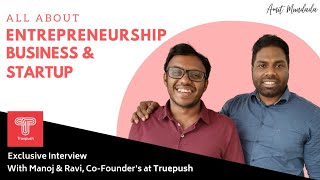
A recorded interview (podcast) with TruePush co-founders Ravi Vaka and Manoj Surya describing their personal backgrounds, early entrepreneurial experiences, and the founding story of TruePush — a free push-notification service. They explain the product (easy two-code install, WordPress support), growth strategy (no paid ads, outreach/growth team), team culture (lean, young hires, emphasis on communication), and roadmap (APIs, mobile SDKs, plugins). Several concrete metrics and commitments are stated by the founders.
Questions this video answers
1.5 billion notifications per month.
Free forever (free push notifications).
Target of 1 billion notifications per day (stated as immediate target for 2020).
6,000+ active publishers.
No — they stated they had not run paid ads; growth driven by outreach/growth team.
Chapters
Hi everyone, I'm Amit Bundora. I welcome you all to the 11th episode of the podcast series from the Scratch. Very excited and happy because we have someone special. We have a guest in this podcast. I have been following his company from past many months and I have seen how they have grown in a very less time without marketing and how they have created their own brand. So with not wasting much time like lets introduce the man himself, Ravi and Manoj, the co founders of Drew Push. Hi sir.
Hi.
Well it's not just one person's effort in building as you have rightly mentioned. We have organically grown very quickly. We haven't spent in fact zero budget on marketing. There are many people behind it. Both Manoj and me are co founders along with Raju Vannapalla. Who is Raju Vannapala predominantly comes with his expertise in data. He's more like an advisor to the company and he's the third phase to the company. He comes with a lot of data experience through his parent company called Way2Online.
Just want to tell to the viewers that it's going to be very informative podcast. We are going to learn from them and everything how from the scratch they have started the journey and it's like it's very informative. So sir, before proceeding and going into depth about how you have started and knowing about the struggles and like the good things about the company, we just.
Want to know a bit, you need.
To go a bit past about your life like how you have, like what you have done, what your schoolings, what you have done and how were your mindsets like.
So the question is what is my pass? Yeah like in school I was in a boarding school for most of my non. I mean no knowledge like 6 to 12 before that you don't know much anyways I don't remember before so I come from a family of business. So though they encouraged me to do a job but that wanting to do a business have been there for me. Even in engineering I have done few things where I earned a little bit of money. So I came to Hyderabad and joined a job but quit in eight months and wanted to start something immediately. Didn't pan out well. I started again. I went into another job that went for another year and I again wanted to quit and start something. I waited for six months for the right idea, did that for two and a half years, closed it and again true Push happened.
True Push happened.
So again my name is Ravi, I'm co founder at TruePush and head of growth at True Push. So I'M son of an army officer. So I have traveled across India length and breadth for my education. During school engineering I've done at Kakinada in computer science. But then I was a very bad engineer. In fact I've done engineering for close to seven and a half years. I flunked lot of exams in between and then finally completed it. Reason behind? Probably I didn't think at the start when I started pursuing my course I pursued it thinking that I might be a good engineer. But I ended up not being one. But then lot of people recognized my people skills. So I have done my management course from a different college later on and also another course from IIT Kanpur in general management. Joined GE from there and then after that I joined as a vice president for a very big content company called wagdot Media. I was there as vice president operations for a very long time. Then I came into entrepreneurship, built two companies which did not work. There were good success stories in that as well. But then predominantly those companies are closed right now. And then before true push I joined another product company called On Go Framework where I was associate vice president there a lot of experience and product which in fact helped me in building tropish in what it is today.
Oh gosh, like you have a very. Like you have started your struggle journey from like from college days only.
Oh yeah, a lot of struggles during college days. In fact it's very difficult if you don't do well in college to survive come this far is tremendous effort, lot of effort in fact. So it's tough but then it is. My journey was enjoyable. I was supported with a lot of friends, family members. They helped me getting past all these hurdles. And then today whatever I am is because of myself a lot of hard work which I have put in. Friends and family supported me.
So like I have one more question on this. Like the struggles, the failures which you have seen in your past journey. So, so what do you think that helped today in building this company? Or they were also part of this or like they were a failure at that moment. There was some learning from that moment which helped you today?
Yeah, I typically don't say failures, I say experiences. Yeah, there are good experiences, bad experiences. You obviously learn from both which definitely has helped in building Troopush. For sure struggles were there, things did not happen in Taiwan. But then you know, if you are focused, if you're diligent and there are support from your immediate family members, peers and all and you have constant eager to succeed, then obviously you can overcome. This is just a Matter of time that things can really turn. I have seen people who are not doing well in life and suddenly in one year they become millionaires, billionaires. So there's something, you know, something overnight has happened not because of. There could be element of luck. Yeah, I agree. But then there could be a lot of experiences which they have learned over the past and that that could have contributed.
Man. Sir, I have a question for you. Is like you had a mindset of entrepreneur from like the school college days or it turned up like you found it mistakenly like such?
No, in my eighth class itself. Like Ravi is telling about engineering. I didn't study much in school because I wanted to start an industry and I didn't understand why I should study physics, chemistry or biology. So I was like, just wanted to cross like 9th class, 10th class so I can just get out and you know, do engineering and become put a software company. That was the mindset at that time. So it was not by mistake, but maybe I've shared so many stories from family about how we used to be in the past as a business family that kind of motivated. So yeah.
How about you sir?
Well, I don't say entrepreneur mindset and all, I'm not really sure. But I was a hustler. Even when I was in college. I did small, small job. I conducted, organized a lot of events. I did events outside. Then see at a place where I have graduated which is Kakinada, there's not much awareness among people. Brands are not really focused about spending money there. So I used to pitch to brands when I was in 18, 19 years old. In fact I also co curator for three tents which I organized way back in 2009 10. So organizing again is not just organizing an event. I was talking to sponsors, getting money. So I say it's not entrepreneur mindset but a typical hustling attitude was always there.
You had that skill in being like and then you found it that you.
Can see basically there's nothing called. For me, entrepreneurship is, it's. It's basically mindset.
Yeah, it's.
It's a term coined for people who have hustling attitude or creative attitude or creative thought, thought process and all. See again, even in job you can hustle. Even in job you can do smaller, smaller things which entrepreneurs do have which is creative thinking. It's not what job you do whether you are doing entrepreneurship or you're working at a job. It's your hustling attitude really matters. So for me entrepreneurship is just a word, but it's actually hustling is what I say one should have hustling and problem solving.
Problem solving, yeah. So like what is true push? Like if you take in a very brief way one single sentence, what is true push?
It's a free push notification product. So anyone can use us save up to $6,000 a year or even more based on what traffic they have. So like lot of people are coming up with new ideas and they want to engage audience.
Re.
Engage audience. And there are a lot of tools that have come for free in terms of development. You can host on GitHub, Mailchimp is free for certain number of. Yeah. So we have our own unique business model where we could be free but at the same time we are helping hundreds of websites reengage their users. As of now our tool is doing 1.5 billion notifications a month.
That's huge.
Yeah, that's huge. Without any marketing there is a market growth team which does a lot of outreach activity but we haven't run ads.
Much and still this is the start.
And we are not even one year old after the public launch and I.
Have was going through the company like I've go through the articles. It seems like it's absolutely free forever.
Yeah.
And the installation is so easy, can be done in five minutes.
Yes.
Can you explain like the installation process in a very simple way?
Very simple.
A person who's not technical also can.
Anyone can do it. So it's very easy. First you have a website somewhere hosted. You can take one file called SW Js, put it in the root folder. We have a clear tutorial for it on our blog or our support team can help and another code where you keep in your. If you are having WordPress again there is a clear tutorial where we show you where to keep the code. You just need to even it's a no brainer. You can just see the screenshots and follow and you can start using. Even if you have one visitor or 10 million visitors, we support you. Equally true. And also it's because it's only two pasting two codes and we have given all the support. A lot of people find it easy and we have tried to keep the tool as simple as possible. Not just the onboarding but even while using you find it's like a play for you. Okay, nice.
So like the link of the company website is given in the description as well as the blog post. Just go and check out. It's very easy if you want to start something of your own. Like if you have an app or website because marketing Is like the way initially you attract the user is very important and where the notification plays very important. Like very important.
Like for layman I probably can explain because I have been doing selling evangelizing the product for a lot of people who are non techies as well. It's a marketing tool and if you have a website or app and typically a website has users who come onto the website to visit a website, to visit something, visit a content or buy a product. Likewise you go to an app to check a lot of information in there. Getting a user is tough, but then to get that user again and again is very very tough. That means I'm typically helping my product trow Push is helping users to come back to the website or see what something it is helping user retention plus adoption of a particular website. So that's what true push is about. We are free forever. It's because it's a strategy which we are trying to bring into place to get maximum publishers on board right now.
So. Ever thought of. Of course like in this period of this journey till today there may be like many struggles, failures, difficult time. Have you ever thought of leaving this and again starting doing the job or leaving this company or doing like because the startup it's like bit struggle. Starting something of your own is bit struggle. Yeah. There is a very like there is a blissful thing in the coming future if you stay at this difficult moment. But staying in those difficult moment is very difficult. So what do you think? What your opinions have you faced this kind of stuff?
See, I think it's more of a gut feel.
Right.
There is no right and wrong answer. Like you feel you would know when you have to stop, but you would know when you have to start. Until you you are true to yourself. Like you. You know what you're doing. Like hundred people will say 100 things though. Sometimes your parents, sometimes your close friends, sometimes your entrepreneur friends will say quit or they will say continue. But I think it's more of you would know what to do.
Like you mean self awareness?
Self awareness? Yeah. Y. Hearing your inner voice kind of. So if, if. If you. If from your inside it feels like okay, it says, you know, you stop it. You have done enough. Then you stop. But you hear the voice. But you also hear another voice. Let's try another day or another month. Then you go for another month or till you could. That's. That's how it works.
I think that's absolutely.
Struggles will come every day. It's not just entrepreneurship or building something startup or or working in a job it's basically you'll have to live with it. So if you're typically talking about starting up or building a company, yeah there'll be failures if the product is not working. It is not working and it is not working. Could be, could have many reasons. It could be your co founder conflicts or it could be product market fit. So there are a lot of things you'll have to consider while you know whether the startup is doing quite well or not. So if you think that all these parameters are not fulfilling or exceeding or probably matching your criteria of success then I think you should evaluate again and again see if there is a chance of feedback and feedback see if there is a chance of getting back contract or if nothing comes as an answer you can, you should, it's wise that you close it off. I have done that before. I've closed two startups before and 10,000 different ideas which I've started and just closed in a day or a couple of days doing a lot of research and I've closed it. So if things happen positively, the challenges are different. You fight for good things like making a better product, providing having a customer delight, having customer delight into picture making sure that your existing customers are very very happy. But if the thing if things don't go right then everything every day is a struggle or a challenge and you'll have to answer those questions on the fly on that particular day because you will end up wasting a lot of time thinking that it might succeed.
Like the time and the resources resources.
Everything plays in nature. You lose a lot maybe sometimes moops also.
Yeah moping of your starting again startup.
And end of the day you would know if you have to.
Yeah.
Like Ravi said all this process will lead you to the decision making.
Sir, like every starter requires a good team also because every investors also they search for good team than any idea or like such. So what's your opinion? What's your thinking about good team will help you in making your company into the next level?
Yes, certainly. But I suggest that you start with a lean team. Founders experience really holds the key. Let's say Manoj is very good at both product and growth. I am good at project management plus marketing and all. There are a lot of tips we share with each other. I have learned a lot of things about marketing from Manoj's previous experience. So founders knowledge is very very important. Manoj also get to know a lot of insights from me because I speak to customers on a daily basis which he implements on his product roadmap. So founders information Is very, very key for me. If you have to ask, I think for me, good team is very small team, lean team. Especially when you are testing a product which is there in market, whether it is performing or not. So I believe that hiring young team and training them would. Would, you know, give us more containment than hiring someone from college. Someone from someone with experience. Experience. So I believed in hiring. We believed in hiring a team which is fresh out of college.
Fresh minds.
When we. Yes. And we trained them and we made it is a good team right now because the results are coming. It's because we have inculcated a hustling attitude in them. The same hustling attitude which we had in the past was imparted in them. Our vision, communication, everything was very, very clear. So for me, if you ask me if good team is required. Yes, it is required. And it's very, very important for any product to grow.
Yeah. And end of the day, only founders or the people who are leading. In the start, we'll be involved in.
A lot of things.
But as we team grows, we'll be more strategic and seeing that all the sanity is maintained. Like everyone is doing the job well. They' taken care. We are hitting the goals. Everyone is hitting the goals. If they have to hit the goals, they should be really good. Like I think good team makes the company company. Yeah. As we, as we go, like probably me and Ravi would be more directional and most of it is being done by the team. Our youngest team member is like 19 or 20 years and we have two of them. Two of them average is probably 23, 24.
If you remove both founders and all, I think all of them are like below 25.
Yeah. Yeah. So I think it's most of it is team and we relay them. I rely on the team like a.
Lot because nowadays like find there is an employee and making him like creating a mindset for him as we are like founders is very difficult because founder mindset is difficult. Like it's totally different than the employee mindset. Employees will think that I have a 9 to 5 job. I'll do the things which you're paying. You're paying me this much. I'll pay, I'll work for that. But finding such team is very difficult. And more than that, you're not finding but making them like forming like a family as you have told you have created that we have made your own like you have. They have indulged like a family and they have created such a nice atmosphere and how they are working as it's their Own startup. They are working like such.
That is what brief I think like how you treat them is how they behave.
Yeah.
Like if you treat them like it's your responsibility and this is your work and whatever you're doing is going to reflect in very big way and if they believe it and they're going to own it, but if you treat them like I'll tell you what to do and you do it, then it's not going to happen.
So.
So you should allow them to come up with their own ideas, implement sometimes there are a lot of times where they did it without our intervention. So if it is a good thing, we appreciate. If it's a bad thing, then we tell why it is bad and what is impact. So next time either they know they have to come to us or they can do it themselves. But they know the right thing to do.
It's important.
Communication is very, very important. You'll have to tell why you'll have to you should do or you shouldn't do XYZ thing. XYZ thing. What are the implications of it? If your vision clarity is there and it goes down to every employee of the company, I think almost everyone will be as good as his founder for his particular role. So if that vision or that practice is inculcated within every employee, there's no one called bad employer, good employee. There won't be any 9 to 5.
Thinking even they would be coming like, yes, I need to go tomorrow again.
I need to work. Correct.
They have that some sort of feeling in that.
In fact there's hardly any, what you call hardly any people who left us. There are only one person who probably have left us, some interns who have finished their internship. Otherwise no one has left us.
This is actually a very. Actually this is one of the milestone, I guess which every startup need a good team and you have got that. Yeah.
So see, we spend a lot of time training every individual. We sit with them. There are some things which they come up with. So end to end. Net net. Both of us have spent a lot of time on a particular piece of work, let's say example. So it's important that you know to retain them because they know what they have done from the start to end. I know what I have done. Every new employee is training from the start, explaining what are the nuances. Then they pick up everything from the start, from the scratch. So it's very difficult. So most easy is to retain very toughest to train. Find the same Sachin Tendulkar you find you can find you found one Sachin Tendulkar but finding many other Sachin Tendulkar to play is very very difficult.
It's both art and science.
So like what's the role of communication in startup?
Very, very important. If you notice true push is like open. It's. It's one single room. Everyone sits right in front of each other. We speak openly about any issue which is there. We get immediate answers. Role of communication is definitely very very important. That's where they know the criticality of one particular. It could be issue, it could be vision, it could be what are we going to do in future versus what are our lives will be if something good happens or bad happens. Communication goes correctly, smoothly, the response is equally good, the reciprocation is equally good.
And like I have also interacted with many people and I got answers of communications like English language. Communication is English. You need to have proper language. I don't think communication is like all about like it's a very big thing.
Communication, communication like okay so here we say you write an email in Telugu. We don't mind as long as it is conveyed. And we spend a lot of time training them on how to talk like new people. Especially people out of college. They will, they are one liners like we are doing, we are not doing. What are you doing? What are you not doing? So we want them to give a complete context and say what is happening, what is the impact? It takes more lines or more time to explain but there is no confusion. There are a lot of times where because of not communicating properly there will be impact. So we take them as opportunities, tell them, see this is the impact. This is how people will misunderstand. I think even after a year our team have become much, much matured. But there is a long way to.
Go, long way to go.
And communication is something takes years to master. So yeah it's going to for us it's primary. One of the primary thing that as a team we try to do better.
Build with good communication.
Good communication is not just English, it's articulation of thought. It could be any language. See the youngest who joined us was fresh out of college when she joined us last year did not have email id. Still studying in college, did not have email id. Today she takes most of the responsibilities in Trow Push growth team and she communicates with our best customers. She chats with them, she write blogs. Today she emails them. There are customers. We have global customers across all the continents. Right now 6,000 plus active publishers are using us. There are people from Puerto Rico, there are people whose native language is French or Portuguese. They write emails in their native language and today we are able to communicate with them is because of our articulation of thoughts, not because of language. So say yeah, I have spoken to a Portuguese customer in their own language. Translated. Translated using Google Translator, heard the, the syllable, the sound and then communicate it back to the person. If your articulation of thought, your vision clarity is there, if you know what you are trying to say, then I think communication shouldn't be a barrier. So yeah, both of us blog. By the way, I was blogging some 10 years ago. I have started recently. Started again. He blogs quite often for me every time it's not English which gets eyeballs onto our blogs, it's it's thought process, how you're connecting. Yes, yes, exactly.
So like does a degree, college or a certificate from a course, does it matter? Any student who is coming out from his college to start his own career in startup or to get a job.
Or to get married, I think both of us different opinions here.
For me, I don't know, I used to say you don't need. But I would say I don't know now reason being thinking about it like I did a lot of learning within the college. So that's a playground, very big playground. You do mistake, nobody cares, nothing happens. You don't lose money, you just lose time. But then you have like three years or four years to experiment. A lot of things work on your skills. For example, in my engineering first year I was very shy to get onto the stage. But third year I was college secretary. I have like 13 or 14 prizes in presentations. So that's something that I, I got excited about to learn and that helped me a lot.
Yeah, that's like something you have learned like through the experience of the college.
College degree.
Degree.
Degree as in it's a paper. Like actually I'm stealing this word from line from Ravi. We are discussing before the interview. So if you're talking about just a paper, then maybe not. But if you're talking about learning some skills, using it as a time to learn something, then probably it's a good way. And I mean you get a lot of friends. Why not like go enjoy, do something that's time where you can enjoy and learn. So go to college.
No, like college is going is very important but still people over there, toppers, everyone, all are behind the marks. Yeah, like they're still more into that.
Oh yeah.
If that is the question, that's really, really stupid. Like you know for me I used to just try to get above 60 so, so that I don't look as a bad student like to be honest. But I never tried for 80, 90 and I know because if you're going for, if I'm trying for placements or I want to build something on my own to do anything I don't really doesn't matter if I have 99 or 60 or in fact 50 also. So I, I think Mark shouldn't have even less. Yeah, I mean I see it doesn't matter at all.
No, no. But again I have a different. If you want to do startup and.
Or if you want to go and if you want to pursue PhD and all then yeah, you need a lot of knowledge. Yeah, that's different.
In, during my career I spoke to a lot of students. In fact I've taught in management schools as well. So my experience is slightly different. I mean I, I relate to his answer. Most of it I have, I mean complete agreement of what Manoj have said. Colleges are very confusing times, you know. That's where you experiment, make mistakes and understand come to a conclusion as to what you want to pursue. Later on you'll have like minded people in the same similar domain or similar area of interest where you can talk. Peer knowledge is very, very important. You learn from peer knowledge more than books or newspaper or anything so on so forth. So college degree is just a piece of paper. But then if you are getting good marks during your education, yes definitely it's advantage because you get place. And yeah obviously if you're getting place in marks really, really matters a lot. But then it is still a piece of paper if you don't figure out how important the college can be for you. So that's one. And you should study. In fact I will study later on as well. I am applying for Y Combinator. I have dreams of pursuing my higher education from Harvard as well. Stanford college is important because you get that network of people or at least people you can cry with or share your pain, agony. It's very, very important that way. So I think in India degree is still important because you get jobs. So I think students should stop focusing on whether you should get a degree or not. You should get a degree for sure. Study hard, do whatever best time, you know, utilize it quite well so that you don't waste, don't waste your college time. That's very, very important. And yes degree is important in India because you get jobs. That's, that's a minimum criteria.
I think more than that your parents will Be happy.
Yeah, yeah.
Maybe that's the last thing you'll do for them.
And you need people support, you need parents support in whatever you're doing. So their happiness is also very, very important. And if you're getting good marks is definitely an added advantage. If you're doing from a better college, of course your struggles have. Your struggles have comparatively less. Now you decide where you fall. If you're a good student and crack a job and do well in the job there are people like Cognizant CEO his salary is or his net worth is 191 million. It's still a job. Right. But he's still earning money. So it's up to you as to how you utilize how you want to utilize your college degree.
So it's like getting a degree and giving equal importance to learning also.
Correct. So I was fortunate.
I would say it's only learning degree.
Should come because there are few students would not afford to start their own startup and they what they prefer is to go to a job and for getting a job they require a good degree.
See no, I wouldn't really agree completely with it. If you don't have money, there are a lot of. One thing is okay, let's say you have like 1 crore. Like can you run the business? Like do you know how to run a business? Do you know what to run? Do you know how to manage a team? There are a lot of things. So it's not money. It's not just money. It could be one of it.
It's about how you execute.
Execute. Yeah. So I learn some money and like do the math. Even if you work for 10 years, you'll not, you know. So in one year all the money will be washed away. So you want. You have a dream and you wait for 10, 15 years and in one year you are going to be broke. That's stupid. So.
So probably if you have a team.
Especially now unless you are going into brick and mortar business like restaurants and or which needs a lot of money. If it is software, I think you can almost do a lot of things for zero.
Yeah.
$00. So today if you are talking about SaaS products, money is not the barrier.
I ran a company for three years without any money. In fact I earned 500 rupees from the first purchase without investing on anything and then bought a domain out of it. So it's almost like zero money. I just use my tactful nature speak to vendor versus a customer, bridge the gap. Earned 500 rupees invested in a domain and then pitch the idea to other person. That other person of course my dad got some money. So he's my initial angel investor. He only spent 2 lakhs. My founder brought another 2 lakhs. We ran the company for 3, 3 and a half years only with that initial amount of money. So you not you don't really need money at the goal from the. From the start. But there are, there can be case to case. It really, you know, are different. You know when once cred started I think they started with money. Good, good money in hand. But then Kunal Shah previous company. Yeah. Free charge did not have. So it depends case to case basis.
Yeah.
And at a point definitely money will define your success. But then how you are getting that money is important. If you. If you want to dilute your stakes and get investors on board, you lose your percentage versus bootstrapped company. You have complete authority a lot of things to trade off.
And like after college also if he's starting his own something from the scratch and building his company with zero investment also and later stage if it's not getting succeed order. But at the end he's learning something.
Exactly.
And he may get something, he may get placed also.
It doesn't matter. See if. If you're starting, if.
If you're someone who want to start.
Up, that needs a lot of confidence. If you have that confidence, you don't need to even think about job. It would come and a lot of. Let's say for us, even if we don't have need and we see a hustler, we try to pull him as much as if we can. Like as much as possible. I think we hired like two, three people because they're just hustlers. Like we didn't have.
We spoke to some clients who we thought that our hustlers can they join and contribute to the company. Things did not materialize. It's different again their choice matters. And all it's important that are you a problem solver or not? Are you a hustler or not?
So like nowadays students who want to start the startup want to start something of their own. They have an idea but they are scared to discuss the idea with anyone elder or experienced or a mentor for them. So they have that thing like they will steal my idea, they will steal my idea, they will copy and they'll start something of their own. So what do you think your opinions on this? To this?
To this. I think it's stupid. See, you don't talk, you launch a website. It's the same thing. Like your website or your product, you have to market and everyone would know and initially it would be so small that anybody could copy. So it's better you would talk, see what are the good and bad things and you know, execute what is the right thing. And also since you mentioned mentor, I think mentor is really important because he might have failed, succeeded for over like 10 years or 15 years. Yeah, you'll have better perspective on things and you might have done the same thing that you are about to do, which you could fail. So your learning time will reduce from like two, three years to six months or eight months.
It's like doing hard work, doing bit smart work.
Yeah, yeah.
By getting the right.
You should leave your ego and ask questions. And you know that you don't know a lot of things when you're starting and you need to ask and should be transparent about it. Say that you want to do this but you don't know how and people are going to help. And if it is easily copyable, then it's not worth doing also. Okay, yeah, what's the point? Like once you have a website and tell few people, people with the right skills are going to copy, copy that. So it doesn't matter. I think it should talk.
I in fact told every idea to in fact get an idea. I tell it immediately. No one copied my idea till now. Maybe the idea is stupid, it doesn't happen even. Yeah, see what's wrong if someone copies it, you might do it better or let them do it. I started something called Suite Experience where I was trying to put sweets from places of origin and bring it on a technology platform. Someone else is now doing the same. I felt happy, in fact texted him saying that glad that you you are doing that, taking it forward, which I couldn't. Yeah, people will do. Let them do. In fact, what idea? Tell me, tell me one idea which is not in the market, which you.
Have right now is the last entrant in the market. So we kind of are copying maybe.
Yeah, we copied and copied from from lot of products and created a baseline product. In fact, in my growth blog, which I wrote recently, which got viral on Medium and Hacker Noon, the first point itself is copying is not bad. Yeah, it's inherently good that that means copying is. There's no problem in telling, sharing ideas or copying from something. Nothing wrong in that. It's how you execute, how you go in the market, how quickly and what's.
The problem you're solving.
And the market is so big. Like for example Kushnodep. Since I'll talk about our industry like the biggest player in the industry only own 1% or less of the market share. Like that Notification. Notification like the end of the whole websites versus how many people are you're.
Talking about the globe?
All world.
All world.
All in India.
No, all world.
One person.
There are 700. There are 700 million websites and 10 million apps which are active right now.
And there are hundreds of push notification tools. Right. Every tool has something different. Otherwise there wouldn't exist lot of tools. So though we are pursuing the same thing re engagement, everyone does it differently. So even so even though you try to copy everything, you can't copy everything. So because your consciousness kicks into a picture and you try to do it on your own and the differentiation comes as you go. So even copying, copying is not impossible.
Actually it's like they are not succeeding in copying that and executing ourselves.
It can't.
It can't.
Why you in in school you copy from your peer and you will not get the same marks. Challenge me if you're getting the same marks. I think you are put the person who has put a full stop or probably written a word and striked it off. I think you have done that as well. Yeah. The only way you can get the same same marks.
I actually exactly remember totally lit everyone. Good, good example.
Yeah yeah. So it's like at the end briefing this out there are people have their own ideas, they are working on it. But if you want to same if you have an idea of the same idea, understanding those market and solving the problems which they are not. Maybe that can be something.
I think to summarize, it doesn't matter. Talk to as many people as you as you can. Especially to clients and customers like whom you're going to sell. And probably mentors like these are the only two people that matters. Everything else like you don't need to talk to your parents and friends also.
But finding right mentors is also difficult.
Okay. Finding the right mentor is another exercise. Like you have to meet friends. For me, what I used to do, I meet one mentor go for three sessions like three times I meet, I.
Do everything he says on a weekly.
Basis depending on the task. So he'll tell why don't you try this? I'll go and try. So he'll give me some insights. So if I see a match between him and me, I continue. If I don't get a match, I move on. Even if I get another mentor or not, I move on because I know it is not compatible. So for my last Startup. It took me like five, six iteration and seventh person very random is in us. His name is Srikant. He even sent me money for many months for me. We didn't meet but he resonated like he had a startup and he sold it for 10 million and he resonated with my idea at that time and he said like yeah, I mean let me help you how much ever I can. And he you just spend a number of hours with me. So yeah, I mean it's luck and a lot of hustle for finding a mentor.
It's not finding the mentor which is a challenge. You have mentors. But then the answers to questions like why do you need a mentor versus what is that mentor? What are. Why is that you need that mentor to be your mentor? What is that? What is his role? That that portion of that answer of that role. Clarity. That is important. That is tough finding in mentors these days. I don't think it is tough at all. But as long as you define as to why you need a mentor versus what is his role those answers needs to be there to find the right guy.
As in India our Prime minister been supporting and pushing startup India.
Startup India.
But still in schools and colleges we have been trained to get a job and it's like they have been setting up our mindset as an employee, right? Because startup entrepreneur mindset, business mind is totally different than employee.
Correct.
Still after maybe actually this year, slowly, slowly they have started introducing few courses related to entrepreneurships like design, thinking, leadership, communication, out trying and all. These are few and not every schools and colleges very slow, slowly they are pushing out and that too in Delhi they have started. Okay so like maybe like so this is the thing and they are still telling to start startup, startup. Okay, what's the game like?
See it's like 199 1% and 99 like 1 or 2% are going to try a lot and it's.
It's.
See maybe entrepreneurship is over glorified. If I ask like if you are in a. It depends on where you are standing. Like if you are in startups you will try to encourage everyone to start up. If you are artist you will try to make everyone an artist. If you are a runner you will try to make everyone a runner. If you are a painter you will try. Like if you see any famous dancer, everyone he will say everyone has dance in them, right? Everyone is part of like they have a lot of things in them. I think whatever they want to pursue they have to. But like you rightly said at least people should know it is there and you know there is something to be explored. I didn't know they're introducing courses of design thinking which is really good thing, like more opportunities for roles. Like when you say startup, there are only two, three founders and most of the people the team does the work and we need really good people who do the design, who do the development, who do the marketing, who do the support job. Everything is important. So I think it's okay.
I'm not telling that if they're school students, they are teaching them about these skills and they need to do startup only after that. It's not like that even an employee or a team member who's working in a company or a startup, those people need those skills. These are the few skills.
Yeah, I think you're more talking about the hustling and taking ownership mindset. I think even if you're a sweeper or a CEO, I think you should feel responsible for whatever your job is. Once that comes, then if you want to start up, then you really have to start up. If you really just want to do great at growth or great at development or coding, I think you should pursue whatever you have to pursue.
See, you're talking about as a country but it's a myth that other countries also have similar problems. Basically our mindset, people who have we are much more risk averse. We don't take. We are not people who are risk taking. So basically our fundamental way of brainwashing as our parents talking to us is an easy solution where you get settled in career. If you see success in startups, obviously people will tell their children to, you know, why don't you pursue career in building something? So you should have success stories in families for anyone to replicate that you should have models. So moving forward, once opportunities come within startup also and people see that as an effective way of earning money or earning wealth, obviously things will change. There are friends in Silicon Valley who have similar problems, not Indians. But then Westerners who tell that my parents don't want to start because there are XYZ risk element. It's not just India, it's elsewhere as well. And yeah, India nowadays I have seen courses not in Delhi, I have seen courses in Hyderabad schools and government schools in remote villages of Andhra Pradesh or Telangana. There are courses which are there which talk about self sustaining. Then you talk about risk taking, then talk about experimentation, they talk about leadership. Yeah, all these things are already there. But then it has to penetrate deep inside the mindset. Then I think ecosystem as a whole should evolve. It's not just a teacher teaching a student or parent telling a student or someone else. Everyone should contribute.
It's like a multi directional.
Yes, absolutely. It's basically your orientation or knowledge or awareness which comes in your life. All these factors matters a lot.
I just want your opinions on this and as good informative as possible. So there are few words. So I just want your opinion on this Risk taking.
Very, very important. It's because of that only you understand.
What is your level or capability.
Perspective. Anyone can answer.
Oh, perspective. It's good to have a strong perspective but you should also be flexible to listen to other, other people's perspective. So yeah, both are different and perspective is going to be a really long answer. I try to keep it short.
Courage, it's important.
The chances of failure in life is as good as chances of successes. So every time you fail I think you should. That's. That's the thing which, which will keep taking you up to. To raise again and do perform.
Discipline.
Discipline very much needed. The more disciplined and focused, the better the outcome, the more predictable and faster it becomes.
And with failure we have discussed in this podcast a lot.
Yeah, inevitable.
Yeah. You can't avoid it. You just can't avoid struggles.
So yeah, last but not the least like advice for the viewers like who are listening to this, like maybe students or it may be anyone who are listening just say advice from your side.
It may be any advice, no advice as such. But then do well in whatever you want to do. You know, if you're passionate about something, pursue that. That doesn't mean that, you know, you shouldn't listen to your parents and all where you are pros and cons versus where you are risk element and then take a decision and whatever decision you take in life, whether it is a job or entrepreneurship and all give 100% money is there everywhere. Don't chase money too much or chase a career that I want. Yeah. There are two ways of defining career. If you are talking about advice is whatever you get, you become expertise in that. Accept it and become expert. Money is still there.
Money will follow you.
Yeah. And whatever you like, you chase there will struggle. But then eventually you'll be happy because you're doing whatever you want to do in life.
And yeah, so we just want to know what are the coming events or coming updates or something good features from True Push.
Okay, so we are coming with APIs. A lot of customers are asking and a lot of our customers will be excited. I feel even we are excited to coming with APIs we are only live for websites right now. In coming months we'll be coming push notifications for both mobile and I mean Android and iPhone. We are coming with a lot of plugins in the coming months and hopefully in the next one year we'll have different forms where you can use our push notifications just like I said in plugins, APIs and probably multiple SDKs within Android. And yeah we are trying to be going deeper as much as possible. So yeah, I mean we are excited about it.
Just to conclude we want to onboard good companies are now adopting true push and our vision is to send 1 billion notifications a day is our immediate.
Target which we want next year 2020.
Yes, for sure that's going to happen for sure. And we want to become world's most preferred push notifications tool by next year.
And after next year also you will be conducting free forever model.
Yeah.
Yes.
No, no, it will be free. No it's free. It's free push notifications.
It's free.
Yeah. So thank you Manoj and Ravi thank you so much.
Thanks a lot. Thanks a lot Amit.
Thanks a lot for coming.
I guess as company goes through push they have given so truly lovely answers to each and every questions. So like deliberately, properly they have given thing. Thank you so much guys. If you liked it their websites and.
All the blog posts as I have.
Told it's given in the description just go and check out you'll know brief it will be very helpful as they have told the coming updates and it may be surely 100% helpful you. So guys, that's it from this episode 11 see you in another one. Another one. Until then take care. Keep smiling. Bye bye. Sam.