#19 Product Positioning - April Dunford (Ambient Strategy) | Builders' Studio: a Founder School
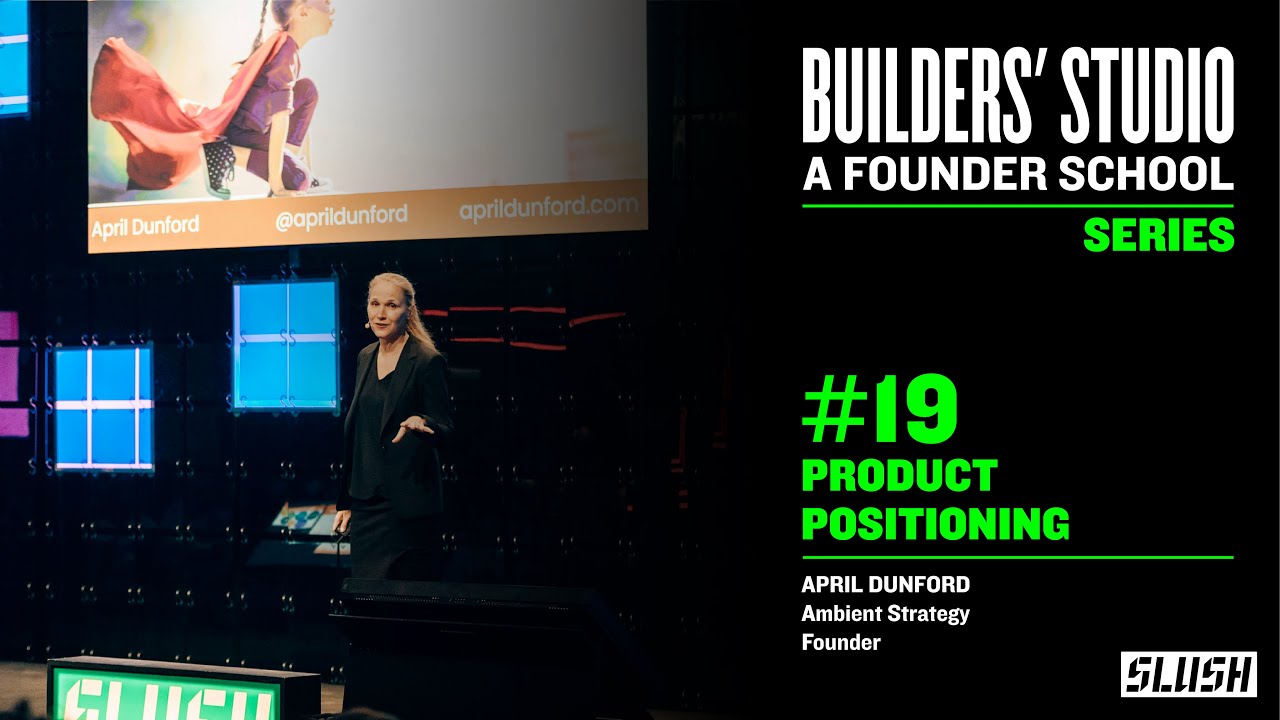
April Dunford explains why positioning is foundational for startups: it's the context that tells customers why your product is the best solution for them. She walks through a five-component framework starting with competitive alternatives, then differentiated capabilities and value, target customers, and market category. A robot startup repositioned as an "autonomous industrial vehicle" and a CRM that found its niche in investment banking both saw dramatic revenue growth.
Chapters
Oh, I'm so excited to be here live, face-to-face. Today I have a really big topic and a really short amount of time to talk about it, so we're going to go pretty fast. I'm here to talk about positioning, one of the most powerful tools we have at our disposal at startups, but also one of the least understood. In fact, it's so misunderstood that most of the time when I talk about positioning, I have to start by telling you what positioning is not. So it is not the same thing as messaging. It's not the same thing as your tagline. It's— my personal pet peeve is when people talk about brand positioning. This drives me crazy. There's branding and there's positioning. Those 2 things are actually completely separate concepts. In fact, most of the things you see on this slide flow from positioning, but positioning actually comes first. You can think about it this way. Everything we do in marketing and sales is the house. Positioning is the foundation upon which the house is built. Now, here's my definition. I define positioning this way. Positioning defines how our product is the best in the world at delivering some value that a well-defined set of customers cares a lot about. That's a kind of complicated definition, but here's an easier way to think about it. It's a bit like context setting for products. And context is really important because that's how we figure out things that we don't know too much about, particularly things that are new, that we've never encountered before. I'm going to give you a goofy example, and then I'm going to give you a less stupid example. So here's a product that I encountered once, completely out of context, surfing the internet. You know what I thought this was? I thought this was a shoe. Like, you know, Crocs, they're really into ugly shoes, and they said, how can we make this more ugly? I know. We'll open up the toe and we'll put this thing at the back. And then I saw it in context and realized, oh, that's not what it is at all. It's actually something completely different. And then if I show you this, you get the dog thing, right? And then I show you this, you might say, oh, she's into dogs. That's a dog thing too. That's like a cone you get for your dog when he goes to the hospital or something. And it turns out it's not for dogs. It's actually for people. Eating noodles. But the marketers gave you some clues about, in the context, about what this is for, and the clue is that guy. You know what this is for? This is for making people fall in love with you. The marketers, they lie. They lie. That doesn't work. That doesn't work. The point here is that a shift in context or positioning can completely transform the way we perceive a product. Now, context is important particularly for tech products because the markets that we operate in are insanely crowded. So I like to show this slide just as a way to like scare you about how crowded markets are. This is if we think about all the software and all the land to solve all the problems, this is one man's attempt to model just the software to solve marketing problems. Look at that thing. There's 8,000 companies on there. If I'm a vice president of marketing and I'm trying to figure out who I should shortlist to look at. How do I figure this out? It's impossible. Well, one of the ways we do this is with market categories. So market categories help us narrow things down and we know what to focus on. So you can see this guy, he's made an attempt to make some sense of this with macro categories, which are the colors, like the red stuff is marketing and sales and orange stuff is content and experience. And then inside each of those colors, there's these little islands and each of those are your own market categories. So let's say I'm a vice president of marketing. I want to do live chat on my website. I look at this thing and go, oh man, that's confusing, but maybe it's social and relationships, and sure enough there's a little island in there and it's called bots and live chat or something like this. And so I've narrowed it down, so this is good. Now I don't have to think about all 8,000 anymore, I only have to think about— well, to be honest, it's still way too many, but at least it's not 8,000. But that's not all positioning your product in a certain category does. It doesn't just narrow down the competition, competition. What it actually does is it sets off a really powerful set of assumptions in the minds of customers about what your product is all about. So it works a bit like this. If I came to you and just told you the market category of my product, you would automatically assume a bunch of things about it. So say I came on stage and I said, hey, I'm here to pitch you my product. I have a revolutionary next-generation CRM. And that's it. You don't get anything else about it. Who's my competition? Salesforce? Pipedrive? Salesforce. Yeah, Salesforce. They're the leader in that market. What's the title of the person that I sell my product to? VP sales, head of sales. That's who buys a CRM, right? What are the— what are 3 or 4 features that you would expect me to have? Tracking a pipeline, tracking deals across a pipeline. Now here's where it gets crazy. What's the price of my solution? How would you know that? I didn't tell you anything. I didn't tell you a single— I didn't tell you anything except the market category. But if you assume that my competition is Salesforce because you assume they're the leader in that market, you would also assume that I don't cost more than that. I'm not charging more than the market leader in this, am I? So here's how this works. If I do a good job, I position my product in a market category such that it sets off a set of assumptions in the customer's mind about my product, and those assumptions are true, great. I just saved marketing and sales a whole lot of time. I don't have to tell you who my competition is. It's assumed. I don't have to list every single feature my product has. Half of that stuff is table stakes. Unfortunately, it works the same if I do a terrible job of it. So if I position my product in a market category, it sets off a set of assumptions about my product that are not true, Now marketing and sales has a lot of extra work to do undoing the damage that that positioning has already done. Let me give you an example. So I got a call once from an investor in Silicon Valley. He said, I've got this company. I just invested in them. I love them. Customers love them. I talked to their customers. Customers love them. But when they're doing a first meeting, no one can figure out what they do. Maybe this is a positioning thing. Can you help them? I say, fine. We get on the phone. So I get on the phone. I'm like, Okay, who are you guys? What's your deal? And they said, we're lawyers, ex-lawyers, and what we have is this revolutionary thing. It's email for lawyers. And I'm like, email? Who knew the lawyers needed their own email? But okay, email for lawyers. I got you. And then they said, all right. And they jump into the demo. And they're showing me the demo. I'm like, this looks fantastic, but how does the calendar work on your email for lawyers? And the CEO says, oh, we don't have a calendar. What? I'm like, wait, so how do you replace Gmail and Outlook if you don't have a calendar? And he says, we don't, we don't compete with Gmail and Outlook. And I'm like, what? So the lawyers need 2 emails? I don't get it. And then I said, wait, so the investor says everyone loves you. Why do they love you so much? He said, oh, we've got this feature. We have a patent on it. And what it is is a super secure context-aware file sharing. So you've got lawyers, clients, they want to collaborate on documents. This has some AI stuff, automatically figures out who should have access to the document, who doesn't, put it in a secure place, everybody that gets access to it. And I'm like, wow, that actually sounds great. But you know what it doesn't sound like? Email. Like, if I wanted to solve that problem, would I buy email to do that? No. So what these folks have is this really innovative, great product that people love, Masquerading as shit email. Now, what if I took this same product and I didn't touch it? Didn't touch features, didn't touch it. But I picked it up and I put it in a different market category. What if instead I said, you know, it's not email, it's team collaboration for lawyers? Ah, that's different. Different assumptions, different competitors. Now I'm not competing with Google anymore. Now I'm competing with Slack and Microsoft Teams. What do I assume functionality-wise? Well, I don't care about calendar. I don't expect it to have a calendar. I do expect it to have something fancy for collaborating with lawyers. And that's exactly what they have— super secure, context-aware file sharing thing. The great thing on this is your assumption about price is really different too, and the price just went way up. Email is free. Team collaboration, we pay a lot of money for that. Here's another example. This is a company I worked with in Canada, founded by 2 guys with advanced degrees in mechatronics engineering. They start a company, and they're robot guys, and they're making robots. Eventually, they come up with this robot here. What it does, it drives around a manufacturing plant, and it delivers things from one place to the other. Now, if you don't know much about robotics, you might think, oh, that doesn't sound so hard. Turns out this thing is a miracle of modern technology. It's full of mapping sensors, artificial intelligence. It's amazing. So they go to sell it to the manufacturing plant. They get the meeting. They go in, and they say, hi, we're ClearPath Robotics. We'd like to sell you our fancy new robot. And the reaction they get from the buyer is, Robots. Robots. Yeah, we got robots, man. We've been buying robots for a decade. In fact, we have approved robot vendors, and you're not one of them. We know what robots cost. Your thing is way too expensive, and on and on. And ClearPath is like, no, no, no, you don't understand. We're special robots. Special, special, innovative robots, like no robots you've ever seen before. So after a while, they get the idea, maybe positioning this as a robot is not doing me any favors. So they went back and they said, well, what's special about us? It's mobility. It drives around. It's mapping sensors, artificial intelligence. How could we position this so that all of these things would be obvious to customers? And eventually, they got the idea, maybe what we've invented here is not a robot. Maybe it's a self-driving car. Or an autonomous vehicle for industrial uses, which is how they position it. Now they go in, it's a completely different set of assumptions. Of course it drives around. Of course it's got artificial intelligence. And of course, I'm not going to get it from the same vendor that picks up a roll of tape and puts it in a box. So how do we actually do this? This is a question that bothered me for— not a joke— a decade. I don't actually have a degree in marketing. I have a degree in systems design engineering. But I get this job in marketing right out of university. And we reposition a product. And it goes from selling nothing to selling hundreds of millions of revenue. And I'm like, wow, I should figure out this positioning thing. I wonder how the marketers do it. So I read a lot of books. And I go to school. And the closest I get to a positioning methodology is this thing. Have you ever done a positioning statement? Without a word, the dumbest thing I have ever learned in university is this thing right here. It's so super useless. So here's how it goes. I learned it at university. So the professor comes out. He says, today we're going to learn positioning. Here's how it goes. It's Mad Libs fill in the blanks. We have a blank that does blank unlike blankety blank blank blank. And each of those things, you fill out one of those things, and like one of those things says market category. Now, how do I know which market category is the best one to position myself in? How do I know if I'm email or team collaboration? How do I know if I'm a robot or a self-driving car? And the guy says, well, you just fill it out and that's it, you're done. And I'm like, well, wait, wait, wait. And he's on to the next topic. And I'm at the back, I'm like, wait, stop, no. And I explain the whole thing. I'm like, how do I know you have a blank there? How do I know what's the best thing to fill in the blank? And you know what the guy said? said to me? He got all professor on me. He's got his glasses, put his glasses down. Who said that? I'm like, me, me, I said it. How do you know? How do you know? And he says, trust me, April, you'll just know. Right? So at this point, I'm like, nobody knows. Actually, literally, nobody knows how to do this. So, but, you know, I think, well, at this point, I've repositioned 3 products, so I think maybe I can figure it out. So this is how I figure it out. I start by saying, Maybe we could break positioning down into component pieces. And that actually turns out to be pretty easy because we kind of agree what the pieces are. So there are 5 pieces. The first one is competitive alternatives. If you didn't exist, what would the company do instead? Second one is unique or differentiated features or capabilities. The next one is value, in particular differentiated value. What does your product enable for customers? The next one is, well, what customers? So who's my target customers I'm going after? And the last one is market category. Am I a robot or a self-driving car? These are the things. So I figure all I have to do is get the best answer for each of these things, smash it together, voilà, good positioning, right? This is where it gets hard. The first thing you realize when you do that is that each of the components actually has a relationship to the others. So if I take anything on here, let's take differentiated value. The differentiated value that my product enables for customers is comes from what? My differentiated features. That's the only place it comes from. Like, we don't get to make it up. It comes from differentiated features. But my differentiated features are only differentiated when I compare them to a competitive alternative. Hmm. And then think about it. My best fit customers, by definition, my best fit customers are the customers that care the most about my differentiated value. So those 2 things are related. And then market category, this is a little more esoteric, but my best market category is the context I position my product in such that this value makes a lot of sense to these people. So if everything relates to everything else, where do we start? And for 2 years, I had no idea. I just started in a random place, worked my way around, got candidate positioning, took it out to the market, tested. If it works, great, we run with it. If it doesn't, I go back and do it again. And that was fine as long as I got it right the first time. If I didn't get it right the first time, then my CEO is looking at me going, tick-tock, like, do you want to get fired or not? We've been on this for 3 months, April, and you haven't figured this out yet. And so how I eventually figured this out is a long story. But I got reading Clayton Christensen. I went really deep into Jobs to Be Done. And after I stewed on that for about a year, I came out and what I decided was, We actually have to do this in a very deliberate order. We need to start with competitive alternatives. If we do not start there, then we get positioning that sounds good in the office, but it doesn't work when we take it out to the market because it doesn't differentiate us sufficiently against the competition. So it works like this. If you didn't exist, what would a customer do? And then once I enter, that's my stake in the ground. This is what I got to beat in order to do a deal. Once I understand that, then I can say, well, what do I got that they don't have? That gets me my differentiated capabilities. Once I have differentiated capabilities, then I can look at all those capabilities and say, so what for a customer? Why does a customer care? And I can map that to value. Once I've got value, then I can say, well, okay, this is the value that, that my product alone can deliver. Who cares a lot about that and why? That's going to get me my segmentation. And then once I have that, I can look at market category and say, look, I got this value for these people. What context can I position that in such that this value makes a lot of sense to these folks? Now, there's a million ways to mess this up. The most common way to mess it up is the first step around competitive alternatives. Most of the time when I talk to companies, they'll come to me and I'll say, who do you compete with? And I have conversations like this every day. I'll say, who do you compete with? They say, oh, got all these competitors. Look, there's a million of them, little companies in Silicon Valley nobody's ever heard of. And I say, okay, well, how do you beat them? Well, ease of use. That's our thing. It takes 59 clicks to do their thing, and with us it only takes 2 clicks. So we're positioning around ease of use. That's how we win. And I'm like, well, do you ever lose a deal to any of these companies? And they'll say, no, actually, we don't actually see them. Well, so what do you lose a deal to? They'll say, we lose a deal to no decision. I'm like, well, if there's no decision, how's the company solving the problem? Well, they're just doing it with Excel or interns or something. Ah, so your competition that you're losing to is the intern. Do you think you beat the intern on ease of use? No, the intern is so easy to use. You are like Joey. Love you. Get me a coffee. Fill out the spreadsheet. Come back when you're done. Easy, easy. Way easier than your product, right? So if you get the— if you're not thinking about this right step and thinking about not just direct competitors, but also, you know, whatever status quo is in the account, then everything downstream from this will be bad. There's a lot of other ways to mess this up. I wrote an entire book on this. You could spend $10 and get a thing that it took me 20 years to figure out. The world is amazing. I have one more story to tell. It is an old story, but I still like it, so I'm going to tell it again. So really early in my career, I got a job running marketing at a company that positioned themselves as enterprise CRM, customer relationship management. And at the time, Salesforce was in the market at the time, but people forget this. Like, at the beginning, they were only selling to small, small businesses. Enterprise CRM at the time was completely dominated by this giant company in Silicon Valley called Siebel. So we were positioned as enterprise CRM. They were the undisputed kings of enterprise CRM. So not surprisingly, we get a meeting with a customer and we say, hi, we do enterprise CRM. And they say, that's great, how are you better than Siebel? And the answer was, we weren't. Like, we pretty much just weren't better than them in any way you could measure. Like, they had 8,000 employees. I was employee 20. They had $2 billion revenue. We were doing $1.3 million with an M. They had 400 They had 200 customers. We had 5. But we did have one feature that not only did they not have it, they couldn't copy it. So we could manage relationships in a slightly different way. And it looked really good in a demo. So we always demoed it. So we'd get in the meeting and they'd say, well, how are you better than Siebel? And we'd say, oh, because we got this thing. You know, and then we'd show the thing. It's amazing. And they'd look at it and go, that looks great. What do you do with that? And we'd say, anything you want. Because we didn't know. Like, we had the feature. We didn't know how to translate the feature into value. Therefore, we didn't understand who cared a lot about that feature. So needless to say, things aren't going well. How we actually got out of this problem is luck, mainly. So we hired a new sales rep. And the reason— we were always hiring sales reps because we weren't selling anything. And then we would fire the sales rep. And then we'd have to hire a new sales rep. So this sales rep came into an interview, and he's from New York, so he's got some attitude. And so he came into the interview, and my CEO at the time also has some attitude. So they sat down together, and my CEO says, give me one good reason to hire you as a sales rep for my product. And the sales rep got all up in his face and said, I'll give you one good reason, because my buddy runs investment banking at Goldman Sachs, and I'm going to get you a meeting. And we were like— Good. Can you start Monday? So we hired the guy, literally on that, and then he got the meeting with the head of investment banking. And so I went, mainly because I wanted to see what the office of the head of investment banking at Goldman Sachs looks like. It has a helicopter pad outside. It's very impressive. Anyways, we go in, we do the demo, and my rep is great. He does a great demo. He gets to the part of our special thing, We show him that, and the guy gets really excited. And he's like, back up, but are you saying if 2 people don't work for the same company, but they sit on a board together, you can model that? We're like, yeah. He's like, so 2 people belong to the same golf club, you can model that? We're like, yeah. He says, hang on, I need the vice presidents. He goes out, he gets his vice presidents, he comes back. He says, show them the thing, show them the thing. So we demo the thing, and they ask the same questions. Like, Oh my gosh, so if 2 people sit on a board together, but they work at different companies, you can model that? We're like, yes, we can. So they got all excited. They're jumping up and down, speaking their banker language. We're cowering in the corner. It's terrifying. Finally, they— and then they're like, we love it. We got to have it. We closed the deal. This has never happened to us before. So we think, maybe investment bankers love our stuff. Let's try it again. So we get a meeting at Merrill Lynch. We go in. The same thing happens. We show them the thing. Everybody jumps up and down. We close the deal. It turns out the value of this feature was very, very important to the sales process of an investment banker. Once we figured that out, then we just spent all our time selling investment banking. So things are looking up. Importantly, it sparked a conversation back in the office about our positioning. Like, are we really enterprise CRM, or are we CRM for investment banks? Now, that conversation— it might sound like a small change, but let me tell you, it's not a small change. So internally, it took It took us a long time to get our heads around that. That sounds like a really small market. Are we actually going to grow big enough? Our investors hated it. We go to the board meeting and we're like, okay, we're going to be CRM for investment banks. And they're like, we did not invest in you to be some nichey little lifestyle business that only sells to what, 12 investment banks in the land? And we're like— Here's how we sold it to them. We said, look, we're not going to just sell to investment banks forever. Here's how it goes. We're going to sell to investment banks because, let's face it, we can't sell to anybody else. But we know we can win here. And once we win there, then we're going to use the traction we had there to go sell to retail banking. Now we're positioned as CRM for banking. And then once we win retail banking, then we can use that to go to insurance. Then we're going to be CRM for financial services. And if we win that, that's a gigantic market. And then we're going to be CRM for enterprise. And those Siebel guys better watch out. That's how we're going to take them out. The board agreed. We did the repositioning. It was absolutely transformational for the business. The biggest transformation was we never got in a head-to-head deal with Siebel again. So we would go in, and we'd say, we're CRM for investment banking, and they're like, so do you guys compete with Siebel? And we're like, oh, Siebel. We love them. They are amazing. They're so big, so smart, so— they're like the world's best general-purpose CRM. for like call centers and retailers and stuff. Not you, Wolf of Wall Street. You need something special. Let me show you this thing. And then we showed them the thing, and that would be it. So we went from $2 million revenue to a little over $80 million revenue in about 18 months. And the end of the story was we got acquired by Siebel because they got so sick of us kicking their tail all over Wall Street for $1.3 billion. And the board didn't think we were going to make any money with that nichey thing. Anyways, that's the end. Here's 3 things. Positioning is like context setting, and context can kill you if you do this badly. We need to position deliberately. We can't just assume that we sit in a certain market or that's the best way to position us. And the last thing is, if you're going to do positioning, you can't just, you know, you can't just know. You actually have to follow up. Thank you. process. If you want to send me an email or tweet at me or something, here's my contact info. And that's it. I'm done. Thank you.
