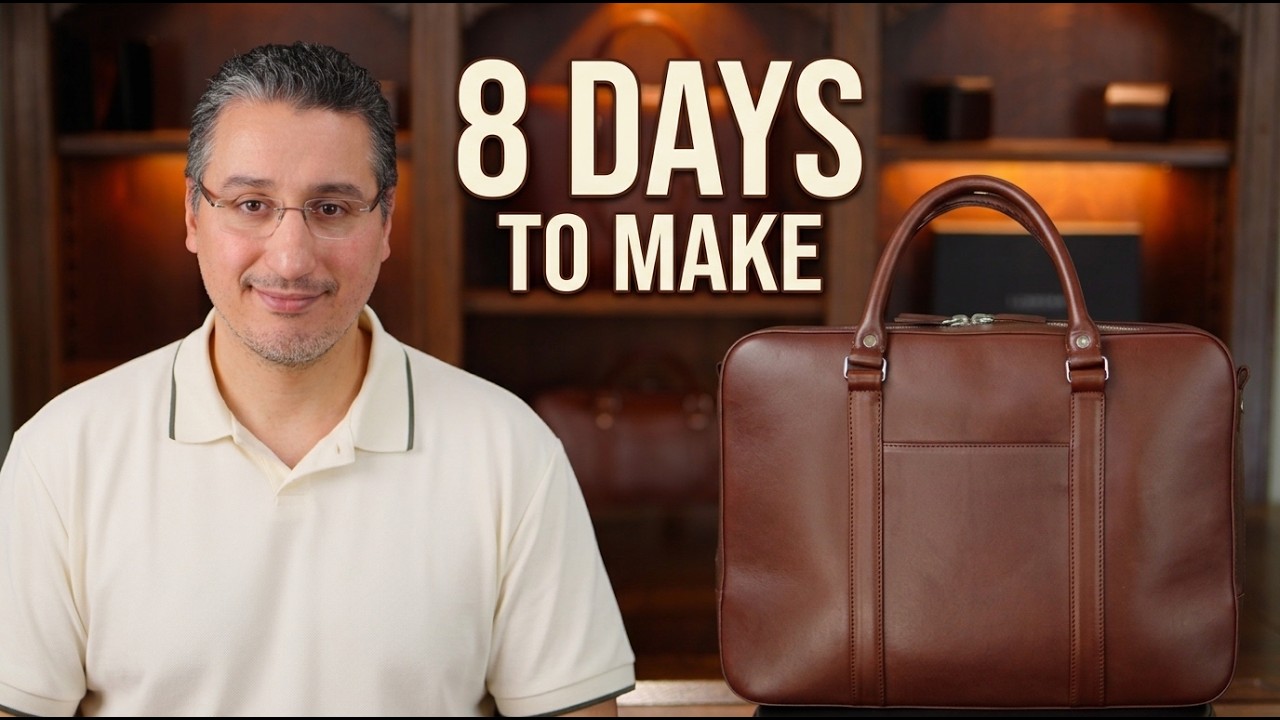
This content was created by Amien Marghich. This content was uploaded by Amien Marghich. This is a YouTube video titled "Lunburg Opus Briefcase Review: A Grand Complication in Leather" (metadata created 2026-07-17). It is a solo product presentation by Amien from LUMBERG describing the Opus briefcase in detail—framing it as a luxury, heirloom-quality piece and walking through the five dimensions of quality (aesthetic and functional design, materials, craft, and reliability). The presenter provides manufacturing specifics (72 hours of master artisan time, 1,233 manual operations, ~30 meters of hand-folded edge), explains the three internal organizations (Integro, Essential, Classic) and protective Poron XRD padding, and lists materials and hardware (Tuscan vegetable-tanned “Perpetual” leather, Andalusian goatskin lining, 316L stainless steel, YKK Excella zippers). He emphasizes traditional turned-edge/“rempliage” craftsmanship, a 50-year warranty, commissioning via concierge, and that the brand reinvests 40% of profits to train the next generation of masters. This is a marketing/presentation video rather than a multi-speaker conversation.
Chapters
In watchmaking, when the hardest mechanisms are united in a single timepiece, they call it a grand complication. This is Amien from LUMBERG, and I am thrilled to present to you our grand complication, but this time in leathercraft: the Opus Briefcase. This is a piece of work that took 72 hours of master artisan time, 1,233 manual operations, and nearly 30 meters of hand-folded edge executed by masters with over 30 years of experience. In this video, I'll walk you through all the 5 dimensions of quality: aesthetic and functional design, materials, craft, and reliability engineering. Let's start with the aesthetic design. When I designed the Opus, my philosophy was simple: this is a piece designed to be used for generations. That means the design has to be timeless. It cannot follow any trends. At the same time, we wanted it to be elegant and imposing. So we decided to remove everything that was not necessary. Even our logo, you will not find it on the outside. It is only embossed on the inside. Because I believe that the signature of this piece should be the quality of its craft. A craft that no machine and no mass production can ever replicate. Now, the functional design. Here, I used the user-centric design process. I wanted this briefcase to be a companion that helps you, something that makes your day easier and more productive. So we created 3 internal organizations based on the job and the daily life of the person carrying it. For the digital heavy professional, we created the Integro. If you always carry a laptop and a tablet, plus all the gadgets, cables, and adapters that come with them, the Integro gives you a maximum organization. Everything has its place. For the professional whose laptop is the main piece, we created the Essential, a padded laptop pocket with minimal internal organization, leaving you space and freedom to organize as you see fit. And for the document-heavy professional, we created the Classic. One big zipped secure pocket for your important documents and a free internal organization where folders, folios, and documents can be arranged freely. All three come with advanced padding technology, Poron XRD on all the layers, giving your assets maximum protection. It is the same technology used to protect defense and aerospace equipment. In all the three, the internal lining comes in light leather color, so whatever you're looking for is easy to find. The external design follows one logic: quick and secure access to the things you need the most. The front pocket is a phone holder with a reinforced panel, so when your phone is inside, no silhouette shows on the leather. On the back, a secure zipped compartment with two internal pockets and a card holder.— organized and always within reach. For the business trip, there is a concealed attachment for a trolley strap. You add it only when you need it. For the shoulder strap, we created a proprietary design that attaches with absolutely no noise. So when you walk into that important meeting, no jingling sound will disturb your presence. Which brings us to the material. My philosophy here is clear: Every material must be the finest, the most reliable, and the most durable. Our Perpetual leather is a vegetable-tanned leather from Tuscany. It takes 40 days to make, using only natural ingredients like mimosa and chestnuts. And during those 40 days, a highly skilled artisan monitors the hides and adjusts the levels of different ingredients to reach the quality our partner tannery is known for. The result is a beautiful leather with deep color that develops a rich patina. It has amazing self-healing properties. Scratches and scuffs can be removed with a bit of rub. And it is dyed from the inside, with no pigments on the surface. So what you see and touch is the natural beauty of the hide and the grain itself. Every time you use it, it's a pleasant experience. For the internal lining, we use vegetable-tanned goatskin sourced from an Andalusian tannery. We chose it because it's a soft cradle for your items while also being very durable. Then the hardware. We use the same material as high watchmaking: 316L stainless steel polished but unpainted, so it lasts for decades and keeps the same color as the first day. For the zippers, we use YKK Excella, the most reliable luxury zipper on the market, also used by the defense industry. Every single zipper tooth is individually polished so nothing ever scratches your materials and assets. And the same philosophy of selection went into everything else: the thread, the glue, and the internal reinforcement technology. Only the finest. We arrive at craftsmanship. Here, we use the most demanding and most sophisticated technique in leathercraft:— a technique that once defined the very essence of luxury leathercraft, reserved for nobility and royalty: the turned edge construction. Most luxury brands today cut the leather and simply apply paint on the edge. We don't. What we do instead is a long, complicated process where one tenth of a millimeter is the standard of precision. At a high level, it comes down to 3 steps: First, we skive the leather, then we reinforce it, and then we fold it by hand on itself. The result is a beautiful, unbroken flow of the grain at every point where the leather ends. To execute this technique, an artisan needs a minimum of 25 years of experience, and even in those hands, it takes at least 10 times more time and effort than a painted edge. In this Opus, there are almost 30 meters of hand-finished edge: the main panels, every pocket, outside and inside, and most beautiful of all, the handle. For the Opus to keep its structure and its beauty across decades of use, our masters assemble every panel on a wooden lath. The result is an heirloom companion, something you enjoy on every interaction as much as you enjoy your Grand Complication. And finally, reliability and durability. Every decision point across the entire process of design and manufacturing was made to produce a piece that doesn't just last for generations, but becomes more beautiful as the years go by. That means heavy reinforcements and double stitching at every pressure point. It means the most durable of materials for every single ingredient. And it means a 50-year warranty. For you, that's peace of mind. For us, that's how we stand behind our craft. So that is the Opus Briefcase, a piece designed to maximize the 5 quality dimensions: aesthetic and functional design, materials, craft, and reliability. Through our website, you can commission a customized Opus. Contact our concierge service and they will be happy to work with you on your commission. And one more thing. The craft of rempliage, the turned edge, is almost extinct. The masters who still practice it are the inheritors of more than 1,000 years of heritage, and we might be witnessing the last generation. That is why at Lundberg we invest 40% of our yearly profits back into this craft, to train and to prepare the next generation of masters, so this great craft survives for generations to come. So when you invest in a Lomberg piece, you become a patron of this functional art.