Amazon CEO Jeff Bezos and brother Mark give a rare interview about growing up and secrets to success
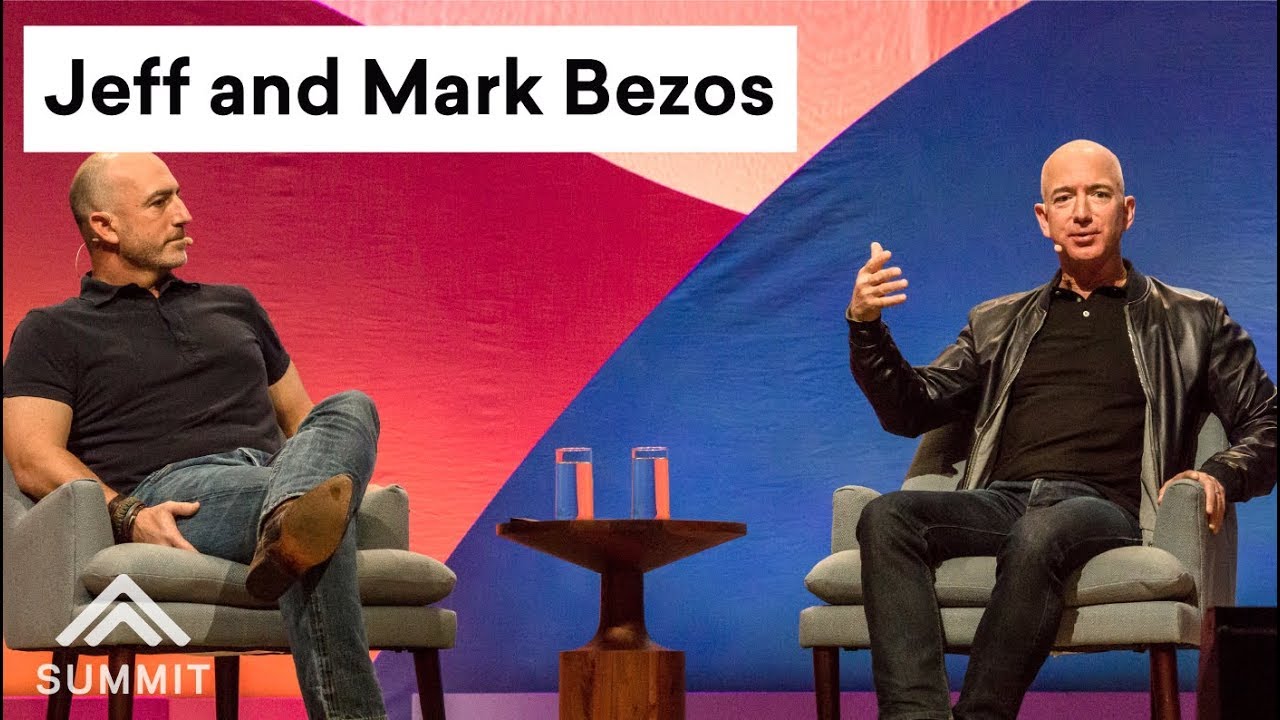
Jeff Bezos and his brother Mark discuss their Texas ranch childhood, early Amazon experiments like Auctions and Marketplace, and Jeff's vision for Blue Origin. He emphasizes long-term thinking, embracing failure, and work-life harmony over balance.
Chapters
Elliot, thank you very much. So this gentleman certainly needs no introduction. My name is Mark Bezos, and you're all welcome to call me what my friends do. They usually just refer to me as Jeff's brother.
So, by the way, just so you know, it actually does go both ways. My brother has a TED Talk about small acts of kindness, being a volunteer firefighter, and it has millions of views. And every once in a while, somebody will stop me and say, I love your TED Talk about being a firefighter and small acts of kindness. And I usually, you know, say, well, thank you, but that's really my brother, his TED Talk. But if I'm in a hurry, I just say thank you. Thank you.
Yes, absolutely. But if any of you do get confused, I'm the one with the smaller bank account to your left.
He's the big brother.
Jeff, before we get started, I think this is obviously a crowd of influential people, people who are starting out. I think we might as well just make the most of their time. dive right into this, if you don't mind.
Let's go.
So, you are captain of industry, Amazon.com, private spaceflight with Blue Origin, the Washington Post, levels of fame and wealth that are hard to comprehend. I guess one question that probably is at the top of everyone's mind is, if you had to choose one thing, what would you say is your favorite What's your favorite part of having me as a little brother? Because I've taken the liberty of writing down some thoughts.
I know the answer to this. There are many things I love about having Mark as a brother, but what he just did is number one at the top of the list. my brother, I just laugh continuously because he is the funniest guy in my life.
Well, thank you. You're an easy audience, and I appreciate it.
I am actually an easy audience.
That is true.
He is.
I am.
All right.
So here's what we're going to do, if all of you don't mind. So the fact that, you know, a fireside chat among brothers, this is not unique for us. This is something that we do Quite often. It's rare that we have a couple thousand of our closest friends with us.
It's also rare that we do it in front of an audience, and we usually actually have a fire.
Yes, and bourbon.
Yeah.
Which we don't have now. What we're going to talk about, the things that I'm going to chat with Jeff about are not the sorts of things perhaps that you would hear in most interviews because 2 pizza rules is not really my jam. We're not going to talk about those things. We do have a shared history. What I really want to focus on is the influences and the inspirations that have led to some of the things, the foundation of what is taking place. This is a little intimidating.
He knows way too much.
What I'd like to do is invite all of you to join in on what is some of our greatest hits, I guess, from my point of view. Because we have such a shared history, What I've done, much to Jeff's chagrin, is I've gone through and taken the liberty of pulling together a bunch of family photos. So I'm going to be throwing some of those up behind us, and just so that you guys can, you know, sort of understand. So if we start talking shorthand, you'll understand what it is that we're referring to. So all sound good?
Yes.
All right. So I am going to— and I appreciate your patience. This is not the sort of thing that I usually do, so I appreciate your patience. So we're just going to dive right into it. So when we were kids, we would spend every summer on our grandfather's ranch in South Texas. We called our grandfather Pop.
That's Pop.
There's Pop right there.
We were probably just fixing that windmill.
Yes, always fixing windmills. Yeah. Before you were climbing them and smashing bottles upon them, which you did recently in an Instagram video. One of the things that we would do every summer, it was really a magical experience. There's little Jeff.
Yeah. That was my maximum cuteness right there. By the way, all downhill from there. That's a 1962 International Harvester Scout. We all learned to drive in that car.
Yes, that car.
Once you can drive that car, you can drive anything.
The 2 of us. That is Jeff teaching me how to open or close a gate, which doesn't seem like it would be that complicated, but I was having trouble.
Wire gap gates are tough.
And then this is—
That's Red. Well, that's Christina, our sister.
No, that's our sister Christina. The horse is Red.
That's Red. That's—
yeah. So I guess one of the things that we learned every summer—
Here's Pop.
Yeah, this is Pop again. As we alluded to with the windmills, there was always work to be done on the ranch. One of the things that I think we learned to value, and you've spoken about this in the past, is the role that resourcefulness, self-reliance plays, certainly in a place like the ranch. Can you talk a little bit about—
Well, so one of the great things that you learn, and first of all, we had a very fortunate, lucky childhood. We got to spend a lot of time with Pop and our grandparents, and you learn different things from grandparents than you learn from parents. It's just a very different relationship. I spent all my summers on his ranch from age 4 to 16, and he was incredibly self-reliant. If you're in the middle of nowhere in a rural area, you don't pick up the phone and call somebody when something breaks. You figure out how to fix it yourself. As a kid, I got to see him solve all these problems. problems and be a real problem solver. He even did his own veterinary work. He would make his own needles to suture up the cattle with. He would take a piece of wire, use a blowtorch to heat it up, pound it flat, sharpen it, drill a hole through it, make a needle. Some of the cattle even survived. We learned a lot of things from watching him. Because he would take on major projects that he didn't really know how to do, and then figure out how to do them.
A good example of that is, you guys built a house.
Yeah.
I think he bought this out of a Sears catalog.
It was a kit house, and we built that thing. Somebody came out, it all showed up in big boxes, and somebody, a professional came out and poured the foundation, and then we did the rest of it. But yeah, that was quite a project. You can see some of the cows there that didn't survive the procedure.
So, you know, when I was going through these, it certainly— I came across this photo, which I'm not exactly sure what it was you were doing here, but I'm almost positive you were doing it wrong.
Maybe that vent really pissed me off. I don't know. That's certainly—
Well, I think there's a couple of things here. First of all, OSHA would not be pleased with No. The way you're on that ladder, and it appears as though you're crafting a spear. I don't know what I'm doing. Yeah. I think that if you can talk a little bit, I know that there's this bulldozer in the background.
That's a D6 Caterpillar bulldozer that my grandfather bought used for $5,000, which is an enormous bargain. This thing, it should cost way way more than that. The reason it was so cheap is it was completely broken. The transmission was stripped, the hydraulics didn't work. We spent basically a whole summer repairing it. Big giant gears would arrive by mail order from Caterpillar. We couldn't even move the gears. The first thing my grandfather did was build a crane to move the gears. That's that kind of self-reliance and resourcefulness.
There's also a story that is somewhat legendary in our family. One of the things that Pop did one summer, it was a little out of character.
Oh, I know what story you're talking about. He really actually was a very careful, conservative sort of person, not prone to crazy acts or anything. He was introspective and even introverted, quiet. But one day he was all by himself. He had driven to the ranch and he was at the main gate to the ranch and he forgot to put the car in park. And so when he got to the gate, he noticed that the car was slowly rolling downhill toward the gate. He thought, this is fantastic. I have just enough time to unlatch the gate, throw the gate open, the car is going to drive right through, and this will be wonderful. He almost got the gate unlatched when the car hit the gate. And it caught his thumb between the gate and the fence post, and it stripped all the flesh off of his thumb. It was hanging there by a tiny little thread, and he was so angry at himself that he ripped that piece of flesh off and threw it in the brush, got back in the car, drove himself to the emergency room in Dilley, Texas, 16 miles away. And when he got there, they said, this is great, we can reattach that. Where is it? And he said, oh, I threw it in the brush. They drove back with the nurses and everybody, and they all— they looked for hours for the thumb, and they never found that piece of flesh. Something probably eaten it. So they take him back to the emergency room, and they said, look, you have 2 choices. You're going to have to have a skin graft for that, and we can sew your thumb to your stomach and leave it there for 6 weeks. That's the best way to do it. Or we can just cut a piece of skin graft from your butt and just suture it on, and it won't ever be as good, but the advantage is your thumb won't be sewn to your stomach for 6 weeks. And he said, I'll take option 2, just do the skin graft from my butt. And they did that. It was very successful. It worked fine. And he— but the funniest thing about this story is that I have incredibly vivid memories, and we all do, of him, and he would definitely— his mornings were completely ritualized. He would wake up, eat breakfast cereal, read the newspaper, and shave with an electric razor for a really long time. Like, he would shave with that electric razor for like 15 minutes while he was eating his cereal. And when he was done shaving his face with that razor, then he would take 2 quick passes over his thumb because his thumb grew butt hair. Which, by the way, did not bother him at all.
No. He was completely unfazed by it.
Yeah, unfazed.
So, thumb butt hair aside, you know, the value of resourcefulness, right? And self-reliance. How do you apply that to, you know, The work that you do on a daily basis? How do you—
Well, I think there are a lot of entrepreneurs and people pursuing dreams and passions in this crowd. You know, you always— the whole point of moving things forward is you run into problems, you run into failures, things don't work, you have to back up and try again. Each one of those times when you have a setback and you back up and you try again, you're using resourcefulness, you're using self-reliance, you're trying to invent your way out of a box. And we have tons of examples at Amazon where we've had to do this. We've failed so many times. We have— I always think of us as a great place to fail because we're good at it. We have so much practice. And just to give you one example, we, many years ago now, we wanted a third-party selling business because we knew we could add selection to the store that way. And we started Amazon Auctions. Nobody came. I think maybe our mother is the only one who purchased something. I bought a coffee cup. You bought a coffee cup?
I did.
Okay, so there were 2 purchasers. Then we said, well, what can we do? We opened this thing called Z-Shops, which was like fixed-price auctions. Again, nobody came.
I didn't use that.
Then finally— each one of these failures is like a year, year and a half long, and so we're trying to invent new things, and we finally came across this idea of putting the third-party selection on the same detail pages, the same product detail pages that we had our own inventory on, our own retail inventory on. We called this Marketplace, and it started working right away. That resourcefulness of trying new things, figuring things out, what do customers really want, it pays off in everything. It pays off even in your daily lives. help your children, what's the right thing? My wife has a great saying. We let our kids use— even now they're 17 through 12, but even when they were 4, we would let them use sharp knives. And by the time they were, I don't know, maybe 7 or 8, we would let them use certain power tools. And my wife, much to her credit, she has this great saying. She says, I would much rather have a kid with 9 fingers than a resourceless kid. Which I just think is a fantastic attitude about life.
Luckily, you have resourceful kids with 10 fingers each.
Yes, so far they have all their fingers.
We'll see. Exactly. I know that resourcefulness is so important. It was a prerequisite for the selection of a spouse.
Yeah. In my 20s, this is way pre-Tinder, pre-Match.com. I had this— at a certain point, I decided I wanted to get married, and I had all my friends setting me up, and I had my list of criteria. This was like good old-fashioned blind dates. I went on dozens of blind dates. It turned out I kept meeting people who were professional blind daters, and I sort of became a professional blind dater. We would sit down, and most of the conversation was quickly about how, yeah, we're not right for each other, but how do you meet people?
Interesting.
It actually turned into a very— But when I was telling my friends my criteria, one of the ones that I would list was that I wanted a woman who could get me out of a third-world prison. And my friends were like, what are your future plans?
You know, like, what?
And I said, no, it's just a visualization for somebody really resourceful, because I think that you don't want to go through life with teammates who aren't resourceful. And so you do want to go through life with people who, if you need, Could get you out of a third-world prison.
Hypothetically speaking.
Hypothetically speaking.
Yeah. So, you know, so this is a picture from—
That's a recent photo.
Yeah, that was last summer, I think. We took that, we were on a family vacation. And I, you know, so this one jumped out at me because, you know, you're doing McKenzie curls there with your wife, and you're looking a little buff. And so that, of course, you know, made me think of This. Now, as internet memes go, Swole Jeff is pretty cool, right? So, you know, if Swole Mark raced across the internet, I'd be pretty psyched. But, you know, I, I, I— this got sent to me by so many people, variations of this, right? Oh my God, your brother looks awesome. Your brother looks awesome. Yeah, I I know, I know. And then, you know, but it confused me because in all honesty, this is what I grew up with.
Yeah.
I'm just saying, right?
So, you know, when you guys saw Swole Jeff, I was like, I was surprised too, right?
I mean, this is—
yeah, this, I mean, sexy, right? Right. I mean, I remember that. How old are you here? That's the Halloween costume I am one of. I had some friends and we went as the Food and Wine—
Oh, no, no, no. Hold on. Wait, wait, wait, wait, wait. There you go. There we go.
That is— yeah, yeah.
The chicks—
They went as lady killers. Chicks loved that. They loved that. We were very successful in high school.
So as fitness goes, and then, you know, there was this guy who's like, what, late '90s Jeff, right?
Yeah, something like that, yeah.
And, you know, your eating habits at this point in your life were not great.
No.
My—
this is— you won't even believe this story. You're just gonna have to believe me that I tell you this is true. When my wife and I got married, I had been eating a whole can for a couple of years. I had been eating for breakfast every morning a whole can of Pillsbury biscuits. So, I would wake up in the morning, I would preheat the oven to 375, I would get out the baking sheet, I would crack open the Pillsbury biscuits, place them on there, and with butter. And I would eat the whole can, and I was skinny as a rail. And it was just— and after watching me— so then we get married, and she watched me do this every morning as my spouse for like 3 months. And then she finally stopped me one day, and she said, do you know what's in that? And I was like, honestly, that wasn't even a concept for me, that there was something in food. You know, that there was like a— I had never read a nutrition label in my life. I ate what tasted good to me. And so she kind of showed me the ingredients label, and we had a little very rudimentary discussion about nutrition, and I stopped eating the biscuits.
Well, I'm frankly very happy and somewhat surprised that you survived all of that. We're glad you're still—
She was incredulous.
She couldn't believe it. One of the things I want to talk about, a question that we've talked about before, you were 30 years old in 1994 when you decided to start Amazon.com. You had a great job. I remember you had a great apartment on the Upper West Side.
I'd been married for a year.
You'd been married for a year.
I had not been eating biscuits for 9 months.
I'm just, you know, how did you go through making the decision to drop what was a very good job and take this chance? It all seems very obvious now, right, this many years later that it paid off, but at the time it was not obvious.
No, it wasn't. I did do a lot of soul searching. I went to my boss at the time, and I really liked my job, I told my boss I was going to go do this thing, start an internet bookstore. I'd already told my wife, and she's like, great, let's go. I said to my boss I was going to do this. He's like, this is a good idea. He said, I think this is a good idea, but it would be an even better idea for somebody who didn't already have a good job. That sort of made some logical sense to me, and he convinced me to think about it for a couple days, so I went away. I was really trying to get my head around how to think about this. I think, for me, the right way to make that kind of very personal decision, because those decisions are personal. They're not like data-driven business decisions. They are, what does your heart say? For me, it was, I could, the best way to think about it was to project myself forward to age 80 and say, look, when I'm 80 years old, I want to have minimized the number of regrets that I have. I don't want to be 80 years old in a quiet moment of reflection thinking back over my life and cataloging a bunch of major regrets. And I think that regrets, our biggest regrets in most cases, you can murder somebody, okay, you'd regret that, but in most cases— Our biggest regrets turn out to be acts of omission. It's paths not taken, and they haunt us. We wonder what would have happened. I loved that person and I never told them. And then they married somebody else. I didn't do this. And so that's the frame of mind that I put myself in. And once I did that, once I thought about it that way, it was immediately obvious to me. I knew that when I'm 80, I would never regret trying this thing that I was super excited about and failing. If it failed, fine. I would be very proud of the fact when I'm 80 that I tried.
Yeah.
I also knew that it would always haunt me if I didn't try. That would be a regret. It would be a 100% chance of a regret if I didn't try, and basically a 0% chance of regret if I tried and failed. I think that's a useful metric for any important life decision.
This is— Our sister took this photo. She was, I don't quite know why she thought this was a momentous occasion. This is you and Mackenzie.
Yeah, we're about to take off driving across the country to start Amazon, go to Seattle. That's my yellow lab, Kamala, named after a Star Trek character.
We're so happy to have these family photos, but we can't for the life of us figure out why Christina bothered to take them, but we're so glad she did. Then she also was smart enough to tell you to leave the dog.
Yeah, she saved us probably, because we were gonna drive across the country with the dog, which was probably not a good idea. So she said, why don't I keep the dog, and after you guys get settled, I'll send you the dog.
So, a question I have is, you know, we just talked about the fact that, you know, there was certainly no guarantee that Amazon was going to work.
No, there never is, any kind of startup.
I think, and what would, What would Jeff Bezos be doing if this hadn't worked out?
I think I— it's a good question. Nobody ever really knows what their life, what twists and turns life takes. My best guess is I would be a very happy software engineer.
Yeah. Working on anything in particular?
Well, today I might be, I don't know, I'm very, very curious about machine learning and artificial intelligence, and at Amazon we're doing a lot of that. Probably I would be attracted to that field today.
I thought of this question. I'm not sure exactly how you would answer it, but I am curious to know your fantasy job, not the one that would pay the bills.
Well, that I have, and you know what it is.
I think—
He knows.
My guess is bartender.
I do have— by the way, I'm really glad I'm wearing my Honey Badger Don't Care shirt. T-shirt there. Thank you for that photo because it looks like I've had about 4 of those already. I appreciate that.
That looks like a Bloody Mary.
That's an early start. What are brothers for? That's an early start. But yeah, I have this—
You make a mean cocktail.
I do. I pride myself on my craft cocktails, and I do have this fantasy that I want to be a bartender. I know that it is a fantasy, like if I were actually a bartender, they're probably like— I've glamorized the job in my mind. I know that. I love people. I like talking to people. I love making cocktails.
You're not very fast.
I'm super slow. It would have to be a craft cocktail bar. We'd have to charge a lot per drink, and there'd be a big sign behind the bar that says, you can have it good or you can have it fast. fast, which do you want?
That kind of thing.
But yeah, I have a kind of fantasy there.
If we could shift gears a little bit, I want to talk about Blue Origin.
Yeah.
Blue Origin is your private spaceflight, commercial spaceflight company. We'll talk in a minute about all the work that you're doing in that regard, but I guess what I want to focus on for a minute or two is the inspiration for that, the passion behind it. So, you know, I'm going to put up a photo now, and this one's really more embarrassing for me than for you. But so here we are. This is your—
You look like you're about to block a soccer kick or something.
I'm auditioning for Alvin and the Chipmunks.
And that's our— on the far right there is our dad.
Chico and the man over there on the right.
He's Cuban, and it's a kind of, you know, it's one of those tricks that the universe plays on you that my mom's name is Jackie and my name is Jeff, and there's no J in Spanish. And so he still has to call her Jackie and me Jeff. But he sounds exactly like Ricky Ricardo, delightful guy. But yeah, that's the whole crew there.
So, you were the valedictorian of your high school in Miami and had the opportunity to give a speech at your graduation. And you, I think the vast majority of your speech was about colonizing space.
I think all of it.
I think all of it as well.
Yeah.
Right. So, and I still remember your closing line. I mean, even then it stood out to me. And it was, do you remember it?
I do. I remember the close. It was something like, space, the final frontier, meet me there.
That was it.
That was, yeah. So, and I've been passionate about space, rockets, and rocket engines since I was a 5-year-old boy.
And so, you know, I want to talk about that a little bit because, you know, we've talked about, or, you know, certainly the story you've told about having seen the moon landing in 1969, right? So this is Pop again.
That's Christina, right?
That's our sister on the floor. So this was a very familiar setting for us. Anytime Pop was watching TV, he was laying on the— he had perfectly good furniture, I can see it, but—
Yeah, no, he liked to lay on the floor.
He always laid on the floor to watch television. And you remember seeing exactly like this when you were watching The lunar landing.
Yeah. No, he, yeah, that was his posture. Yeah, and I do think, you never know exactly, you know, you don't choose your passions, your passions choose you. How they are formed, you're never completely sure, but I do think you get imprinted somehow early on with certain things, and you just get excited about them, and because you're excited, you pay more attention, and they grow. And that's, space is like that for me. I watched Neil Armstrong step onto the moon when I was 5.
I do wonder, I know that Papa's a big fan of the Watergate trials, also watched those in the same setting.
Yeah, I watched them just like this. He was kind of a news junkie anyway. He obsessively watched the Watergate hearings.
Do you think at some level that might have influenced you, at least by the Post?
I'm just curious about that. It's hard to know. Post because I think it's an important institution. I told the team at the time, like, you know, the Post at the time was kind of financially upside down, had a lot of work to do, no fault of their own. The internet had really taken the wind out of newspaper companies. I said, look, you know, I would not buy a financially upside-down salty snack food company. But the Post is a real institution that I think matters and needs some runway. So that's why I did it. I happened to know the guy who had owned it for so many years, Don Graham, who's just an amazing person. And so that all worked out. But did watching the Watergate hearings with Pop on the carpet have influence on that? Probably.
Right, at some level. You know, so going back to, Blue Origin. I mean, space has been such a big part of your life for so long, and certainly every memory—
That's in Houston. We lived in Houston for many years.
That was a park not too far from our house. I think that science fiction, science fiction movies, books, my passion for that stuff certainly came from watching you enjoy it so much. I look at this picture and I thought to myself, well, I've seen That face recently. And it's— and this— so this is— you're standing on the landing pad.
Yeah.
In West Texas, the launch and landing site in West Texas where you're launching and landing a New Shepard vehicle for Blue Origin. So if you could just take a minute or two and sort of help us understand, what is Blue Origin up to?
Well, Blue Origin is— the vision for Blue Origin is millions of people living and working in space. The key thing is we have to dramatically reduce the cost of access to space. Right now, space travel is very expensive. The reason it's expensive is not hard to understand. It's because we throw the hardware away after each use. We need reusable rocket vehicles, and that's what Blue Origin is working on. Making sure that we don't have to throw the plane away every time after you fly to your vacation destination. That would definitely increase the cost of your vacation. That's what we need to do, and we can do it. It's totally possible, and I think it's important.
Yeah. This is what the booster looks like when it's coming back down.
Yeah.
This is, again, coming back down. My cowboy hat still has champagne stains, That's right, your hat still has the same paint.
The best kind of stains.
I guess if we could talk— this is one of my favorite shots. This is the booster in West Texas.
That's West Texas. It's beautiful country.
If you could just talk a little bit about— you've been passionate about space your whole life, but this is not just a plaything for you. No, God, no. The work that Blue Origin is doing is not No. This is important work.
My view is that it's incredibly important work that needs to be done and done as quickly as possible. I have my own reasons why I believe that. They can be explained pretty simply. For me, it's not the— there's a very common argument that's been around for a long time, actually first popularized by Arthur C. Clarke, who said, all civilizations become spacefaring or extinct. And this is the kind of Plan B argument that, you know, when Earth is destroyed somehow, we better make sure that we don't have all of our eggs in one basket. And I hate the Plan B argument. I think, you know, Plan B with respect to Earth being destroyed is make sure Plan A works. So, we have sent robotic probes to every planet in this solar system. Believe me, this is the best one. We know that. It's not even close. You know, my friends who say they want to move to Mars or something, I say, like, why don't you go live in Antarctica for a year first? Because it's a garden paradise. Compared to Mars. And so we really— this planet is so amazing. It's a jewel in our solar system. And we have— if you take baseline energy usage on Earth and just compound it at a few percent a year for just a few hundred years, you have to cover the entire Earth's surface in solar cells. So that's not going to happen. So, we have 2 choices. We either go out into space, or we switch over to a civilization of stasis. And personally, I do not like the idea of stasis. You know, we have— it's— we live— our grandchildren and their grandchildren will live in a much better world if they can continue to advance and develop and use more energy, and all of the things that we've enjoyed for hundreds of years as As a civilization of growth. I don't even really believe in stasis. I think things are either growing or shrinking. I think stasis is highly, highly unusual and in real life doesn't exist. I don't even think liberty is consistent with the idea of stasis. I mean, if you get real stasis, somebody's going to have to tell you how many kids you can have, how much energy you can use. There'll be all kinds of things that just aren't consistent with liberty and freedom.
Yeah.
So, but in space, we have, for all practical purposes, unlimited resources. We could have a trillion humans in the solar system and wouldn't— still wouldn't be crowded. And so then, if you had a trillion humans, you'd have 1,000 Einsteins, and 1,000 Mozarts, and 1,000 Da Vincis, and how cool would that be? But we have to go to space, and we have to go to space to save Earth. That's why this work is so important, and we don't have forever to do it. We've now gotten so big as a civilization on Earth that we kind of have to hurry. And so I believe that, you know, really in a kind of a long timeframe, the most important work I'm doing is Blue Origin and pushing forward to get humanity established in the solar system. Thank you.
So, in what sort of timeframe are we talking about?
Well, the grand vision, you know, a trillion humans in the solar system and so on, that's, I mean, that's hundreds of years. But, you know, but we can have, in just a couple of decades, I think we can have much lower-cost space travel, and then we can start to, you know, have really a dynamic entrepreneurial explosion in space. You know, you can't really have much entrepreneurial activity in space today because the— just the basic price of admission is too expensive. I mean, just to do anything, even something relatively small in space, is still very, very expensive. We need to lower the cost of admission so that thousands of entrepreneurs can have companies in space, kind of like what we've seen on the internet. Right now, you can't be— 2 kids in a dorm room can make Facebook, but they can't make A space company. It's not practical. I want to make that practical.
Gotcha. That leads me to think about some of the conversations we've had. This is another view of those mountains in West Texas, sitting around that fire pit. Some of the most profound conversations, for me anyway, that we've had are around the topic of long-term thinking, which is something that you've really embraced, and you've brought to the businesses that you run.
Yeah.
I was wondering if you could just talk a little bit about that. I don't think that most people who are running businesses, or who are making, even starting a company like Blue Origin, allow themselves to think in centuries, even for visions, for a vision of what they're creating. Or Amazon, I know that you've said 5 to 7 year timeframes for experiments. experiments that you're running. Talk to me about long-term thinking and your point of view on—
Well, long-term thinking is a lever. It lets you do things that you could not do, or couldn't even conceive of doing, if you were thinking short-term. So if I— that's why I have a project where I'm helping a group of people build a 10,000-year clock. It kind of ticks once a year, and Dongs once a century, and the cuckoo comes out once a millennium. It's a big 500-foot-tall thing inside a mountain right here.
Inside one of those mountains.
In this mountain range. The 10,000-year clock is a symbol. I don't think it'll do anything for the first few hundred years, but after a few hundred years, once it's old, people start to pay attention to older symbols. A few hundred years from now, I hope that people will think about that as a symbol for long-term thinking. If I, you know, if I collaborated with somebody here in this audience and I said, look, I want you to solve world hunger and I want you to do it in 5 years, you would properly reject the opportunity. You would say, look, it's not possible, it's not practical. But if I said, look, I want you to solve world hunger in 100 years, that's a job you'd take because it's a much— more addressable problem. You can first create the conditions. You have time to create the conditions where then you can solve the problem. That's a very important way of thinking, and it works with everything. I mean, you have to back up and find the right time horizon for what you're trying to do, but at Amazon, we probably do most of our things, we expect to get some results in sort of 5, 6, 7, 8 years, but we find a lot of our, you know, other companies that compete against us in various ways, they're often trying to get things done in, you know, 2 or 3 years. And so we can do things that, you know, if everything has to work in 2 to 3 years, then that limits what you can do. If you give yourself the breathing room to say, okay, I'm okay if it takes 7 years, All of a sudden, you have way more opportunities.
One of the things I want to shift to here is when we are raising a glass around the fire, and you usually have a toast that—
A standard toast.
A standard toast that you usually kick off the night with.
Yeah. To adventure and fellowship.
To adventure and fellowship. Literally, that's like the toast that he kicks off just about every dinner with, right? Every dinner, every night. It's interesting to me because I know that you are somebody who pays attention to the words that you use, right? You're careful about the words that you use, and those seem like very specific words. I was wondering if we could just talk a little bit about Why adventure and why fellowship? As I was thinking about this, it occurred to me that you've been taking some adventures throughout your whole life. Here you are.
That's our grandmother, Nanny.
Yeah, that's Nanny. When you were a kid, you used to take road trips with Nanny and Pop.
Yeah, we did the Wally Byram Caravan Club road trips, 300 Airstream trailers.
Here.
Yeah. Driving down the highway together, then we'd park in these—
This was before they were hipster cool.
Big wagon wheel formations. Yeah, there was no avocado toast at this time.
You and I had the fun opportunity, we drove across the country not too long ago.
Yeah, you and— oh yeah, in the Defender. That was an amazing trip.
That was a very fun trip. And then, you know, we also— we spent 3 days on horseback.
That was a 50-mile ride in West Texas, 3 days, super fun.
My butt hurt. Yeah. I apologize about the quality. Like I said, this is not what I do, so this is the best I could do here. But I did take this picture. That's Jeff sleeping on that trail ride.
It was cold. This is that ring of You can see how I'm keeping that pillow from my— this is when you know it's really good to be a mammal.
Provide your own heat.
Provide your own body heat and keep the frost away from your face.
I guess, you know, all of these adventures, you know, this is— you're dropping down into a cave.
Yeah, that's me rappelling down. That was really fun. You were on that trip.
I was on that trip too. But so, you know, people have asked me this, you know, because they know that we go on a lot of adventures. adventures together, and they're a bit incredulous when I answer the question, but they ask me, is he on his phone the whole time? Can he ever unplug? They're incredulous when I say, honestly, he's not on his phone that much. He's just— we drove across the country, and it's not that you didn't do the work, but most of the time it was this.
Yeah.
I see the same thing when you're with your kids. I don't have a fraction of the responsibility that you do, and I find that I'm always wrestling with my phone. I'm just curious, what sort of discipline or what sort of— how do you go about compartmentalizing the way that you—
I do not. When I have dinner, I have dinner, whether it's with friends or with my family. I like to be talking to the people I'm with. I like to do whatever I'm doing. I don't like to multitask. It bothers me. If I'm reading my email, I want to be really reading my email. When I— my mom tells a story about me being in Montessori school, and they couldn't get me to switch tasks, so the Montessori school teacher would have to literally pick up my chair and just move me to the next task station. So I don't know, it's not like—
It's not intentional.
It doesn't need— I don't need discipline in order to not be checking my email. For me, it's very natural. I love being present in what I'm working on. I'm happy multitasking, but I do it serially. I will spend, and then, honestly, if something really important is happening, somebody will find me. It's not like I have to check my text messages every 5 minutes or something like that. That's not a big deal.
Usually when they do find you, it's rarely to give you good news.
Oh yeah, no, if somebody comes and says, you need to check your text messages right now, that's gotta be bad news. But that's usually, actually, honestly, you know, it's usually a family thing. It's like a medical thing or something. It's like, but it's not, I think that it's probably just a very personal decision. I think some people are very good at multitasking, and so they can do 2 things at once.
Yeah.
I'm at a restaurant with my wife or something, and we'll see a couple both texting, but every once in a while they show each other their phones, and it seems like they're having a very nice date. I'm not sure there's anything wrong with that. It's just not how I'm wired.
Got it. Going back to the sense of adventure, can you talk to me a little bit about what the role that adventure plays in your life? And, you know, what is it that it brings to you? It's more than just a distraction.
Yeah, no, I— so that when I say to adventure and fellowship, for me, adventure is a— you can choose. We all get to choose our life stories, and it's the choices that define us, not our gifts. Everybody in this room has many gifts. I have many gifts. You can never be proud of your gifts because they're gifts. They were given to you. You might be, you know, tall, or you might be really good at math, or you might be extremely beautiful or handsome, or, you know, there are many gifts. And you can only be proud really of your choices because those are the things that you are acting on. And one of the most important choices that each of us has, and you know this just as well as I do, is you can choose a life of ease and comfort, or you can choose a life of service and adventure. And when you're 80, which one of those things do you think you're going to be more proud of? You're going to be more proud of having chosen a life of service and adventure. You see this in your— Firefighting work and everything else you do, Robin Hood, and so on and so on. I feel that that is, for me, adventure is a shorthand way of thinking about that.
Got it. I think that one of the other things that we've talked about when we talk about adventure is exposing yourself to new things, right? Maintaining that childlike sense of wonder.
Totally.
I know that this is important to you, certainly in our personal lives, which is why we do all of these fun things, but it also plays an important role in how you approach the businesses that you're involved in.
If you want to be an inventor of any kind, inventing a new service offering for customers, or a new product, or anything, being an inventor requires, because the world is so complicated, you have to be a domain expert. I mean, in a way, even if you're not at the beginning, You have to learn, learn, learn, learn, learn enough so that you become a domain expert. But the danger is once you become a domain expert, you can be trapped by that knowledge. And so inventors have this paradoxical ability to have that, you know, 10,000 hours of practice and be a real domain expert and have that beginner's mind, have that look at it freshly even though they know so much. so much about the domain. That's the key to inventing. You have to have both. I think that is intentional. I think all of us have that inside of us, and we can all do it, but you have to be intentional about it. You have to say, yeah, I am going to become an expert, and I'm going to keep my beginner's mind.
I know that this is so important. It's a regular refrain, even at Amazon, this far into it, that it's still day one.
Day one.
So, you know, one of the— so I guess the other half of that toast is, you know, to fellowship, right? To adventure and fellowship. And again, fellowship is a very specific word, right? Friendship is much more common. So what— why did you— like, what about— what is it about fellowship?
For me, the word fellowship conjures a vision of traveling down the road together. It's a— it has more journey in it than friendship. Friendship would be— is great and would be great too. But fellowship captures friendship and traveling that path together.
So, this is down at the bottom. Oh, there we are. Yeah. There's our brother. There's Mackenzie, our brother-in-law Steve, friend Danny.
That was a great, great trip.
That was quite the adventure.
You don't have to worry about checking your phone there.
No, no, definitely not.
No radio signals down there.
You know, another adventure, I guess, an opportunity for adventure and fellowship.
Oh, that was a fun trip.
Was this trip. We were out at sea for 30 days, and we did this. When you've been out at sea for 30 days, this looks like it's in focus. So, but why don't you, you know, can you talk a little bit about what we were—
excuse me.
And by the way, my beard game is very strong.
You're crushing me on the beard game. I don't even try. My beard thing doesn't work at all. Look at that crap beard. But this is the recovery expedition. We went and recovered the Apollo 11 Saturn V F-1 engines from the bottom of the Atlantic under 14,000 feet of water. They'd been resting there peacefully for more than 4 decades. And we did it. It was an incredible adventure. The captain— there were 60 people on the boat, including our mother, Jackie, and she was the only woman on the boat. So it was 59 men and my mom. And when I first got on the boat, the captain came and found me. And this is a big 300-foot boat with, you know, a moon pool and diving submersibles, remotely operated vehicles, very high-tech. The captain came, very nice Norwegian guy. And he said, we've never had a woman on the boat before, and I've taken the liberty of removing all of the pornography from the common areas, and I just wanted to make sure that's okay with you. And I was like, yeah, that sounds good. That's fine. That's good.
I never did find that stash. And so, so we were successful. We recovered those engines. And where— so where are they?
One of them is at the Smithsonian, and one of them is at the Seattle Museum of Flight.
Well, hopefully there'll be some other 5-year-old who runs into them and is inspired as you were.
Yeah, they're incredible engineered objects. I mean, still today, there's probably no rocket engine that has been more successful than the Saturn V F-1.
So, you know, one of the— as I was putting this together and looking at all of these pictures and, you know, thinking about the adventures that we've had together, and, you know, again, you know, knowing how much time and effort you put into Amazon and the Washington Post and Blue Origin, and, you know, I also happen to know that you're a devoted husband and beloved father with your kids. You have a fantastic relationship.
The Bezoses have a lot of kids. He has 4, I have 4, our sister has 3. We're making sure that the population doesn't go down.
We need to go into space.
Yeah.
Well, one of the— I guess one of the questions I have is, you know, how do you go about establishing that work-life balance that everybody, you know, talks about and thinks about? You've got I mean, you live a big life, right? How do you balance it?
I get this question a lot. I teach senior executive leadership classes at Amazon for our most senior execs, and I also teach— or not teach, but I also speak to interns, so kind of all across the spectrum. I get this question about work-life balance all the time. from both ends of the spectrum. My view is I don't even like the phrase work-life balance. I think it's misleading. I like the phrase work-life harmony, because I know that if I am energized at work, happy at work, feeling like I'm adding value, part of a team, whatever energizes you, That makes me better at home. It makes me a better husband, a better father, and likewise, if I'm happy at home, it makes me a better employee, a better boss, all the things. It's not about— it's not primarily about— there may be crunch periods where it's about the number of hours in the week, but that's not the real thing. Usually it's about doing Do you have energy? And is your work depriving you of energy, or is your work generating energy for you? And you know, there are people, everybody in this room knows people who fall into these 2 camps. You're in a meeting, and the person comes in the room. Some people come into the meeting, and they add energy to the meeting. Other people come into the meeting, and the whole meeting just deflates. And those people just, They drain energy from the meeting. You have to decide which of those kinds of people you're going to be. Are you going to add energy?
The same thing at home.
The same thing at home. It's a wheel, it's a flywheel, it's a circle, it's not a balance. Because a balance, that's why that metaphor is so dangerous, because it implies there's a strict trade-off. You could be out of work, have all the time for your family in the world, but really depressed and demoralized about your work situation, and your family wouldn't want to be anywhere near you. They would wish you would take a vacation from them. It's not about the number of hours, not primarily. I suppose if you went crazy with 100 hours a week or something, yeah, that maybe—
Right.
Maybe there are limits, and they probably are, but I've never had a problem, and I think it's because both sides of my life give me energy. That's what I would recommend. That's what I do recommend to interns and execs.
We're out of time. I just want to say that, first of all, thank you all for joining us around the proverbial fire pit. It's not lost on me that I'm incredibly— it brings me joy to have the opportunity to have conversations like this with you often, and I do cherish those opportunities. Me too, brother. This is just one more. Thank you very much. Thank all of you. I guess there's just one more thing to say.
We should toast. To adventure and fellowship.