For the last 20 years the West fundamentally misunderstood Russia | Mark Esposito
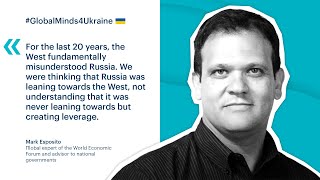
Mark Esposito argues the West misread Russia for 20 years by romanticizing it, missing its military leverage and Europe's energy dependence. He warns against repeating this with China, saying Western intellectuals need to study Chinese thought. Governments should adopt agile approaches, testing policies and measuring results like Estonia and Singapore do.
Chapters
I had written several questions while I was following your presentation, but I think I will start with the last one because it is a very intriguing one. Yeah, you provoke us to think about these new challenges and searching for new conceptual frameworks and theories. And of course, this is so difficult because how can we, how can we do it? Yeah, we have socialized in certain world intellectual traditions and it's, uh, and we're trapped there. Yes, so it's so difficult to, to develop these new conceptual frameworks. And you also have emphasized that the role of China is significant now, and it will be even more significant in the future. So maybe one of the, you know, um, ways of, uh, thinking about our future would be, uh, to borrow some intellectual tradition from this country, you know, like to understand their culture better, their intellectual tradition, how do they see the world, try to understand them, and also try to adjust— not, not necessarily adjust, but at least to, to get some inspiration from them. Or maybe you believe that this poses certain threats, uh, in a way that you, you have said yourself that China poses certain challenges to the world. So maybe adjusting our worldviews to their tradition could be wrong. So can you somehow speculate about it, about, you know, the opportunity to learn from them, but also to be careful with what— how far can we go?
Yeah, Timo, thanks for this wonderful way to start. The way we see this is that China started to decolonize itself from the West. There was a time where China was going after the Western icons, right, the Western brands and all that. And I think over the years a bit of a combination between the Cultural Revolution that happened that brought the Communist Party to power, to the fact of the one-party system that, of course, believes in surveillance and control as the only way for the degree of complexity you have in a country like China, we start to notice the rise of Chinese alternatives to the Western ones. And over time, if you have generation of people that are born only exposed to that, you kind of get, allow me the term, indoctrinated into a Chinese way of thinking. I have a friend called Ted Sun, who wrote a book about 10 years ago called Inside the Chinese Mind. I think we really have to go inside the Chinese mind to understand. Back in the 1950s, no matter whether you were American or not, you had to understand the Americans to understand the way the world was about to be designed. We had to. All of us became colonized to the American idea one way or the other, because we had to. I think it's the same now. We have to get closer to the Chinese way of thinking for us to understand where this country is currently headed and going. And what you said is correct. Can we borrow ideas? Can we work with them? I always find that in the ability to have a conversation with a party, you can say, my way versus your way, you can say, can we create a third way that is reconciling some of this? So I think there is one of the comments that we learned from Parakana, who is somebody that we know, and we know his work. He said, the world is converging in a number of different ways, but is culturally diverging as well, because of subculture tribalism, We have to, I think, make a step towards integration somehow, because thinking that we'll ever be able to simply antagonize China, that's not going to go working. So I think moving closer and understanding is really— and let me finish with this. The way we have been colonized through the American principle, the Western principle for most of our 20th century, we have to colonize yourself intellectually also to the Chinese principles, not because we have to embrace them, but because we have to understand them. I think that's clearly one area of intervention.
Yeah, I cannot help myself but thinking about Russia and Ukraine now, and I think a lot of intellectuals also have noticed that this desire, or maybe attempt to understand Russia by Western intellectuals, has also created sort of romanticized narratives of Russia. Yeah, and, and some people were lured into these romanticized narratives. So I think this can be also a powerful example to all of us. So, you know, to build some boundaries. Yeah, when we want— and, and to have this clear strategy whether we want to understand someone, appreciate someone you know, have some cultural exchanges, but not to get lost into narratives and romanticized ideas, because it could be, yeah, it could be dangerous. It could be dangerous. Absolutely. National security.
Well, Timofey, you, you are experiencing the, the price of having underestimated the narrative in the way it should have been, you know. And that's a critique to, uh, you know, the West for the last 20 years. We have fundamentally misunderstood Russia. On the contrary, we were thinking that Russia was leaning towards the West, not understanding that it was never leaning towards, right? It was creating leverage. I think across so many different US presidents as well, we have seen so many mistakes from Clinton to George Bush to, to some extent, even Obama, right? Trump, for us to really not having understood the thinking behind. I think a country like Ukraine, this conversation could have never been so easily done because you have the historical context to understand Russia better than other parts of the West, right? But outside of that context, we were all romanticizing, as you say, with that. I think, again, we cannot afford the same mistake with a country like China. I think we have to remember and I know I'm using this because I know in academic terms we have the ability to be intellectually free, right? Russia is economically quite inconsequential, but it's just because it's a military power. If it wasn't for the military power, a country like Russia would constitute roughly 3% of the global GDP. So it's actually Russia, with 145 million people, has the same GDP of a country like Spain. And with the devaluation of the— depreciation of the ruble, likely a country becoming like Portugal. I think it was the same Taleb who wrote it on Twitter. So we had to imagine that the economic dissonance of a country like Russia is compensated exclusively by the military capabilities. And I think this is a mistake that we have made by thinking that just because it's a country with a relatively modest economic condition, it doesn't necessarily build the threat. And last on this. Haven't we really paid a high price on underestimating the conversation on dependence on energy right now? Isn't Europe today understanding that if you are dependent by 50% of your energy intake from a country, that by itself is economic fallacy, right? But anyway, can you imagine the number of people who got elected on the promise of having more affordable energy? But that's really sleeping with the enemy, so to speak.
Yeah, absolutely. I agree. But also, it brings me to the next question. I think it's a nice segue. Um, because you have also mentioned this idea of new types of leadership, um, in this world, and I want to ask you, uh, maybe it's about some specifics, because we live in this very complicated global world with these large-scale complicated international organizations, you know, like European Union, NATO, and sometimes these organizations, you know, they can be slow in their response and reaction to, to growing challenges. And obviously we have these decentralized, uh, academics and intellectuals and businesses who, who have this alarm system, you know. They, they see new challenges, new opportunities, and they, like you do, you, you talk about them in, um, in your lectures, in your books. And also you have said that you advise, uh, to governments. Yeah. Uh, but nevertheless, I imagine that it's very difficult to, to have this you know, to manage these quick changes, how to leverage leadership in this world which is so much regulated. Yeah, I can, uh, and I, I think a lot of Europeans, uh, also have experienced these negative, um, things with populism. You can say that populists are people who take, uh, leverage and who propose these dramatic radical ideas how to change world, and then everything collapses. So Europeans and Americans, they have built the system to protect against wild, crazy ideas. On the other hand, we want wild and crazy ideas to be heard and to elevate up to the, you know, top offices. Yeah. So is there any practical solution? How can we build the system? Maybe we should create one more organization that will be called International Office of Crazy Ideas. Maybe we should, uh, have some advisory boards. Or maybe, I don't know, we should trust— not just trust to intellectuals, but have some offices with them. I don't know. Can you share your experience, how you advise to governments, and whether you and your colleagues have these ideas how to practically implement the structure of leadership?
Yeah, thanks for this. That's a complex question, so I'll try my best with your question, Tomofei. I think what governments lack is the ability to pivot and experiment policy to the point in which you can learn about policy and policy failure, policy fallacy, assumption. We have this very static view that there is an input, which is the policy, and there is the output, which is the expected outcome. And of course, policies are nonlinear. So I guess it starts by understanding if we accept that complex systems with large degree of interdependency are nonlinear, we start rethinking that success rate is not based in setting the policy. Success rate is based on approximating the policy to what you're trying to achieve. That means that building what a colleague of mine called Andrei Siknev calls agile governance is really the essence of the future of the government. Timothy, in the years to come. Can we think of government in an entrepreneurial format? And I think, put it this way, private investors understand the return on investment. We teach this in many courses we teach in universities. But government doesn't have the idea of return on public value in the same way. So I think if we are able to understand that return on public value happens by taking risks, then those crazy ideas can be eventually pivoted, tried. And how do we see this happening in practical terms? We're looking at country like that we all talk about, right, from Singapore to Israel to the UAE, now to some extent some part of the Saudi government, to country like Estonia that did not exist before 1989, where I happen to know Ilves at the time I was at the World Economic Forum, or country even like Finland, right? What they do, they fundamentally experiment. And they experiment without feeling the experimentation is a form of stigmatization or failure. So if we can see how this small country have been able to largely experiment, we understand that the role of government in the 21st century is not static and based on centralized ways of operating. It's much more decentralized, territorial, flexible. To some extent asymmetrical, because it's quite normal, but very agile and capable of learning from the experience how to move the policy. I would say that fundamentally is where I see this. These are some of the examples we see currently running. And Ilves, the former president of Estonia, has an anecdote. Says, you know, it was the time in which Estonia was trying to integrate e-government. How do you do this? Well, he was able to say, how many times do we fill out the form and what is the cost for us to do that? So the moment we are able to convert traditional behavior into an economic cost, you can eventually try to remove the cost from the balance sheet. So rethinking, I guess, processes for government in a way that are going in the direction of what we need, likely we'll see the rise of more innovative and radical ideas emerging. It goes from small things like technology, but— Michael Porter, with whom I have worked at the time I was at Harvard, wrote something in 2017 called Why Politics Is Failing America. And his fundamental argument is that politics is failing America for the lack of competition. Because basically, either Democrat or Republican do not represent the majority of Americans, right? Either the majority of the intellectual capacity the country like the US has. So I think these are where we have to experiment: governance, voting, technology, agile governance, and eventually moving government into return on public value.
Hello again. Please don't forget to subscribe to our YouTube page where we have a selection of fantastic lectures and conversations with leading international scholars. And I encourage you to watch a video by Bruce Bueno de Mesquita, who is a famous political scientist. He is talking about electoral theory, authoritarian regimes, and the risk of coups and mass uprisings. Thank you.
More from Mark



Stanford Professor Omer Reingold on what it really takes to build fair AI systems

Stanford Professor Andrew Maas explains why the future of AI will rely entirely on humans


260225 0840 Opening keynote Understanding the future as it unfolds the power of megatrends




