Navigating the Complexity of Global Systems with Dr. Mark Esposito | Voices of the Future
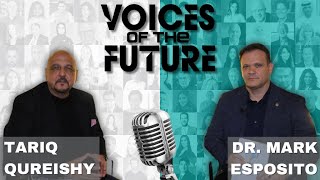
In this moderated panel and audience Q&A, Professor Mark Esposito, a scholar of economics, strategy, and foresight, discusses the launch of his new book and his broader vision for a human‑centric future. He argues that the discontinuities of the past are necessary to construct a new, non‑predetermined future, and that technology must be used to augment humans rather than replace them. Esposito introduces the "6 Cs" framework – Cognitive, COVID/web, Crypto, Cybersecurity, Climate, and China – as a lens for understanding emerging global system shifts, emphasizing decentralization, the rise of grassroots innovation, and the tension between hyper‑capitalism and new incentive structures. The conversation also covers the risks of technocolonialism, the importance of leadership super‑powers (questioning, listening, storytelling), and how modern books can become interactive, AI‑driven knowledge hubs with chat‑bot interfaces and multilingual avatars. Esposito reflects on ensuring global inclusivity by counteracting US‑centric bias, using diverse interviewees, and employing storytelling personas to make complex ideas accessible, especially to younger audiences. The discussion concludes with calls for design activism, ethical AI, and broader engagement beyond elite publishing channels.
Chapters
My name is Mark Esposito. I'm a professor of economics, strategy, and foresight. I teach across institutions: Hult International Business School, Harvard University, and I'm also part of Georgetown University.
I'm happy to be here in Voices of the Future.
We are absolutely delighted and really privileged to have Mark with us on the sidelines of a program where he's talking about the launch of his book, and I'm also talking about Voices of the Future, as you know. And Mark and I know each other for quite some time, and we share common values, we share a passion for learning and development, we share, you know, our ideas in terms of a lot of the things that are happening in business on a day-to-day basis. And that's why it's so wonderful to have him here.
Mark, lovely to meet you again in another opportunity like this.
That's right.
We'll be sharing soon together.
Indeed. Mark, as a professor and as a prolific author, you've been writing many, many books. You know that as part of Voices of the Future, you to me are indeed a voice that is very unique and genuine. What is your core message that you're projecting in the book or in your life in general at the moment?
I think you have the discontinuity from the past is needed for us to see a new future emerging. That future emerging is not predetermined. It's largely a construction of what we think it is. And so this power that is around human-centric systems to project the future that is what we want to construct and eventually try to execute it. That's, I think, where the book is trying to talk about the, well, kind of the upheaval we're currently facing in our society.
Right.
And what this requires, new form of architecture of global systems.
We are going through a lot of technological transformations at this point in time.
My thesis is that as we become more and more technological, we need to become more and more human. And so values like love and compassion and humanity and trust and ethics and creativity suddenly start becoming 10 times more valuable. What is your view when you look at economics and strategy and so on? In building these human values in a hyper-capitalistic world?
So I think the one of the, let's say, strategic mistake we have made is to think that technology by itself is enough. And we have seen humans augmenting technology.
Yeah.
And we have this conversation about enhancing more and more our technological solutions, but we haven't seen the flip of the story. Can we use technology to augment humans? And I think if we start thinking of technology as a driver of human-centric systems, then we could think about addressing some of our major social challenges through technology.
I get asked the question, will AI replace humans? And I said, I do not think AI will replace humans for at least the next 25 years. But AI will—
human with AI is likely to replace us on a day-to-day basis.
Absolutely. I subscribe 100% to this. And I think it's a power of thinking that by integrating powerful technology, we also elevate in ourselves. And I think that is the narrative that sometimes is very weak or underdogged, but we should try to push and pioneer more this level of conversation.
So I think let's go and join the audience. I wanted to get a couple of ideas in one-on-one with you, which we've done, and we'll be talking to Mark again in greater depth and he'll be well featured in our book. And we look forward to welcoming you there.
Thanks for having me.
Thank you very much. I will pick up bits and pieces.
Great, thanks so much.
I talk about superpowers, human superpowers, leadership superpowers, and I always talk about 3 things. The first is the power of questioning, curiosity. I used to talk about this as a speaker 5, 6, 7 years ago and they thought, you know, we're not at school, what is this questioning, Tariq? I mean, power of questioning and being curious, and I said, no, it's really important because that's how our mind works and that's how we discover and that's how we iterate and experiment. Today, what are we doing? Asking questions to ChatGPT. It's about prompting. So really, the essence of who we are is about the curiosity and questioning, number one. The second superpower all of us need to have is the power of listening. Listening through our ears, listening through our hearts, listening through our ambient environment. Listening through data, listening with empathy, listening in a completely different way. Again, I'll refer to ChatGPT. I get my young 23-year-old young executive who is super smart and super fast on that, and he produces stuff for me regularly. But every now and then I ask, it's a word salad. There are lots and lots of things. So I said, Kerem, what does that mean? And how does this all come together? And what's the overall connection? And he gets very defensive. I said, "Karan, what you're not using is making sense of things, critical thinking and those kinds of things. That's all about listening." And the third is the power of storytelling, and those are us as leaders. We need to be able to tell a story. Think about the greatest business storytellers. Who do you think is a great business storyteller? Suhra.
Simon Sinek.
Simon Sinek is a great business storyteller, but he's actually in that business. Now, I was thinking more somebody like Elon Musk. He tells a story, stock goes up, he tells another bullshit story and it goes straight down. But it goes billions up and billions down just because of the narrative he comes up with. Jeff Bezos. They don't even need to actually do anything. They just release a story, release an idea, release a thought, and then they start playing with it. And a lot of what we do, and if you look at these people carefully, they speak in a way that they connect with you. They make it relatable. They make it connectable. And that's what we're gonna do today. So these are just a few remarks I wanted to talk about storytelling, and we'll get into it in more detail. Today we are very privileged, apart from our, of the wonderful authors from the club who are here today, is to invite Professor Mark Esposito. Mark and I go back many, many years. We've done things together, and as I was saying to President Saleh, that he's a brother from another mother, because we have so many values together that we share. And I've seen him perform, I've seen him work, and he is deep, he is genuine, he's kind, he's authentic, real, and that's what makes it special. And when I met him a couple of months ago in London at Thinkers50, which is a book fair, I said— he said he's going to be here for this event, and I said, please give me the honor to host you. So please put your hands together for Professor Mark Esposito to come and join us.
Thank you very much. Very, so nice to see you again under a new role now at the house. Very, very good evening to all of you. Very nice to meet you, and thank you for hosting me here. I should tell you why Harvard is something that we have in common. So we establish the ground. So I was a postdoc student back in 2010. I went to Harvard Business School after my PhD, and I happened to be under the protection of Professor Michael Porter for 9 years. So with HBS, then I migrated over to the Harvard Division of Continuing Education, and I just been appointed to Harvard Kennedy. Actually yesterday. So I've been part of the Harvard ecosystem for a few years. I decided to take a non-tenure track so I could do more things. And so in everything related to strategy and economics, Harvard's been my, my home. I'm currently teaching a course at Harvard on artificial intelligence, which has a waitlist of 18 months. And it's great to see leaders coming to Cambridge and explore this conversation with somebody who is not a technologist, but is starting from the business environment. So when the opportunity of the book came out, I reached out to the team and thought, shall we have an event here in Dubai since we tend to have a lot of events around the world? But I thought it would be a perfect place if we could do it here at the house. So thank you for having me. It's an honor to be here. And I hope it's just the very beginning to have our Harvard community connected through this wonderful clubhouse you have. Maybe I should tell you why the book, and it's only an excuse for the conversation we will have together. So I didn't want to do a book talk with the intention just to promote the book, but the book has an opportunity to engage in conversation. How do we all start? So COVID was a landmark for many of us. Moment of reflection, many things that we wanted to understand more about a world that seems to go in shambles. And so we started the reflection with my co-authors. Terence was also on the show with Tariq a few years back, so he's a colleague for many years. Olaf Groth is a professor at UC Berkeley Haas. And so we wanted to start the conversation about where do we see this eventually moving forward. And so we start thinking, well, the world is going through a significant amount of distress, and likely the infrastructure the world has— we have seen it— is going to change. And so 2 years into the work, we started to interview people. And so we had roughly 100 interviews. We were able to tap on the network to be able to have from prime ministers to influential people political leaders, business leaders, NGOs, and the book came to life. We got published by MIT University Press, and so for us it was important to have the representation of what we call a blue-chip publisher to be able to reach out there. So today we run events around the world on this. The book was endorsed by Professor Klaus Schwab from the World Economic Forum. And there is a course that runs in the executive format currently at Haas. And we're launching one at Harvard as well that will be about disruption. And so it's not only a book. It's a project that has started to be part of a companionship on the reflection of the emerging new structure. What is this emerging new structure? Well, likely we started to see that a number of different things were actually emerging. That although they're not predetermined in the way that we can tell for a fact these things will happen, but they tend to show convergence in which direction likely certain things will try to organize themselves. So we started with a framework called the 6 Cs. We refer sometimes as 5 as we take one as the umbrella. We started with the technologies, a conversation that Tarik and I were having just before joining you down here. On technology fundamentally transforming us, so shifting from the digital infrastructure to the cognitive one, technology that is mimicking the brain at the pace that is largely becoming a surrogacy of what humans actually do. That's not a replacement of humans, it's simply an extension of the use of technology in many of our everyday uses. The cognitive economy is an economy in which the cybernetic relationship between machines and humans is largely penetrating the psychology, the biology, the physical infrastructure, the political institutions, our production systems. So much deeper level of permeation than we can imagine. From there we start thinking, well, there will be impact on our infrastructure of information. And so the web has largely expanded by roughly 30% in comparison to pre-COVID. Which means that today the internet is stronger, it's more distributed, and with more distribution there is more access. So this decentralization process that was, I think, one of the premises of technology is now happening at a faster pace. With more decentralization, more business models are emerging, but equally we see that these business models are largely decentralizing money, value, opportunity, decentralization of tasks through AI, So we see the shift from convergence and centralization to decentralization and delegation of power. Then, of course, we started to see more tension around the cybersecurity challenges. As a world is becoming largely digital, it is also much more exposed to threats. And so there's this amount of work that we have seen from hacking the brain all the way down to hacking nuclear powers or institutions or banks. We then started to see the narrative on carbon and climate largely shifting towards a carbon economy that is transitioning to different form of adaptability and mitigation for humans, almost to say climate change as a paradigm failed us because it was too simplistic in this binary system about decreasing of emission, and now we're moving into more ecosystem-driven transformation. And the final conversation was China. How do we deal in a world where China is largely going to become not only a large country but a system of reference and alternative challengers, a different point for money institution and power to be formulated? So if you put them together, they start with Cognitive C, then it goes into COVID-19 triggering the internet, it goes into basically crypto, everything related to blockchain, the centralization of value. Then it goes into cyber, then into climate, and then China. And that's where you have the, the 6 C's. So because the 3 of us are working in business school, we have to come up with a framework so eventually we can monetize. But fundamentally, that's where we started, and that's what the book really does. The goal of the book is to engage in what we call a generation of design thinkers. Design leaders who are active in building the infrastructure of tomorrow. And I think doing this here in the UAE, I think it resonates even more. A quote that I always use in some of my conversations from Sheikh Mohammed, which is actually in Emirates Towers, says, "The future belongs to those who can imagine, design it, and execute it." And I think we want to imagine the same, that design activism is a form of imagination of the future, that is reflecting the needs of the 21st century. It's a form of execution, that's why we need activists, and it's a form, of course, of engagement into something that is greater than the sum of the parts. And that's to give you a nutshell of the work.
Mark, thank you very much for that little monologue. May I challenge you on something in typical Harvard style? And that is that we're living in a hyper-capitalistic world. There are 50 companies that have just taken the lead. They know their stuff, they know AI, they know how data works, they've got the formula. There are another 500 companies behind them who are good. All the rest are just simply worker bees and they're just literally chasing it, number one. The second is that they— that because of this hyper-capitalism, the incentives are completely disjointed and disconnected. So why would an oil company throw away $5 trillion worth of assets in terms of, you know, in organized— I mean, in sucking out oil and exploring oil and stuff like that.
Why would they do that?
So in other words, there is no incentive. So you go to the WEF, do blah, blah, feel good about it, come out, and nothing happens. The same happened with COP28. Nothing happened. You can have a little announcement and things like that, but nothing substantial happened, 28 COPs have happened. So what is the incentive structure for these big 50 companies, for these trillion-dollar organizations and so on to have any kind of change? And because other than then, you know, why would they change? Because they've already got the lead and they've already got the control.
Right. Look, complex question. So we can try to engage it as part of a of an instigation to the conversation. So I think first, the decentralization has already given access to companies that are disrupting markets and they're coming from nowhere, right? OpenAI is a perfect example of a company that none of us really had on our radar unless you were in the technology stack. They had an investment of about a billion dollars, but unicorns today are quite common. But what happened is that they were able to fundamentally challenge search engines. So this transition of power makes it also very possible that it's not that we're gonna see lack of incentive or change of incentive from the traditional players, but we're gonna have new incentive for player that are coming from the grassroots. Today, geographically speaking, a lot of the innovation is no longer concentrated where it used to be. We do have a bipolar system between U.S. companies and Chinese companies, We started to see Israeli companies rising and dominating the venture capital markets. We do have Nigerian fintech. They are now building way faster unicorns than we have in the US. We start having in this region companies that are now being incubated by funds from all over, and now they are aspiring. We do have in the UAE the third largest developer on the planet, which is Emaar. We have the largest trade trade operation in the world, which is DP World, with some of the greatest— we have operation company in aviation, which is Emirates Group. And if you go north to Doha, Qatar Airways has used the blockade and COVID-19 to fundamentally expand exponentially the size of their supply chain. Today, supply chain innovation is not coming from the US anymore. So I think the trajectory of the large technology company continues to be lack of incentive to change. I think there is a, there's a grassroots movement that is coming where technology has largely empowered, where these players are now coming. The funding are coming from a combination of formal funding and a lot of crypto investment that were non-regulated, and growth is happening in a much more multilateral forms. So I don't think we're changing the big guys, but we're fundamentally seeing tension happening between the macro and the micro that we didn't have before. I'm not sure whether it will change the world, but it's definitely a reason why we have reason to believe that the balance is no longer bouncing back to where it used to be.
One more quick question and then we start talking to— get you guys to ask questions. Technosocialism. Technocolonialism. And what I mean by that is, in the past, countries used to take over other countries and colonize Africa, colonize Asia, et cetera, et cetera. Today, what's stopping Amazon to buy Cyprus? What's stopping Apple to buy Malta? Because they can. Because their quarterly earnings is bigger than the total GDP. So the technocolonialism is likely to— be the next step towards technical technology companies taking over countries, taking over populations and so on and writing the new agenda. Your thoughts?
So look, I think it's feasible, it's plausible. Will it happen? I don't know. I don't have the ability to express myself in terms of something that could happen but it might not happen. I think where this is happening is technology largely condition and behavior to the point that I no longer need to have a military to eventually hack a country. I simply have to largely persuade you that what I think is good is good for you as well. And because you have access, and today you are largely independent in your financial transaction, you're using digital payments, you have access to several forms of opportunities, then I can largely manipulate the perception that you have. I mean, during COVID we have seen brain hacking and we have pushed people to events that were extreme or violent. And that was mainly because the brain is an easy— it's easy to manipulate simply because we are not very good at defining the difference between reality and perception. I personally find that social media has created the largest form of inequality that we have ever had in the world today. Today social media is largely digitizing inequality. It has created an alternative reality that is creating an echo chamber of information that could become politically empowered. We already saw this with the US election, that elections today are no longer what they used to be. But somebody could argue that the election are not authentic or legitimate, and it's very difficult to dismantle the argument, right? Well, back in the days, I think it would have been black and white, right?
Good evening, everyone. My name is Eva. So I'm coming from a land with a lot of great literature. I read it since I was a little girl, and my question to you, since You have put so much effort, inspiration, and time, overcame imposter syndrome with pulling your ideas out there. How do you think— you are— we are writing it for our generation, but there is also a huge challenge to make younger generation to read books. So how do you see— have you thought about it when you were publishing your books? How do you attract younger generations to these topics that you are disclosing? Anyone who is willing to take on the subject.
Sure. See, I'm fortunate that I teach and therefore I have an audience of people where that are younger than me that I can ask them to engage in the conversation. So I think in my case it's been slightly easier because there is a natural channel. It's also true that this book was never designed to be for everybody. And I think it was an explicit choice that we wanted to have a voice that could be heard by people who could go out there and build this architecture, as I mentioned before. So there are choices when you're writing. You need to write for somebody, and of course our choice was people who are in either business or policy environment, and also our students. So I think there is a limitation to where books can eventually go. But I also believe then it's the message, right, that really comes. So some of this book can become, you know, games, multimedia engagement. Some of them, they can become cases. Some, they can become stories. So the art of visualizing the story, I think, is a critical part as well. And that might help some.
[Speaker:MARK_ESPOSITO] Can I shamelessly plug my book? It's called Voices of the Future. These are 100 voices that we put together initially as a podcast, then transcribed 30,000 words per podcast. Then it goes into YouTube and into all of the channels. So that's the modern way of consumption. Then there's an ebook, there's a hard book and then an ebook. And last but not the least, we've taken all the transcripts and put them into ChatGPT and you can actually talk to the book and ask the book a question. What does the book say about trust and ethics in AI? What does the book say about sustainability and utilization of facilities management? So you're actually querying the book and now we are training it. So what you're now doing is actually talking to the book. And just yesterday, a friend of mine, his name is Shahzad, he's a super creative, creative director with BBDO. He has created something called HumanEyes, which is making human avatars with human voices. So that book in about 3 months' time will have my avatar with my voice in Arabic, in Russian, and every other language speaking from ChatGPT book to you. So what I'm going with this, Eva, is I think the modern book is not a black and white A to Z. A modern book is a mix of all of these elements.
I suppose my question is one of access. And accessibility. And I noticed that one thread of connection between many of the things that we've been discussing tonight and themes that run through the books is something that caters to an audience that is maybe more global or more international. But then how do you arrive at a conception of the global that takes into account the nuances of various regional contexts? Like, for example, we're in the UAE currently. How do we talk about the global? And in your writing process, what is the moment in which you arrive at that conception? Do you feel that that is a challenge for you at all? If you have any points to share.
Thank you.
What's your name?
Shamma.
Shamma. Thank you, Shamma. Beautiful question. During COVID Mark Esposito and I had some, some hard conversation about globalization and deglobalization. The whole world went global and then put in during COVID everything was becoming deglobalized. So what happens there? I mean, what is the dynamic that you go through? Global, local, and please.
So thank you for your question. Wonderful one. Let's start from the statement of the problem, right? People like me will likely write US century stuff. Right? We are a byproduct of North American system. I operate out of Harvard. So it becomes self-justified that what we do seems to be universal. But we are not operating always in the US. And I'm very lucky that part of my time here in the UAE. So we have iterated almost obsessively to make sure this was not a US-centric book. Although all of our interests are US-centric to the point that it's easy to be justified as such. It's MIT, so it is a West End of a certain kind of culture. So the other issue happened with who do we interview. We hire an editor that was helping us to challenge whether our assumptions were US-centric or not. And we tried to filter as much as we could to make sure that we had a diversity in the voicing. That shape, I would say, a more comprehensive view, knowing that there are biases and shortcomings from the fact that we don't understand everything. But I think we have made an intentional effort to move away from a gravitational US centrism that for people like me are sometimes inevitable. And I am very appreciative of that because I can have a conversation in the Great Room with Mark Esposito, with you, I can have it in Asia, in Africa, or in Europe, and I feel that the narrative of the book helps me not necessarily to become overly dependent on one flow, but it's really open. But it was an intentional effort that we had to actually put in. Otherwise, the default, the default sliding is towards what is a comfortable assumption of reality in this likely westernized for us, in our case.
Thank you.
My name is Hazem Alaboud. My question started with the art of storytelling again. For the last 3, 4 years, I read a lot of book about biology and what's happening in the brain when there is any communication happen or whatever context being built within the environment of the human being, and storytelling being essential for us, for our lives. And in the history, like, there are a lot of developments in terms of the how to introduce and engage audience. Talking about the brain and the, and the chemistry, uh, signals and the electric signals that happen in the brain whenever the communication happen. There are lots of things that happen in the brain in terms of connected the empty or long-term memory with the storytelling, how we want to tell the storytelling and how, what techniques that we use in order to engage our audience and let it be in the LTM. So long-term memory. Your experience, please.
You want to take that, Mark? I can't. I'm just coming from a limited— my limited contribution to this, right? I tend to— we tend to use personas sometimes in books, even if they're business books, where you're kind of looking at the journey of a person in the next 10 or 15 years. It's much easier to relate to a future that is dynamic and is experienced through the biography of a person. So at one point in time, I think it's chapter 5, we have a story of Fiona, who is a lady who is living in 2035. And she has been able to become a design activist and start creating that architecture of the emergent future, as we think. And we wanted to use a persona because we wanted to to make sure that the book could be understood in a way that is not just theoretical, abstract. So I think storytelling, using persona, future persona, future narratives, and also when you're doing something like online digital content that you can create courses out of this, it's much easier to relate to people in a way that people will feel that you're connecting to their own sympathy, to what is important to them. Again, it's limited in my case. I have a captive audience. I have a platform. And I have a publisher that will put this stuff on the shelves. So I don't have the same pain points, to be very honest with you. I find that people that are operating within a certain niche don't feel some of the challenges. They simply sell books. And they have events. And they feel like the world keeps on going on. But I think when you're engaging at a deeper level and you try to say, well, what was really the contribution this what the book has made to your own life. You have to relate it at a much more personal level. So humanizing the narrative is becoming important, more than before, I would say. And that can happen also through your social media action or social media advocacy where you are becoming a person, not just an author that is too far from the reality of people.
[Speaker:MARK_ESPOSITO] Brilliant.
[Speaker:JOSÉ_MARÍA_ESCÁNER] Do you think that picking up the right publisher will contribute to achieve this? Outcome? It does help, yeah. I mean, we sold hundreds of thousands of copies, right? And it makes it easier, right? It makes it easier for me to send an email to any publisher and say, "I did this," and I don't find many doors closed. But it's also the problem with the system, is that people like me might have access, but there will be hundreds of authors that have even more important story to tell. That might never be given a chance. And that's the problem with self-reinforcing systems that is reinforcing the 1% of the elite somehow.
Mark, over to you to close the evening and, you know, tell us what you think, what we should be doing, and should we just be racing out buying your book, writing a book, and what do we do?
So I share with you what made my life very fortunate is that I had incredible mentors. So Michael Porter was one. The late Clay Christensen was somebody who has largely inspired my thinking. And I was speaking with Harry Mintzberg two nights ago in a fireside chat, and I'll be speaking with Edmund Freeman, stakeholder theory, in two months. These are giants. What they all have in common is this incredible desire to become more than what they used to be. Mintzberg, who has fundamentally shaped the environment of organization, has written a book in 2023 called understand the organizations, finally, and he's 85. So what I wish you is to continue to look forward to becoming what you currently are not. And I think this is what books are really all about, is an instigation to a better version of yourself. I personally find it inspiring that the best days are ahead of me simply because of the learning I currently don't have, that I'll have by engaging, talking, writing. So make it a journey of, self-fulfillment towards the future. I think this is what I wish you all. And that's why we write books, many of us, for a legacy that is going to help us become what we currently are not. So that's what I'd like to finish the evening. [FOREIGN LANGUAGE]
More from Mark



Stanford Professor Omer Reingold on what it really takes to build fair AI systems

Stanford Professor Andrew Maas explains why the future of AI will rely entirely on humans


260225 0840 Opening keynote Understanding the future as it unfolds the power of megatrends




