The Great Remobilization, IIPP in conversation with Mark Esposito
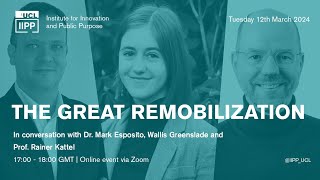
Mark Esposito discusses his book on how crises reshape global systems, built from 100+ interviews after the 2020 pandemic. He identifies six forces reshaping the world: cognitive economy, digital expansion, decentralization, cybersecurity, climate, and China's rise. The post-Bretton Woods order is collapsing, requiring new institutions and leadership beyond outdated metrics like GDP.
Chapters
Great, I think we are ready to go. So good afternoon everybody, or good morning, or good evening depending on your time zone, and we are very happy to welcome you at this book launch event. And let me do a very brief introduction to what we will go on here for an hour or so. My name, first of all, is Reiner Kappel. I'm a professor at Institute for Innovation and Public Purpose, and I will be guiding you through this event. So we will have a brief book presentation talk by the author, or one of the authors of the book, Mark Esposito, talking about The Great Mobilization: Strategies and Designs for a Smarter Global Future. So it's a big topic, so there's hopefully a lot to talk about as well. Mark is a Harvard-based economist and also a policy fellow here at IAPP and works with lots of governments really across the world. And perhaps untypically for an academic, he's also really interested in talking to wider audiences through accessible books, which of course is a great thing. Because that makes a dialogue with more people and more audiences, of course, really possible and welcome. And then we have a discussant for the book as well. And of course, we are welcoming all comments and questions from you, the listener. So whatever questions and comments you have, you can put in the chat and on the Q&A function, rather, and we'll go through them and take them one by one. But we have a discussant. Discussant is one of our students actually at IAPP. We have a wonderful Master in Public Administration program, and one of the students, he's the discussant for the book. Wallis Greenslade is the discussant. She originally comes from New Zealand, but for the time being, she's here in UK studying with us. So the way we have thought about this program today is that Mark will talk about the book without any slides, I think, but just to sort of COVID the base, the key topics, and, you know, but also I think that the rationale and motivation behind the book for about 20 minutes, 25 minutes. And after that, we have Wallace's initial sort of like reaction and questions and comments. And then we come to you, the audience, and That should take us 60 minutes or so. So Mark, whenever you're ready, I give the floor to you to present the book. And thanks for—
Thanks to you, Rainer, for making this possible. Looking forward to the conversation with you, Wallace, as well. And thanks to the entire team at the Institute, right, for having nonetheless welcomed me as a policy fellow for now 3 years, right? I started in 2021. So I So like a COVID fellow, if such a term exists, right, in many ways. Allow me to then walk you through a little bit of the, the contents of the book and what brought us to write. So my two co-authors, Olaf Groth, who is based out of Haas in Berkeley, and Terence Tsai, who's based out of Hult International Business School. So we know each other for quite a few years. We've been doing some writing together, and during the pandemic, we of course started to write more about what could be simplified as some form of post-pandemic recovery. So we ran a summit in June 2020. We were thinking that the kind of economic model that were arising from the pandemic, we coined it in a very trivial form, coronomics. And then we started to invite people to our event and asking questions more about where do they see the world shifting. And we were, I think, all under the assumption that we were in an inflection point where we would not go back to where we were coming from. And I think there was a number of hard data that supported that. Also before the pandemic, we knew that we were shifting rapidly. And if we want to look at it more at a macro level, our institutional frameworks were changing. The effectiveness of top-down designs that were coming from the larger multinational entities were becoming weaker and weaker. Weaker. We started to notice, so like convergence towards the center was equally becoming quite weak. And so as a matter of fact, more of the public opinion was distributed across more polarized debates and ideology were kind of being captured by this more radical views. And so it was becoming difficult for us to imagine that we will simply go back to a sense of convergence as we call it across the book several times. And so from the initial conversation that rose from a summit, we decided to go deeper and say, well, what if now, rather than having maybe 10 or 15 people coming to the summit, we interview more and we try to ask questions about where do they see the, the direction of travel taking us. And that's what we did. So we started, uh, with a bit of background research. We had a framework in place that we have called Flip It that was sort of like helping us to navigate this like denormalization phases where we were thinking across the world, every time that we have a fundamental crisis, we tend to see a number of different forces at place that will build new form of logics, that will consolidate in new forms of business models and practices. And then there will be an all impact across industries, regions, sectors. And are we capable of rapidly succeeding the crisis into some form of innovation. And that's where the conversation started. So the framework was instrumental for our thought process. And then we started to collect interviews. And so we interviewed roughly 100 people across the world. We did a job of geographical distribution, industry, seniority. We wanted to represent as much as we could a cohesive voice that will give us a sense about where we think we can show some sort of like consistency in our project. And so after about a year and a half of interviews and writing alongside, we started to see a more advanced draft of our work. And we were ready to go to print early 2023. We were slightly delayed by our publisher, MIT Press. And then in February, the crisis with Ukraine and Russia happened. And so we had to go back to the writing bored and that add the dimension of Russia as a global player that was now largely disrupting what we thought could have been a very different scenario before the war happened. And so we integrated the Russia part. We equally started to see India becoming more critical in our conversation. So we add a part about India and then we came out with a book in October 2023. So that's sort of like to give you a bit of a chronological order where the book started, the summit, the interviews. Why did we write this book? So we wrote this book for a number of reasons. We are, the three of us, we are what we call academic practitioners. So we are all appointed somewhere in universities. We went through formal scholarship processes, but we equally started to work closer to either governments or businesses or industries. And so we tend to have appreciation for our actionability. We equally started to feel that the world was in need of not necessarily answer, but at least like a reconstruction of the big questions so that we could orient them towards where we think largely these new frequency models are going to take us. And then we wanted to understand ourselves whether we were really into a significant decline in period of our history. Or whether this was a transition. And so the answer to the question, if there was a first answer to the question, we're definitely shifting rapidly and seeing the exhaustion of the Bretton Woods rules. So we see what has been a dominating principle for the last 80 years clearly in crisis. We don't think this is like a precipitation per se. We consider this to be more of a transition to a different form of value creation. And this transition tends to also be supported by some of the people we interviewed. Just to give you an example, when we interviewed Alec Ross, who is an American, so like former policymaker, who was the chief technology advisor to Secretary Clinton and worked in the Obama administration, he wrote a book called The Rage in the 2020s. In this book, Ross talks about the 2020s as this funnel of time that's going to take us from one organizing principle to the other one. And so that's pretty much where we started to feel that maybe we were really in, in this transitionary period of time. Now, transitions are violent. They, they have a lot of disruption. They have a lot of discontinuities. This is also why we see a lot of denormalizations. But this transition also gave us an opportunity for rethinking our institutional framework. And so at the same time as we were trying to define how we are surrendering to the evidence that the new world order is rising, for the lack of a better term. We also knew that it was not deterministic per se. It wasn't coming with a specific set of prescriptions. It is entirely up to us to build and craft this new direction. And so we operated with a bit of, I would say, paradoxical mindset. We started to think And I'm quoting Parag Khanna, that was one of our interviewees, well, we are converging and diverging at the same time. We are converging towards a new set of raffle rules and engagement, and they're not necessarily easy for us to navigate, especially when our inherited principles of reference that tend to be 20th century theoretical models. But we're also diverging to a point that likely our next wave of globalization would not look like the first one. And so we might be calling de-globalization, we don't think it's de-globalizing, it's just globalizing differently. So there's more emphasis on local, there's more tribalism, as we mentioned before, there's a larger accentuation on polarization. And we find it difficult for a democratic system to eventually represent the right level of principle, agent dilemmas, and maybe because of the vested interest, and also because in many circumstances, we've seen democracies shift into more radical choices or what we can call a bit in a hyperbolic way, the tyranny of the majority, where a majority of people eventually will select or elect extremely difficult choices. Example, for example, Brexit, where the majority who went for the referendum has completely repressed the ability for the minority to be part of the European Union, or the example of Trump. And when Trump was elected, even against the popular vote, he sort of like represented the election of a president against millions of Americans who did not want to vote for him. And so this extremely stark contrast started to show that also in democratic exercises, the effectiveness of representation is becoming challenged. So to give you a bit more of of context in the, so like what we call the verticals. As we were interviewing people, it was becoming quite evident that few, let's say plots, different language, plots, buckets like convergence area of frequency were emerging. So we organized them under, you know, so like an umbrella. And we said, look, what seems to be very, very common is a conversation of technology becoming more than just technology. It's almost becoming an infrastructure. And this is not the digital infrastructure that we had at the beginning of the millennium when we wanted to digitize the analogic. This is more of what we call a cognitive infrastructure in which technologies that is mimicking the brain is permeating many sides of our life. So we are seeing the cognitive economy entering into biological, Physical, of course, infrastructural, emotional, psychological. There's an entire area of work in which the cybernetics of integration between machines and humans is now a topic to discuss. And we are far from ready from a conversation that can navigate from a regulatory perspective, from a liability perspective, but equally in terms of ethics, we are far from understanding the navigation principle for that. And that is like we thought is another more than underpinning. It could be an underpinning, but it can also be an overarching structure. So technology running across. And then we went deeper into this and we started to see that there were specific declinations of that. So we saw that through mainly the forced stay at home that COVID has imposed upon many of us, the size of the internet has grown. And so today on a global level, roughly 30% of the internet has expanded in comparison to before. The internet is a larger infrastructure than prior to COVID. And with the larger infrastructure, of course, we have a significant degree of decentralization that has happened. Just to give you some context, from pre to post-COVID, roughly 2 billion people have been given access to the internet. And so this is a significant number in comparison to, of course, the fact that more people defines more access, but more access equally defines larger, I would say, spectrum or rough unifications. With the extension of the internet to the peripheries, if we want to call it this way, we have seen the rise of new value models that are now becoming pivoted. So in some cases, we're seeing the web, so like pivoting with the idea that decentralization could become a Web3 proposition. We're seeing more and more automation happening in many parts of supply chains. So today, technology is enabling millions of suppliers to be part of a larger concentration of supply-demand propositions. We're seeing business models rising from all over the world. We used to have a concentration of business models across few locations, and today innovation is a scattered conversation. It happens in many parts of the world, it just happens differently. And sometimes it's captured, sometimes it's not. But we have seen that too. And we also seen money becoming fundamentally a decentralized narrative. And today, we do yet talk about bitcoins, cryptocurrency, but no longer just about currencies. We're also talking about the inherited value of blockchain that is now becoming more and more of an infrastructure reference for the verification of transactions. And not necessarily just in Europe. Or in North America or in North Asia, but also in what we call the emerging economies that are rapidly leapfrogging with technology there and making them globally connected to the supply chains. Now, interesting on that, when we were discovering this decentralization, we also discovered that the concept of emerging economy is kind of obsolete. Every country is emerging these days. There is no longer a country that is emerged and a country is emerging. So we started to see less, I would say, more nuances maybe in the definition, but less stark differences between what we used to call developed economies and developing ones. And that has created, of course, an increasing sense of multipolarity that we perceive it, a sense that the older gatekeepers are no longer gatekeeping as before. There's a sense of vacuum in leadership globally. And also the fact that multipolarity is creating this multiple poles of power that are emerging at the same time. So all of this were equally represented by some of our conversations. Then we went into the challenges of a world that is becoming more and more dependent on technology. And so we spoke about, well, in our book, we of course talk about cybersecurity, but if you're looking at some of the reports of the World Economic Forum, it is rightfully called cyber insecurity, right? And so the fact that we are largely exposed to cyber threats and cyber terrorism, and the fact that we no longer have all of our value stored into the physical world, that most of this is becoming a digital transaction. And so there's a whole part about the work where we were capturing inklings that the cybersecurity narrative will continue to grow in the years to come. Then we shifted over to climate, and so we started to see how a lot of our interviewees were basically mentioning the climate change paradigm as it was originally formulated to be mainly a fail paradigm, and shifting over to, I would say, a more contemporary language. So mitigation, climate economy, climate adaptation— there's a clear sense that The trade-offs do not work anymore. We want to think differently about this. And even before the COP28, which was the first COP after the book was released, we could really feel in some of our conversation the transition towards a different way of rethinking, for example, our energy model. And that was already, I think, much more plausible rather than thinking about heavily decarbonizing. It was much more about decarbonizing while transitioning. So we started to feel there was a timeline that kicked in. And the final part of the conversation in terms of the frequency was, of course, China. Now, this frequency, they all start with C. It makes it easier to make it more in terms of dissemination of knowledge if we talk about the 6 Cs or the 5 Cs. And so, you know, we have cognitive economy, COVID-19 triggering the expansion of the internet, decentralization. We have crypto and everything related to that part. We have cybersecurity, we have climate, and we have China. And so China was, of course, another big conversation, not necessarily just as a country, but as an entirely alternative sense of reference system from before. And we see this these days, right, from alternative technology offers to alternative infrastructure proposition, alternative financial models. To the point that the only challenger to the Washington, D.C. institution has been what Beijing has been able to pull forward. And so this was kind of the narrative as it was emerging, and I'll summarize so we can start our discussion. The end of a world to degree of dependency from the old Bretton Woods model, for sure, transitional, and we feel the impact of this. The sense of a big vacuum in moving forward, but equally the opportunity of rethinking the creation of a new infrastructure as emerges, non-deterministic to the point that it's up to us in the next few years to really define and devise the direction where we like our institutions to go, and a concentration of frequency points that emerge from our interviews. So the cognitive economy, COVID-19, Crypto, Cyber, Climate, and China. And that became kind of, you know, our story. So we are right now a few months after the launch. We've been doing several events around the world. The book has been well received and we got shortlisted for awards as well, which is easy to aspire to but not easy to achieve because I think Today, it's difficult sometimes to differentiate how a book can really contribute. But I think the fact that we are globally distributed and we tap on multiple audiences help us to have a global conversation about this. And so the more we represent this conversation, the more we are learning from the localization of the conversation on how the book can resonate. The book has become an executive course in some institutions as well, adapted somehow to the local needs. And we are hoping for the book to be nothing more than an anchor for a conversation about where are we heading from here? How do we design these institutions in this framework? How do we build a generation of what we call design activists? So people that are going to fundamentally drive this. And how do we keep going? Because staying standing still is not good news. And so this is, I would say, in the time you gave me, Reiner, a bit of the— the gist of the narrative of the book, uh, and looking forward to our remainder time with you, Wallace, and the, the guests we have, the attendees.
Thank you so much, Mark. And, and yes, as you say, it's a, it's a conversation starter, and, uh, and I think it's a great conversation starter for sure. And, and I have multiple questions, but, uh, before that, I'd like to give the floor to to Wallace, who's not only our student but also, of course, a civil servant. And so she can speak to that as well, if you would like to. What does it mean from a civil service perspective as well, as we are going from one world order, as it were, to a quite different one? So, Laura, if you want to— Wallace.
Okay, great. Kia ora koutou katoa. I'm Wallace, so I come from Aotearoa, New Zealand. I have a civil service background working in climate policy, and I grew up in the green land of Wellington, which is kind of surrounded by hills and Parliament, and both of these things very much shaped where I went in my career and where I'll go going forwards. I think it's useful to kind of ground ourselves in where we're coming from, particularly because I've got the civil service lens, but I've also got the fact that I'm a young person who has begun working in a post-COVID world, and I think that's really important when we're talking about this book in terms of what, what a new social order looks like going forward, coming from this idea of liminality or coming from this idea of kind of change. So as Rainer said, this book is kind of aimed at all audiences, so I'm very much going to continue in that vein. And I think it's really nice, Mark, that you finished with kind of a recap of the story that you felt that the book was telling, because I'm going to come back to you with the story that I took from it. Which I think is quite interesting to have that kind of dialogue between the two. So for me, the story was painted as, as this: one, we are moving from a 20th century logic to a new logic in a multipolar, hypercomplex cognitive era, which you refer to as this kind of fourth industrial revolution. Two, we're going to need new institutions for this new world. Three, we're going to need new governance and leadership. In this new world. 4, we're going to need new capabilities within those institutions for this new world. 5, trust becomes the most important part of the Fourth Industrial Revolution. And 5, young people are defining value differently, and we need to think really hard now about what that means for the social order going forward. So that was kind of the, the story that I took, and that's why I refer to the physicality that I'm coming from, because I think it's interesting that different people can take such different things from a story like this. And I think that's the, that's the real value in talking about these kind of 5 Cs and talking about these trends at such a high level. So we're talking about turbulence, we're talking about volatility, we're talking about risk. One of the things, though, that I found really powerful reading through this was the really hopeful and empowering framing that you put around the future. And I know that you and the other authors did that quite intentionally. I think what was really helpful about that is that while uncertainty and risk are very scary and we all kind of shy away from them on a daily basis, actually a hopeful narrative can be incredibly powerful for enabling action. And so I wondered as a kind of starting point, because we're talking about stories and we're talking about the way that this book flows, how do you see the role of storytelling and crafting narratives in the Fourth Industrial Revolution?
So, well, first of all, thanks for having captured— I mean, the way you capture it also is an incredible way for me to learn how it's perceived. And all of this is one of the reasons why, before I was mentioning to Rainer, running these events around the world is helpful for us to understand the difference between the ideation of the book and then the implementation in the real world, right? Look, I think the collective narrative that made the 20th century theory so powerful was straightforward, right? It was where we're coming from, a period of scarcity. And the idea was growth will be a form of reinstating dignity, opportunities. And we had this incredibly powerful incremental narrative in which from one generation to the other, we simply can improve. And if you're looking at fundamentally, most of the hard data shows that in any dimension from GDP growth to number of people on the planet, to GDP per capita, to assets, we have of course improved largely, no matter whether we are in the least performing part of the world, which is Sub-Saharan Africa, or the best performing part of the world, which is China, and anybody in between, the world is better off today than what it was if you measure it in the specific proxies. But there was a clear narrative that was driving this forward. I think we don't have a narrative today. I think we are romanticizing with the narrative of the past because it has worked for many. Just imagine the number of people we lifted out of poverty in the previous century, right? But it's not working anymore in the same ways. But we are in the absence of a new narrative. So I think the idea of the book, of course, we don't aspire to become the narrative, but to be maybe the initial conversation that will craft a narrative is to rethink that now is the time for us to write what kind of rules of engagement we want to have moving forward. Which brings me to a point that I think you mentioned, which is so important. Most of our growth models were never designed around people. They were designed around the industrial policy, the make factories or the farming unit as the creation of value. So people were working in factory because it was the best way they had to contribute, to grow. And the entire way of organizing labor and education and so like our entire social security algorithm was defined around an industrial model. Today, that industrial model is failing simply because no longer we're not working in factories no more, most of us, but also because we are a much more sophisticated generation. And so we don't necessarily feel that emotion, desire, aspirations, they have to be secondary to just labor. And so we are much more human-centric in our manifestation of life, but we're not human-centric in our application of institution or employment or policies. And so I think question that, we would like to have is how do we start building a more humanized or human-centric narrative that is going to shape the size or the mandate of these institutions. And storytelling is a great way for this not to be an intellectual conversation. It's to make the way for people to feel engaged. And, you know, back in the days, everybody knew that if you work hard, your effort eventually will yield results. And so it was easy to translate, no matter whether you were doing this by maybe going to school and educating yourself to postgraduate and maybe becoming one of the aspire professions, whether you were doing this as what we used to call the blue collars, because proportionally everybody has an opportunity to make a difference. Today, I think our social immobilism is problematic and we have to start rethinking what is a society looking like, especially with large part of our physical task are largely delegated to technology. And this is now one side of the story. With technology becoming mimicking the brain, the same narrative will go about, is that job really designed for dignifying a person, or was it simply a translation from a factory job into an office job without thinking that eventually one day we'll have technology powerful enough to take over some of that repetition? So I think we have to start rethinking the narrative. And I believe storytelling is an incredible way for building a generation of people can aspire to something that is greater than our current model, which seems to look at the past, but not necessarily having the same energy towards building the future. And I think in many parts of the world, we're stuck into this liminal phase, where to some degree we are aware, it's almost like the consciousness tells you that we are moving forward, but our physical infrastructure does not allow us to know how to take the first step. And all we need is to actually facilitate the first step. We think that the transition to a different organizing principle doesn't happen by having, you know, to use Mariana's language, a moonshot only. But moonshots are this radical idea that needs to be in place for bottom-up innovation to occur. I think it's exactly the same principle, right? We need to have a vision so that we can inspire action on the ground. And that is the part that I think that is important and critical in storytelling to make it a distributed story rather than concentrated or elitist.
Hmm. Yeah. And it's really interesting as well then how we approach that in terms of the educational systems that we're working with today to try and build those capabilities for a future generation that are going to deal with situations we can't even really imagine. And so I know in the book you talk a lot about how we can kind of embrace things like scenario-based foresighting and blue sky thinking. And one of the other things that you talk about a lot is this idea of a zeroth principle approach.
Yeah.
And I think it's really interesting in this context of, you know, setting up future generations, thinking about increased volatility, but also just a world that we can't even imagine. And I'm particularly both intrigued and confused by this idea of the zeroth principle thinking, which is kind of the idea of starting from not first principles, but from building blocks that have seemed kind of unimaginable before. So I suppose it's sort of normal that I'm a bit confused by that because, you know, it's quite human to be influenced by all of the social norms that we see every day. But I wondered if you wanted to talk a little bit more about this idea of zero principle thinking and how we can start to build those capabilities in future generations today.
Yeah, you know, well, I think it's a great narrative. I say zero principle rather than first principle. It's a narrative that could be aspirational. It's also true that if I have to bring it down to what does it really mean, that's where, for example, some historical reference can help us. When we integrated or developed the GDP in 1934, it was revolutionary. It changed fundamentally the way economy are measured. That, if you think about it, was a zero principle in the way we started to think about compound or aggregation of data for the sum of goods and services that are sold and exchanged in an economy. When we started to develop, mainly through the social market economy that Germany brought forward, developed by the Nordics and then became what we call today social welfare. Social welfare is an incredible zero principle. Even the concept of universal education is a zero principle. The fact that we are guaranteeing education just because being a member of a community, right? So I think in the past we have seen many moments where we have come to a realization in which radical idea could really create entirely zero principle that then, then build the derivatives on the first principle and so on and so forth. What we're lacking today is that desire and courage to think radically. And so this is really where the principle goes on. It goes back to what I was saying before. In an incremental model, radical thinking does not belong to it because it's outside of any form of distribution in any graph. The revolution, the mathematization of the economy by building financial model to justify the measurement of value, it is a mathematical model tends to be bounded by an x and a y-axis. And so we've been thinking with some degree of limitation on the possibilities. In fact, in many cases, we talk about what makes sense. We use this language, we say sensible. Sometimes we call it plausible. And it looks like if I ask, for example, a group of managers about What do you think could happen? The common language would be best, worst, and most probable case scenario, but they're within a boundary that is already predetermined. That means that all we can aspire is second, third, fourth order effects rather than thinking radically about like we did it in the past. What, for example, should money look like in a world in which centralized control of money is no longer trusted? What happens when, for example, social welfare or Social Security no longer fits because the demographical changes that we had do not fit the life that we had in 1960 when social welfare was largely distributed? I think these questions that are so big, it requires the aspiration to think big as well. And that is a zero principle effort in many ways. So that's what we mean. And so it goes into, for example, healthcare. We've been largely thinking of healthcare as sick care, right, rather than necessarily healthcare that is institutionalized by doctors and clinics and hospitals. We think about education as being kind of symmetrical. We have batches, individual assignments. And if you think about it, if you just step back, it's very structured. But what if education is not necessarily fitting into the narrative of how emotional or emotional compass is evolving in our lifetime. So what if we start thinking about education, maybe decoupling this from employability? Because so far, most educational programs, they tend to have, I would say, some degree of correlation, either positive or negative, with employability. But employability is a form of utility, economic utility, where my effort as an educated person has to serve society in a specific way. But what if knowledge, education, and employability do not pertain to the same equation? I think this is our big question that requires the thinking that needs to go into Zeroth. Just in case people are wondering why Zeroth, because when the number zero was introduced in algebra, it fundamentally changed the way we do mathematics. And after that, we were able to have, you know, derive other mathematical rules. It's the same idea. What are the kind of radical ideas that we can bring up there, rethinking our frameworks, institutional aspirations, that will go back to your first question, build a new narrative so that we're not bounded by the experience of the present or the past, but we're much more actually enticed by the pools of the future. And I think this is the kind of generation we need to have, capable of thinking beyond the convention, the conformity, of a system that has largely worked. So it's also hard to break through. See, when we lost everything during World War II, it wasn't too hard for people to aspire for something better. Today it's difficult because we are comforted by a lot. But the point is not to be comforted by a lot, is to have the courage to think what is really the 21st century anthropic question about, you know, humans on Earth. And I think this is why The book aspires for people to read it and feel, yes, I am empowered to think in that way because I do not have a dependency anymore from a system of reference that is largely incremental. So that's kind of, you know, the story of it.
I think it's really interesting to think about what that looks like in government, and possibly this is an opportunity for Rainier to come in with some of the thinking around capabilities because I'm really curious about how we can intentionally build spaces for that within our institutions, you know, starting with the current existing institutions that we have now to move towards that future.
Yeah, thanks so much, Wallace, for throwing the ball back to me. And then indeed, one of my questions was around the idea of what kind of capabilities we need from the policymaking perspective. But I think Before we go there, because it's a great, great topic, I want to bring in the audience. As you see, Mark, there are like 3 questions. Maybe you can, maybe you can take those and then we come back to the capabilities. Sure. And because the audience question maybe goes to some of the genesis of the book and why you took some things in and why, why, you know, why you talk about the Fourth Industrial Revolution in the, in the age of climate emergency. And then we come back to that dialogue you have.
Thank you. Look, I'll try to do this quick, Rainer. So to project on your question about India, look, I think we have experienced India being a country large in size, but their economic footprint on a global level was not too high. And so in the last few years, we started to see the country rising, not just in terms of GDP, but I think globally India is much more on the maps and also in our headspace than before. And I think it's a country that is rising as an alternative pole to let's say the East and the West or like the dynamics. It's a country that has still a really young population. So, the prospect for growth are coming from just their composition. And it's also a country that has been pivoting the most successful scaling of Pfizer on a global level. They went for, they administered 2.2 billion doses and they went through that after a first wave of, oh, actually, unsuccessful delivery. And so what I think India is important is for us to understand that, especially back to the point that maybe we'll talk together, Reiner, especially in policy, what we can replicate with large scale and complex geography and countries and succeed, there's a lot of replication that can be applied to other parts of the world. So I think India is a country that we need to use as an incredible laboratory what could possibly happen in terms of food, the climate challenge that we're gonna have, right? Which is, it's gonna be not necessarily as meaningful if it's the same breakthrough happens in small countries. We don't have the same degree of complexity. So I think goes back to a question that came from also from another person, I think it was Amma, right? Then I'm gonna go to the question from Sumana. The question on the climate action, right? And so just to give you a sense, in the Fourth Industrial Revolution, first of all, the Fourth Industrial Revolution does not exist as it sounds. It's an aspiration that started from a World Economic Forum event in 2016 by recognizing that technology was permeating more layers of our life. So the original proposition was that technology entering the physical, the digital, and the biological domains. And when that happened, it redefined the interoperability of our society. And so the question will be, can we use technologies to advance some of the most important questions? For example, climate modeling. Can we use technology to rethink the impact of climate on protein and agriculture? So there's a clear link between the aspiration of the Fourth Industrial Revolution and of course climate. We know today that technology can be an accelerant towards climate action. We hope that we'll use technology not just as an efficiency in strict economic terms, but also in terms of things like social environmental issues where we have deep needs. So that's to give you an answer to that. To the question from, so from Sumana, right, about technology inside out, right? So it's more related, someone, on the fact that a lot of the technology are now using behavior as a way of modeling their value chains. And so it means that if before humans could be considered consumers, today humans are both part of the research and development, but equally they're part of the product itself. And that is happening more and more with technology that are using our behavior as a form of creating a strategic vantage point in the market. So many industries are doing this. I think retailing has been advancing rapidly about this. E-commerce, of course, has been pioneering on understanding behavior and needs as a way of proposing new forms of, you know, commercialization. But we also see healthcare being largely impacted by how our behavior behavior fundamentally impacts sleep, nutrition, exercise. So I think we are looking at our own life as so like a precedent for all of this conversation to really happen. There was a time where businesses were thinking about that there is an inside-out proposition from the firm level and the consumer will eventually go out there and consume. Today I think we are much more sophisticated in rethinking that the point of reference really is the more humanistic side of the story. And that's pretty much why in the book we talk about that. So just to give you a reference to that. So I think, Renner, there were 3 questions. Now there's a 4th one. Maybe I can answer the last one and then— Yeah, definitely. So let me read it through, though.
Yeah, sure, sure.
That's a great question. Look, I think the question of the US dollar's dominance First of all, yes, the US dollar is a hegemonic currency. So it's designed to be a vectorial currency to exchange. And today, 78% of transactions globally happen through the US dollar, followed by the euro, which is 11%. So the gap is significant. Now, I think the Web3 is a possibility to rethink the relationship from the centrality of one currency to the decentralization of the same. But we will not de-dollarize anytime soon. So I think it's important we consider that And then let me tell you why it's not political. It's more about the nonlinear distribution of entangled systems. The dollar is integrated into many aspects of any complex supply chains. And so it's difficult for us to rapidly move away from the dominance of one currency to a portfolio of multiple currencies with equal weight. Likely what will happen is that there will be a decrease of dependency as we are transition into a larger diversity of means of payments, but there will not be a drastic, you know, reduction of the US dollars yet. And I don't know whether that will ever happen in the foreseeable future, but I think the idea of Web3 is that we are now empowering more conversations to happen that create a value exchange. The value exchange back in the time was regulated fundamentally through money. Today it doesn't have to be regulated through money, can also be part of a closed network of reference. That's why cryptocurrencies are quite interesting because back to the point that we were mentioning before, and this was emerging in our work in the book, we are currently suffering from an erosion of trust from central systems. We don't trust centralized structure anymore. And so clearly centralized governance of money suffered the same problem. So decentralization has helped us a lot. But when, for example, we are exchanging a Bitcoin against dollars, we're not removing the dependence on the dollar. We just simply create an additional way of validating the dollars as a proxy. So I think the question will be over time whether we can move away from benchmarking with existing currencies or not. And maybe not in terms of financial, but it can be in terms of social or environmental exchange where also money doesn't have to become all the financial transaction. but it could also become any form of validation of value that can be non-financial. And maybe that's a way for the Web3 to accelerate the dominance from your question from just a single currency model. Rainer, back to you or Walis.
Yes, I think now we have answered all the questions from the audience. So, but yeah, your audience keep questions coming. So we have still slightly more than 10 minutes. I think one of the things I wanted to, you know, maybe for both of you actually, you know, this discussion around that you had also like zero principles or first principles, I think it's really interesting in a sense that I'm sure you know the work of Carlota Pérez around sort of techno-economic paradigms and in her work, of course, we are in the middle of ICT-driven fifth rather than fourth paradigm. And I think her point, I think, is what I mentioned here is that actually the sort of the dominant technology is really driving all those new logics and new ways. So when we are thinking about climate, we have to think about climate from the perspective of ICT and digital technologies in terms of what is there in terms of ways of working, what it allows us to do. And so I would like to sort of pose this to both of you. So how much you see that actually being sort of like the zero principle, or let's say it's like the algebra of the zero principle comes from ICT, or do you see that actually there are still other parallel logics as well, like climate, for instance? Yeah, either one of you.
Well, do you have any— I can let you please take the first stab if you like.
No, I'll let you go, Mark. I was just going to say that Carlota is here and watching. So what do you think?
All right, that's great.
That's great.
I didn't know that.
Look, I think, right into your question, technology has for sure created an alternative way for us to think about many of the conversations that before would have taken an entirely different, you know, logical approach. So I think there is some inherent zero principle in the way technology is currently operating, and I think something we have to recognize. Whether it has been used for the right principle, for the right purpose or not, that's a different story. I think largely today, the overall conversation I'm hearing when I travel is technology still as an hyperbolic means for economic efficiency. We haven't yet crossed the way for technology to become a value creation of a different kind. And so it can work in maybe some aspects, but for example, technology as redefining our climate modeling that will eventually inspire policy. That is a different way of dealing with, for example, risk mitigation altogether. Technology redefining our behavioral dimension around finance, or for example, saving. Before, saving was basically good practice, goodwill. You have to help people to do that, but it becomes really more of free arbitrariness. Today we can look at, for example, behavior nudging, that by looking at how technology can model performance over, let's say, 20 years, young families can decide to invest simply because they can see their performance over time and therefore mitigate fears coming from the unknown. And that is an entirely different way of thinking about the consulting around financial models that are designed for savings. But what I'm missing still is whether we have enough institutions that are helping people to save. So I think that the zero principles are, I think in terms of their potential, definitely there. The application in my opinion are still quite weak. And I think there's a lot of ambiguity around where technology is simply helping transitioning faster, but we're using language that tends to go back to the industrial model. It's just that it's about maximizing, increasing, you know, really So like industrial on steroids. And in other circumstances, we see technology as empowering decision-making to come from an entirely different matrix. And that is, I think, the essence of the conversation is how do I make decision using technology to understand a specific relationship in the real world in terms of the phenomenology of the world differently from before, differently than from a narrow economic exchange. And I think this is where technology can really help us. It can help us because it can, it can help us see, we can visualize, we can virtualize it, we can become sensorial. So now I can experience it in a multi-way. And I think this is really important. Think about, for example, a child going to school, going through a multisensory experience through technology. And then there is a whole, you know, pedagogical journey to help the child Understanding emotions, right? That is where technology can create a zero principle in the way where we're defining schools. But if we're using, for example, technologies just to get people to write from paper to the iPad, to me, that is unfortunately is a poor use of it.
Yeah. So as while Wallace is sort of answering the same questions, perhaps maybe Mark, you can look at the Q&A because I need Carlotta Perez in the audience.
Yes, I see this. I see.
So, so, Wallace, maybe, maybe you want to keep— give your take as well.
Yeah, I was just going to add on to that exactly what you said at the end there, Mark, around kind of the design justice principles that are built into the technology that we use for that future. And I think sometimes it can be easy to overlook those kind of underlying values and norms that sit underneath the technological progress. And I think we have to figure out how in this kind of increasingly volatile complex world, we have to figure out how to ensure that those design principles are at the basis of whatever is developed. But I think Carlotta's got a fantastic question around supranational institutions.
Yeah, go for it.
All right, well, yeah, look, Carlotta, thanks very much. First of all, thanks for being part of this. I appreciate it. I know your work and I'm a fan, if I can say so. Look, the question is this, you know, Steve Waddell, a few years back, wrote a book about the global action networks, and it was the fact that Only supranational institution, like you call it, are capable of addressing some of the challenges we're having globally. But then you do have to deal with the fact of what you rightly say, highly financialized and mainly financial economy largely inflating in relation to real economy, organization that are so strong that are making it difficult for us to even think, how do we reconcile this? I think Having institutions that are much more targeted to a mandate and using back to Stephanie Kelton's work, which I know is also close to Mariana's work, finance not as a creation of debt, but an investment towards the future, to rethinking our financial model so that it doesn't accrue into debt largely paid by low-income economies. I think this is fundamentally the difference. Where we have to rethink in our financial model for the construction of the future. And this construction of the future needs to actually have as well, supranational institutions that are going to be able to address this. Back to the question on zero principles. When the United Nations was edified at the end of the '40s, or even the IMF or the World Bank in 1944, that was zero principles. To think about an institution that in their original premise, They wanted to alleviate poverty and avoid financial crisis. And the United Nations, with the fact that we'll have an organ of oversight to avoid the horrors of war. So, we had already created an understanding. What we didn't have is the contending power of financial institutions. They're going to challenge governments over private sector. I think we have to be clear that governments are needed. They are important because they facilitate the creation of value. But it's also important that they contribute to this global mandate that needs to be, I think, adequate to the challenge that we're having right now. So it starts from updating our current institutions. Many of them are obsolete in their original onset. But equally, in understanding, as I mentioned before, the rethinking of the financial model that currently is still largely measured in the same way. Which brings me, if you allow me, guys, to the question from Mike. Mike, look, no more than, I mean, me and some of my colleagues, you are pushing an open door. At Harvard Business School, we started the program back in 2013 called the Social Progress Index. And what we have mainly said is that, look, GDP is largely inaccurate to measure quality of life or purpose of life or basic needs. It is an economic measure that is only doing what it's supposed to do. And the same guy who introduced GDP, Simon Kuznets, in the '30s made it clear. He said, "Don't ever use this for a measurement of social welfare." Of course, we have ignored his warning. So I believe, like you said, that we have to move away from this. We will not move away, so we will not necessarily replace it, but it goes back in the conversation we were having before. The idea is not replacement, it's expansion. Can we expand the way of GDP so that GDP become one indicator across multiple other indicators. And then we're using malleability of data to show us the correlations so that maybe in a given context, more financial resources do help in terms of social environmental purposes. In another context, it doesn't. And therefore, rather than thinking of policy as boosting the economic model, we want a policy that is going to boost social contracts. So I think the question is really moving from the sense of absolutism in which I can say for a fact that GDP is good for everybody to a sense in which GDP needs to be understood in correlation, and I'm meaning in statistical terms, with other indicators. And then the unique relationship that we are understanding shapes policy. So maybe in a given region, it is really a problem with scarcity of resources that is not allowing schools to operate. But in another part of the world, it might be simply that we don't have gender parity in school attendance. And therefore, it's not about having more finance, but having, for example, more programs to onboard girls in school. These are conversations I think needs to become powerful at the local level. And I think the locally-led economic development needs to integrate multiple metrics rather than what happens at the national or international levels. Where the only way we have to understand development is with aggregates. So I think the challenge is not the metrics, is that if we use it at the macro level, the only way we can have a conversation is the aggregate level. If you use it at the micro, the local level, we have to be more granular. I think this tension across is really the critical part.
Yeah, thanks so much. And time has flown by. We are already at the end of our—
It's incredible, yes.
Yeah, just like one quick final round from me to both of you, because, you know, we are here in the middle of a master's program as well. So what would you say are like the main implications for teaching public policy, public administration? So both of you, Olaz and Mark, what would you like a takeaway from the book and the discussion for what would we need to change in teaching programs?
I can answer with a very specific response because this is front of mind for me at the moment. This piece around foresight, around scenario planning, and the idea of doing foresight that doesn't— isn't, um, extrapolatory, so isn't coming from historical data, isn't based on a history that was kind of quantifiable and the risks were really different. I think we need to be teaching the next generation of, um, well, we can call them MPAs, we can call them MBAs, the next generation of people in, in the world, um, to be understanding how to work within that level of ambiguity, uncertainty, and volatility. And I think one of the things that you spoke about really beautifully in the book was this idea of charismatic leadership needing to evolve and needing to be much more aware of, um, when to acknowledge what we don't know, how to manage emotional with data, and how to kind of move into perhaps more of an era of agile stability in management and being able to balance between these two things. So that would be kind of a piece from me.
Thank you. Mark?
Well, you make it easy for me to answer after yours. I subscribe entirely to what you say. And look, there was a question from Theo that we haven't answered. So I'm going to use your question, Theo, to answer this question. Look, The idea of, for example, engaging more people around, for example, things like the SDGs, they are not zero principle. The SDG is far from zero principle. What is zero principle? It's the global collective effort we're putting towards this and what we'll unleash out of it, right? And so I think it's bringing to the fact that teaching the nonlinearity of growth or evolution is a critical part, balancing what you've already said, There's a side of the skills that needs to be actually built around the ability to understand data and why it's so critical, because an empirical mindset helps. But we also cannot stay enslaved in the empirical mindset when we're dealing with future constructs, because their future does not exist and there's no data on this. So the ability to navigate the different kind of challenges we're facing so that it doesn't become one a superior form of evaluation, the other one is an inferior one, but is actually interdisciplinary to the point that the nature of the question we're going to formulate fundamentally trigger the methodology of investigation. That is a skill that I see today rising more at the elective level in the school rather than in the main course. But we still think of the fundamentals to be rooted into the historical, you know, validation of what we used to appreciate. And I think it's important to expand it more and more so that we can do important things that may be a first day look, just a first step, it might sound or look incremental, but it's that first step that really opens up not to fulfillment of an incremental journey, but the fulfillment of much more transformational one. And I think this is the narrative that I'd love to see more in schools, in MBA programs. And this is the kind of policymakers that we want to build. Capital understanding the world and equally having the courage to generate regulation when they don't understand the world, because it's important nonetheless that they have a voice. Otherwise, it'll become back to Carlota's point, largely driven by corporations, right, rather than the policy, uh, the policy, uh, efforts.
So thank you both. Yeah, it's all about learning, and I think just to realize that the ways of learning are also expanding and then changing as we go along. So thank you very much, Mark, for presenting your book, and hope people went out and bought it. And thank you very much also, Wallace, for your wonderful questions and commentary. And thanks everybody in the audience, particularly to Carlotta Veres. Hello, Carlotta. And hope everybody have a great day or great evening, wherever you'll be, and see you next time.
Great. Thank you for having me, guys. Take all the best.
Cheers. Bye-bye. Thanks. Bye-bye.
Bye.
Thanks, always. Bye-bye. Bye.
More from Mark



Stanford Professor Omer Reingold on what it really takes to build fair AI systems

Stanford Professor Andrew Maas explains why the future of AI will rely entirely on humans


260225 0840 Opening keynote Understanding the future as it unfolds the power of megatrends




