The Great Remobilization: Strategies and Designs for a Smarter Global by Olaf G. Mark E. Terence T.
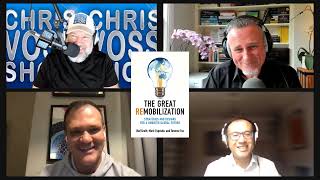
In a lengthy episode of The Chris Voss Show, host Chris Voss interviews the three co‑authors of The Great Remobilization: Strategies and Designs for a Smarter Global Future – Olaf Groth, Terence C., and Mark Esposito, PhD. The conversation introduces the book’s central premise: the post‑COVID world is moving from a Globalization 1.0 era of liberalized free‑trade to a “Great Remobilization” (Globalization 2.0) driven by six tectonic shifts – the pandemic, digital/cognitive technologies (AI), crypto/Web3, cyber‑security, climate change, and the geopolitical re‑balancing of China (with a rising India). The authors explain that their research is based on roughly 100 in‑depth interviews with executives, policymakers, entrepreneurs, and scholars, which they use to build a framework they call the “cognitive economy.” The cognitive economy is organized through the FLIPIT decision‑making model (Force identification, Logic‑collision, Impact assessment, Prioritisation, Implementation, Triage). It is meant to help leaders diagnose the new forces, generate emergent logic, and decide which legacy activities to drop and which new capabilities to adopt. The book also proposes a new breed of “design‑activist” leaders who practice “zero‑principle thinking” – rebuilding systems for 2029 rather than retrofitting 1990s models. The guests discuss the over‑hype and real‑impact of AI, emphasizing that AI will augment rather than replace humans, but that hallucinations and ethical risks remain. They critique slow governmental response to rapid tech change, argue for broader stakeholder engagement, and warn about the generational knowledge gap as many boomers retire faster than younger talent can replace them. Crypto is framed as a “trust revolution” that emerged from governance failures, and the authors see decentralization as both an opportunity and a governance challenge. Geopolitically, they note China’s complex role and the rising importance of India, suggesting a future of multilateral power rather than a binary US‑China rivalry. The conversation ends with a call for collective action, empowerment of individuals, and the book’s purpose as a reflective, non‑prescriptive guide for decision‑makers across sectors. Key take‑aways: (1) the global economy is undergoing a structural remobilization; (2) six inter‑linked forces reshape strategy; (3) the FLIPIT framework offers a practical way to triage legacy versus emerging capabilities; (4) design‑activist leadership and zero‑principle thinking are required; (5) AI, crypto, and climate change present both opportunities and systemic risks; (6) inclusive governance and generational collaboration are essential for navigating the transition.
Chapters
You wanted the best. You've got the best podcast, the hottest podcast in the world. The Chris Voss Show, the preeminent podcast with guests so smart you may experience serious brain bleed. The CEOs, authors, thought leaders, visionaries, and motivators. Get ready. Get ready. Strap yourself in. Keep your hands, arms, and legs inside the vehicle at all times because you're about to go on a monster education roller coaster. With your brain. Now here's your host, Chris Voss.
Hi folks, it's Voss here from thechrisvossshow.com. Thechrisvossshow.com. Welcome to the big show, my family and friends. We certainly appreciate you guys coming by. Thanks for being here. As always, we have the most brilliant minds on the show, and today we have an amazing, uh, eclectic group. Is it eclectic? Is that the right word? I don't know, I flunked second grade. Is it?
All right, I'm being told it is.
Motley Crue. Motley Crue.
We have an assembly of, uh, professors here, uh, from their new book that is put out by MIT Press. So if you didn't think you were gonna be smarter after listening to one of the Chris Voss Show podcasts after 15 years, damn it, and 1,500 episodes, what do you want from us? But, uh, this is gonna be a pretty smart discussion. Might be above my pay grade. How much do I get paid? $5 a show? Oh, awesome, man. This is probably definitely above my pay grade. So we'll be getting into the show, but as always, we must guilt and shame with the plugs. It's one of those necessary advertisements. So as always, go to goodreads.com/chrisvoss, youtube.com/chrisvoss, linkedin.com/chrisvoss, and the TikTok.com/chrisvoss1 and The Chris Voss Show. We're starting to get some traction over there. And give us 5-star reviews on iTunes. I beg of you, please. No, whatever.
We love you guys.
Audience. Uh, today these gentlemen join us on the show, 3 of them. So, uh, you know, we just, we just thought, well, what the heck, why, why are we doing one guest at a time on the show? Let's have 3, the power of 3, if you will. There's probably some algebra in there, but I flunked that too. Uh, they are the authors of the latest book that, uh, is, uh, coming out October 17th. What, we're October ready? Anyway, October 17th, 2023. The Great Remobilization: Strategies and Designs for a Smarter Global Future. Uh, they join us on the show, and we have the three authors with us here. Uh, we have, uh, Mark Esposito, we have Olaf Groth, and Terence C. joining us the show. Welcome to the show, gentlemen. How are you?
Very well. Thanks for having us here today, Chris. We're, we're glad to be with you and your audience.
There you go, and we're glad to have you guys as well. Uh, we're excited because we're going to learn so much. We probably definitely want some brain bleeding on this show. Uh, so let's go around the room and, uh, just get some quick bios from everybody.
Sure thing, Chris. So, uh, my name is Olaf Groth, and I'm a professor of practice at UC Berkeley's Haas School of Business. I hold an adjunct position at Hult International Business School, and I'm the CEO of an advisory think tank called Cambrian Futures. We look at how disruptive technology, emerging technology, is disrupting, you know, economics, economies, organizations, strategies. So 25 years in industry, then consulting, and now academia, and glad to be writing books with the likes of Mark and Terence.
There you go. Terence?
Chris, thanks very much for having me. Great to be here. My name is Terence. And I'm a professor of finance at Hult International Business School. I'm based in London. I'm also a co-founder and executive director of a company called Nexus Frontier Tech. We are actually based in the UK and Singapore, and we are like, we help our clients with putting AI into their businesses, mostly financial services. Mark, over to you.
Thank you very much. And Chris, my name is Mark Esposito. I'm also a professor of economics and strategy I work at Hult International Business School and I also teach at Harvard Division of Continuing Education in Cambridge, Massachusetts. And like Terence, I co-founded Nexus Frontier Tech, which we lately call Industrial Learning Lab or something of this nature. So we kind of like it because I think it just goes in the direction of AI and the AI hype these days.
There you go. And I'm Chris Voss, just a lowly podcaster. They say if you're in a room of people smarter than you or think you're the smartest person in the room, you're not, which I'm usually not. But that's that's why we have guests. So welcome to the show, gentlemen. The Great Remobilization— this sounds like my first 6 divorces of my assets. So, uh, oh, one thing we need to do is we need to get out of your plugs. Uh, can you guys throw out your dot-coms if we didn't already through, uh, all that?
Sure. If you want to look us up at Cambrian Futures, the URL is cambrian.ai, and that is spelled C-A-M as in mother, B-R-I-A-N ai. And you can find us there or on LinkedIn, Olaf Groth, as it were. You can also find my profile on the Haas School site. No problem finding me anywhere.
And we get everybody— we got everybody's plugs.
Go ahead, Terence and Mark.
Yeah, so, whoa, LinkedIn, I think that's the, that's the best way. Otherwise is nexusfrontier.tech, or just go straight to Haas International Business School. You will find me and probably Mark.
That's right.
I look—
to be very boring, it's mark-esposito.com. How does it sound, right? That's my personal webpage.
There you go. At least you got it on your name. That's the hardest thing to do. Yeah, yeah.
You know, Chris, you find one of us, you find all of us. We're the Three Musketeers, so that's right, it's all good.
That's what the judge says about my 8 personalities. Yeah, uh, so there you go. So, uh, give us a 30,000 overview of, uh, what's in this book, maybe a little bit about why you wrote it.
Sure, I'll give it a, I'll give it a start here and then Terence and Mark can lean in. So The Great Remobilization is a book about how the global economy is changing, mostly because of tectonic shifts in, in various areas and what kind of economy we're looking at going forward, right? So we've said Globalization 1.0, the global economy 1.0 as we knew it throughout the '70s, '80s, '90s You know, total liberalization, free trade, all of that global integration, all of that is essentially dead, to be provocative. And we are exploring in this book what's— what the next frontier is. What does the shape of the global economy look like in the 2.0 world?
When do the 2.0 start, by the way, before we get to the next— everyone's input?
Yeah.
So it starts on October 17th, October 17th, 2023, Chris. Right. That's the release of the book. That's when it starts.
Right.
We created it. I mean, that's the list we could do, right?
We started, we started.
You guys have the patent on this? That's probably good. Uh, do— is there— want to chime in on this?
I, I think like, uh, just as important is the fact that we're not just like saying, oh, you know what, you— we need to look into the future. Uh, but the fact is this, I think like we are at a, uh, you know, at the, at the impasse like right now where we really have to actually do something. And, uh, I think one of the key features, one of the, the main aims that we want to actually achieve is to get a lot of, like, people, especially the younger generations. You know, the fact that we are professors, we talk to a lot of students, we come across a lot of very, very keen students to do something. And what we really want to do is to, you know, give, like, a show— not, not really show, like, pathways, but, like, uh, shed lights on various, like, uh, aspects that you know, we need to focus on and what are the things we need to be aware of, what are the things that we need to keep abreast of, and therefore we will be able to make the necessary changes.
There you go. Mark, anything you want to input on this?
You know, sure, because, you know, this is probably what we would call a COVID-19 child. We started with the reflection coming from COVID We started with a summit in June 2020 called Coronomics. Where we could get some of, I would say, good influential people joining us on a webinar. Then we started to draft the framework. I think as business school professors, we tend to use frameworks as a way of conveying complex concepts in really practical terms. And then we thought, why not turn this into a longer project? So I think like in many people's lives, COVID was a trigger. In our case, it triggered us, but it also instigated to go deeper in what Olaf and Taryn said before.
Yeah, just to put a, put a final point on it, Chris, right? So during the pandemic, we were— everything was being thrown up in the air. There was pure chaos, right? People's lives were upended. Companies didn't know how to do business anymore. We didn't know what to expect in the economy. And so we said, look, it's incumbent upon us as, as professors, as ostensibly thought leaders, right, to chart the path toward the next frontier. And that's what we did in this book.
And there's a lot of things that are going on like AI and different things in the frontier. So my understanding is the book is you guys drew from 100 interviews used roughly, and conversation with top-level executives, entrepreneurs, policymakers, and diplomats, generals, scholars— you didn't call me, but that's okay— and other leading experts from around the world. That's probably why, because I'm not a leading expert.
That's for the sequel. That's the sequel.
I know how to flunk second grade. Um, and, uh, so is, is that correct? Do I have a good understanding there?
Yeah, that's pretty correct. I mean, you know, we do, we do action research, right? So we go out to the people that actually lead in the world or create disruption themselves or write about it, right? And so we want to hear a lot of the things that many of them don't put in writing. So we go to the actual minds. We interview them. We draw out the best stuff. And that often goes beyond in terms of breadth and depth between, you know, beyond what you can find online or published in papers or formal research. And so, yeah, we interviewed some really cool people, young leaders and accomplished leaders in all sectors and across the globe.
Did you ever think about asking that guy who walks the street holding the sign, "The end is near"? You know, he might have some input.
Yeah, right. We have a lot of those in the Bay Area. Yeah, too many too.
That's pretty much what our podcast does every day. Uh, so you guys are talking about tectonic shifts that are going on. Uh, one of the things you discuss is the 5 C's, which I believe is, uh, cupcakes, cupcakes, cupcakes. No, that can't be right.
It's cream. Actually, one of them is cream.
Yeah, cookies, cookies, cookies, cream.
Yeah, coffee.
Coffee's there for sure.
Exactly.
So tell us about what the 5 C's are.
All right, so I'll start. Mark, you want to chime in then? It's, you know, we started with the pandemic, like Mark was saying, right? So what happened during COVID both in terms of science, governance, how people were behaving, the new rules under COVID, right? All of that. And then we said, okay, there is clearly a lot of disruption happening there. And from there, we went into digital technologies because we all were going very digital with Zoom and other platforms. So cognitive technologies, right, AI and other technologies, very important. From there, we went into, into crypto and Web3 and then cyber because we see revolutions happening in cyber as we're all more digital or more hybrid anyway. We need to pay attention to cyber, right? And that takes new shapes and new forms these days. And then climate and, and China. Because, you know, climate is the existential threat, as we've experienced, all of us, during the summer. And China, because you can't really think about anything or do anything without co-thinking and involving to some degree, cautiously albeit, China, right? So big things, definitely.
Uh, China, yeah, different. You know, we just recently saw, uh, President Biden having a, having a big summit with Japan and South Korea to kind of try and align what's going on there. We've seen the saber rattling from China. There's some interesting I was reading, I think it was Bloomberg this morning or yesterday morning, that, uh, President Xi in China is, uh, kind of, kind of let the economy do what it wants instead of putting their finger on. I think they can't put their finger on after 20 years of manipulating GDP. I think that's kind of their problem. But it's really interesting, the status they've taken with, like, with COVID where they're just like, well, if you guys don't like us locking you up for COVID, don't fuck it, just let it run. So it's very interesting.
Or when people actually want to get out, you say, you know what, guys, like, here is like, you know, the door is now open. Yeah, get out of here, right? Yeah. So, um, and it is exactly— I think like, uh, you know, uh, I think like at least in terms of China, right, you know, it is the fact that yes, you know, like, uh, you know, we have no idea where it is going. It is a kind of very unpredictable government, if not a leader, uh, but the fact is this, you know, it is a large economy. It is after all, you know, like, uh, you know, a a very prominent, uh, you know, technology, like a superpower, right, if you like. So, you know, we do need to actually engage China, you know, like, uh, no matter what relationship, uh, we are going to have with, uh, you know, with, with, with this government. So, uh, I think, you know, China is, uh, you know, it's, it's an important piece.
It's an important piece, and it's a very, very difficult piece, right? Because it's, as you say, Chris, it's very wobbly. It's back and forth. It's, uh, you know, it's got a lot— Xi has a lot of things going on. And we encourage people not to think in linear terms about China, right? China being, you know, the dominant force in the future. That may not happen, but it's still too important, as Terence is saying, to ignore or to sideline, much less go to war, go to war against, right? So we, we describe in the book how to engage China.
I mean, you said, Olaf, you said it is, uh, the most difficult piece, but I think, you know, the one that is the most difficult, the most difficult is definitely climate change.
Oh, definitely.
Yes.
Right. You know how, like, uh, you know, how can, how we can actually deal with it, you know, if we actually have the courage or the political will.
There you go.
To actually do it. Yeah.
And we're seeing, I mean, it's indisputable at this point in my mind. I've always been kind of like half and half. I've not denounced it, but I've been like, you know, I'm not really sure about this stuff. I'm not a scientist. But, you know, there's a lot of people who are in denial over climate change. There's a lot of people who are very active in it. But I mean, you can't deny what we're going through. I mean, we just went through what, the cyclone in California? in 90 years or 80 years or something like that. Uh, you know, it downgraded, but you know, that doesn't happen a lot, uh, considering, uh, you know, we just went through a first pandemic, uh, after 100 years. Uh, we, you know, there's, uh, this heat wave that's been going on across the nation, the massive, uh, uh, where we didn't have water everywhere for there for a while, but I think now that's kind of flipped. But you know, it's flip-floppiness. You know, we're seeing, we're seeing things that we're not seeing before. And, uh, you know, there you, there you go.
That's right.
Yeah, if I may just chime in on something. When we talk about climate, we're not necessarily just talking about the narrative about global warming, but we say climate change will manifest itself in, in unprecedented ways. Just to give an example of that, uh, what we think about the next few years being critical is not necessarily, for example, the more conventional, uh, you know, battle against cancer, but for example, the fact that we're building tremendous immunity against the anti— against bacteria, right? Therefore, our antibiotics in the future will be less effective. I remember having a training on the Great Remo, as we call it internally, with a pharma company who said, by 2030, we fear the majority of death rate will come from people that will simply be immune depressed, right? Because their body won't be able to really adapt that easily, right? And these are some of the examples where we talk about climate change 1.2, 2.0, whatever it is, right? Since the fact that this is a ramification of implication. They are not just about global warming. And I think this is what we try to intertwine in the book as well.
Yeah. And there's, there's, there's other big things coming, like Mark is saying, like things that you don't necessarily combine or associate with climate change, like humongous amounts of migration, climate refugees, right, from the global north, south to the, to the global north and, and further. And we're thinking there is at least 500 million people that are going to be migrating. If you just look at everybody who lives at the coastlines that needs protection. And won't get it fast enough. So people will be migrating north. And what will that do to our politics? Right. Can you imagine? I mean, even just looking at some of the Canadians saying, we don't want you all Americans all in Canada. Right. But, but that's only the beginning of it. So lots and lots of secondary effects there that will really be disruptive. It's coming home to roost in a big way.
Yeah, it really is. I mean, you've got biblical plagues, sexual relations between species, interspecies. You've got Oreo has gluten-free Double Stuf.
Cookies.
Um, the world's coming apart. Even those, uh, Peeps that they have around Easter are now, uh, in different flavors. So I mean, it's, you know, we're losing whole track, uh, you know, we need to get back to values. I don't know what that means, that just sounded like a good joke that I set up. Uh, so there you go.
No, it was good, it was good, Chris, it was good.
We tried. I just wrote on the cuff and was typing here in the background, so, uh, there wasn't a lot of planning that went into it, but it sounded good at the time. There's a joke that I stole something off a comedian who's like animals and people living together, whatever. Uh, so anyway, uh, let's talk about AI. How disruptive is AI gonna be? And, uh, what do you think about this new thing? This, uh, is it gonna be a thing or is it just gonna fizzle like, uh, like, uh, I don't know, what were those one things, NFTs?
Yeah, no, look, we, we don't think it's gonna fizzle necessarily, but like everything in AI and beyond, right, it's overhyped. And so what we're saying is it's here to stay. It's definitely a big advance. It'll be very disruptive in how we do things, but it's not going to displace humans. The human will continue to stay in the loop or in the picture, as it were, because what we're seeing is there is a lot of hallucination, right? There's a lot of human judgment that's still needed, but it's going to make us better in some ways because it's a power tool, right? It's an efficiency tool and it frees us up to do maybe more creative things. Once we learn how to prompt, but it's not going to completely push us out of the picture.
Yeah, that's right.
And there's a lot of hype about this. I do actually— I ran a webinar last week through Harvard called Demystifying Generative AI. And I run some time program where people say, oh, the power of ChatGPT. And I think they simply didn't understand that ChatGPT is not like the mantra that will solve all the problems. It's just a tool. It's a calculator moment. I think the educational journey that we— yeah, it's kind of a calculator moment. Like, you know, because the calculator is not that we are now, uh, you know, we became less intelligent. It's the opposite, right? We just simply free up a lot of time. But there's this lack of education about the fact that these are technologies that are designed to augment humans. We, for some reason, think that we are supposed to augment technology. And I don't know where this is coming from, but I guess Hollywood gave gave a bit of that spin when we started to create the Exterminator or Terminator around this powerful machines that were taking over. Look, I loved the movie back in the days, but they didn't do us service, to be honest.
You want to jump in here, Terence?
But I guess, you know, like, what is truly— you know, I think AI is here to stay, right? The adoption rate is fast in terms of media coverage, but very, very slow actually in business terms. But it is here to stay. And as Olaf was saying, right, you know, the key is actually get it to work alongside with human beings. But the problem, of course, is, you know, if we were to allow not just AI but like other technologies, and this is what we argue in our book, you know, under the, you know, under the, like, the, the banner of cognitive economy, right? Um, what happened if we have more and more technologies that are getting closer and closer to us? You know, let's not forget, right, you know, We used to have computers and the separations between us and computer is a desk. And then we have got laptops. The separations between laptops and us is our lap. Now, we can actually have a very powerful computer in our trousers, in our pants. And therefore, it is just a very, very thin sheet of cloth. It is getting closer and closer to us. And in our interviews, We actually heard, you know, like, uh, what, you know, like, we— what technologies can already do being part of our biological, uh, you know, parts. What happened, you know, like, uh, if there is like someone hacking it, you know, what, like, uh, what kind of effects would it have on us, you know? Will it drive us to do stupid things? You know, there are— I think this is— these are the, the, the things we really want to highlight in our books, you know, how when what happened when all of these ramifications actually come together. I think that is something that we, we are, we are trying to actually like, you know, like a layout.
Yeah. Let me, let me, let me expand on that a bit because Taren said exactly the big term in the book, right, is cognitive economy. What does that mean? We're now able to connect like the, the, the 100 billion neurons in your brain slowly but steadily. We're not there yet, but we're well on our way. To our, to our environment, to our internet, to our, you know, to the, to the physical infrastructure. Right. So we're actually saying people are using AI, data science, things like brain-computer interfaces, potentially quantum computing to connect us across all these different areas of life and our infrastructure, making decisions a lot smarter. Right. Making it easier to make money. But, you know, at the center of it should be the human being. And as Senator Terrence was alluding You know, when you go into the brain with AI, right, and you scramble things up or you pull things out, you can't easily reset the brain like you can an iPhone, right? So we have to think very carefully about how we shape all this thing, all this thing.
Yeah, to play devil's advocate with what Mark was talking about, um, you know, it seems like every new technology we have, uh, it's a Pandora's box. And when it first arrives, you know, I went through this with social media, with Twitter, the launch of Twitter back in the day, and everybody's like Oh my God, it's like John Lennon and all Imagine All the World Will Be Together, and we can all talk to each other and kumbaya and everything else. And then, you know, evil people, evil governments went, what can we do with this? You know, um, we might be one of them. Uh, and, uh, you know, so it ended up being that, you know, turned against us. We saw elections turn against us. We've seen all sorts of conspiracy rises from it. Turns out, you know, everyone's like, hey, if we give people more information, everyone will be smarter. And it's actually made people lazier and dumber. And I wonder if AI is going to do that as well. You know, like, I can put, you know, PR stuff into— copy into ChatGPT, and I'll put stuff out that makes it sound brilliant. I'm like, wow, I mean, I can just do this all day long.
I—
you know, people writing books now using ChatGPT and stuff like that. Um, so I— do you think it's— do you think we're gonna win? You know, as Terence said, We're not, we're not the greatest human beings at doing, doing the best with our intent. Is it, is it, is it— I mean, maybe it turns into some sort of Terminator 2.0.
Look, tech is, tech is always, you know, tech is always good and bad at the same time, right? Tech is what we do with it. And so, yeah, we get better maybe through ChatGPT asking smarter questions, focusing on what matters really. What should I be asking? Right. But we may get worse at actually digging stuff up ourselves manually, right? Uh, or maybe judging it, uh, when ChatGPT spits something out that's nonsensical, right? So there's good sides to it and there's bad sides, and we got to understand both.
Yeah, I think, you know, I just, I just thought of this. ChatGPT, you know, it watches everything and collects all of our data and everything that we do, and it may just reach a point where it just starts its OnlyFans and says, the hell with the rest of you, I'm just doing this. I don't know what that's going to look like, but no one does. Uh, so one of the things you guys talk about book is the framework for strategic leadership and how to chart a path forward, providing a breed of design activist leader. What does that mean?
Yeah, so the flip it— the framework is, we call it flip it, right? It stands for F-L-I— well, what is it? F-L-I-P-I-T, right?
You guys wrote the book.
All right, we better know what it is. So, so we start off with, with understanding the forces, right? And those are mainly the 6 that we just gave you Then we try to collide them and see what kind of new logic emerges. And that's what we call the cognitive economy. And that's the organizing principle by which everything is being organized around the globe. Right. Then we go into what does this mean for implications for each one of us? So for industry, for government, for us as individuals in our careers, in our lives, and then we triage, right? That's what the T is for. And triage means you got to drop some stuff you've been doing and you got to add some new stuff in, right? You can't do it all. You can't just add. You also have to drop to free up resources. So which ones do we need to free up and what do we do that's new? And so that's a decision framework in our book. And Mark, I don't know if you want to take on the design activist leader, right? But that's, that's a different type of leader these days. Yeah.
I guess it goes across why we call it Great Remobilization because it's not predictive. Neither is something that is predetermined. We kind of point into where these trajectories are taking us and we give give readers the tools to understand the different buckets, like the different 5 C's. And we said, look, when you want to actively engage into this, you can start assessing the force and looking at the logic emerging, the pattern, and then do the diagnostic and the impact it generates. And how do you eventually triage? All of this creates a generation of activists, people that are not necessarily continuing the trajectory that they inherited. So it's not operating on the legacy. They start basically triaging new ideas. They try triaging challenges to status quo. They start rethinking the ramification because we tend to be really poor at looking at system-wide kind of analysis. So it's this generation of people that are navigating multiple complexities that they're capable of doing. I would say both social empathy and digital technology is part of their identity per se, that they're able to put back what you mentioned before, values. So they are redefining value-based system. And that's also why I think what Olaf said at the very beginning, the 1.0 is kind of coming to an end, is because because the value system are coming to an end, right? And we can't simply continue to squeeze more lemonade out of the same lemon, right? And that's basically where— maybe we need to change fruits. There you go.
So what you're saying is we move from okay boomer to Gen X has got to clean up all the messes, or Gen Z has got to clean up all the messes, or Gen Alpha now even. Is that just— oh crap, we've gone full circle.
Yeah, and we're trying to get him a better broom. How about that?
Yeah, I'm waiting for Alpha Beta. Urgen Beta, whatever. There's a joke there somewhere. Um, and this is really interesting. And so you're— you, you basically, you want your book to remind everybody that, hey, this is a huge tectonic shift. Everyone needs to think differently, uh, especially leaders of industry, captains of industry, future leaders of interest industry. Um, what about our politicians? Because, uh, I don't know if you check lately, but I mean, and I want to be respectful because people want to be shitty to people that are suffering from dementia. Um, you know, we have some politicians that got a little old, and, you know, we've seen, uh, the one young lady from, uh, California who's definitely suffering from dementia and probably should resign from the Senate. Um, and, uh, you know, and see some of these politicians that don't understand how an iPhone works or a technology, you know, some of the interviews we've seen where you're like Do you understand how email works? And you're like, you're the one making the choices for the future of where our country is going and, and everything is going. You guys talk about your book. Any thoughts on that, whatever I just said?
Yeah, look, I mean, there's, there's, there's good and bad and ugly in, in, in every institution, right, in our society as we look at this, this revolution. But what you're talking about is that, that government and politicians are just notoriously slow and aren't often up to, up to snuff, right, when it comes to cutting-edge technologies. And then they're too slow and trends pass them by. You know, entrepreneurs are much faster, stuff spreads, and then you have to reel it back in. Right. So that's, that's a lack of competence and a lack of speed. But then what they're good at, maybe better than business leaders, is talking to multiple stakeholders. And that's also what's needed going forward. Right. You got to, you got to talk to multiple stakeholders. Some are not that powerful. Some are not in business. They don't have a lot of money. But people need to be consulted about this. You need to involve them because life is changing, careers are changing, identities are changing, right? And so, so oftentimes, at least some of the democratic governments, some of them anyway, in some areas, are not that bad about consulting stakeholders. And that's the other thing we're calling for—better governance of all of this, right?
Yeah, and we all need to take responsibility and realize that we each, uh, play a part in this, you know. I didn't have kids, so I wouldn't pollute the world and create, uh, create, uh, uh, what do you call them, landfills. But I do my part with paper plates and plastic forks. Uh, and so this is really interesting, uh, thinking about all these things. Do you guys take into play India? I know India probably now might beat out China being the largest, uh, future economy in the world.
I think, Mark, that's one for you right there. Yeah, yeah, yeah, we do, we do.
Uh, because we, we have factory in India.
We We actually are— we work in India. We have friends not too far from, from the governments in India. And, and we actually started to feel as we were writing the book that at first India was largely underplayed. And towards the end of the book, we had to consciously say maybe we should recalibrate. So that's why we did it towards our final reviews, because we start realizing that India was coming online really, really strong. Not necessarily comparable to China. I don't think we see this as an alter ego to China, neither a natural replacement, but as a country that I think naturally plays this interplay between East and West. And, and, you know, one of the things that we understood it from the book is that we're dealing with a pluralistic world in which no longer just US or Europe and now China, maybe there will be India and maybe India will dance tango with more than one country, right? So there's this sense of multilateral reality that we no longer have with dependency just on from the West. It's something that India plays at this full power. And so, you know, it's also, it's not an antagonist to us, not antagonist to China. It's a player that is quite interesting. So we see this as a rising power, but very different from whatever we've seen before. I would say so.
You can make one of the 6 Cs called Cindia. Uh, but no, China has, uh, like you say, it has an interesting web of influence. I mean, between its cornering minerals and precious metals in Africa and basically mining Africa, the loans it's doing in these countries and then causing defaults and, and basically seizing property, which is a weird form of imperialism if you think about it. Uh, the Russia factor of their relationship with Russia, North Korea, and the Ukraine war, etc., etc. Uh, you're right, there's a lot of play there that goes into it. Um, and so maybe we need to rethink how we vote for presidents and how we vote for politicians and whether or not these people have this sort of activist mentality as you talk about in the book.
Well, you know, and that's where the crypto revolution came from, right? It was really— it wasn't intended to be a financial revolution at the core. It was a trust revolution. It was a governance revolution, right? Call it overhyped and bubbly and naive and whatever, but people were tired of big institutions that weren't working well for them, whether that's big government, big banks, big internet corporations. And they, they thought to diffuse and democratize governance and ownership, right, with all of the flaws that came with it. But that is— that's also not over. Just because it's blown up a few times doesn't mean it's not still there. The foundations are still there. And I think there's a bunch we can learn from that, right? And we need to listen to those instincts too and say, hey, we got to do a better job governing ourselves here across borders, particularly.
Yeah, I mean, you know, so fundamentally, right, you know, the, the crypto revolution and, you know, like, uh, the, you know, all these benefits that are all new business models, you know, decentralized finance, you like, you know, models, right? The— I think the key word is decentralization, is the fact that you just don't want to have a centralized, i.e., government, a— or a governance entity. It just shows how fed up people are. Now, we're not saying that, you know, we cannot— we don't need centralization, or, you know, we can do everything decentralized. But the fact is that, you know, there is a very real people need. And, you know, like, people are making their, um, you know, making their, uh, their anger known to, like, uh, to, you know, to, like, uh, to, to the world. So, uh, I think, you know, like, going back to what you're saying, right, Chris, you know, like, uh, you know, there is a, uh, we, we, we don't trust, uh, politicians. I, for one, you know, who lives in, like, the UK, right, you know, I, I went through Brexit, you know, you tell me, right? Uh, but the fact is this, you there is a— I think there is a— in general, you know, people are willing to come up with new ideas to try to figure out, you know, what are the— you know, how can we actually get like everyone to have an equal voice, you know, like, you know, like an equal, equal vote as well.
Yeah, you could actually see that, right? A lot of the crypto stuff blossomed in countries that had bad governance, right, where people were struggling to have a voice. Voice, like places in Africa, Ukraine, and Russia, right? No surprise there, right? Southeast Asia. And so, so, so yeah, wherever you have a vacuum, people are now digitally empowered to innovate around it. And the question is, how do we deal with that? And how do we, as Taryn said, how do we balance that against some degree of centralization that we need, right? We need some quote-unquote parental supervision on a global level that has situational awareness.
I've seen humans, they need a lot of have, uh, people. I do. Um, I'm— I being one of them. Uh, you know, uh, you made me have an epiphany here that's made me realize from what you guys have said is that this world— the world is seeking, like you say, more rights, more democratization of, of just about everything when it comes down to it. And, and, and kind of maybe taking back power from centralized governments, centralized politicians and everything else. And in a way, it opens up, uh, the floodgates to abuse, uh, theft, uh, you know, the fact that it's all cybers, you know, opens up the thing to the dark webs and everything else. I've seen the dark version— I've, I've seen and heard of them. I haven't seen them specifically, but, you know, my understanding is there's a bunch of very dark web, uh, no-morals ChatGPTs now that are out there. Uh, they're not ChatGPT, but they're, they're basically versions of that, but for evil, or can be used for evil. Um, and so it's interesting to see where this goes and, and, and how it goes. But it was interesting to me what you said, Terence, where people are fighting for this and they're, they're sick of it. Um, but there's also a balance to it. Um, you know, like I was just thinking in my head as he was saying that about, uh, how what if we got rid of the federal government, we just had the states run everything And I've been— I'm in the midst of reading The Federalist Papers by, uh, those Federalist Papers, uh, by Madison and them, uh, and why they form things the way they do. And one of the things they talked about is, you know, why they formed a federal government instead of the 13 states at that point, or, uh, what it was, and, and, and why the importance of that was. And so it's kind of interesting, um, how I don't know, is democratizing everything really the best thing for us?
You know, it's, it's, it maybe not, right? And, and there are a lot of cases to be made against it. But, but what you're describing, Chris, interestingly, that's Switzerland, right? Switzerland has a very weak federal government, and it places all this power in the cantons, which is their word for states. Uh, and when they experiment in one, it doesn't take down the entire country, right? But it's a small country, uh, There's some cultural diversity there, but it's nowhere near as diverse as the US or, or India. So larger countries without any sort of, you know, coordination between the different pieces in whatever shape, that's a, that's a tricky proposition. But in the book, we're actually picking that up. We have a scenario in there that describes where you were going, Chris, which is, you know, people stop believing in Washington, people stop believing in Beijing, and power de facto gets devolved to much lower levels of communities. Until there's a turnaround, and you have to buy the book to read about the turnaround. But, but, you know, that's de facto sort of this intermediate stage that's going to be very, very uncomfortable. There you go.
It's, uh, and as you guys say, it's, uh, the great mobile remobilization, uh, and so everything's shifting and moving, and probably— I mean, everything shifts, moves, and changes faster than ever, and it, it— and I guess it just is going to keep going to blinding speed. What else haven't we teased out on the book that you think it's important for readers to, to hear about so that they go pick it up?
You know, uh, Chris, we called it at the very beginning, um, The Vost Plus book, and not because we wanted to equalize yourself to what happens in The Vost, but we wanted to have that level of decision makers that are really engaged in the narrative of the book. There will be people going to this important meetings, but equally people are bringing from maybe the theory to the practice, or simply practitioners who simply are looking for something more than just a toolkit, right? It's more about a reflective journey. So it's a book that we have written to engage and entice decision-making around the world. We try to balance also the voices we were collecting so that we were not necessarily overly dependent on our own mental models, but we wanted to make sure that our ideas were challenged. So the book is really, I would say, collective action. You know, we have really started to think, how do we collectively address some of the challenges we see? So I find it to be as biased as any sort of like book is, because there's a beginning and an end and there's a confinement. It's open to a number of diverse points of views that I think makes it a global book, not necessarily just a US-centric or UK-centric or Western-centric. We think is a book that represents a larger representation in general, a larger form of, you know, voicing.
Now, I think there's a book, Tell Me How It All Ends.
Oh great, everything ends like, you know, fantastic. Yeah, fantastic, fantastic. Everyone lives happily ever after. But I think like, you know, the book is a, um, the book is a great, like, uh, what we call a big thing book, right? You know, it is not a technical book, it is not It is not like a book that will give you very, you know, tools that you can actually like put into use the next day you like go back to your office. But it is rather a book that captures a number of elements. We don't pretend that, you know, they are all right or they're all wrong. But it is like throwing out ideas out there. And hopefully, you know, we will be able to get our readers to think a lot more about what we need to do about the future.
And that's— I think that's the key point here, Chris, right? That we are calling for a new type of leader. We're calling for rethink. We're telling people you cannot think in 1980s, 1990s terms. You're going to bring us right back to where we were, where all the trouble started. We have to have a fresh rethink. The old ways that may get you to retirement if you're already in your late 50s. But, you know, our kids are not going to thrive. Right. And so we're saying we need leaders, whether they're young in college now or older somewhere in government or at the top of corporations. Who are courageous, who are courageous and creative to rethink. And this is where this term came from. That's really key in the book, zero principle thinking, right? Which is think beyond first principles. Don't try to rebuild the world of, you know, 1989 or 1999, but rebuild the world or build a world, right, for 2029 that our kids can live in and that we can retire in. And there's stability, there's resilience, There's more sustainability, right? And it can be done. I mean, we've done it. We did it after World War II, right? Maybe not perfectly so, but we did it once. We can do it again. But we got to have that courage not to think in old terms. And that's what we call zero principle thinking, right?
I like that because, you know, even I get stuck in this from time to time where I'm like, God, I wish we could just go back to right before COVID It seemed like everything was so good then. And then I have to kick myself, and most people should, um, mainly because some people do need an extra kick. But I have to kick myself and go, wait, dude, we're in a— it's, it's a whole new ball game. It's never going to go back to that. Yeah, I've got a Russian war. The price is right, we're gonna go back to that. You've got, um, you know, the— a lot of the boomers and the Gen Xers left early and retired earlier over COVID. They're not coming back. I, I was reading that for all the people that are leaving daily the job market to retire the boomers and everything else, you have 7 people that are, uh, this is an estimate, 7 people that are skilled, have a lot of knowledge, have decades of experience leaving the workforce, and only 1 person is replacing them with this new smaller generation from the boomers that doesn't have the skill, is fairly new and novice. Um, you know, we've had doctors that have come on the show and talked about how the doctor, new doctors ending the business are declining. They have this problem in the pilot field right now with airlines now. Where they don't have enough stuff. And so it's going to get weird, going to get really weird.
Yeah, it's going to get weird. And we need more what we call buddy systems, right? We need that experience of how to make things work, how to be grounded and be smart about life, have some wisdom, right? And that's the older crowd that's retiring. And we also need the young ones to come in with new concepts, new creativity. But they need each other and they can't pass each other by like ships in the night. So some of our clients, my clients, are actually finding that to be one of the most the biggest strategic problems ever, how to get those two generations to talk over the water cooler, whether that's a real one or a digital one.
Yeah, well, I think the thing will save this is that new TikTok trend where they do the animation stuff on the screen. I think that will save and fix everything. Have you seen that?
Yeah, Terence is a master in that. Absolutely.
No, of course not, I'm not that young.
They do the live thing and they get— I don't even— they act like an NPC or a bot. Yeah. Yeah, yeah, I think that's— I think China is winning. When I see that, I'm like, yeah, I think, uh, I think we're done. Thanks, TikTok. Uh, we love TikTok. Don't knock the TikTok, Chris. Uh, but, uh, there you go. So this is very insightful, a book that can help people kind of think about different things on different levels and then start formation— formating how maybe they want to go about stuff. And everybody's usually on you know, doing their own different things in different variations of leadership, various industries, various careers, paths, and interests. And so people can take from it what they will and utilize it in their own mechanisms.
Yeah, and we're giving lots of suggestions at the end of the book, last chapters, on what you can do, what we can do together. New concepts, new designs, new institutions, new ways of doing things. I think lots of ideas there, you know, rub off on them. Tell us, tell us how you think about it.
That's right. Okay, here you go. But I want to be romantic here. I want to be romantic and make sure that, like, you know, they—
since when you're romantic?
Here comes the human element. I am treating—
remember, I always think you're just an AI.
Let Mark speak. Uh, thank you, Chris. Thank you so much.
This is a battle, battle that I've been having for life, so It's more about thinking that the kind of future that is ahead of us, as mentioned before, is not predetermined. So we don't want people to feel this is a book that's going to make them sad or depressed. It's more about saying you have the option to build the future you really want, but the future cannot be a mimic of where we come from. So we have to think by disrupting or decoupling from the last 70, 80, 90 years Nonetheless, of incredible prosperity for many parts of the world. And I think it's so— I like to say it's a book that encourages you to build your future. So becoming sort of like a contender to the future rather than a bystander is a part of a powerful message. And that's really— that's where it's so romantic, isn't it? Right. Be a contender to the future.
Isn't it cool? Oh, it's definitely— I'm with you there, man. I'm a total romantic that way. An optimist too. It's a book for people who want to be empowered. Build the world you want to see, you know. Don't leave it to others that you might disagree with. Be active. Shape the world you want to see. That's the only way to get on top of it. And, and it's worked in the past.
It can work for you. And hopefully it keeps working in the future, knock on wood. Uh, and, and that is the, uh, core of the human experience in survivalism, is the romanticism of the hope always springs eternal until Terminator shows up and Skynet shuts us all down.
So there you go.
Well, gentlemen, it's been very insightful and stuff to, uh, speak with you guys and lots of fun discussion. Uh, give us your.coms. We'll go around the room there, uh, so people can find you on the interwebs.
Sure. So, so, you know, you can find us at Cambrian, C-A-M-B-R-I-A-N,.ai. Uh, you can also find me on LinkedIn. Happy to give you my email as well, always answering emails, groth@cambrion.ai. Looking forward to getting lots of comments and engaging. There you go.
Personally, Terence T, PhD on LinkedIn. Otherwise, it's nexusfrontier.tech, or just go straight to Haute International Business School. And there you go.
Terence doesn't want people to forget he has a PhD. I'm sorry to interrupt you there, Terence.
Oh, they're like, uh, yeah, because I don't look that way. Because I don't look that way. I understand, I understand.
Then you'll be as crazy as us. Don't do that, don't do that.
There you go. Yeah. Yeah, so I'll be boring again, uh, this is mark-esposito.com and all the different affiliation things that we do with—
so you, so you're boring romantic or what?
I am, I am boring romantic, but I'm a conservative in that case. Oh my goodness, I'm working out the first principle rather than zero principle regarding this.
Chris, I think somebody needs a divorce lawyer here.
I, I, I, I'm just sitting here going, man, this would have been fun and editing on your book between, between me and him or between him and and his wife, you know, 2 years of this crazy—
2 years of going back and forth.
Yeah, a COVID child going like this. Yeah, exactly, exactly.
Well, I look forward to book 2 on, uh, hopefully it was happy ever after on how we all turned out with this, uh, little— this little human experiment that we're always up to, uh, and then we get better. Thank you very much, gentlemen, for all coming on the show. We really appreciate it.
Thanks for having us. Thanks so much.
There you go. Thank you so much. And go to my website, Chris Voss Doesn't Have a PhD, he's an idiot. It.com, uh, which someone's probably already done that as a thing. But go to goodreads.com/chrisvoss, youtube.com/chrisvoss, linkedin.com/chrisvoss, uh, TikTok @chrisvoss1, even though we threw some shades at it. Thanks for tuning in. Be good to each other. Stay safe. We'll see you guys next time. All right, take care, y'all.
Take care. Thanks.
More from Mark



Stanford Professor Omer Reingold on what it really takes to build fair AI systems

Stanford Professor Andrew Maas explains why the future of AI will rely entirely on humans


260225 0840 Opening keynote Understanding the future as it unfolds the power of megatrends




