#TheIndiaDialog Conversation with Mark Esposito
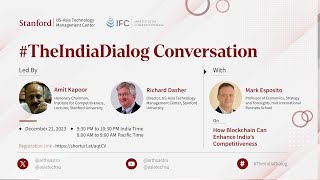
Mark Esposito, a strategy and economics professor, explains blockchain as a decentralized trust mechanism beyond cryptocurrency. He connects it to India's digital infrastructure like UPI and digital land records, and outlines uses from supply-chain tracking to AI data security, while flagging risks like immutability errors and governance gaps.
Chapters
Good morning. Good evening to everyone who is actually part of the program. It's absolutely a pleasure to have you with us today. Incidentally, as you know, the India Dialogue Conversations is a series that we have co-created together with Richard and US ADMC at Stanford and Institute for Competitiveness. This is where we actually try to delve into ideas about India and how various sets of new technologies or things could actually have an impact on India's competitiveness, India's growth, and India's journey forward. As you know, like India is possibly, as I always say, one of the most or the least understood economies of the world. Either you are absolutely too positive or could be too negative. But I always feel that there is a very strong middle path. In fact, Richard and I have had some amazing conversations on it as well, wherein we feel that India has to be seen from various lenses. And this is an effort to really understand as to how we can look at India from different perspectives. Over a period of time. And today we have a very special guest, Mark Esposito, who's joining us. He's right now in Dubai, but somebody who's a globetrotter. I've known Mark for, I think, about 20-odd years, and it's absolutely been a pleasure. In fact, Mark is someone who's done a lot of work on some— in the area of competitiveness, idea of the Fourth Industrial Revolution. He has done work with the the World Economic Forum. And then, of course, to say the least, he's a professor of strategy, economics, and foresight at Hult International Business School. And then, of course, he's been a professor, or he's associated with the Harvard University's Division of Continuing Education. He does too many things, so you might actually get confused as to how many hats he wears. But right now, he's also appointed as a full professor of public policy at Mohammed bin Rashid School of Government in the UAE. And I think the most recent thing was that he actually joined as an adjunct professor at Georgetown in D.C. And his claim to fame is that he has co-authored a book with me. Everything else is— I do not know, meaningful or whatever, but we have done a book together on Fourth Industrial Revolution. So, Mark, welcome. It is absolutely a pleasure to have you with us. For this dialogue today.
Thank you. Thank you, Amit, one more time together after so many years that we have been trying to, I think, make sense of this complex world of ours. Very nice to see also Richard connected, and the pleasure having met Richard in person last February in Stanford, and in not from long from now in Stanford again at the end of February. So very nice to have you both part of this conversation, and I look forward to the chat.
Thank you. Thanks, Mark. So we'll just quickly get started, you know, Mark. So this is a very interesting topic that we are really trying to delve into today, something which is possibly seen as exotic by some. Some people would actually see it as a very complex thing. Some people will see that it is a panacea for all evils, or somebody will think that it is going to destroy the world. and so on and so forth. And this is where we talk about blockchains. So my first question, like, what the— what is this idea of blockchains or distributed ledgers, and how do you really explain it? It— I know it is just not about— like, a lot of people will think it is just about cryptocurrency. There is so much beyond this whole idea of blockchains. And what— how do you explain it? Like, what's your initial, or what are your initial thoughts on this?
Great. Well, Amit and Richard, look, I start by a disclaimer. Like you, Amit, I'm an economist, and I think the same for you, Richard. That's your background. I'm not a technologist, right? So I came to technology from a perspective understanding in economic development. And a lot of these new technologies, they need to be fit within the larger interest that we have on competitiveness. So just to give a bit of space in the interpretation, Blockchain initially was attached to the idea of a new form of currency. In fact, this is why the original idea about blockchain with cryptocurrency happened when the white paper from this anonymous user Satoshi was introduced, introducing Bitcoin. Now Bitcoin, of course, is a revolutionary idea in the sense that is reframing the concept of money through social trust rather than through central governments. But what people didn't know back in the days is that the technology used to host the infrastructure of Bitcoin was really the blockchain. So I think we owe to Bitcoin the birth of blockchain as like a technology distributed. It is also true that we should not associate blockchain and crypto only. That I think is a fractional use of what it is. Fundamentally, when we think about blockchain is the core idea about where do we store value. And historically, that question was answered by institutions. So where do we store money? The answer was, for example, banks. Where do we store, for example, medical data? Either would be the hospital or the hospitals or the Ministry of Health. Where do we store sensitive information? The Ministry of Interior used to have red case. And in countries where we have, you know, intelligence services, it was the intelligence services. Think about all the movies we watch about CIA and FBI, and the fact that there is a concentration of information, or the fact that there is in theory, a secret book of records that is in the Oval Office about the many, many secrets that have happened in the United States that are not publicly available. So the idea was knowledge to some degree whatever that is, or value to some degree, is centralized. What Bitcoin did was to say money can be decentralized because if you and I trust each other and now we create an alternative form of exchange that is not traditional money or US dollars or fiat currency but is a token, then what if, for example, other things can be decentralized? And so the process of decentralization from the original centralization is really the essence of what Bitcoin, blockchain does, right? It's the distribution of value through the internet, just simply to say this in, in few words. And this is why I'm happy you asked the question. We should differentiate crypto from blockchain. We should understand why they were kind of coined at the same time. But the application of blockchain are much more interesting than the limitation of cryptocurrencies. And I think today we know cryptocurrency are a volatile currency in general. Everything that has a limited supply is inelastic and therefore pricing can never be normalized. If I tell you that El Salvador pegged their currency to Bitcoin, from an economic perspective, that's difficult to accept, right? Because we know the limitation of a limited currency. But that is, I think, just the side of the story. The other side of the story is really if I can start storing information on a technological infrastructure that are no longer centralized, but what's the purpose of ledgers? What is the purpose of archives? What's the purpose of repository, depository, and all of that? But I think the power of blockchain is the inherent transformation of the concept of value. And this is why I think this conversation of today or tonight, depending where we are, if in California or in India or somewhere in the middle, is really to say, in the context of a country like India that kind of gave direction after the G20 that the digital public infrastructure is so important, does this make any sense? Or is it too far away? Or is this a fad? And I think this is what we try to do together in trying to navigate this. And again, from a non-expert perspective, but from a perspective of somebody that in the economic development plans or project that I do, I come across more and more about this, and I'll try to share some of my direct insights from what I have found out.
So this is very interesting. And what you really say is the very basis for something like this is trust. And I have to ask you a very interesting question to straight up, like when you really talk about the world, which is possibly devoid of trust right now, and then you have these technologies coming in. How do you really look at technology solving the challenges or problems that the people face?
Yeah, I mean, look, I think when, you know, you have interviewed, I think, Terence some months back about the great remobilization, right? In that work, what we discover is that from a perspective of trust, the erosion is becoming very visible. We don't trust governments in many parts of the world. We don't trust banks in many parts of the world. We don't trust institutions in many parts of the world. And if I ask, you know, people in some countries, do you trust entities like the UN, the IMF, the World Bank, many people will say no. So I think the concept of trust from converging institutions that were supposed to be gatekeepers has been over time eroded. And on national levels, especially in countries where we elect the officials, trust has been eroded because I think politics doesn't serve as well as before, we either have large polarization of the public opinion or we see the erosion of trust. Is that technology is creating digital unemployment? So many people are asking questions. So I think the very beginning of the problem, which was the erosion of trust, started to trigger a conversation about, well, can we reframe or reform trust elsewhere? If we don't trust central, can we trust decentralized? I think this is where the pain point initiated this conversation and started to widen the application. This is why I think talking about this now makes much more sense than if we were talking about this even a few years before, even before COVID where the erosion of trust was not as accentuated as it is right now. But today, globally, no matter if you are in Asia, if you are in the Middle East, if you are looking at the two conflicts that we currently have in Europe or in North America, trust is largely debated, right? And so I think this is where the conversation of trust has probably been an accelerant of the use of technology of this nature. Because if you don't trust central structure, who do you trust? And so the answer is in this case, well, probably technology, which is great. It's equally coming with a number of dilemmas at the same time. So this is not It's not a clear cut, right? It requires some thinking nonetheless.
So let me, uh, just jump in very briefly and point out that I think that a lot of the kind of blockchain community has thrived on this sense of lack of trust for the old traditional big institutions, whether it's a central bank or whether it's a you know, some government repository of information about driver's licenses or whatever. And, you know, blockchain is offering the ability to use the technology itself to kind of guarantee the ownership and provenance of a particular piece of information or a particular kind of unit of value, whatever. But, I'm kind of curious how you see this developing. Are you suggesting that we're going to stop having central currencies, that basically the world is going to shift to blockchain?
Richard, that's a great question. Look, I think rather than thinking that we'll have to face trade-offs, I think we'll talk about expansion of the same concept under different forms. I'll try to be more specific. I think we started at the time of Bitcoin to say, oh, Bitcoin will disrupt money. And if you think about this applied to banking, we were thinking fintech will disrupt banks. The reality is banks are still there and money is still there. The point is that it did not replace it, just expanded the whole construct of what is money and what is a bank, right? I would say the same is for mobility. There was a time where people thinking Uber will kill the taxi companies. In many countries, taxi and Uber, they coexist, right? So markets have expanded. I think this is where technology like this are largely going to expand the original semantic on what was a central structure. And this is where it's interesting because in central structure, governance is quite clear. It is within the bylaws of the structure. In the centralized structure, which is multiple regions, multiple jurisdictions, But we are nonetheless rethinking about distributing value through that structure. Well, how do we govern is a big question mark. And I think the other conversation that likely happens is that central structure used to be attached to government activities. The centralized one, they are shifting power more and more to fundamentally technology companies, which is, I would say, a conflict of interest in itself. When a lot of value storage is now in the hands of technology company, which are private company whose primary purpose is to maximize shareholder value. Nothing wrong with that. It becomes wrong if shareholder value has to coincide with public goods. And this is an area where I think we have to be careful and vigilant because otherwise most important things will now be in the hands of private entities. And what will the role of the government be? And as much as I think I am, I grew up as a free market economist. I don't think that government should be invisible. I think government has a role to facilitate, but that doesn't mean that the role is less important than the creation of value. But if you start having creation and storage of value in the private sector, so what is the role government have? And how do you eventually make sure that ethical standards, compliance, legal frameworks are reinforced? I think these are some of the dilemmas that I see rising on the horizon.
Okay, thank you. Amit, over to you. Yeah, sure.
Thank you, Richard. So Mark, this is fascinating in terms of like how you're really laying the land or how you're really explaining as to what it is, what are the challenges. But let me just take it a little further. And how do you think this whole concept of blockchain connects with the wider idea of digital public infrastructure? You did talk about G20 India in your initial remarks, but how do we understand this a little better?
So I think to understand that, I mean, in the idea that governments are attempting worldwide to catch up with the technology pace and modernize, a country that are emerging, they have an opportunity rather than going through the tiers and the legacy of historical steps that are in many cases ineffective, at least in the context of now. Many countries are thinking leapfrogging. When you leapfrog, you are largely digitizing government services. It is likely that in some country, visa happen as an e-visa upon arrival. If you see, for example, from the East in the US or the New East in the UK to some of the East in Saudi Arabia, it happens to be within a few minutes from the time you apply. And then suddenly your visa has been issued, right? This was unthinkable back in the days when we have to go to embassies and wait in line for a visa to be issued. So I think this has permeated many parts, from deeds of properties, certificates, to renewals of IDs. And I think in the US today, driving licenses are somehow digital with basically holograms that show the feature, the face that you can carry on your phone. I mean, all of this is part of an infrastructure, the government that had to become somehow digital. So in the context of a country like India, they are looking at their big growth spurt in the next few years. Because first, I think the world has realized that this country is rising no matter what, as you rightly say, is a largely misunderstood country in many ways, but nonetheless is a country that is is growing, driven by the demographical benefit, but also by, I think, the new geopolitics of the world in which India finds itself to be at the right time, at the right place, with the right narrative, stability in the government that the country had. All of this is kind of bringing the country forward. I think when you and I met, I remember slides from 2010 when we were at Harvard where India was a very, very tiny contributor to the global economy. And now in a few years, you have seen a country growing larger. And if I'm asking what do you think will happen in the next 10 or 15 years, very likely that that number will double, triple. So within this, by shifting digital, so government services to digital, the infrastructure, the public infrastructure changes, not necessarily on everything, but it could change, for example, on mobility. It could change on subscription-based model. You could change a request of documents. And if you do that, the question government have to ask is, how do I securize this? How do I make sure this is not becoming easily hackable? And so by extension, blockchain becomes a safer choice simply because as a distributed technology, it requires significant larger attempt of cyber attack before we can largely see hacking in general. So I would say it's not in the inherent value of blockchain. The government are doing this by saying in blockchain we trust. It is in the question, how do we make sure that cybersecurity does not create data leakage that we're having cyberterrorism, that we're losing millions or billions of dollars in just, you know, what we don't understand. Blockchain becomes, I would say, most the natural form of immunity against large scale. Just to give you a context for both of you gentlemen, it was a few days ago in Qatar. I didn't know Qatar is the country with the highest number of cyber attacks daily, millions of attacks, right? So clearly what these guys have done, they have to create a cybersecurity capacity. I mean, the whole idea, I don't want to go too political, but the whole idea about the embargo a few years ago happened through a cyber attack. They that came from the region and created fake news. And then the blockade started. So long story short, this guy had to, guys had to figure out what to do. And one way to do that is to start shifting some of the government data on blockchain. They equally brought companies like Google and Microsoft to Doha with the intent of securing the servers. But so interesting that out of necessity, I would say in this case, Blockchain happened to be one of the remedies they have against this reckless problem that we're having with cybersecurity, which currently is impacting money, data, supply chains. And I don't think we are far from it. I think we are just at the very beginning of a cybersecurity crisis because we are far from the capacity required to countermeasure this. So I think that's the context that I've seen this. In, in kind of the work I also do around me.
So you make a really good point that, um, the decentralized nature of the ledger in blockchain means that even if somebody can hack into somebody's personal data, they won't be able to see anybody else on the blockchain. So that's right, in a way it is much more secure than the, uh, the old alternative of just trying to rely on passwords or even biometrics.
But if you remember firewall, right, the idea that— oh yeah, the fortress, right?
The fortress.
Like, as, as, as strong as the walls are, you'll be able to, uh, to, uh, secure your, your, your town, right? That kind of—
with thousands of attacks every day. Yeah. So the one thing— what's kind of coming back to this though is government attitudes toward what keeps the government in control, right? I mean, think about it. This sort of distributed ledger may be very secure, but does the government have access to the kind of information that it's used to having? And, um, you know, how do you get people sort of weaned away from this whole thing about we are the people that, that store the information, therefore We have some sort of power.
Yeah, Richard, you know, there is an anecdote to this that I think answers nicely your, your, your, your train of thinking, right? A country like Estonia, very tiny, but kind of benchmark around the world for many reasons, right? First country that truly seriously did a government theories back, goes to Brussels and say, we at the European Union can start having an EU-wide blockchain initiative through our ID cards. Why didn't happen? Because the French and the Germans were actually saying, where will the servers be? The German wanted the servers to be in Germany, the French wanted the server to be in France, and nothing happened. Exactly what you say, right? The problem with control, the illusion of control, right? The government wants to have is a critical part of why this technology, although available has not really been scaling globally, right? So I think it's a conundrum that we have to navigate. Where do governments feel that giving in on control will enhance security? And where will government feel that I would rather have security issues but still be in control? And I'm not sure whether the upside and downsides in this case make much sense. But I think this is exactly right, hitting the nail on the head, right, with your point.
Yeah, it's tough to get people to think in a new way, but it's also a very powerful kind of approach. One of the things that I've been looking at is the use of blockchain in supply chain management, where you really have a desperate need to share a lot of information across independent companies and governments. In an international shipment. And so really no one wants to allow anybody to have all of that information. And so a distributed nature of a blockchain-based kind of document, sort of process, would be very attractive. And I think that that's one area we're starting to see blockchain move ahead in. What kind of things are you seeing, especially in India? What do you think, uh, where do you see blockchain really having a concrete impact in India?
Right, Richard, I think there are two answers to that. The first one, reinforcing what you said, uh, you know, India is currently, uh, both an internal market but also supply-side economy. There's a lot of export there now going from India to the rest of the world. And introducing blockchain is a form of, I would say, creating compliance, especially when you're exporting to demand-side economies that tend to have, I would say, requirement from a regulatory perspective of traceability. I think the second conversation is really on this whole narrative about COP28 and onwards. Really looking about what COP28 was able to do this year. You know, I personally, and allow me to be very open, I find that any COP has limited impact because it's very transactional and the value it generates tends to be just, just like very minimal. What I think becomes transformative is a series of COPs, in this case 28 years, that over time has shifted, right, the conversation moving forward. So I think in COP28, I think one of the new concepts that was more widely accepted was the concept of transition. And transition is how do you transition? And let's say that you transition by decarbonizing as much as you can, you transition by dematerializing, and there will be companies around the world that can no longer do supply chain with vendors that are not proving that they are engaged in this process. Why? Because otherwise either their investors, their board, or compliance, or to some extent customers, will simply no longer, you know, be part of that. So introducing traceability at the supply side with the conversation on transition of, mainly evolution from where we are, where we will be, I think is a form of integrating many of the Indian companies into the global supply chain, which is a necessity considering that when supply chain got discontinued in times of COVID largely driven by China, I would say migration of behavior from soft to hard power and rethinking China as a different role than before, largely has created more localized trade deals. And so somehow we went back to the clubs, right? More localized kind of exchanges. A country like India does not benefit from localization this day when it's a country in actually in explosion of opportunities. So having the ability to export around the world is a critical factor. So if the export comes with blockchain to some degree, it can also be within part of it. It doesn't have to be throughout the entire supply chain. I think it will benefit a lot those, those supply, those demand countries where they will try to fulfill the scorecard on whether or not in their SDG they are making any progress, especially when we start noticing that significant amount of resources are now being invested into green bonds, green, like green performances. I mean, I personally find there's a lot of greenwashing as well in all of this, right? But this direction of travel that we've been noticing as well.
Okay, thank you. Amit, over to you.
Thank you. So, so, you know, like, uh, Mark, we have done some work together on the Fourth Industrial Revolution and the emerging economies. But I have to ask the question here in terms of like, how do you think that body of work relates to the idea of blockchain and how, as an infrastructure-driven thing, and so on and so forth? And what are the right level of investments that we have to really understand? Because on your previous answer, you know, like, of course, it does create some security, But I do seriously believe that if there is a breach, if at all, it could be catastrophic.
Yeah. So, yes. So, I mean, look, another great, great point. Look, the two technologies that are really driving this idea of the Fourth Industrial Revolution, right? And I think it was aspirational when it was originally ideated in 2016 by the World Economic Forum. I personally found it was aspirational in the sense that it doesn't exist. Right? It's just how we would like economy to move towards a much more integrated and interoperable technology. Today, I think what is happening is that accidentally through generative AI and how we now see AI largely becoming a large language model with the ChatGPTs, the number of things, circumstances where I find myself dealing with either question about GenAI, AI jobs, all of this stuff, right? It's building. I think when you and I were in India together, right, a few months back, equally, right? Even if the country doesn't have yet, you know, a clear development like you can say comparable to the US, but AI is now part of the government conversation, right? It's not completely away from it. So AI from a perspective of generative AI, which is sort of like large language modeling and blockchain that go hand in hand because this large data that is basically shared by The fact that millions of people are using this, our store of blockchains, this is the only place where you can eventually store that. So it is constitutional to the idea of the Fourth IR now that we have internet access to GenAI. Before GenAI, I would tell you that maybe with Internet of Things in advanced manufacturing, if we can have data that is stored on a blockchain, it probably is a safer way for the data to become critical. We can replicate the data elsewhere. We can think about how do we use this in one part of the country, replicate it to the other one. I would say this was a 2020, 2021 conversation. Once GenAI became so widely distributed, I think today we can talk largely about large language modeling, which is somehow distribution of access to some form of content creation from algorithms. And they have to be stored on infrastructure that are blockchain. I think this is where now we see more and more emphasis, especially in a question that you asked, right? How do we securize this? The bridge could be disastrous. Today, I think the contribution that blockchain is trying to bring forward is the fact if before blockchain was trying to validate the transaction, the idea of Bitcoin before, you know, you mining and all that, Today blockchain is trying to validate ownership. Who owns what? The challenge with data, the information, is that in the old days, if I have a barrel of oil and I burn it, it doesn't exist anymore. If I have a barrel of oil and I sell it to you, you have it, I don't. But if I have data and I give it to you, I still have data. So how do you equally protect the information from being duplicated? And we saw this with the fact that Many of the current conflicts are largely misinformed by algorithmic inefficiency, right? So I think the question is becoming more and more about development of countries where productivity is being largely driven by some integration of generative AI. Question is, where is this large language modeling being basically hosted? The answer is in blockchains. A country like India, imagine the scale that it generates just by having a few million people integrating their everyday operation into AI and the training of the data. But naturally, we don't have capacity in the traditional storage like cloud to be able to host that, right? And so I think this is where, again, the unintended benefit of the time we live in makes it more likely for this set of technology to kick in. Although it's been around for now, I would say 15 years from the original white paper from Satoshi, right? But So it didn't really scale before. It seems to be scaling more now, also because of the good premise that both of you made at the very beginning, because we decoupled it from crypto. We started to use, like the example Richard, traceability supply chain. I was intrigued, gentlemen, to discover that in Botswana and in South Africa, which you both know are where many diamonds are extracted, the most blockchain industry is actually diamond. And they, when I asked them why, they said because the risk of a stone being replaced by a fake one has such a high reputational hazard that the company would never be able to recover from that, right? So what did they do to secure that? They put the entire traceability on a blockchain. I think it's quite interesting. I think that the timing are, are, are definitely more propitious now than, than if we were having the same conversation 5 years ago.
So, you know, Mark, you talk about a certain set of applications, and I'm just curious to ask, say, one of the biggest challenges that India faces are, say, the pendency of court cases, the land records, and so on and so forth. Do you think there can actually be certain applications of these technologies in solving for these challenges, which might happen in India and which might happen in other parts of the world, or From a broader perspective, how do you think blockchain can actually help us resolve some of the social challenges that we actually see?
Yeah, look, I mean, that's another great point. Look, I think one of the things that blockchain does, and I think it's an inherent value, or I would say feature, that I think has a social connotation, which is transparency, especially in regions of the country where things are maybe informally still inferred. Where we don't really have clarity on how certain things happen. Even a very small portion of a transaction on a blockchain generates traceability. I think this is one of the possibilities that we have in understanding better, almost like the behavioral data of the country, right? So that we can start modeling where we can start eventually predicting what will happen, but equally educate a lot, right? So it can start from the mom-and-pop kiosks that are very popular in India that somehow they might want to do a transaction of rather than on traditional digital payment through a blockchain. I mean, I am constantly reminded how a country like China was able to create e-commerce by, by a size we had never seen before with WeChat. And now WeChat became the largest infrastructure of e-commerce that the country ever had, to the point that with less GDP per capita, during Black Fridays that the Chinese were celebrating on the 11th of November because it was called the single day, 1111, right? This guy were raising billions of dollars and they had half of their population in kind of, you know, economically viable and with the GDP per capita was roughly $14,000. While in the US we were looking at $60,000, but Black Friday would probably be $2 billion or $3 And so the, the number was disproportional. So China discovered that e-commerce was a way to accelerate transaction for anybody, no matter whether you were on a kiosk, on a stand or not. I think we saw some of this, this conversation happening with digital payments where people could start to pay with their phones more and more to the point that today Apple is the largest fintech in the world. It's unthinkable, right? But it's also true to all of us. Sometimes I don't really have cash anymore in my pocket. All I do is basically tap in my phone. So when you're looking at blockchain as a way of measuring this transaction, the traceability generates more transparency. It goes back to the question we were asking before with Richard. Well, where is this information available and who controls this? Which is actually a problem that we do not easily solve. It cannot be entirely government. Sometimes it can be private sector, but then it kind of breaches on the fact that when government do not have a way to control this information anymore, do we always want transparency, which I think is a big question mark. Sometimes we don't, right? Just because it's a good thing, it doesn't mean that we want to have it.
Well, and some bad actors really don't want transparency, right? Absolutely.
At all. At all. Absolutely not, Richard. But I remember one of the very first exercises I was doing on blockchain, somebody said, see, blockchain is an unforgettable technology. But humans in time love to be forgetful because kind of we can recover from something we don't remember anymore. We forgive, or we don't remember that that bank had a scandal. But imagine when information are becoming now constantly available where we have an always active memory. Is it good? So I think this is a big question to ask. But I mean, I would say transparency for social dimension, it would be probably important. It's also a way for us to start having data on behavior that today we can hardly anticipate because they are part of a cultural norm that is not formalized. So we don't have a trace. We don't understand necessarily how it operates. It's also in the interest of how do you nudge differently? How do you enter market differently? That kind of, you know, access to data that allows you to start making hypotheses, which I think is the value that this technology gives you, is the ability to pivot differently from before, because it's not about blueprints anymore. It's much more about, look, you know, social constructs are very different now. How do I hypothesize a new idea, a new business model, new government service, new support for healthcare? How do I improve people's health? I think this big question, they are easier to formulate when you have some form of databases to start with. I would say that's the direction of thinking.
It's very interesting that people do really seem to appreciate transparency. And as we talked about in the India Dialogue last February and since then, one of the impacts of the UPI the unified payment interface in India, is that a large part of what used to be the, quote, informal economy that never got reported to the government, never got taxed, has shifted over to being, you know, in this system because it's so convenient for people. And so if you give people something that will make their lives better, they will vote for the transparency. But that also makes me kind of wonder if developing a system like UPI could actually be a sort of barrier toward conversion over to blockchain because it's already developed so well with its current, you know, clearinghouse and that kind of system. will it be harder for India to move into a more distributed approach to, sort of online transactions?
Richard, this is a great, great point. Look, I think it could be if it's functional, because suddenly you're not really raising pain points or why people should really transition elsewhere. But it's also true that UPI has, has limitation like every, every possible proposition that you have in any given economy where you have a specific function taken care of by a specific service. So it might be a way of differentiating which industries they need to go faster or deeper in that. And I tried to make an example that I think is where in the variety of the conversation that we have. So these days we all talk about compliance in many parts of the world. I think for many, many organizations, compliance is becoming big. In the United States, from mandatory training that we have at university to the entire diversity, equity, and inclusion that has largely permeated the narrative, to the whole idea about identity and pronouns and how do we have to respect it. Now you can notice that compliance is trying to lift up, right, the standards. Yeah, it's also true that Somehow when you're looking at compliance, it is an opportunity for organization to start thinking, well, is this enough or can we do better? And if you're looking at the pharmaceutical companies, their compliance is much more stringent than the regulatory one. And I think this is where maybe blockchain will not work well in many industries because we have enough functionality with the UPI. But it might be like an example of diamonds, a supply chain that is critical, that refines its value proposition in traceability where blockchain does a much better job. I always find that when we can differentiate kind of what, you know, this, this, uh, this Harvard economist called Ricardo Hausmann called economic complexity, right? When you can have countries that are able to largely differentiate depending on what they really need. Then I think you're creating some form of fortitude out of this where I love the idea that blockchain is available. I don't need it to be streamlined to every single industry, right? Would I like, for example, the post office in the United States to have more blockchain? I think so. Why? Because he has suffered from lack of productivity for so long right now. Would I like medical records to be on blockchain? I think it would help if I, for example, go from one state to the other, that I don't have to refill my medical history. But maybe should other aspects be blockchain or should they nonetheless be private? For example, the whole conversation we have in many countries about genomics, right? Should my genomic data be on a blockchain or should it be somehow protected? And I think this is where a country have to have the ability to think Not necessarily everything has to be in one direction or the other, but not having the option in the first place, I think is a form of economic deprivation that you don't want to have in a country, in the case of India that is talking, is still like hosting the narrative today, that is in the process of moving to this next phase of maturity in many ways.
So I just have a curious question here, Mark. So you're saying that, of course, blockchain might not have an application everywhere across the system. You have to have a graded approach in terms of understanding it. But I'm sure there could be possibilities of mistakes or things going wrong if you're shifting ledgers from, say, physical to blockchain. And whether you talk about medical records or you talk about something else, there could be challenges. Like, what are those?
Look, I mean, the challenge is because it cannot be easily mutated or changed, you will find a permanent mistake in the system. So if you have, for example, a problem, you know, bear in mind there is a lot of human inputs, right? For example, a birth certificate that is inside of a blockchain with a mistake. It's so difficult to change that. Because somehow the immutability of the record makes it difficult for anyone to really change that unless you have administrative rights, you can try to change that. But imagine that in the course of the life of a person, eventually the process is so different from how the process originally was set up, right? So these are problems that reversibility is important in many cases. You can always reverse decisions when decision becomes definite. They are strong if it's the right decision. They are weak if they're the wrong decisions. This is also in the case of cybersecurity we mentioned before. Today, the cybersecurity can easily program information on blockchain and they become some form of evidential, but it's fake evidence, right? We had a lot of conversation about fake news. The point with fake news, you can still fact-check them and say this is false. But what if permanent records goes into blockchain? It becomes very difficult for us to really reverse engineer this back. I think this is the first part to your point. Back to the point you were asking me, where the fourth industrial revolution kind of becomes fascinating but equally kind of challenging. If more AI and blockchain go hand in hand, one of the major problems we're going to have is the explainability of predictions. And if prediction becomes data stored on the blockchain, we will find ourselves with decisions that were made that we have no idea how they were made in the first place because they were driven by an algorithm. They were not driven by a human decision. So the whole concept of accountability is under siege as well. You know, it's like one of the trade-offs, more secure in many ways, but also less accountable in the sense that you can no longer say who is in charge of this. You will shift it over basically to say, well, it's the infrastructure. So one way to mitigate that, Amit, if we use it for non-critical information or if we use it for functional information, I think that will be okay. If you can survive a mistake in the reporting of blockchain because you say it's not that critical. And there are many of this. Or in area where we are so dysfunctional that having some functionality would help. I'm going to make an example. For example, intellectual property, right? IP. We could store IP on blockchains. So you're not going to actually have constant debates or fights about whose idea is this because you have a record where it was originally recorded. You can say the music could be recorded on blockchain from an IP perspective. So no one would basically say my music was stolen. Art, I think it would be fantastic. Or even charity in countries where we're doing donations. It would be great that the confirmation that maybe a philanthropic action has occurred is on a blockchain because it creates that sense of transparency. But maybe on other aspect, if you are relying greatly on blockchain, you must equally factor in some form of human intervention, which is kind of, you know, important, what we call human in the loop. You don't want this to become deterministic to the point that you are in no way able to understand why a decision was made. So I think these are some of the major risks. A society that becomes completely clueless on why certain decisions were made because they were entirely automated. Imagine this happening in some aspect, right, of life. So it's very, very— I like— it's very, it's very— it's— I think it's a very thin line to basically navigate. I personally am, I think, an advocate in the sense that I would like to see a wider utilization or use of blockchain in some industries. But I wouldn't want this to be an absolute, you know, integration. Because I think it's still important that we're keeping some dimension within the inefficiency of humans in many ways, if you want to put it this way.
Thanks, Mark. And we have a very interesting question from the audience as well. And I think this is the right time to pose it. And the question is, when national governments utilize generative AI, And AI-assisted technologies, could they prevent cybersecurity-related issues? That is leaking of original data by utilizing blank blockchain.
Yeah. This is where, so that's Takahito. I see the question. So that's a very good question. Look, I think when you are utilizing GenAI and you are trying to basically create a strategy against leaking of data, Blockchain, of course, is one way to secure that flow of information better because you clearly have a trace, right? And therefore, it also gives you a sense of accounting of the data that might have been leaked and to what degree it's been damaged. So I think it's a form of, I would say, damage control. The same happens with cyberattacks that are going into reputational hotter where you are trying to basically introduce fake information about any given party, that suddenly you are using blockchain to verify data because now you have storage in a place that is not arbitrary anymore. I think this information will be critical. I would say even news, like for newspapers, like we used to go to library where we could really vision and screen old papers. If it's on a blockchain, you have a permanent record that kind of becomes an historical chronicle of what has been kind of reported in the history of times. These are also very important facts that I think are important to consider. But to the question that was asked by our colleague in Japan, I think it's one way to mitigate. It's not a full-rounded solution that will solve the problem in the first place. Because I think the challenge with the cybersecurity needs to be understood at a deeper level on the fact that most of our assets at this stage are becoming so intangible. They are exposed to basically data leakage and all of that. But by creating an infrastructure technology as a countermeasure to cybersecurity is the only way, unfortunately. You cannot protect the intangible with more tangible. It's not by putting stuff in a vault. right, that will protect the data leakage, but by creating sufficient countermeasure at the security level that is equally technologically advanced. And blockchain is just one of the infrastructure that can provide that. So it's definitely the right, the right direction of thinking. It just by itself is insufficient to fulfill the mission, which I think is, is none of the technology we have today are enough for anything. But the integration of all the different technology created a powerful form of creation of value, protection of value, storage of value, and all this conversation that we're having.
So Mark, I have a very curious question here. And when I hear you, I also hear a certain set of dangers that exist here. And I could play devil's advocate on this whole idea of blockchain. And if I may ask, you know, like, if everything of my life, when I say my life, any individual's life is recorded on the blockchain, That means that there are absolutely no chances since your childhood that you can actually make a mistake. And because it might actually just get recorded and get embedded for the rest of your life. And that leads us to a huge level of surveillance, which could be very, very detrimental to the idea of independence, freedom, free thinking, because you do not know how it is actually going to get used or how it might actually get exploited. Over a period of time.
I mean, I, I agree 100%. And I think I believe that this is where blockchain shouldn't be an imposition. It should be a selection of where we think it will improve the efficiency. It's like if I tell you, should we reduce bureaucracy? Well, the answer is yes. Why? Bureaucracy is bad. But that doesn't mean that, that I should, for example, annihilate completely, right, processes of check and balance. Why? Because the original idea of bureaucracy is that you need steps of that check and balance for things to be approved. The point is not to completely eradicate them, but maybe to simplify them. So I think when we use blockchain to simplify a process that is to some degree about functionality or productivity, that's fine. But as you rightly say, which by the way is one of the worries I have about the social credit score in China. Which is largely driven by your life becoming a score, you know, it truly becomes very difficult to recover from mistakes. What if you've been kind of ambushed and betrayed and suddenly the mistake is becoming a part of the price you're paying, but you have no way to recover from that? But think about in the US, the concept of the FICO and the credit score. And imagine if you have a bad turn in life, you know, in everyday life today, you can still recover from that. You can go back and recover from a bad financial failure. But what if now that's becoming a permanent record that will never give you access to the full employment because people will doubt you, right? So I think this is where as humans, we should not put the benefit of technology above what are really the value of a society. We should understand what is the boundary and where do we see this as driver of competitiveness in the same way as Look, when we're doing digital payments today, it's different from when we used to have money in our pockets, but we enjoy the convenience that has given to us. And if it has given to millions of small business owners the possibility to be part of the global economy or payment, they're no longer cash but digital, that was good. It lifted everybody up to some extent. But I think there's a space in which we'll say this is a bridge we don't want to cross. Why? Because even if it's technologically possible, the implications it has on a societal level are way larger than what we are willing to pay for. And I think this is where as a society we have to have the courage not to subdue entirely to the fascination of technology, but to create specifically boundaries to say, even if I can, I shouldn't do it. And that's exactly for the reason you say, right? To protect especially the most vulnerable member of our society. So I find that when we talk about technologies, no matter whether it's blockchain, but imagine that in a future episode we talk about AI, the more we talk about them, the more we're talking about people. And I think we have to start understanding how society needs to define itself above technology and use technology just to accelerate, not to become replaceable with technology entirely. Otherwise, one day is about, you know, information about your life, another day somebody could use it entirely against it. And, you know, we have seen how dystopian life can become, right, in some cases. So I agree with you, Amit, it's a point of surveillance and vigilance we should have.
Mark, I have to pick up on this because you're making such absolutely wonderful, really critically important points. But as we are seeing, the technology world is moving forward much faster than the regulatory world. And do you see any solutions for new kinds of cooperation or new approaches to implementing and delivering technologies that would allow government to keep up so that we avoid the old pattern of letting something become a problem and then trying to regulate around to fix it?
Yeah.
Which may be too late for something as fast as as blockchain or AI.
Yeah, Richard, look, I find that what the EU has done recently with what they call the AI Act. Yeah, it was trying to, I would say, limit the application of some generative AI business models is really what we should be pursuing. Not because regulation has to be a driver of innovation graveyards. But because regulations should actually lift the standards up, protecting basically people that don't have the same opportunity that maybe other people have. The same way as the tobacco industry used to be non-regulated and then it became regulated, the food industry was not regulated and then became regulated, the pharmaceutical industry was not regulated and now became regulated. So regulations are necessary for the functioning of any given industry. And I think today Technology has to be regulated. And that doesn't have to be punitive. It has to be technology that's regulated because we want to make sure that we guarantee the function of a society based on humans. And just maybe to quote on what I personally believe, right? We sometimes see technology as being of superior order, but we forget that technology must serve human augmentation. I have to use technology to enhance my thinking, my action, my, my activity, not to feel downsides. And I think if I'm using blockchain because I'm safer, it has enhanced my safety. But if I'm using blockchain and I am becoming more of a traceable individual and my life is becoming a surveillance item, that makes my life worse. So how do we create governance that is protecting the interests of society above the pace of technology, I think is the ultimate goal that we should have as a society. A country like India can, because of the size, have governance around that. The EU did it already. The EU can, of course, influence in the relationship with the United States on how we do that. GDPR in Europe has largely prevented privacy from being basically stolen by marketing companies that were using data. So I think we can truly build governance for the purpose of lifting humans up, and technology becomes instrumental to that. But it should never be an end on its own, right? It's always a means to an end, and the end shouldn't be technology. It should be basically the enhancement of society. And, you know, back to, you know, Richard, Amit and I, we met at Harvard Business School. You know, Michael Porter has been somehow an icon for us. He used to say that a competitive economy is when standards of living and productivity, they coexist. You know, it wasn't removing standards of living. He was thinking when people have higher standards of living, it's a more competitive economy. I think we should use the same. How do I use technology to enhance standards of living, not to deteriorate them?
I think those are such important comments. Thank you. Amit, over to you.
Thank you. Thank you, Richard. And a very quick answer, Mark.
Yes.
How do you see— like, you did invoke competitiveness. So your final word on the idea as to how do you think the field of competitiveness will emerge and change and how that full integration with these sets of technologies might happen into the future?
You see, I mean, you and I grew with this idea of clusters, and cluster used to be industrial conglomerate. They were basically concentration. Today we have to realize that many economies will generate digital ecosystems. We'll have countries that will start promoting digital trade. And so I think the fact that technology is there inevitably will change us. Will be if we have a digital ecosystem, because you have an ecosystem that is both a physical and digital hybrid. Well, how do we navigate the conversations that are about research, institution for collaboration, government agency, innovators, startup, finance? I think it's just to redefine the ecosystem, I would say stakeholders, and some of them will be physical, some will be digital. Maybe an investor can be global, but then in this case, we'll have to figure out what is the regulatory framework for capital to go to an ecosystem. Back in the day, it could be called the traditional FDI. And today, FDI can come through a digital transaction. You might have countries that are going to use digital procurement to get basically contractors to compete globally. And that is through an auction model that is now on dynamic pricing internationally. But somehow it has to be reframed in the context of always the purpose of a competitive economy, which is enhanced productivity and standard of living. And this proximity has to be calibrated to what it means to be in proximity in time of what we call phygital, physical and digital, right? So I don't find it to be disrupted to the point that it will go away. I think it's just going to be elevated to just the next evolution of a competitive model, which will have to take into account digital ecosystems.
Thank you, Mark. This has just been a very fascinating interaction. I think the last 60 minutes have just passed by. I think we could have asked questions, but we look forward to engaging more in the other dialogues to come and other locations that we catch up and meet. But thanks a lot for joining us today. And I think I would just like to tell my— tell the audience and people who joined us today for the program, happy holidays, and we'll be back with this program in the new year in 2024 on January 25th. But thanks a lot, Mark, Richard. It was absolutely a pleasure to collaborate on this session with Mark. Richard, if you would like to say anything.
And thanks, Mark. Thanks very much for a really well-thought-out session on a very important kind of, you know, transition we're in, in the history of the world. And also thanks to everybody for participating this morning. We're delighted that you wanted to spend your time and hear about this topic, and we look forward to talking with you again in the new year. Thanks to everybody.
More from Mark



Stanford Professor Omer Reingold on what it really takes to build fair AI systems

Stanford Professor Andrew Maas explains why the future of AI will rely entirely on humans


260225 0840 Opening keynote Understanding the future as it unfolds the power of megatrends




