What most people miss about building truly helpful AI
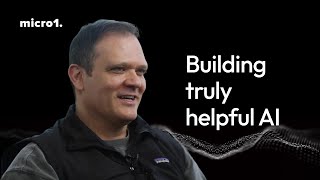
Mark Esposito, a former hockey player turned Harvard academic, works as a "human data scientist" testing and refining prompts for large language models at MicroOne. He argues AI works best as an augmenting partner, not a competitor, and that responsible human oversight is essential to prevent bias and misinformation.
Chapters
My name is Mark Esposito, PhD, PhD. I grew up in many parts of North America. I did my high school in Montreal, and I ended up in the US as I was a hockey player when I was very young. Currently located in Cambridge, Massachusetts, but I spent quite a good amount of time also in Dubai, and so I'm kind of split, if I can say so, between this side of the US and Dubai. When I look at my life, I always say there was a first life and there's a life that came after that. First life, I was an athlete working as a professional hockey player. Then I had an injury and I was kind of in my 20s, and then I had to figure out what to do and went back to school and decided that I wanted to go deeper into my knowledge journey and Long story short, I decided to become an academic almost accidentally. Many defining moments in my career. Clearly, coming to Harvard was one of those moments in my life where I felt this was a pinnacle for anybody who's doing my job. And I think, long story short, lots of really great encounters teaching students that became, over time, friends. Meeting exceptional colleagues. Those are some of my highlights. Many people became mentors, helped me to figure out what I wanted to do next. And a person like me at this stage measures his own success by the number of students who are becoming extremely successful out there after school, some of the books we've written and people who read it. It's a relatively simple life, but it's also a life of privilege in many ways, working with very talented people. So the very moment I am working more on the governance of technology, AI is a big conversation. I do teach, write about AI, I do consult governments in this very same field. And with MicroOne, I started to be what I like to say a human data scientist. It's mostly working with MicroOne to determine the strength of prompts, working with large language models. And I think the community of MicroOne is an incredible opportunity for people like me to work in the real world with real problems and really sort of like getting this hybrid perfect combination between what is my academic upbringing and the experience on the ground with a large language model and with an incredibly dynamic company like MicroOne. You know, MicroOne kind of got in touch. They were looking for people who had PhDs working in academia, willing to work with vetting, probing, testing prompts. And that's how we all started. If I remember correctly, it was right before the end of 2024. In 2025, January, I started to get more interested. I went through an AI recruiter and I passed the interview and it was great. The first time that I had been interviewed by an AI, which I think it did a phenomenal job. Then I got onboarded and back in the days it was a pilot, so it was a group of people selected to go through the pilot. Extremely interesting, lots of learning, and I would say my learning curve was really steep after that. Pilot was successful. Micron, so like, asked me to stay on board. I got to know more of the people, and I am now part of a pretty dynamic group of people distributed across the world where we are all data scientists trying to work really hard to determine the boundaries of how good a prompt can be when we're using large language models. Determining what we as humans recognize immediately as very good and what sometimes the machine will struggle with. Over time, I have to say, the quality of the AI is getting better and better. So proving our point is equally getting hard. But this is really why people like me learn a lot from these experiences, because you can immediately relate that experience into what I do in my primary job. So just to summarize how I see my collaboration with MicroOne, I am creating prompt that are going to be tested with large language models. We're waiting for the response from the model and we evaluate that. That's where the expertise is coming from. And then once we find that the, the answer was not good enough, we kind of started building rubrics that help navigating some of the shortcomings of the model with that what we call human-in-the-loop expertise. And so this is where humans and machine are symbiotic. They work together in defining the quality of the model in the future. So it's really about training the model for future use. That's— it's like in a nutshell the experience with MicroOne. I like to give it a more colorful expression, at least the way I say this sometimes to friends over dinner. It's like playing chess with large language models, with generative AI. You kind of expect a very competent player, and you need to determine when this player eventually is making a bad move so that you can educate the player on how to improve the game. In the Most of the times when I started this, I felt I was playing chess and being checkmated by the large language model. I would say now I'm learning how to play as well, and it has become very rewarding to understand this incredible innovation that we're dealing with right now on GenAI and how humans have a significant role to play when it's about educating the models. Well, I didn't know that I had so much time before starting with Micro One to dedicate to prompting, but I would say sometimes 3 to 4 hours every day. It's about really working with the generative AI. Weekend sometimes are marathons or even longer hours, but it's a daily commitment. To work with the team and with the task, with the reviews, with the prompts, with the language models. So it's really, I would say, a secondary job in many ways. So I try to blend it with the teaching, the research, the speaking, the calls, the travels. So it became part of my life, extremely rewarding. And I didn't know I would enjoy this so much when I started. But I am. So thinking that AI is like a Concorde moment, like if you remember the supersonic airplane, I don't think we're there. We are way past that proof of concept. It is here to stay. It is integrated and permeated in everything that organizations do. It's a matter of time before we're going to see this even more AI in our lives. So it's inevitable to consider the presence of AI as, as part of a constituent of the value creation. Moving forward or looking ahead, I think there will be more and more use cases, but equally there will be more mechanisms of oversight on how do we govern this incredibly powerful set of technologies. And how do we understand the role that we play? So far, it was played sometimes a bit of a trade-off, humans versus machine. The answer is much more humans and machine. And that kind of conversation, it is understood, but not as overly debated and discussed as much as it should be or emphasized. So my hunch is that there will be more humanization of AI. Moving forward, but we have to be vigilant, prudent to make sure that the conversation happens, people speak, we exchange, we look at the limitations, and we also looking at the incredible opportunity that are ahead of us. See, as an educator, when I'm thinking about what am I doing, right, I am using what could be my, my knowledge, my expertise to directly relate and to some degree interfere with what would be a model response to a more complex question. And I find this is a 21st century touch on how education should really be. We used to think about classrooms, we still have them, teaching students, but the limitation are always related to how many people can be in a classroom. Even if you have a big auditorium, whether it be 100, 200, 300 people. Imagine the input we have in educating large language models, how many millions of people can really use it. And if we are kind of operating from an ethical perspective where we really want to educate it for the better, for the improvement of the response, to make sure the response is not overly biased, we are kind of expanding and amplifying education through generative AI. So I find there is almost like a community purpose and engagement in training models. For people like me that kind of have a dedication for teaching people. And now I can do this by augmenting my voice through the work I'm doing with generative AI. One of the things that is important is to recognize the models are not perfect. I like to think that AI is an extension of our collective brains. And so it comes with biases. It comes with limitation. It comes with stereotypes. It would be very bad if we are digitizing ignorance. So one of the way that I think my job is important in this narrative is to try to, first of all, demystify where we might have mistakes that might be logical fallacies or simply assumption that are coming from, from cultural norms. There's a responsibility that many people that are receiving or consuming the AI might not really have the same privilege that we have in, for example, in North America. They might not have circles or communities capable to critically engage. And therefore, the responsibility we have is that the end result of a prompt is as close as we can to what could really help them rather than hallucinated, fake, or fundamentally fabricated. So there is a, I think, a responsibility that is building on what we do as educators a responsibility that's even more grave because we understand that we're reaching out to people that we might never meet. But we do have almost like, uh, aspiration to a moral compass, and that's what we do. Look, MicroOne is doing an important role. It is a company that of course represents some of the companies we've seen from the Silicon Valley, really starting small and now scaling out and reaching out the world. Like, if I'm looking at my colleagues and the team, truly distributed across the planet. Micron has responsibility to be one of those ethical AI companies that are very directly attached to the narrative on AI. So they do have an inherent educational journey. PhDs, people who decide to work as expert in any field, they have an opportunity to engage with technology not as the enemy, but as a form of really enhancing, elevating people. I like to consider this as an augmentation. Sometimes we talk about automation versus augmentation. The work MicroOne does, and people like myself who have started a journey of education, going through doctoral school and becoming professors. We kind of have a role of helping automation migrate into augmentation. We do augment ourselves with our ability to really reach out to millions of people. We augment the functionality of the model, and we're augmenting the knowledge distribution and dissemination that we're hoping generative AI will reach not only in the short term but also in the long-term future. If I think about the impact of my work in the next few years, I would love to imagine that maybe in some form of fuzzy logic I was able to contribute to make AI more trustworthy, more transparent, and more useful. Today, the AI is incredible in many ways, but there is a lot of circumstances where we feel there are limitations. It's a matter of time before those limitations will be lifted, but it would be great they are going to be lifted for the well-being of society at large rather than just in terms of efficiency or economic viability. So I love to imagine that the work I'm doing is contributing more than what I'll be able to directly know. And I think this is one of the best rewards for an educator like myself is that we can really spend our life somehow to improve the state of the world. If a colleague is currently watching this and thinking, what is Mark talking about? Look, it's a great opportunity if you start using technologies in your own life, in your classroom, in your design of your research. To get even more engaged in the conversation, almost like a feeling of getting entrenched in the real AI modeling. And I would invite them to explore. I think at the moment, when I'm talking to friends about what I do for MicroOne, many, they kind of find out about the human data scientist for the first time when they hear me talk. It would be great that more people are going to be attracted to the field. Where we're going to have more people willing to use AI as a way of amplifying their voices. And if actually having a community of scholars who are also going to write about this, which is how we are going to bring this also to a more scientific level where we can prove more empirically that people like myself with communities of scholars who are engaging with AI responsibly are going to improve the quality of the large language models in the future. So if you're wondering how to start, I would imagine MicroOne is the starting point. It's an incredible community of people who are dedicated to what we mentioned in this interview. So I would say it's a starting point. I believe there are other companies that are following their steps as well. I don't know them because it's kind of a nascent and quite early stage period of our, our time with these companies. And if you ever come across an opportunity to work around this, explore it. It's worth it. It's educational. It's introspective. It's a great way to be part of the 21st century, not only problems but also solutions. To the MicroOne team, thank you for having onboarded me. It's been great. To be honest, a bit of a steep curve, but fascinating, learning so much from interacting with all of you. And to all of you watching this, just get curious. Try to explore. It's worth it. Thank you so much.
More from Mark



Stanford Professor Omer Reingold on what it really takes to build fair AI systems

Stanford Professor Andrew Maas explains why the future of AI will rely entirely on humans


260225 0840 Opening keynote Understanding the future as it unfolds the power of megatrends




