Youth AI Talk #6: Prof. Mark Esposito -- The Implications of AI for Society
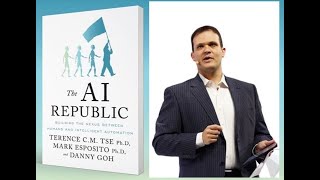
Mark Esposito, economist and author of The AI Republic, argues AI should augment human work, not replace it. He warns that automation will hit regions and income levels unevenly, and calls for government-led upskilling and policy to ensure inclusive transitions. Esposito frames AI as controllable if guided by ethical governance.
Chapters
Hello everyone, and welcome to today's Youth AI Talk. I know we have some new audience members here, and I think we actually have some members from Europe. So we're excited to see so many new faces, and thank you for joining us and supporting the Youth AI Initiative. So since the kickoff of the Youth AI Initiative on August 13th, we've hosted 5 great talks so far. From IBM fellow Dr. Jon Cohen, who shared his personal tech journey and gave a high-level overview of AI, to our second speaker, MIT professor Song Han, who shared his research on TinyML and efficient AI. We've had Professor Peter Stone from UT Austin talk about autonomous agents and robotics. We had Professor Tse-Hsin Huang, also from UT Austin, discuss the interplay between graphics and AI. In our last talk, AI ethics writer and thought leader Fiona McEvoy presented some of the ethical concerns surrounding emerging technology. And with all these great speakers, we've been able to cover a lot of topics and we just wanna thank everyone for your support. Before introducing today's speaker, Dr. Mark Esposito, I would like to quickly share our upcoming talks. So on October 31st, Professor Moshe Vardi will discuss the interrelationship between humans, machines, and work. Professor Vardi is a renowned mathematician and computer scientist. He is a member of the US National Academy of Engineering, the National Academy of Sciences, the American Academy of Arts and Sciences, the European Academy of Sciences, and Academia Europea. On November 7th, Dr. Xiaodong Huang will share Microsoft's AI journey to help everyone and every organization on the planet achieve more and communicate better. He will also share the AI tools and projects he has been working on Microsoft's vision for AI and what skill set Microsoft expects for its future employees that are interested in working in the AI field. On November 21st, we will host Dr. Olaf Groth. His talk will focus on data, which is the new oil in the age of AI. Come join us and help define the next frontier of digital growth ethically and equitably. Dr. Groth is a professor, advisor, and executive for the evolving global innovation economy with 20 years of experience with corporations, consulting firms, and academia. Dr. Groff is co-author of Solomon's Code: Humanity in a World of Thinking Machines and of the forthcoming book The Great Remobilization: Reinventing the Post-Pandemic World. Pre-registration for these three talks is open. You are welcome to register and join all these exciting talks. Please help spread the word so more people can learn about AI and its impacts. I will now turn it over to my co-host, Melinda Xu.
Hi, my name is Melinda Xu. I'm one of the team members of Youth AI Lab and the co-host for today's event. So if you're— real quickly about social media— if you're hoping to keep up to date with upcoming events and information, go follow our social media linked in both the YouTube description and the Zoom description below. Okay, before introducing, uh, Dr. Mark Esposito, I'd like to briefly go over the logistics of the talk. Because we have audience watching from our YouTube livestream, we'll be doing Q&A through a platform called Slido. So either go to the URL, uh, provided in the chat, or go to Slido and enter event code 55585. Feel free to submit questions throughout the talk, but we'll only be answering questions in a Q&A session at the very end of Dr. Esposito's talk. Now let me introduce today's speaker, Dr. Mark Esposito, PhD. We are very grateful to have him here today to discuss the implications of AI for society, governments, and the impact of AI on future work. Dr. Esposito is a business professor, bestselling author, entrepreneur, and senior advisor to governments. He was inducted in 2016 in the Radar of Thinkers 50 and as one of the most 30 prominent rising business thinkers in the world. He's a global expert of the World Economic Forum and advisor to national governments governments. In his academic career, Dr. Esposito has held academic appointments for some of the world's leading institutions, including Hult International Business School, Harvard University, and University of Cambridge. In 2019, Dr. Esposito's book on AI, The AI Republic, became a number one bestseller in the US, UK, France, Germany, Spain, and Italy, and received global accolades. Let's give a warm welcome to Dr. Esposito.
Thank you very much, Melinda and Jeffrey, for this. I hope you guys can see me. It's night where I'm calling from, so I have to use external lights to make sure you guys can see me, but from what I understand, you can see me all right. So if the sound is okay, maybe we can start. Shall we?
Yeah, looks good.
Yeah, great, great. So, and I'll let you guys take care of the, I think, the waiting room as people come come in and join. So first of all, thank you for having me. I mean, this is exciting, and when I was brought to knowledge of your initiative, I immediately said yes when you guys extended an invitation, because I think what you're doing is important, and it's providing that degree of exposure about this important conversation around artificial intelligence. Differently from some of the colleagues that have already been on your channel, I don't come from data science. I'm an economist by training. And so I came from a more social science perspective. So today I will have a conversation which is more related to the understanding of the implication for artificial intelligence at the greatest scale for society. Of course, we're going to touch upon a bit on the future of work. But I guess considering the number of people who are joining us today, the best part would be then to have some generous Q&A. Where we can try to address some questions. And I'll let you guys then help me guide through the question that come through. So you want me to choose, if you choose it for me, it's entirely up to you how you want to do this. So let me try to share with you, first of all, why I got myself into artificial intelligence. There is something that is more important than what actually it is from an academic perspective. Direct, direct experience with having co-founded an artificial intelligence company. So, um, just a very quick story before then. I, I'll share some slides with you. Um, in 2015, I started to work on the intersection between trends and foresights, understanding some of the major changes that we were currently undergoing. Transformations was clearly a big conversation that was already happening. It was pre-2016 when we know that The world went through major geopolitical transformations as well. And together with my co-author, Tarrant See, we decided to work on a book specific on trends. Within that book, we define out of the 5 major trends, one trend that was more related to technology. And so what we decided to do later on is to go a little bit deeper and understand that technology was becoming much more than just an efficiency ratio, but it was becoming a transformative channel capable of transforming some of the core tenets that we have been relying on for decades. From there, we were involved through another colleague of ours, friend actually, into the setup of a company. This was on the offset of 2017 in what became Nexus Frontier Tech. And today Nexus is an artificial intelligence company, is mainly machine learning company. We have over 100 people working for us. Our main data science heart is in Vietnam, and the headquarters in London, but we have pockets in Japan, in Singapore as well, and across Asia. We're very well, uh, slightly scattered across the regions, but we're quite proud that large part of our data scientists are, are girls. And we also have initiated back in time like an academy to help people going through the career in data science. So we became a data science company and now we're working in a number of different fields. We started to be industry agnostic and now we're a little more into the regtech, financial services, insurance, compliance, auditing. So we're like gaining some form of identity around those areas. So the experience in the physical field in running this organization, and on the other side, the research led to the AI Republic. And in 2019, together with two of my co-founders, Danny Go and Terence Si, we came in June with another book that, as Melinda was generously explaining, became a bestseller quite rapidly, so we had to start facing a conversation about how do we now utilize this book to go out there and talk more to people about the implication of artificial intelligence. At the very beginning, we wanted to be very controversial. We wanted to say that there is no intelligence in AI. This was the working title. And then we were advised otherwise, considering we wanted to eventually sell commercially into the AI world. We then changed it into the AI Republic, which became somehow a message to democratize artificial intelligence. Today I'd like to share a little bit of that specific journey, and I'll try to spend more time on the implication that AI has for society from more of a socioeconomic perspective. And then I'll stop and I'll make sure that Q&A can come and we'll spend a good part of the time and just getting to know each other. So without any further ado, I'll share my screen. And if you can give me just a sign of life, you guys see the screen? Even a thumb up will work. Yeah, yeah, it goes great. So this is the iRepublic. It has been a bit of a lucky charm for us. We started to really go deeper into the conversation between humans and intelligent automation, and we wanted to provide with a number of different conversations when we started to work on the book. The first thing, there's a lot of misconception about artificial intelligence. Sometimes it really looks more like something like this that really wants to create some form of AI phobia. We are quite far from thinking of AI as a scaremongering technique or more of a sensationalist— sorry. Sensational, sensational kind of technology. We're much more intrigued by the possibility that artificial intelligence really has in expanding our capacity. We understand that a large part of the misunderstanding is coming from a lack of knowledge on what AI really is and on the fact that we have two primary school of thought that you have already seen with previous speakers. The one that is much more related to the emulation of tasks, such as, for example, the strong AI. And on the other side, you have the more probabilistic kind of technology, the one that helps us make decisions, which is also called weak AI. So we clearly are more on the side of looking at artificial intelligence as a vector to help us move closer to augmenting some of our capacity. Rather than thinking that AI will simply take over and we'll see some form of singularity arising in 2040, '45, as it was originally— some hinted. So we are quite positioned from that perspective, both as authors, then as entrepreneurs. We try to understand that there's not really a duopoly, or they talk to me between these two views of AI. There is a lot of media pollution that has really not really helped in the last few years to create a clear way forward. For sure, a conversation on artificial intelligence is important because it doesn't happen within just a technology that is replacing an old way of doing things. We're talking about artificial intelligence as one of the leading drivers of the Fourth Industrial Revolution. And this is probably where I'd like to spend more time at the very beginning. So we are facing a transformation that is happening not only because of AI and what AI can do, but much more related to the ability of artificial intelligence to rapidly replace, first of all, some of our jobs. This is because the job that we are currently running in many parts of the world were designed when technologies were not as developed as they are right now. So we tend to blame the nature of the technology advancement. We should also recognize that many of the jobs that we currently run were designed many decades back. So it's really a problem with, with the obsolescence of jobs in the first place. Um, the second consideration to make is that technology these days is rapidly transforming, uh, the concept of value. And so in the Fourth Industrial Revolution, as we have interoperable and integrating technologies capable of rapidly advancing value creations, we are challenging the way we've been creating value for at least the last 70 years. So it's a transformation that profoundly transformed the way in which society has been able to be productive. And this is not just in terms of productivity as an efficiency metric, but productivity in terms of the ability of creating value without too much human intervention. And the third part is related to how this will profoundly change our culture. And changing our culture and changing our understanding equally has an implication on identity. And we are seeing today that digital natives are experiencing reality in a much different way than people that were born analog and converted to digital later in time. So clearly, We are much more interested in the rise of the Fourth Industrial Revolution rather than just on the technical side of AI. And that part is properly covered. There's a lot of really interesting practitioners and scholars who work about this. But I think we have a space that is still underserved in trying to understand in which way artificial intelligence, among other technologies, is going to change the way we function. So I'm going to skip some of the slides just to make sure that I'm going to take you to where I want to. And here it is again, where I think a conversation starts. We talk always about jobs, and there is reason to believe that jobs are going to go through some form of challenges. Look at what happens on the right-hand side. On the right-hand side is a census from a paper in 2016 on automation, the effects occupations This was, uh, um, tried to measure, actually represent about 270 jobs that were listed in the census in 1950. And if you're looking at how many of those jobs still exist in 2016, a large majority of those jobs still existed. And in some cases, demand fell. In other cases, we have tech obsolescence. In other cases, we got automation. But the first conversation to have is, uh, many job were created many, many years back and they still exist today. This job sooner or later are going to be exposed to some degree of optimization. When you try to optimize jobs, what you tend to do, you try to assess an economic value around the job and you try to replace the job with most likely an algorithm. On the left-hand side, you also see an important part to take into account. Again, number of different sources, studies that indicate about 45% of daily tasks currently done by humans could be automated. And secondly, a quite famous paper, 2013, uh, from Frey and Osborn, The Future of Unemployment, uh, 47%— 47% of jobs in the U.S. will be lost to automation. Now, what is the reality? The reality is that not 47, but 14% were actually measured in 2013. And they were considered to be highly automatable. And the reality, and it's a stark contrast with what we see with the paper from, from Freyne Osborn, is that regardless of the optimization of a given job, many different factors need to actually play a specific role before a job can be transformed. And I think a key part of the conversation on the future of work has to be recalibrated around the concept of transformation of the value chain. Many jobs these days are difficult to automate because they're integrated into a rarely obsolete way of doing business. The transformation costs not only financial resources, but there's a whole set of organizational processes that needs to be updated. There is a cultural resistance around transforming jobs. There is a human component around this. And I think there is an integration of any given task within any new form of transformation that needs to actually occur. So before a job can be easily replaced, multiple checks needs to occur. This is the first hurdle that we have to consider. The second hurdle we have to consider is that in many parts of the world, because of a really low income performance of the country, or country that are, so to say, emerging, we might see that hiring people might still be cheaper than replacing them with automation. So we clearly have to consider that the economic position of a country strongly inferred the possibility of a job to be replaced. And so while we are not surprised if a job is replaced in the US or in Europe, we might take longer or harder effort to replace a job, for example, in Brazil. or if you want to replace a job in a country like Turkey, if you want to replace a job in a country like Nigeria or Pakistan. These are countries that are really large in terms of the number of people who are living in those countries, but their economic performance is still emerging. So there's a lot of macroeconomic conditions that are determined, uh, determinant to the understanding whether a job can be transformed or not. So this is an important part to take into account because we want to also understand that a job per se will be optimizable or automatable in the ability for the economics to make sense. But if we find that economics in favor of preserving labor, you might find that the job that can be replaced by an automated process is still in the hands of a person. So these are important asymmetries that needs to be taken into account when we're talking about the future of work. We sometimes have this blanket thinking about the future of work as one-size-fits-all, but the greater, uh, the dependency is the condition of any given economy and the ability for an economy to rapidly transform. There's another side of the story that is worth exploring. In many emerging economies, a job in automation that can be replaced by any form of automated processes is not only replacing a job for, let's say, either an RPA, a robot process automation, or an algorithm. It's also replacing jobs in the service industry that are indirectly connected with that job. So let's try to create a context for this. If I am changing or replacing a job in a low-income economy with some degree of automation, I'm indirectly affecting roughly 5 jobs. So the economic implication that happens in a narrow transaction might be offset by the social implication of losing more jobs into the extended periphery of an economy. So sometimes we have to consider that what seems to be a short-term rational choice from an economic perspective might become a quite illogical choice in the longer term if unrest in the social fabric might, for example, trigger either drop of consumption, or it might trigger even social unrest, or any form of polarization that tends to be connected in more political economy sense when jobs tend to be lost. So there's a lot of conversation to be made around the nature of future work. And I would like you to start thinking more and more that the nature of the Fourth Industrial Revolution is about advancing through technology the transformation of our society. Artificial intelligence, like blockchain, is considered to be a foundational technology in the sense that it's providing significant form of transformation that will change the concept of value. In the case of AI, it's more about the creation of value through the fact that machine learning is capable of elaborating possible decision-making or possible probable scenarios that tend to be larger than the range that happens through traditional jobs. And on the other side, blockchain has the ability to store value in a way that is diffused, decentralized, and, and much more transparent. And therefore changing profoundly the understanding of value creation and value storage changed the nature how value altogether is defined. That is important, but what is more important is the fact that this will also change some of our social economic behavior. It will change social institutions, and it will fragment some of the existing players. On beside this, there's a whole geopolitical conversation about where this technology are currently being mainly pioneer and advanced. There is a more of a cultural connotation about where there is a reflex to replace a job with robots. There is a macroeconomic implication about what is the level of economic activity of a given country that might provide or not the facility for the job to be replaced. And there is also the social implication that a job itself is not just an economic ratio, is connected to a multiple level of social jobs that might be experienced or exercised in the service economy. So the number of different considerations to be made about this. The trend will continue to be, without any doubt, in some form of automation, but it won't be in the incremental and linear way, in the same way that we have seen in the forecast. One, because the forecast tried to take some form of normalization formula in which we're assuming that the future has some form of familiarity with the past, but we're living under extreme I would say volatility. So very, very easily, the dependency from the past will continue to be disrupted. And secondly, behavior, although it can be predictable in many ways, tends to perform itself in a quite random format when it's about a circumstantial factor that decides whether or not a job can be transformed. Economics plays a major role, but economics and finance are also correlated. So the ability, for example, for capitals and financial flows to reach a given solution are equally important. I would say there's a number of different things to take into account when we're looking at the future work and how we see this possibly evolving. So a few more considerations, uh, just gonna go basically to, uh, um, where I like us to be before other slides. Um, we are probably looking at a much more constructive way of looking at the future of work in which we're not necessarily thinking about a replacement. We're thinking about the coexistence between RPA, where we're looking at physical jobs replaced by robotics, or what is mainly called symbiotic intelligence, the ability for a job to coexist together with algorithms in which the coexistence of jobs can possibly create value in the economy in a way that is going to advance the integration of AI within existing job rather than naturally replace them. Let me try to spend maybe a more minute on— an additional minute on that. Whenever you're looking at the relationship between a job and an algorithm, you're to some extent using metric of efficiency to determine who performs better. Clearly, in most jobs where you're having some degree of automation, and where you have decision-making that is determined by some form of data analysis, machines are more performing because they do this faster and they have 100% active memory. But the question is, what happens if I'm integrating the algorithm in the existing job? So then expanding the scope of the job, naturally in that case you are not only improving the efficiency, but you really change and transform the nature of the job itself. So it's in the nexus between cobotics for robotics and symbiotic intelligence for artificial intelligence that we see some of the exciting developments in the future where more and more jobs will possibly move in the direction of some form of coexistence, coexistence rather than a quite simplistic way of thinking replacement, because that is where we think it's just an economic factor that will determine the replacement. It will not be the extent of implication that we mentioned before that are important when we're looking at the future work altogether. Skills will naturally change. We need to have more and more people capable of becoming technology literate so that technology can become part of a language discussed. Today we have a clear problem of silos where technology departments or IT, they tend to be separated from the more strategic decision-making inside the firms. We will have to understand how the design of and the execution of algorithms will have to be integrated into an ethical format. I noticed that you had another speaker who spoke about ethics and AI. This is going to be an increasing conversation to have because a lot of the mental models that programmers are injecting into an algorithm will naturally impact the way the algorithm will function. We already have examples of algorithms that are quite ineffective, not necessarily from an efficiency perspective, what they're designed to do, but from the number of either implicit or explicit biases that might actually suffer from. And I think these are some of the conversations to be made when we're looking at what kind of job do we see emerging in the future. It will be much more related to strategy, PR, marketing, more humanistic side of jobs in which we can utilize different parts of the skills that humans do better. Our contextual intelligence is superior. Our dexterity from a physical perspective is equally superior. There's a number of different tasks that humans do better. The question is, again, how do we make sure that we're using technology to augment our ability? And there's a whole sense of, I think, social implication in the sense that trying to improve society, which is like also given the title to tonight's talk, where we can think about utilizing technology to improve, of course, health, to improve people with probably have condition that do not enable them to perform at 100%. We can think about robotics integrated through technology that, for example, would allow people that have mobility problem to be more independent We can think of technology as a way of detecting anomalies in any form of social event. We can think about it in a much more systematic form of crime prevention or fraud detection. So there's phenomenal uses that technology can actually serve us for that can expand the nature of the jobs. And the part that I think is important to take into account as we're talking about jobs is, are we talking about job per se, or should we talk about something else? Well, here's what we learned when we were actually working directly with Nexus Frontier Tech, the AI company that I mentioned to you before. A lot of the conversations happens always about replacing jobs. What is difficult is not the idea of replacing job. We should think about replacing task. Because if you're replacing a task, you are expanding the scope of the job. If you think in terms of replacing the job, you might see the larger saving from a perspective of what could be the cost associated to a job in a given company, but you might not really see the non-financial implication of replacing the given job, from the tacit knowledge to the transfer knowledge to the fact that human capital these days is becoming challenged and challenging to eventually upskill. So these are important things to take into account when we're looking at the nature of a job, and I think it's where we see the largest side of the conversation where technology doesn't necessarily serve the purpose of augmenting what could be, for example, a specific set of performances that are the traditional financial ones, but technology can equally help us a lot in augmenting humans. And this is where a large part of the conversation will also be shared with Professor Olaf Groth, that is a close friend of mine, and I know the nature of the work that Olaf does. And the previous book that he published, Solomon's Code, was really about this ethical implication and how thinking about setting up a Magna Carta for the digital economy that tried to take into account all of these ripple effects that we're currently mentioning right now. My last few slides before we can maybe come up with a conversation. When we're looking at Fourth Industrial Revolution, we're really looking at the fact that from what has been the normal evolution We're looking at cyber and physical systems, so it's the integration of technology in three major domains: the physical one, the digital one, and the biological one. So when you're integrating technology in cyber-physical systems, you're of course using technology to redefine the framework or the blueprint of what the system looks like. So one of the things that I want you, as you are all coming from different parts of either the US or you're currently connecting from elsewhere, just the power of technology and what we can really do right now doesn't only stay within the technological advancement. It really stays within the ability for systems to be transformed. And when we talk about system, we talk about, for example, um, society in general. Our election can be improved by that. Our healthcare system can be improved by that. Our educational system can be improved. Our penitentiary and our our prisons can be improved by that. Our ability to create inclusion and create opportunity for people to be part of an inclusive process can be enhanced through technology. Our ability to go into preventive, preventive, you know, medicine or making sure that we can preempt as well significant healthcare, of course, can be used into that. And of course, the ability to use technology to draw foresights on scenarios that are close to the environment and climate change. It's a potential that we are still, uh, probably just exploring on the periphery, and I would love this to be a much more significant conversation to unfold in the next few years as we're using the power of AI simulations to also understand implication and behavior on climate change. So there's some of the conversations I think really matters when we're looking at the implication of our technologies like AI in general. The way to finish this is really to talk about that the 4T revolution is a foundational revolution. It's where we see a number of different opportunities for technologies to now finally integrate, become a cohesive integrated structure, allowed automation to be a form of lifting millions of people out of really repetitive jobs. We see this as an opportunity to use transparency as a value that we want to reinforce and inculcate around the world. We also see this as a form of generating more equitable processes. So it's still an aspirational process. The Fourth Industrial Revolution did not happen yet in the way we would like to. But we see the orchestration of all of this in a number of different ways at the country level, at the city level, at the municipal level, it can also be at the firm level, in which we're trying to aspire at the much more positive sum role that technology can really have. And this is where I think we want to place the conversation of today within these two major venues. The first one, the future of work and the conversation that we had on what we're going to replace, the behavioral consideration to be made about that, and all the different things that we mentioned as we're looking at the hurdles before a job can possibly be replaced. On the other side, the more macro picture about technology becoming an aspirational force for good, hopefully, that is going to help us in transition and migrate into the 21st century, help us create opportunity that we currently don't have, and create an ecosystem model between cobotics and symbiotic intelligence that can profoundly change the way we augmenting jobs these days. So this is really where we think, uh, fourth IR and AI breaking the rules. And I'm going to actually stop, um, with this, and then we're trying to maybe have some question and answers. So we think, uh, and this is something that again Professor Olaf will largely touch upon, you know, we have to think about the way we currently employ AI and the kind of policy we are going to use and how we're going to implement them, because they will have massive societal changes. As you see here, the power of the Fourth Industrial Revolution is that it emboldens the social mandate we feel to improve our lives by the use of technology. And we really would like to imagine the Fourth Industrial Revolution can start closing the large gap that the last few decades have inadvertently created in having a multi-tiered and multi-gear world in which only a minority of people currently have access to the fastest technologies, and most people are still trapped into some form of income trap that doesn't seem to happen too fast. They don't have access to the, the amount of technology potential that we could really have, and we would love to imagine that it will really accelerate at a faster pace, making sure that more and more people can have access to this, the power of these technologies. And the whole idea about the AI Republic as a book was trying to bring this positive message forward within the, of course, the hope and the, uh, um, the overarching of the Fourth Industrial Revolution. So I would stop my share here just to make sure that I can get to some of the questions and At the same time, I appreciate see that the number of people that join us is even more than when I started. But that is my treat now that I can use the remainder 20-something minutes to talk directly with you and see how we can possibly have a conversation that will enable us to go deeper with the dialogue we're having tonight. So I'm going back to my host, Jeffrey and Melinda. You guys would like to tell me how to navigate from here on, and we're going to take it from here.
Yeah, thank you again to Dr. Esposito for giving such a brilliant, thought-provoking talk. And especially after the last talk about AI ethics with Fiona McEvoy, discussing the integration of AI into society, governments, and the impact it has on our jobs is definitely a crucial topic to discuss to provide more insight into the impacts of AI on our world. So I see some questions in the chat.
Sure.
Starting off, so one question is, if AI are replacing menial tasks, why do most websites have procedures like CAPTCHA?
Yeah, good question. That's, I see Computer Max, right? Max is the name. You know, and I don't know whether Max will be your name, so I'll call you Max just for the sake of simplicity. Still, because we're collecting information and we are We're still helping machine learning to determine what are going to be the image recognition. One of the larger reasons why we have to click on "I am not a robot," and then there are a few pictures there to select, is to maybe empower machine learning to recognize what is a traffic light, what is a bridge, what is actually a dog, what is an hydrant. So I think it's really feeding the data economy. This is something that you'll see with Professor Olaf that will talk about the trillion-dollar economy. So it's really still because of a controversial problem that we're having about data, data companies, the technology giants, and the governance that we must have for these technology giants to serve a much more socially oriented purpose rather than what they currently do, which is also problematic, controversial for them. Remember that the technology companies started all with a social purpose and they— so like now became large advertising company. Where data is the main gasoline. So I would say to your question, it's still a problem with the lack of governance on the data and how data is still critical for most of the predictive models that we currently have. Thanks for your question. Melinda, I go back to you.
Oh, sorry. I was muted there. Definitely amazing answer to that question. And another question from Hector. As artificial intelligence evolves throughout the world and some human jobs are continuously replaced by machines, what can or should governments do to make sure that humans can still attain jobs where they can take care of their families?
Hector, great question. So Hector, I think we still like cover briefly on this. Number one is the design of job we have is obsolete. So, you know, in history, economics always wins. So over time, those jobs will be replaced. The question is whether governments can really help to integrate technology to advance the nature of the current job rather than allowing the theory, the hypothesis of free market, to be the only determinant of that. It's called hypothesis for a reason because it was never really tested, and we know now the shortcoming of that specific hypothesis, that it works well in some conditions, but when you're having, um, technology company, they're actually a small group, there is an oligopoly. The problem we're having with technology companies, they're creating some of the largest market inefficiency we ever have in history. This is why the Dow Jones performs very differently than how the real economy works. And so I think a question to your— an answer to your question, Hector, is we'll have to have government understanding how technology can really improve the nature of the jobs. And if you integrate technology in the right sense of task by expanding the scope, you equally creating jobs that we currently don't really have. So I think there is no trade-off between technology and new job, but there is a trade-off today, which is coming from the industrial era, in which we're only measuring the nature of a job by an economic assertion, I think that is what we have to change. So governments should really try to educate the process of technology within the current job in the first place, facilitate the creation of jobs, and of course, whenever necessary, they call it this day universal basic income, but I think we can call any form of subsidy, not to have just cash, but to allow people to upskill and reskill to jobs that currently are nonetheless becoming obsolete. So I think we can use government spending to redirect and migrate the labor pool from one set of skills to the other. I hope that provides you with an answer, Hector. Melinda?
Definitely. I feel like it's really important to not just replace these jobs, but I feel like just to integrate with— integrate AI within these jobs in order to improve them, in order to actually help the people who are already working in those jobs. I'm actually going to hand it over to Jeffrey to ask the next question.
Sure.
Yeah, so I see in the chat, um, Ali asks, uh, what if AI is integrated into law and political systems? Would it be fair or applicable to reach a stage where political leaders will be represented by robots or computers? Um, what advantages and disadvantages do we have here regarding the role of humans and their political directions?
Okay, great question, uh, Ali. So first of all, If we integrated artificial intelligence in the electoral process, we will probably improve a lot the current process, right? Because if you're looking at what the electoral process requires is some degree of efficiency in making sure that counting of the ballots replace as much as possible what has been voted for. So technology like AI can, of course, help with that because it's quite narrowly defined scope. This is one side of the story. Whether an AI algorithm could be better than a prime minister, which is really the controversial question you're asking in the background. I think it could be better in terms of decision-making that go in a specific way by measuring that value decision versus specific goals. But that defeats the principle of what the society is all about. Dialectics, the ability of political parties to debate and bring the public debate forward is what defines somehow society. No matter whether you are a democracy or not, public debate in any form is a form of advancing the cultural norms and the social norms that are important for the society, and that cannot be delegated to machines. I think we can let machines take care of a lot of different processes that now are tedious, they're laborious, and they're taking a lot of time. But I think we should never forget that the purpose of a society is to actually to define rules and principles or norms that are designed to perpetuate itself over time from one generation to the other. And that can only happen when it's mainly a societal process. So I see enormous potential for that. I can give you an example, Ali, which is a little bit of a tangent. I used to know a group of students of mine, former students of mine, that actually set up a company where the CEO was actually an algorithm, was not a physical person. Did the company succeed? Well, it performs very well for a long period of time, but then eventually when you're having scanning of the environment in which decision needs to be made that cannot be measured by metric or variable that are amicable to an algorithm, of course the company was not able to progress. So I think we should never forget the decision-making does not have to be always a measurable variable that tends to be determined by a scale. It's a much more complex process, and this is particularly true in politics. But we could use AI for sure to also correct some of these absurd conversations we're having right now in the country about voting and how we'll vote, whether votes will be accepted or not. I mean, this is where transformation of the digital— of the analog into digital really comes to a purpose. Jeffrey, back to you.
Yeah, so I guess like this is a personal follow-up question from me, but just Sure. Last week, Ms. McEvoy talked about a lot about how in like there's this recent trend towards, I guess, machine-assisted like human jobs where, for instance, for these roles where we probably wouldn't fully trust a human, sorry, a machine to take the role. For instance, like if you're giving a medical diagnostic, but there are oftentimes like machines will assist these roles. Do you ever think we'll reach that point in politics or leadership, or do you think even that is a slippery slope?
Good question, Jeffrey. So I think we'll get to a point where a lot of automated possibility will be presented to decision makers. I think we already see now that in— as I told at the very beginning, I've been working a lot on the intersection on trends and foresights. So we can use a computer simulation to come up with possibilities. That defines options. Again, the machine will never be able to assess the option for other than a formal risk assessment that is measured mathematically. But humans don't necessarily operate in terms of that. We operate in terms of complex systems. In complex systems, mathematics is not the same as in linear systems. So decision-making, I think, has to be still related to that ability for us to be accountable for a decision, and it can only be measured. It can also be actually a wrong decision from an economic perspective, but it can result to be a right decision from a societal perspective. So there are too many dimensions for that. Clearly, there is a lot of waste of time and resources that we currently are still utilizing human skills that can be easily replaced and replicated by, let's say, assisted processes. I think this is why the subtitle of the book is called Intelligent Automation and not AI, because we really think that the degree of intelligent automation can really help the nature of job and change the sphere of influence. And I think it will happen in a number of different cases. I hope it will always be on the more probabilistic side in which we're leaving the last mile to humans, because that's also where the legal framework becomes complex otherwise. In defining what is the jurisdiction of accountability of an action if it's completely delegated to a machine. I hope I provided with at least some partial answer, Jeffrey.
Yeah, it's obviously a complicated issue. For the next question, I'll hand it back to Melinda.
Yeah, so Matt asks, from a geostrategy perspective, what do you think is a big next step for Africa in the Fourth Industrial Revolution?
Great. Well, Matt, thanks for your question. You know, so Africa, you know, somehow has less strings attached than other countries in terms of how quickly they can go from 0 to 100. Well, it's called an economic leapfrogging. We saw this already in some specific industries where, for example, Rwanda went from a country being inflicted by civil war 25 years ago, and today is one of the most internet effective and penetrated country in East Africa. We saw this like with energy revolution in South Africa, where it's now being tested to transfer energy from one household to the other. We saw this with the solar energy in North Africa, where now Morocco and Tunisia, they provide solar energy to Spain and Italy. And they're now advancing energy storage and energy harvesting. So I think Africa is— and of course, Nigeria and Ghana where you have in Nigeria migrating from the dependence on oil and gas and, and really vibrant middle class rising, and Ghana advancing a lot of social purpose blockchain, which is mainly the use of blockchain for identifying, for example, fraud, synthetic drugs, and all of that. So I see an enormous ability for the continent to really rapidly move into the fourth IR. The challenge in this case is First of all, capitals going into the region at the right time. Second is the development money coming from the international banks, making sure that we are going to allocate them in the right projects. And thirdly, you know, Africa is the youngest population in average in the world and the oldest political class in the world. So I really think about bridging that into more younger people joining politics and also change the narrative. Of how the continent operates will somehow see the next few steps. I think the technology is there, that the ability for the country to— the continent, sorry, to eventually step up and transform digitally doesn't really have much of inheritance that will pull them back. It's really more about realigning the political, the financial capitals, and of course the entrepreneurship capital of making it happen. But I think the acceleration that they could have is much faster than what we see in the West. Thanks for your question, Matt. Melinda, back to you.
Excellent answer. I feel like it's definitely important to sort of define how we move forward with that in sort of like more developing countries. I'm going to hand it back over to Jeffrey to ask the next question.
All right, so over on Slido, someone asked, in robotic process automation, what kinds of robots are being used to implement AI in industries?
So thanks for your question, Jeffrey, whoever asked it in Slido. So anything with warehouses, anything related to industrial conglomerates, we see a lot of RPA. We have some degree of intelligent automation. I wouldn't even say it's AI. By the way, we don't need AI for every single type of automation. As far as there is no predictive and there is no machine learning, you can have some form of pre-programmed intelligent automation that works like a chatbot. That is intelligent, and I'm using intelligent in open and inverted commas. It's just a way of defining something that is not intelligent because it resembles and emulates what we would call— what we call actually intelligence, but it's mainly a computational model that is becoming fast, right? And so capable of capturing significant amount of the data set. I would say that anything related to hardware, the industrial is profoundly transformed the logistics industry. You know, these industries have seen the rise of the IoT, the Internet of Things, at the pace that we sometimes do not really discuss too much. IoT is a precondition for the degree of transformation to go eventually to a data model that will enable machine learning to be placed. So I see this as a precondition before maybe an algorithm can now be integrated because there is a question that requires prediction. Or prescription, depending what you want to see, or recognition of pattern. So I think this is where I have seen a lot of— I would say to summarize, logistics distribution around the world, the large logistical company have been rapidly change— I've had that rapidly adopting RPA with some degree of intelligent automation. A lot of the physical industrial conglomerate where you have in transportation and warehouses are shifting to driverless vehicles that are transporting from A to B. And that are on the predefined routes that tends to be the fastest one utilized, the most efficient. And of course, you know, in the platforms, anything related to the distribution that are coming from the platform such as Amazon has seen the rise of robotics. Although Amazon has equally hired more people than ever before because there are limitations to what the robotic part can do. Anyway, great question, Okslado. Back to you, Jeffrey.
Yeah, for this next question, it's also over on Slido. So if someone— someone asked if AI is creating and replacing jobs at the same time, are there net more jobs or less jobs because of AI?
Good question. So I would say the question needs to be answered in the benefit of time. Any transformation, of course, will always see that the disruptor tends to be much more vocal than the creator, right? And in history, every time that we have disrupted job and new job were created, they didn't happen simultaneously because we used to have the idea of a penetration of a technology into the market. So the example I was sharing my slides before, if you were replacing a transaction at the teller with an ATM, it took time before new jobs in the bank were created because now the people working at the bank had more time. But I'm pretty sure that if I was measuring the number of people that were hired at the time in which ATMs were introduced, most likely some people might have lost a job because of that. So I think it's ineffective for us to measure jobs while we are in the middle of one of the largest labor transformations of all times. Very likely though, the rate of capital is going to be superior than the rate of the economy, which means that The issue is not necessarily just about the automation, it's who owns the capitals, who owns the assets that are somehow utilizing the technology. So I think it's more of a conversation on the distribution of capitals that currently sees automation as a way of reducing costs rather than automation as a way to determine job creation. This isn't why the question before on what governments should be is equally important. Because government has the ability to rapidly top-down create direction or directives that help us go in the right, in the right, say, towards the right destination. So I think I am a techno-optimist. I always think that we'll create significant amount of jobs because the information economy, the data economy, any form of economy emerging out of this, especially the post-pandemic economy, will have to reset and calibrate on rules very different from before. The problem is right now we are right in the transition of the storm. So measuring now would be a very quick urge, but it would not be the smartest move because we still have to see how some of this large investment that we're currently making will unfold into bad news that will then create jobs. I think if by 2025, uh, 2030, we'll notice a significant drop in the overall job numbers, then I guess we'll have to redefine what is the purpose of the job for humans. But I also think that the way we're currently measuring those jobs is flawed, because if we only measure jobs at the aggregate level, we're waiting for this job to generate enough volume to be captured at the aggregate level. But many of these jobs powered by the gig economy, by the microentrepreneur, they stay on the horizontal level. So they will never get captured by any form of former— this formally designed macroeconomic models. So I really think that the measurement of jobs can not only be determined by the labor census, because that will define job in a certain way. But there are many people currently working in formats that are not necessarily considered conventional. But they're still not measured as employed. And I think this is a problem with metrics that we have to actually address over time. And again, it's a big conversation. You guys are asking phenomenal questions, right? But I think, yeah, that's what I'd like to say as we're wrapping up towards the end of our time together.
All right, I'll hand it over to Melinda for the last few questions.
Yeah. So on Zoom, James asks, since what do you think the minimum level of tech literacy for future social and business leaders would be? Since it seems like since we're going into this fourth industrial revolution, it definitely seems like the integration of AI is going to become more and more common. So what do you think? How do you think business and social leaders have to know about AI in order to help their businesses to thrive?
Great question. So I would say the first thing is like, you know, coding is a language that we need to understand, not necessarily to master, but in the same way as we understand statistics. And none of us is, or many of us are not statisticians, you know, we have to understand coding as a formal language. If I tell you in statistical terms that the correlation is negative or positive, most people understand it. If I say it's about 5% and use the percent— percentage sign, people will understand that. If I tell you that it's likely or unlikely from a probability perspective or I'm assessing risk in that way, I'm inferring statistical conversation and people have some degree of literacy about that. I think the same should happen on coding, not because we want people to become coders, but because we want to understand what is the genesis of an algorithm. And how algorithms are by design permeated by human values that are really sometimes becoming biases. So I would hope that there is more literacy on understanding what coding is because it's really where coding will allow us to understand the nature of algorithm. Once you understand what the code is and how it's run and how it becomes predictive in the moment in which we're introducing machine learning, We're also moving away from this quite dangerous conundrum where we think of technology being smart. Again, I have written a book called AI Republic, and I work in the AI field. But I don't think that machines are intelligent. I think machines are transactional. I think that what we say, read, smell, write is using verbs that describe what we understand as humans. But the machine does not understand in the same way because there's no understanding per se. So I really think it's about creating the sense of reality. I give you this very short anecdote. I work, and when we set up the company, with people that have PhDs in AI, many of them from Japan. They are absolutely cutting-edge scientists, but they don't have this Hollywood feel on AI like we see, for example, from the media pollution about that. They understand AI is a computational capacity that is capable of addressing significant questions in a way better than what we can do. They understand that this has implications that are profound, that they can change the nature of jobs, but they never think that it's going to be an alternative to us. I think what we are all getting aware is that mismanaging this conversation is much more dangerous and what the technology is set up to do itself. So I think this is where I would imagine coding will really help us to get some degree of reality check on what is an algorithm and how much power an algorithm can really exercise, but that there is a perimeter or there is a boundary to what that conversation should be. I hope I provided an answer with that. Awesome.
Regretfully, we're reaching the end of our time, so we got to wrap up. Um, thank you again for Dr. Mark Esposito for giving such an amazing talk, and, um, I'm just going to hand it over to Jeffrey.
Yeah, again, thank you so much, um, Dr. Esposito, for your time. It was great. It's so sad that we only have an hour to discuss such a nuanced and complicated topic, um, and we really appreciate you coming to speak with us. And for those of you in the audience, thank you as well for spending your time on this Sunday afternoon or morning or wherever you are to tune in and listen. And if you're interested in AI and our economic implications, stay tuned as we'll actually have Dr. Olaf Groth in a few weeks. So if this is a topic you're interested in, I think Dr. Groff's talk is another one that you will enjoy.
Well, thanks for having me, Jeffrey, Melinda, and everyone working in the Youth AI Lab. I really appreciate what you guys are doing, bringing this conversation to peers of yours, and I really look forward to even more interaction. My details were on the COVID of my slide if you guys want to get in touch with me. And all of Professor Olof Groth and I, we're actually friends. So it's almost like an extension to some of the work we do together. And that's also why the next book, The Great War Remobilization, is together, right? So it's a bit of an extending the conversation we had today. And of course, seeing this extended with the expertise that Professor Groth brings to the table. So thanks for having me. It's been a pleasure to be with you today. I wish you all the best and take care. Thank you. Bye-bye.
All right.
Thank you. Thank you.
Thank you.
Thank you.
More from Mark



Stanford Professor Omer Reingold on what it really takes to build fair AI systems

Stanford Professor Andrew Maas explains why the future of AI will rely entirely on humans


260225 0840 Opening keynote Understanding the future as it unfolds the power of megatrends




