Auto Mileage v. Actual Expense: Who Wins?
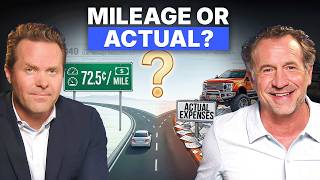
In this episode of the Main Street Business Podcast, host Mark Kohler and guest Matt Sorenson stage a playful "boxing match" to compare the IRS standard mileage deduction with the actual expense method for vehicle tax write‑offs. They walk listeners through the mechanics of each approach—72.5 cents per business mile versus tracking fuel, repairs, insurance, depreciation, and lease payments—highlighting record‑keeping requirements, the 50 % business‑use threshold for actual expenses, and the impact of bonus depreciation and recapture when a vehicle is sold. Throughout the conversation they illustrate how occupation (realtor, contractor, dentist), expected mileage, vehicle cost, and tax bracket influence which method maximizes the deduction. They also discuss strategic uses of a second vehicle, leasing versus buying, and the importance of disciplined bookkeeping. The episode ends with a decision‑matrix framework (affordability, business image, mileage volume, record‑keeping willingness) and a call for listeners to claim any auto deduction they’re entitled to.
Chapters
Guy is dying to go buy a truck before year end, and his number one argument is tax write-off. And his wife is like, you do not need a new freaking truck. I put down $1,000 and drove off the lot with this kick-butt truck, and I get to write off $48,000 even if I had an auto loan.
So let's think of it from a financial situation. You are spending the money too.
Don't chase a tax deduction. Look for the type of vehicle you actually need and can afford. Welcome everybody to the Main Street Business Podcast. My name is Mark Kohler and I'm here with my worthy opponent, the one and only Matt Sorenson, in the ring with me today talking about a very, very contentious issue.
Yeah, we're going to battle it out today, but the net result is you're going to learn how to write off your auto in the best way possible because we're going to duke it out. Between mileage or actual expenses. Which wins?
Yeah, and you're going to have fun. You're going to have a good time. You're going to learn something and have fun.
It's like, that's pretty much what this podcast is all about.
Yeah, that's what it's all about. It's edutainment. So you're welcome. Okay, so now Matt, what do you want? Mileage or actual?
Round 1.
Round 1. Ding! Bring it.
In this corner.
In this corner.
Can I get somebody announcing me to come out?
Yeah. Okay.
Okay, so mileage.
I'm going to take mileage. Oh, okay. I'm going to take mileage.
You know, and, uh, that means you're actual.
I guess so.
We drew straws and Mark got the short straw.
Yeah, yeah, yeah. It's—
I won't say what— it's not that it's Mileage is better or worse, it's just, yeah, maybe I got the cool robe.
I come out with better music, a little Kid Rock coming into the— you know, into the stadium, whatever. Okay, so Mileage, what do you like about Mileage for, uh, you? What's your first part here?
The first thing I want to say is, just to put this in context, Let's say you drove 10,000 miles for the year and you're a business owner, self-employed. Well, I can take 72.5 cents as the deduction and I'm getting $7,250 as a deduction on my business return. Sole proprietor, partnership, S corp, doesn't matter. I get to write off that mileage. Simple, easy, done.
Okay.
Huge deduction. This is one everybody should have. You are going to have some mileage if you're a business owner. Every business owner is going to have this.
But was that 10,000 total miles, 10,000 business? It sounds complicated. How do you know? I think this is a little complicated. Do I have to have a mileage log? I, I don't know. I'm just— make that sound so simple. I don't know if I can take that punch.
That's true, you're trying to dodge this punch. You don't want it to land. Okay, so, so what I would say is this is business miles, okay? This is not you're going to the grocery store to buy a gallon of milk. But if you're going to the grocery store to buy some stuff for the company party, now we're in business miles.
Okay.
All right. See what I did there?
Yeah, no, that's good.
So that's business miles. Now here's another thing that's not business miles. Commuting. All right.
Oh, I thought that was my counterpunch. I thought I was going to get a little— Hey, you want to take a hit? Like fall down? Hit your head?
Yeah, just like walked into it.
You know we're in a fight right here. Yeah.
Just go ahead.
Keep talking.
Just like put your face right into my glove.
All right, but you opened the gate, so I guess I'll have fun with this. I'll at least finish the point. Yeah. It's only business mileage that you can deduct. Commuting doesn't count. So going to and from work doesn't work. But yeah, that's pretty cool. It's like simple, easy, 72.5, 2026.
Now let me have a retort to that.
Oh, okay.
Counterpunch. Counterpunches. What if I have a home office? Oh, and now I'm going to the airport. Now I'm going to a meeting. Now I'm meeting a vendor. Stacker. Now those are business miles. I'm going from the home office to these other places, and that is now business miles. It's not commuting miles.
Okay. All right. Okay. Well, all right. Thank you.
Okay.
My pleasure. All right.
Tip there.
I'm gonna dance around a little bit.
By the way, I learned that one from Mark J. Kohler.
Yeah, what is it? Something feather, you know, you know, yeah. What is it?
Uh, sting like a butterfly. Wait, well, like a butterfly, you know, something float like a butterfly, sting like a bee.
Yeah, there's— that was some Bali. Yeah, come on, Tristan, we're gonna, we're gonna screw this up. That was Tyson.
Why does it feather? I don't know what that is. That's something else.
That's like a— yeah, that's Dumbo.
That's like witchcraft or something.
It's Dumbo. All right, all right, all right. Actual. Okay, well, you know what, 72.5 cents just doesn't cut it for me. I want a bigger write-off.
You want more?
I want more. I deserve more. I'm a business owner, I'm hungry, and I got a big old truck. I'm freaking driving down the road, I'm a contractor, I need a truck. And 72.5 cents, that's, that's chump change. I, I want to write this truck off, so I'm going to go with actual. Actual gives me fuel, repairs, Maintenance, insurance. When maintenance comes around, that's cleaning the truck too. That's a— I got registration, tires, all those things goes an actual expense on my tax return. And then I can throw in depreciation. One big beautiful bill, baby. So I can take a huge chunk of that truck in the first year. I mean, I could do some examples here. I might have to.
This is the bonus depreciation.
This is bonus depreciation. And I've got some more things up my sleeve here. But example, I've got a $60,000 truck and I go, I'm going to be 80% business use, 20% personal. I'm going to commute, I'm going to go to the lake.
I'm just going to bring that up.
I'm going to take the boat up to the lake. Yeah, you know, I need this truck for some fun too. I'm going to go shoot a gun, something.
All right.
But $60,000, I take 80% of that, that's $48,000. I can take that $48 grand in year 1. Even if I had an auto loan, I put down $1,000 and drove off the lot with this kick-butt truck and I get to write off $48,000 plus fuel, plus repairs, plus maintenance. You got that measly $7,200 deduction, so. I don't know. Okay. How you feeling? You're okay?
Well, that one did hurt.
Let's be honest.
That was a little painful. Great for your tax return.
Yeah, yeah, yeah. There you go.
And that's what I'm doing. I'm taking the hits for you.
Okay, okay. All right, all right.
Now here's what, you were tracking all that stuff, right? So the insurance, the repairs. Are you keeping all your gas receipts with that?
Damn you. Little duck and roll here.
Yeah, so with, the ability to take a greater write-off there, which you can get with actual, including the bonus depreciation, that stuff you're talking about. You got to track all that crap. Mileage, I just got to track that I went to a business, out of business purpose for that mileage. I'm not keeping my gas receipts. I'm not doing all that. It's simple, it's easy.
Okay. All right.
Also, here's another one. What if I just use that vehicle 20% of the time for business? You know, otherwise it's mostly personal. I got a side hustle.
Okay, okay.
You can set it for business.
Well, you do not get to take the actual deduction.
I don't have the option.
You don't even have the option. You gotta be 50% or more business use. Fair, fair.
But I can take mileage.
Okay, let's lean on that 20%. Okay, so you go buy that very nice vehicle or truck and you're over $50,000 and you actually don't put on the, you know, You want to save it for the nice trips, the nice client meetings, you know, the nice client meetings. You're not commuting in this thing. It's the nice car. And you're not putting on a lot of miles. Your deduction even went down further. You only put on 5,000 miles. So now, man, we're down to $3,500. I see what you did there. Yeah, we're better off. I see what you did there. We did fewer miles business, but the car value went up. So the mileage is hurting me.
So what you're saying is, For actual, which is a good point here, if you do have some personal use of that, you want to make sure it's below 50%. So you're only taking that car out for the great client meeting, you're trying to impress, you're the real estate agent driving your clients around looking at houses. Leave that POS car at home. That's the one you take mileage on when you bring it out. You're taking mileage on that baby.
Yeah, and that's fair. And you know, we're gonna— Probably make some arguments here too for our opponent a little bit here, but I—
That's true.
I think that is a really important point is that when it, with the meth, when you're going actual, if possible, you want to have that second vehicle, that one that is the commuter, it is to the, go to the grocery store. And you can at least argue that with the IRS so that you can drive up the business use percentage on that more expensive vehicle And that's going to help get you that larger depreciation deduction, the more expenses, 'cause you can show this other car. So, all right, I like that.
That's good. But point still is important. You must have 50% or greater use to be able to take actual in the first place, which is not required for mileage. So I like mileage, by the way, any of you side hustlers and stuff, This is simple, easy, not complex on your tax return. Actual is gonna be some work.
Okay, all right. Now, here's another counter.
You better have an accountant do an actual.
Okay, well, now we're getting nasty. That was below the belt.
I mean, having an accountant's not the worst thing.
No, no, fair, fair, fair. Hey, now, here's my point though, and I don't know if this hit home for everybody here. If you missed that, here's the replay on that. You know, you're watching the fight, you were eating some nachos or something. Okay, all right. When you have low mileage on a vehicle, business mileage, you're going to want to lean towards actual because your deduction's lower, your value of the car is higher. So you want to be thinking through this going, hey, if I really want to write this vehicle off of my business, and I'm going to spend some money for it, I'm going to want it, and it's going to be lower mileage, I'm going to want to go actual. Conversely, I'm a realtor, man, I'm going to throw down on the mileage. It's going to take some beating, you know. I need a car that's cool. I mean, you gotta look impressive as a realtor. I get it. My daughter Sydney, little shout out, Orange County, she, uh, she's a realtor. She's got a cool— she's got a Range— not a Range Rover, oh my gosh, a Land Cruiser. What is she driving?
4Runner.
4Runner. She has a 4Runner and it looks good. It's not too ostentatious, but it's also cool.
It looks cool.
So she's putting on a ton of mileage. She would— I would not want her to take actual. Even if this 4Runner was $50,000 or whatever, I want her to go with mileage because every year, man, she's getting hit with 20,000, 25,000 miles of business. That deduction, we are going to milk that mileage deduction even though it's a higher value. So I think my takeaway here is you got to really figure out, am I going to put on a lot of miles in this car and how much do I want to spend on the car? Those are going to be drivers.
[Speaker:TOBY] Okay, so we're already contrasting the two. We're supposed to be fighting this.
[Speaker:MARK KOHLER] I know.
[Speaker:TOBY] We're just so conciliatory now.
[Speaker:MARK KOHLER] Yeah, we're in that one of those hugs things, you know, where you're getting tired and you're kind of like, hey, you know.
[Speaker:TOBY] Wrapping up or whatever they call it.
[Speaker:MARK KOHLER] Yeah, they're wrapping up, the crowd's booing. They're like, show us some action. [Speaker:TOBY] We want to fight. [Speaker:MARK KOHLER] Okay, you want to, I've got some things.
I got one.
Okay, all right.
I want to throw a punch at you. All right. What about when you sell that truck you just took bonus depreciation on? Did you track that? Do I need to recapture anything?
Wow, wow. Yeah, that hits hard. And it is true, you cannot 1031 exchange a vehicle, personal property any longer. And that changed under the Tax Cuts and Jobs Act. So when you go to sell that vehicle, if there's any remaining useful life and you accelerated that depreciation, you got to give some of it back. Yeah. My little counter to that, you know, move here is when you recapture that depreciation, you're also typically buying another vehicle that next year, that same year, because you got rid of one, you're going to get another one. So you're going to grab that depreciation to offset any recapture. So I think there's a little of that going on where you can use an offsetting write-off the year you sell a vehicle, 'cause you're going to hopefully replace it. So you can play that game a little bit to deal with the recapture.
And do you have to worry about recapture on mileage? What if I sold the vehicle, but I took a lot of mileage? It was that 4Runner I put 20,000 miles on and took a $15,000 deduction on. I mean, that's what I would got, about $15,000.
Yeah.
In a write-off on that.
Okay, but here's the thing, everybody, do not be afraid of accelerated depreciation, 'cause what you're getting is an interest-free loan from the IRS. You're saying, hey, I'm going to take that $38,000 on that truck right now as a write-off, even though I'm going to sell the truck in 3 or 4 years and have to give some of that deduction back. You just saved taxes on $38,000. If you're in a 30% bracket, bed and state, you just saved $10,000 in tax. Now maybe you have to recapture half of that 3 years later. So you give the $5,000 back. You got an interest-free loan from the IRS. That too many people stay away from depreciation. Well, I got to give it back. Yeah, but you get to have it for 3 years. That could be fun. Little—
Yeah.
Borrow that right off.
Yeah.
I think you'll get better for that. Yeah.
I like it.
All right. Now I'm going to throw down another strategy that I think is great for actual So let's say they go, this doesn't, 'cause with mileage you can't do this. What am I going to do with my lease? So if I go lease a vehicle, now what I love about leasing is I don't have to go spend $80 grand for that BMW and have that sunk cost in there. I can just go lease a BMW. Maybe it's $700 a month, a grand a month, whatever. But I love those models when you, uh, the financial models where you start to compare leasing to buying because you're going to give those keys back in 3 years. So when you lease, you're going to use the actual method. You're going to write off a good chunk of that lease payment, fuel, repairs, maintenance. If you have repairs and maintenance on your lease, you got bigger problems. But the point is the lease is sweet because you can get that higher value car. Who cares about mileage? You know, I get that write-off.
Yeah, that's true.
That's a good economic decision.
Yeah, because I'm— yeah, I mean, you are spending the money too. So let's think of it from a financial situation. Okay, I like this. Because yeah, I got the bigger deduction because the lease expense, and say I'm dropping $1,000 a month, all right? But I don't have that $1,000 anymore also.
You go buy it for whatever that— a lot of times the loan payment on the car is more than the lease payment.
[Speaker:MARK KOHLER] Yeah, but let's just hang in here. Let's just say you decided, this is where I don't mean to push mileage into the cheaper car, but I'm just saying the bang for your buck on the write-off for mileage when it's like the car you already have that might not be so great, but it's paid off versus the new lease. Maybe let's contrast that. The car I already have, I'm not going to take actual on, it's not worth that much. but I can start throwing miles on it and I can be taking mileage on it. And so, so if, if I'm in that, now let's say that that car is toast or you don't want to be caught dead seeing a client or doing anything for business in that car, then this doesn't apply. Then we can look, then that leasing, 'cause now I'm going to be paying, you know, a payment to the bank for that car. I'm going to come back to interest here in a second. But so I think it depends on what cars we're talking about here too.
Absolutely. And I think this is so— I'm actually loving this podcast more than I envisioned because some people are like, well, I'm just going to— how many of us have bought a freaking car impulse buy? Like, I'm going to buy a car this weekend. Oh, boy. You walk on that lot, buckle up. They're good. They're good.
How many people have done that? Mark.
What? No. Come on. You have too.
I show up to Park City to go skiing with Mark. I'm like, hey, how's it going? I bought a new car.
I had to, I had to.
I was like, we're on vacation, we're supposed to be skiing.
Hold on, this is getting personal. This is below the belt again. All right, now hold it. Okay, so some of you might take your time in a vehicle acquisition. Bless you. I would argue that you need to include that tax advisor a little more in the conversation beforehand. Don't rush out and impetuously buy a vehicle because here's why. I like what Matt's saying. Let's do some examples. Let's say you're a realtor and you're going to put on a ton of mileage. Okay, so if you're going to be putting on a lot of mileage, we're going to be looking at a very different type of vehicle. We know we're not going to go actual. We want that write-off to cha-ching every year. But then, oh, so, but I need that extra vehicle that's going to be my personal use. That having that personal use, I guess, trump card in the driveway, even if it's a cheaper car, now you've got that argument that, well, I use that personally all the time. Number 2, you're a contractor, you need a truck. Okay, that's going to be a different dynamic. Now I need a truck, 6,000 pounds or more, typically going to be more expensive, and your mileage might be moderate. You're kind of in the middle of the road there. Well, I want to accelerate that write-off on that truck because I can go 100% bonus depreciation up to my business use percentage. And if I've got another vehicle, I might say it's 100% business use. So now I'm getting this massive write-off upfront, but I'm not going to drive around a truck as a realtor. So I think your occupation, how many miles you're going to put on, how much do you want to spend? Are you like, well, I want this luxury vehicle, but I don't want to go drop $100,000 on that thing. The loan payments, $3,500 a month. But I could get a lease payment for $1,200. So there's economics. It gets to that. A conversation with your accountant could really pay off.
That's where I'm trying to go. Yeah, and also maybe you're wanting to have a December to Remember type of event.
Big red bows. Those are so cute.
'Cause this is the end of the year when clients are trying to get that car that's over the weight limit here to be able to write it off at year And frankly, they want to reward themselves, but also get an amazing write-off.
You know how many couples I've drove into marriage counseling? It's great. Drove, no pun intended. I get a call and I'm on Zoom and there's husband and wife there. And I'm like, what's going on? It's December, we're doing our year-end tax planning. And all of a sudden I realize the guy is dying to go buy a truck before year-end. And his number one argument is tax write-off. And his wife is like, you do not need a new freaking truck.
And I'm like, and you're supposed to adjudicate this? You gotta pick a side.
This is not going anywhere good. So I'm like, who's paying my bill this month? Or who's really my client here? I'm like, I'm out. You know, is this a trick question? I don't need this.
So, but seriously, that's another little consideration here and factor is like, is this a year where you're in a 37% bracket or that write-off is more valuable?
Which drives down the cost of the car economically.
Yes. And, or, Maybe you're just in a lower year. Maybe you're just in a 20% bracket and the value of that deduction isn't as high. So when you're in that high years where you're hitting the maximum rate, I can see actual being actually more important where you might want to chase that to grab that deduction to help minimize that tax burden.
[Speaker:MARK KOHLER] Well, a couple other side notes. It does not have to be a new car. It could be a used car. You can also contribute a vehicle to the business. You can always dial up mileage on an extra vehicle. The teenagers are helping with the business. Yeah. Spouse is driving. You can pick up mileage on everything.
Great point. Also, let's say that you have a loan for the car. See, when you're doing mileage or on the mileage category, the 72.5 cents for your business miles is supposed to capture everything, your gas, your repairs, your insurance, the depreciation essentially of the car. It's supposed to just be, let's just give people a number and let them just run with this. And they say, you can do actual if you want, go do all the math and it's a little more work. And this is where we're saying that does pay off actually, but mileage is easier. But the one thing that they did not include was interest on the loan. So if I bought a vehicle, that, and I'm taking mileage on it and I have a loan interest on it, that I'm, so when I'm paying the bank, there's principal pay down on it, but there's also some of his interest. That interest component of it is deductible in the business as business interest. Now again, we've got to look at what's the percentage of business versus personal use. It wouldn't be 100% deductible, but the percentage that's business use, let's say you're using that car 80% for business, 80% of the business interest would be deductible.
Very well said, fine sir. Now let's get back to our little metaphor analogy role play here. We're in the ring, it's getting ugly, like we're gonna have to go to the cards, you know. We're exchanging blows, we're probably a little scrappy, scrappy. We're fighting for each other and maybe helping each other out with some dumb moves. I, so I, so the, the, I guess the big reveal is, is this Um, both are awesome. It depends on your situation. I know some of you hate that. You're like, just tell me which one to freaking do.
But you learn the pros and cons. If you've gotten this far and you're still watching—
yeah. So even though this might go to the cards and the judges to see who wins, I want to, I want to try to do a little decision matrix here.
Let's just—
I'm going to do my best here. You tell me if you'd modify it a little. I'd say your first question And you said it earlier, and I'm going to take a Dave Ramsey approach. Don't chase a tax deduction. Buy the car first, or look for the type of vehicle you actually need and can afford. And Dave Ramsey would argue pay with cash. You're not going into debt for this thing that's going to depreciate in value. I guess my first decision matrix is economically decide what makes the most sense for you. Then we'll go to stage 2. What do you think?
I like that. I like that. And also some of your businesses are different and that's why we kind of contrasted things. Let's say you're a dentist, okay? You're not going to have massive business use and mileage likely.
You don't need big truck either.
Yeah, but you're the contractor going to job sites. You're the real estate agent driving to it. And, but even if we take the contractor versus the real estate agent, the contractor needs a truck and, and, um, it's gonna have high mileage. The realtor doesn't have to do a truck. They might not even like that for an appearance, for however they're trying to brand themselves. And so they, so, but they can obviously do an SUV, I guess, and get over and get over the weight limits. So, um, but let's, let's look at what, what makes sense for your business, the, the auto. Next year.
Yeah, I like that. So what can you economically afford? And then what makes sense for your business? And I know some of you want that sexy big truck or that luxury auto or the convertible or whatever. And, and I've so said to so many clients too, that that may be down the road. That's a goal. You're like, when I hit X dollar in sales, or I get to this level in my business, or I have an exit on this rental property, or the— I finally sell. Set some goals for yourself and just be careful This is Millionaire Next Door concept, people. Wealthy people are a little more cautious than you realize. The people driving around in flamboyant vehicles, you ought to see their bank account. It's not always— Yeah.
Yeah.
Okay, third. So you're going to be smart about what you can afford. Number 2, you're going to think about what's best for your business, your look, your image, your utility, whatever. Third, you got to go actual Third, how many miles are you gonna put on?
Ooh, there we go, yeah.
It's gotta be like, what are you really gonna put on?
Yeah, and that's why I'm like, the dentist, this might not be, you might not need to spend too much time on this. You might be like, well, I'm gonna go to some conferences. Do you really meet your patients? No, you don't. It's so, and but you have great income and you're not gonna, you use a deduction, but you're gonna have some. You're probably sitting over here in mileage is my guess.
I'd agree. And you're not going to have over 50% business use because your commuting doesn't count. But I think this is a good point to make that you might have multiple businesses too. You might have rental property. Yeah. You might have your S corp over here and you've got all these things going on. You can take— you're not going to have one business where you're 50% or more business mileage. but you might have business mileage on multiple vehicles. I had a client that had, he owned a Harley-Davidson. He'd go show rental property with his Harley. And yeah, it was kind of a brand of his. If you're a motorcycle owner, let's go look at property on our motorcycles. And he could write off the mileage on that. So you might have an RV, you might. So I don't know. I just think you got to consider your mileage. And then multiple businesses. That'd be my next matrix. Are we going to be able to bury this or hide it?
Yeah. And I think the contrast we did when you talked about Sidney and the 4Runner and high mileage, $20,000 a year, let's say, that's a big deduction. And that's a nice car, but it's not like over the top. Over the top. I think you used ostentatious.
Yeah, I did.
Is that the word you used? Yeah, that was a good one.
Her husband's named Austin.
Is that right? He's always being so ostentatious.
Um, I never used that one. I can't believe it. That's a total dad joke I would have got. Yeah, yeah.
Next time he's, you know, creating drama, you know, just quit being ostentatious. Um, quit being you. All right, anyways, okay. But that's a good example where even though she could do actual, it's a lot of business use, it's the majority of the use of the auto, the mileage is paying off. But let's come over here to the contractor that maybe only has 10,000 miles a year, but it's still the majority of their use in a truck. They may actually want to go, the actual could be more bang for their buck.
Yeah.
And help you a lot more in the long run.
Yeah. I, um, the, the— my final takeaway I would just have everybody consider is how anal are you? How, you know, and that's probably—
that's an interesting question.
What were you thinking? I'm thinking analytic, you know, like, are you really— what, what? Oh my gosh, no. Okay, I'm saying Are you a good record keeper? Are you going to keep good records? Are you good?
I mean, oh, that's where you were going with this.
Yeah, well, I don't know where you were going. You were going to crazy town.
Okay, uh, one thing I'm not into, it's actual mileage or actual records.
Yeah, I mean, just own it, you know? And if you're keeping good records, lean into it, you know? Just, you know, really Okay, this is getting bad. All right, now anyway, we are a family show and I don't know what you were thinking about, but this is— the point is you've got to be on top of your QuickBooks, your record keeping, and be willing to, uh, do the work if you want that. If you want me to try it out, we just lost 10 more viewers. We gained 10. This is a good point, okay?
It's a good point. We're talking about actual versus mileage, all right?
Yes. Yeah, all right. I thought we were.
All right, so my last, my last strong point here for mileage is it's easy. Yeah, it's easy. Everyone can do it. It's simple on your return. You're not having to track too much. I know you got to keep a log of your business miles versus personal use. but I'm not tracking every receipt. 72.5 cents a mile is pretty damn good. Side hustle, main hustle, doesn't matter the size of the car, POS, nice car, you can do mileage.
I love it. And my final point would be take advantage of it. So many accountants, I'll look at, I can't tell you how many tax returns I've looked at in my career, and they have a rental property on a Schedule E and there's no auto deduction. I mean, how do you not have some auto deduction on even a crappy rental that's down the street? You're still going to have some auto. So don't let your accountant tell you this is high risk or whatever. And but a lot of accounts, if you don't bring it, they're not going to ask either. You've got to be engaged in this process, be aggressive, go for it. I think people leave money on the table here too. That's my final point.
Well, thank you everybody for tuning into this. Hopefully this battle between actual and mileage helped learn something about it and the situation that you might be in and where the benefits could be to help you get the maximum auto deduction on your tax return. Because our goal is here is we want you to pay as least as possible and keep more of the hard-earned dollars that you're earning every day in your pocket.
And I'm sure some of you are like, if I paid pay-per-view for that fight, it was not worth it. I don't even know who the hell won. They were like running into each other, whatever.
But are we charging for this podcast?
You didn't tell me. I know this should be on a pay-per-view.
You didn't tell me this was behind a paywall.
I know.
Damn. Did I get a cut of that? Maybe.
You know, but I, yeah, no, I think it's a tough debate to win. This is gonna be a draw and it's gonna depend on your situation. Thanks everybody for listening, watching. We'll see you next week for another episode of the Main Street Business Podcast. Please give us a 5-star, 2 thumbs up. Uh, yippee-ki-yay! We'll see you next week, mates.
More from MARK




The secret to managing your family's future #financialfreedom #estateplanning #shorts



Moving Property to an LLC: What They Don't Tell You #realestate #investing #tips


