LLC vs S Corp in 12 Minutes or Less (Attorneys Explain)
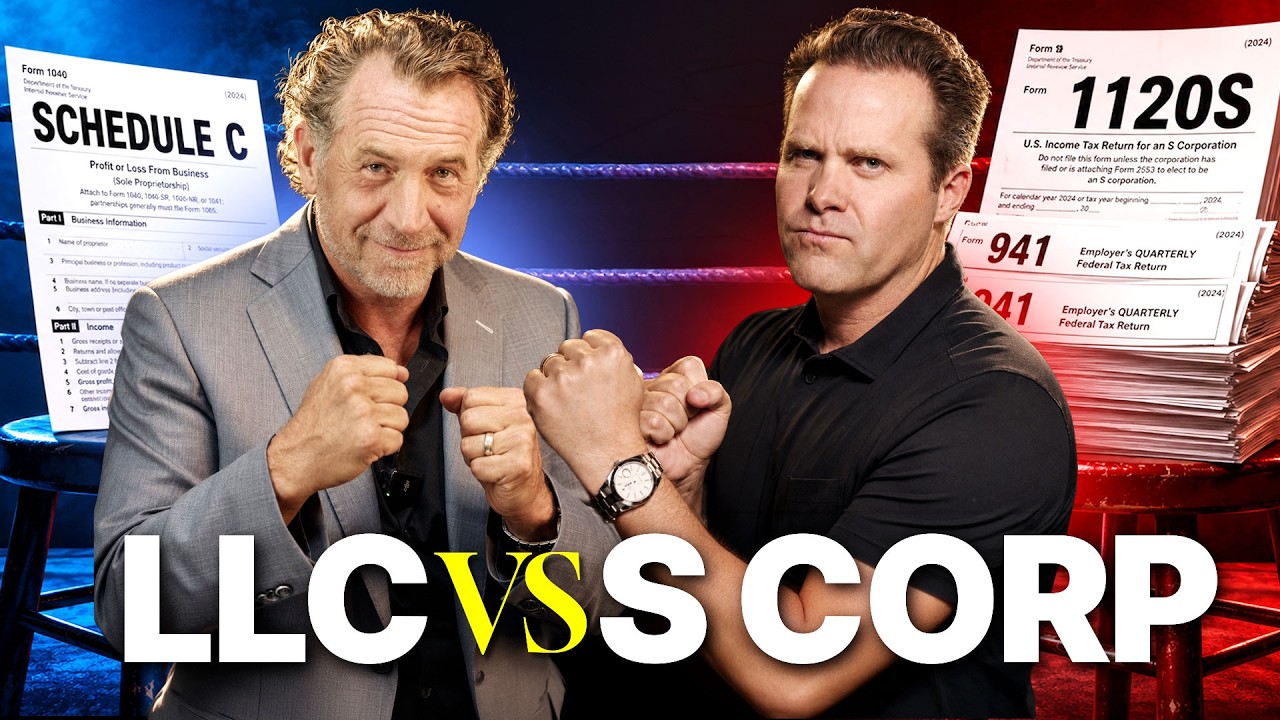
Matt Sorenson and Mark J. Kohler explain when an S corp saves money versus an LLC. An S corp lets you split income into salary and distributions, potentially saving 15% on self-employment tax. But it only makes sense once you're earning $50-60K, since the extra paperwork (quarterly payroll filings, Form 1120-S) costs more below that threshold.
Chapters
You will be an S corp at some point. It's just a matter of when. Let's say I'm making $80,000 a year after all my expenses. At least take half of that in a salary and half of it in profit. On that $40,000 of profit I'm taking, I'm saving 15%. That's like $6,000. If you've got rental real estate, do not be setting up an S corporation.
If you have a partner, you should always stay as an LLC. Some people make that S election too soon because they get all hot and bothered on the savings strategy.
Welcome everyone to the Main Street Business Podcast. This is Matt Sorenson joined by the incredible Mark J. Kohler. Two lawyers coming at you fast in 10 minutes or less talking about LLC versus S corp. Which one should you use?
And we're going to try and do it. Siri, start timer, 10 minutes. And I'm going to take sole proprietor. I'm going to take the tougher one to win here because I think I'm up for the fight today. Are you willing to take the S corporation?
Please, I got the better horse.
So you think. Now, many of you out there are probably deciding what entity you should be. Well, let me give you a little spoiler alert. This is really sole proprietor versus S corp because an LLC can be both. When you file an LLC, you have the choice. Should I be an S corp or should I just stay a sole proprietor? Because you get the same asset protection with both. This is really down to the taxes. And so I think that's really what we're comparing.
Yeah, and I think that's probably the first thing at the outset. Let's just talk about asset protection. Actually, it's about the same. If I have a corporation with an S election on it, or I have an LLC, no matter what tax election I choose on it, if something happens in the business, customer, tenant, whatever, they've got to sue the entity. LLC, S corporation, doesn't matter. They can't go after me or my personal assets. So I get that asset protection no matter which entity I use. I think let's just get that one off the table. We're getting asset protection either way.
Okay, I like it. And let's get another issue off the table. Your write-offs are going to be the same whether you do an LLC or an LLC taxed as an S corp. You will be able to take dining, travel, auto, home office, all the write-offs you would in either one. Don't let anyone tell you that, oh well, if you do an S corp, you get more write-offs, or you get an LLC, you get more write-offs. The basic business operational expenses will be treated the same. Think about it. If you're going to have a lemonade stand, you're going to write off lemonade, ice, sugar, a sign. You're telling me if you're an S corp, you can't do that or you get a better write-off? They're the freaking same. So same asset protection, same operational write-offs. All right.
But the taxes can be different. All right. This is the key here. This is where you're going to make— which one do I want to choose? If I have an LLC taxed as an S corp or I have an S corp just right out of the gate, I did a corporation, I applied for that S election with the IRS. So I'm taxed like an S corporation. I have an opportunity to save on self-employment taxes. So when I'm paying myself out of that entity, I can pay myself a salary on some of the money I make, which I have to pay self-employment tax. That's your Medicare and Social Security, comes to 15.3%. But I also can pay myself profits or dividends out of the S corp, which are exempt from self-employment tax, which is where the savings are for S corporations, because I'm paying myself some money out of the profits. I'm taking money out of the business. That I'm not having to pay into Medicare and Social Security, which is 15.3%. It's a very simple simplification, Mark. Let you take it from there. But that is a reason why you should do an S corp or an LLC taxed as an S corp.
Okay. So if the S corp wins on saving self-employment tax, I'll give you that. I agree. But I'll tell you, you're going to have to do more paperwork. You're going to have to do payroll every quarter, doing a payroll report. You don't have to do a paycheck to yourself every 2 weeks and crap like that. If you've got ups and downs in cash flow, you can do it on paper with your quarterly report called the 941. But you're going to have to do that as an S corp, not as a sole proprietor. And you'll have to do a tax return for that S corporation called an 1120-S, as in Sam. With a sole proprietor, I can pop it off on my 1040 with a Schedule C, as in Charlie. So the tax reporting Paperwork is easier with the sole proprietorship, although it will cost me self-employment tax. Fine, I'll give you that one.
Yeah, but if I'm making enough money, I'm going to pay for someone to do my payroll and my tax return because I'm going to be focused on making more money in my business. So let's say this. Let's say I'm making $80,000 a year after all my expenses. Okay. And I decide I'll at least take half of that in a salary and half of it in profit. I'm going to be very conservative. So, well, on that $40,000 of profit I'm taking, I'm saving 15%. That's like $6,000. I'll give $2,000 of that to the accountants to do that, and I'll keep the other $4,000. So if you're in that scenario where you're making enough money, I think the S corp pays for itself, even though I got more paperwork.
Okay, but here's the problem. Some people make that S election too soon. Because they get all hot and bothered on this savings strategy. And so if you're making less than $40,000 or $50,000 net, I'm a firm believer you might as well just stay as a sole proprietor, because if you're making less than that, you're really going to be breaking even paying for the services of the accountant to do that extra work or the extra headache it's going to cause you versus the savings. So I think we split the difference on that, 'cause if you're making more than 50, 60 grand, okay, S corp could pay off and still cover the costs. If you're making less than that, you may just want to stay as a sole proprietor a little longer until that—
And when you say, yeah, I agree. And when you say stay as a sole proprietor, you mean for tax purposes. You're still setting up an LLC. You're an LLC with the state and you've got the asset protection and we've got the brand and the entity name And the nice thing about that, and this is where we'd agree, let's come together on this, is as I'm starting out in particular, maybe this is a side hustle. I've been working for a few years trying to turn into a main hustle. I've got expenses, but I'm making $20,000, $30,000 a year. I don't want the S election yet. It's not going to save me taxes. It is just going to be more work. But eventually I'm going to turn the corner and I'm going to be making more than that $50K, and I want to just keep that same entity. But that's when you can add the S election later. So I think your final destination, no matter how you slice it, if you're an operational business owner, you're selling goods or services, is you will be an S corp at some point. It's just a matter of when. As long as you're making money. I mean, if the business doesn't work, it doesn't matter. But yeah, you will eventually turn into an S corp if you're making money.
Well, I would hope all of you watching, your goal is to make money. And with that in mind, I would concur that you will end up being an S corp. But I like your point and I will agree with you on this, that the LLC really acts as S corporation insurance. You start your LLC right out of the gate, you start making some money, you get that brand, you get that name recognition, and then you can elect to be an S corporation. And when you do it, you can oftentimes backdate it to the beginning of that year, whichever year you do it. So the LLC is still a winner because I want that LLC in my back pocket ready to pull that S election out when I'm ready. So the LLC is obviously better.
Yeah, let me hit two others. I'm going to talk against the S corporation now. Okay, I'm going to go against my own team here. All right. I'm going to go over either two scenarios or maybe I'll just take one at a time here. Here's a scenario where I don't want to do the S corporation and you shouldn't either. You've got a rental property. If you've got rental real estate, do not be setting up an S corporation. Okay. Rental income. Like when I own rental real estate, what am I making money on? Rents and capital gain when I sell the property. Neither of those types of incomes are subject to self-employment tax. They're entirely exempt from self-employment tax. The S corp strategy is a strategy and additional work to save on self-employment tax. I don't have it on rental income or capital gain income. So the LLC is cleaner. There's other tax reasons for it. I'm simplifying it there.. But for rental real estate or your investment assets that are producing rental income, capital gain income, stuff like that, no reason to use an S corporation there. Let's just go LLC, whether that's a single-member LLC, sole prop flowing down your Schedule E, I guess, or D, or whether that is a partnership, which is another entity we should talk about.
Well, I'd love that you threw that rental property argument in the ring. Thank you very much. I'll take that. If you want to throw yourself against the wall, I will also point out that partnership issue. If you have a partner, you should always stay as an LLC. Now, if you're married, a husband or wife could have an S corporation structure that could be pretty efficient. But if you're going to be in a partnership, you should stay an LLC. It's going to give you a lot more flexibility and better tax planning. Just like the rental property issue. If you have a rental property, you're going to stay with the LLC. The S corp has a role to play. The S corp has a lane, but it's— we're in a 6-lane freeway. And so that S corp, we're going to pull into that lane. If I have an operational business and I'm making enough money, then it's going to really save me and it can pay off big time. But I'm glad I took the LLC. I think I'm winning this sucker.
Well, I mean, I think, you know, we're both right. You know, we're coming to consensus here. And I'll say— so let me summarize a couple of things here.
We're almost done. You get— 20 seconds.
Okay. Okay. My final, my final thoughts. Do an S corporation if you're making more $50,000 a year selling goods or services.
Wow. That was shorter than 20 seconds. I'll just say in summary, always start with the LLC, get proof of product, proof of service. You can always make that change to an S corp later. And if you're going to have partners, you're going to want to consider that LLC as a long-term entity for that relationship. I think this has been a great debate. I hope to see you in the ring another time, Mr. Sorensen. Yeah.
And today's podcast episode is brought to you today by KQS Lawyers, Mark and I's law firm, where our attorneys have been advising clients across the country, been around for 25 years, setting up thousands, tens of thousands of LLCs and S corporations for business owners like you, structuring it in the optimal way for your specific situation. So let us know if we can be of assistance over at KQS Lawyers dot com. There's of course a link in the description below. And thank you everyone for listening today's podcast. Make sure you're subscribed, giving it thumbs up, sharing it. See you next time.
More from MARK




The secret to managing your family's future #financialfreedom #estateplanning #shorts



Moving Property to an LLC: What They Don't Tell You #realestate #investing #tips


