The Exact Order Self-Employed People Should Fund Retirement Accounts (5 Steps)
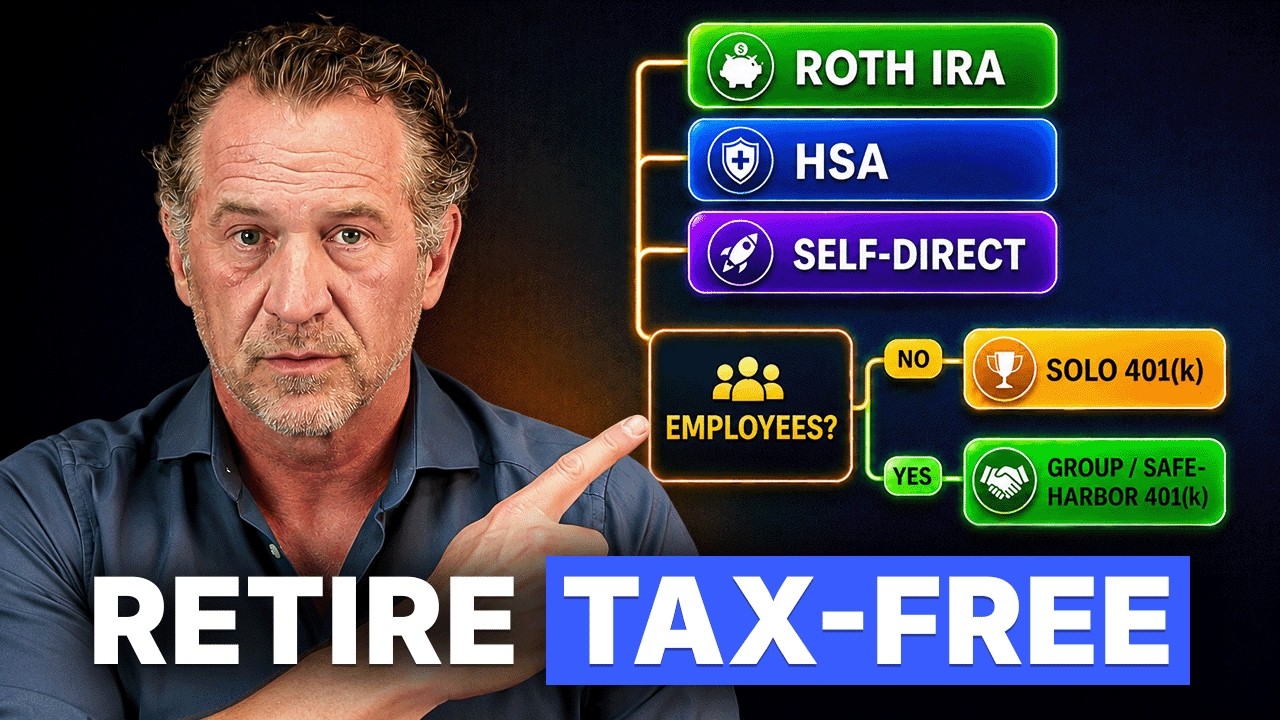
CPA Mark J. Kohler lays out five steps for self-employed people to fund retirement accounts. Start with a Roth IRA ($7,500 under 50), then self-direct it into real estate or crypto for higher returns. Add an HSA for tax-free growth, then a Solo 401(k) with up to $24,500 in deferrals if you have no employees.
Chapters
Believe it or not, the wrong retirement plan can quietly drain tens of thousands of dollars from your future through missed tax benefits, lower contribution limits, and years of lost growth from the way you can control it. You may never recover from this and not even realize you made a wrong decision at the very beginning. Now, the sad part is many self-employed people know that they should be saving for retirement rather than putting every dollar back into their business. I fell prey to that, but they have no idea actually which plan makes the most sense. If I'm going to put money in a retirement account, which Which one is best for me as an entrepreneur? It can be confusing. They hear about Roth IRAs, traditional IRAs, SEPs, SIMPLEs, solo 401s, and suddenly it becomes alphabet soup. So the real challenge becomes which one is best for you? Which one is going to save the most in taxes? That's your income level. Works with your business. Do you have employees or not? And these are the biggest issues that'll have the greatest impact down the road. Now I've got a strategy to share with you, and it's not that complicated, but it requires you to kind of go through this decision tree with me so that I can help you make the best decision that could literally put 6 figures into your retirement account or more with the right decision. I'm Mark J. Kohler, CPA, attorney, bestselling author, and I've spent much of my 25-year career helping entrepreneurs navigate these issues, figure out the taxes, the retirement planning, the asset protection, and understanding self-directed retirement accounts, the real power here. So in this video, I'm going to break down the main retirement plan options available if you are self-employed, which means any type of side hustle. That's 1 in 3 Americans today have a side hustle, which means they have a self-employed business, even if it's on the side. So which one makes sense for you? Which account will help you put away the most for retirement and a future where you have more choices and more freedom? Let's break it down. Now, what does self-employed really mean? And like I just said, 1 in 3 Americans have side hustle income. Well, that is self-employment. That's a Schedule C on your 1040, and it can take lots of shapes and sizes. A consultant, a 1099 contractor, a realtor, a freelancer, someone selling products online, driving Uber, running a storefront, operating a restaurant. The list goes on and on. The key is that you're generating income for yourself, not on a W-2. And it doesn't matter if you're an LLC or a corporation. You might have an LLC, you might have an S-corp, doesn't matter. The real issue is, are you earning business income? Even if you are getting a W-2 from a day job, you can have both. And here's what was interesting. See, you can have a day job with a 401 and also have your own retirement plan for your side hustle or your full hustle small business. You can have self-employed income on on the side and still participate in two retirement accounts. That's pretty cool. Now we're talking major tax savings. See, the side business may open the door to a separate entire retirement strategy that puts your main retirement plan on steroids. See, over 45 million Americans today have some type of side hustle, 1099 income, or small business activity. So here's the strategy, and it starts with a simple one. Step 1, fund your IRA, individual retirement account, every year. Now, even if you have a day job with a 401, you can still have an IRA. And even if you make too much money, you can have a Roth IRA. I've got videos on that. But before we talk about anything else fancy, I want you to fund your IRA every year. Now, preferably a Roth IRA. We'll come to that. But for 2026, that's $7,500 if you're under age 50. And if you're 50 or older, that's $8,600. That's around $625 a month if you're under age 50. I know that sounds like a lot and it can be a lot for many of you. It's like a car payment. But if you don't have a retirement plan, that money starts to be very, very important to set aside. Now, if you're married, you can both contribute to an IRA and put away over $1,200 a month. And it doesn't matter if one of you has a job or not. Income in a marriage is attributed to both parties for purposes of an IRA. Now, that even gets to be a bigger deal because that $1,200 is going to add up fast. And again, I understand that could be a lot for a family. That could be a huge sacrifice. And that's maybe where the strategy starts and finishes. Just step 1, fund that IRA every year. And if you're a married couple, both of you. And it takes discipline. It takes consistency. And it takes saying, I'm going to pay my future self first. And it's not easy sometimes. But get the IRA funding process on autopilot as much as you can. Out of sight, out of mind. Automatic deposits out of a certain bank account. That's level 1. Now let's talk about traditional versus Roth and why I love the Roth IRA. Once you commit to funding the IRAs, single or married, this is that next question: traditional or Roth? And I'll tell you right up front, I love the Roth. And I'm not saying the traditional IRA is bad, but for long-term wealth building, especially the younger you are, the more powerful it is. I'd rather pay tax on that seed money and never pay tax on the harvest again. So here's the basic difference. A traditional IRA gives you deduction today, potentially. It does depend on your income. And then that investment, whatever you choose, grows tax deferred. When you pull that money out, you're going to pay tax no matter what amount it grows up to. You'll pay tax when you pull it out. Now, yes, it might reduce your taxable income now. And some old-timer CPAs or accountants might try and talk you into that. But I am not a fan. I would rather have that Roth that works the opposite. You pay the tax on the money money now, meaning you earn money, you pay tax, but the Roth works the opposite way. No deduction today, but the money grows tax-free and comes out tax-free no matter what amount it grows to. And when you do financial models on this, the more that account grows, the bigger that account becomes, the more the Roth IRA wins because you'll never pay tax on that large amount. And I get it. Some people say, well, it depends on what my income is now. And there's so many variables. No, it's simple. In my opinion, 99% of the time the Roth wins. And yes, there are variables— your income, your tax bracket, whether you qualify for the deductions or not, your age and your long-term plan. But every time I run the models and run the math over and over again, the Roth wins the debate. And especially again, if you're young, because now that snowball is growing bigger and bigger and you've got time on your side. The larger the account down the road, means no tax in the future, where with the traditional, the deduction was on a smaller amount and you're going to pay tax on the bigger amount. See what I mean? So in summary, I just don't automatically chase the deduction and give up decades of tax-free growth. So that's why for me, Roth is often the winner. And if you've been told you make too much money to have a Roth IRA, please watch my other videos or read my articles on the backdoor Roth IRA, because you can still fund a Roth IRA no matter what your income level is. And let me just say about Level 1 again, if you can be dedicated to funding your Roth IRA, especially if you're married, every year, this is going to turn into millions of dollars down the road. Just start doing the math. It's insane. Now, Step 2, before we go to anything else, we have got to talk about your investment strategy. Now, I'm not an investment advisor. I don't want to be. I don't make any money off of what you invest in. But what I do want is for you to invest in what you know. It's called self-directing. You get to direct yourself what you're going to invest in. So if you think of the Roth IRA like a vehicle, I want you driving the car. I don't want you in the back seat with an investment advisor in the front seat. Now, maybe initially while you're learning how to drive the car and you don't have a lot in the back seat or the trunk, your car's just getting going down the road. Sure, let someone else drive it. They could tell you to invest in an ETF or a mutual fund or a bond or something safe and simple, because what you're doing is putting that contribution in every month, every year, and starting to fill up that trunk. Maybe it had junk in it before, but now we got some good stuff in there and we're starting to grow the assets in that vehicle. Well, at some point I want you to say, hey, pull the car over, I'm going to drive it. Kick out that advisor and you become the advisor. And it doesn't mean Wall Street investments are bad. It doesn't mean ETFs are bad. I invest in Wall Street myself. But at some point, I want you to drive that Roth IRA yourself. Because when you are self-directing the Roth IRA, You can invest in a lot more than just stocks, bonds, and mutual funds. You can invest in real estate, notes, crypto, gold, silver, and not a fund that owns crypto or owns gold and silver, real gold, silver, crypto coins, alt assets. Anything that you understand and want to invest in, you can, and it's called self-directing. So if that sounds interesting to you at all, where you can invest in what you know, and here's the big reveal, get a bigger return than 8% or even 10% if you're lucky. 'Cause if you're investing in real estate, you know you're gonna be getting a 15, 20% or more rate of return. And yeah, you can use leverage too. You can get loans to buy rental property in your IRA. If you're putting away that money every year, step 1, and then you're investing in what you know, getting a 10, 15, 20% return or more on small business or again, all assets, Now that retirement account is going to grow exponentially. The ROI, or return on investment, will blow you away. Let me just show you some math here. I've got my laptop. I just put in a financial calculator here. $16,000 starting point. So if you're married and you're both putting away $8,000, and of course it's adjusted for inflation, so it's going to go up every year. I'm just starting with $8,000, which is a little high per partner here. But if we can do that for 20 years, 15% return, on just $16,000 a year, that's $2 million, approximately $2 million tax-free in 20 years. You start doubling down, getting better investments, putting away more in years to come when that contribution amount goes up. People, this is a multimillion-dollar tax-free account because you're investing in what you know. That is step 2, the contributions and smart investing. Now, my partner and I, Matt Sorenson, believed in self-directing so much, we started our own trust company 7 years ago, directedira.com. And if you want to open up a Roth IRA for yourself, your spouse, even your kids, you could do it on your phone in minutes. So check out the link below and maybe even make a free appointment for a discovery call to see how you could open up a self-directed IRA account today. Now, let's move on. I'm going to close my laptop and let's move on. To step 3. Step 3, I'm going to take a turn that you probably did not expect. I'm going to throw out 3 letters here. HSA or Health Savings Account. A Health Savings Account is much like a Roth account on steroids because you get a deduction to put money into a Health Savings Account. It grows tax-free. It comes out tax-free and you don't have to wait till you're 59 and a half. You can pull out money at any point for any medical expense. Pretty crazy. I like the HSA even more because the number one reason people claim bankruptcy in America are for medical expenses. And the number one reason why people take money early out of a retirement account are for medical expenses. So this is a close tie on which one you would put money in first, the Roth IRA or the health savings account. Now, to have a health savings account, you have to have a high deductible health insurance policy, which you may or your spouse may already even have at your day job.. But if you're self-employed, you have the latitude to choose the health insurance policy you want, and you don't have to include employees in your health insurance policy planning unless you have 50 employees or more. So there's lots of options to get a tax deduction for your health insurance. Choose the right type of policy that allows for an HSA and contribute to an HSA and not even have to include employees if you have them. This is really, really powerful. Now let's talk about contribution limits for 2026. If you're single with no kids, you can contribute up to $4,400 at any income level and get a tax deduction on the front of your tax return. If you have family coverage, meaning head of household or married, you can put up to $8,750. If you're age 55 or older, you can add another $1,000 as a catch-up contribution. Now, again, this is a snowball that'll gain more and more snow as it goes down the hill and start to build that tax-free wealth that you are starving for, that I'm starving for. Now, that health insurance plan has to be a high deductible health insurance plan. If you're single, that means your minimum deductible has to be at least $1,700. If you're head of household or family, $3,400. Now, some of you may say, Mark, that's a big deductible. I don't want that. Well, let me ask you this. Do you even use your health insurance? Do you know 80% of Americans don't even use their health insurance that's just there if something bad happens. See, the 80% that don't even use health insurance, their premiums are paying for the 20% that really use it. Now, I've had those years where I've been on both sides of that fence. And if you have high medical expenses, my heart goes out to you. Medical is brutal. The cost of medical in this country is off the chart. And so if you need health insurance so badly that any sort of deductible at all is important and your network or your doctor that you want to go to is in a certain network, then you get that insurance. The PPO or the HMO plan with the low deductible, no problem. But if you're part of that 80% where you don't even need that health insurance or use it, get a higher deductible. If something bad really happens, you've got it and you can take the savings of a lower premium probably and put all of that into your health savings account. Get a tax deduction. If you need it for the higher deductible, go pull it on your HSA. You don't have to wait till you're 59 and a half. See what's going on here? You're getting a tax deduction for medical expenses that you haven't even had yet. And if you've got a higher deductible and a lower premium, you're already saving money. If we combine that with step 1, a Roth IRA, step 2, investing in what you know, and step 3, an HSA, you're building 2 tax-free accounts that can grow exponentially because another big reveal, you can self-direct your health savings account. My HSA owns a rental property in Illinois. It also owns some cows on a ranch in Utah. My HSA has been doing crypto mining. It owns some XRP. I've done it all with my HSA just to prove to my clients how easy it is. When you're on that app setting up your Roth IRA, you can even set up an HSA account and self-direct that. See, your spouse may have a day job with health insurance coverage, or you've got health insurance coverage in your small business. That's separate from the HSA. See, the HSA is an account that you can create anywhere you want and put those contribution amounts I told you about in, get that tax deduction, invest it and grow it totally separate from your Blue Cross Blue Shield policy. It doesn't matter. They're different. So you can already see this is how the rich get richer. This is how you build tax-free wealth little by little. It's a get rich slow scheme, and I love it. Now I'm going to give you steps 4 and 5, which are big topics, but I want to expose you to this information so that you can do more research on this if this applies to you. And that is you can put away more. God bless you if you're having that good of a year or you're making money where, Mark, I'm funding my Roth IRA, I'm doing my match at work with my 401 or my spouse is, I'm funding my HSA. Is there anything else out there? Yes, you can look at a solo 401. Now, if you have employees, we'll come back to that in a moment. That's going to be your step 5. But step 4, if you don't have any employees that full-time and been with you for at least a year or a part-time employee that's been with you for 3 years. So essentially no employees. Once you've handled all those contributions to your IRA or HSA, you can set up a solo 401. And you can have a 401 at work and a solo 401 for your side hustle. Your spouse can even be in the solo 401. See, the solo 401 is a powerful plan because you're the employer and the employee of this this side hustle. So you could do matching, which could even be bigger than the amount of matching you're getting at your day job or your spouse is getting. So as an employee, you're going to make deferrals just like you may have done before in a prior job. Then as the employer, remember you're wearing both hats, you're going to be able to do a match from the profit from the company. That's why the solo 401 can allow you to even put more away on top of the Roth IRA, on top of the HSA. Now this year you can defer that employee portion as much as $24,500. And if you're 50 or older, an additional $8,000. That's over $32,000 going into a Solo 401. And then the company gets to do a match of 25% of your profit or your W-2 if you're in an S corporation. So let's say, for example, you're taking a W-2 of $40,000 out of your S corporation and you want to put $20,000 into your Solo 401. Again, on top of the Roth IRAs or HSAs, then your company can do a 25% match, which would be $10,000, 25% of that $40,000. So you just put another $30,000 into a solo 401. Guess what? You can self-direct that as well and go buy rental property, form an LLC and put all your Roths and 401s together. Oh, and you can even include your spouse in that solo 401 and give him or her a W-2 and sock away another $20,000, $30,000 or more, the numbers start to go off the chart. If you're a little older and you're an entrepreneur and you're trying to sock away a lot of money for retirement, feeling like you need to catch up, start going through those 3, now 4 steps and putting the solo 401 on the fire. It's like gasoline. It's amazing. This is why I love the solo 401 for the right self-employed business owner. It gives you contribution power. It gives you flexibility. And if structured properly, it can give you traditional and Roth options. See, the company match is a write-off as if it was like a traditional, but your deferral could be Roth. All sorts of options inside that Solo 401. Now, like I said, step 5, if you have employees, you're going to take a right-hand turn. And let me pause here because this is critical. If you have employees, you cannot participate in a Solo 401. You just can't pretend they don't exist. Either. Now, this is a full-time employee that's been with you for at least a year or part-time employees that have been with you for at least 3 years. If that's the case, the solo 401s are off the table. But what is still on the table is what's called a Safe Harbor 401 or group 401. And you may think, oh, well, that's terrible. I can't do the big 25% match like I could in the solo. Yeah, it might only be a 4% match, But the beauty is you can still do that big deferral of up to $24,500 or $32,500. You can still put away a lot of money even though the match is not as much. And these Safe Harbor 401s are not expensive. The cost of it has gone down dramatically in the last 20 years. Now, with all that said, you may have heard about the SIMPLE IRA or SEP IRA. They do not compare to the solo or group 401. They don't even make my list. Now that's me. I'm a little opinionated and I kind of want to recommend to my clients what I think is best and what I do. So maybe think twice if you're being pitched a SIMPLE or a SEP. My 5 steps are amazing. And if you can do those 5 and take control of your investing, you will truly have millions of dollars tax-free at your disposal in just 15 to 20 years. And if you can dump in some money faster with some of these 401 plans,, you might be in the millions 10 years or less from now. That's the roadmap, and I believe in it. I'm excited about it myself, and I've been teaching it for years. And let's review. Level 1: Fund your Roth IRA every year, and think twice if you're going to fund a traditional, because I'd rather pay tax on the seed than the harvest. Number 2: Learn how to self-direct. Know your options of what you can invest in, because I promise you, you're going to get bigger rates of return. Number 3, look at the health savings account if you can qualify and get the right type of health insurance. This is going to be one of the biggest costs in your life, and you can access the money immediately, get tax write-offs. The health savings account is amazing. And third, you look at the solo 401 if you're able to afford putting away more money and don't have employees that will kick you out of qualifying for the solo 401. And finally, If you do have employees, do not discount the Group 401 or Safe Harbor 401 as it's referred to. I think they're phenomenal and will still allow you to catch up quickly in your retirement planning if you're behind the 8-ball. Now, if you want help setting up the right self-directed Roth IRA, HSA, or even solo 401, please talk to my team at Directed IRA who can help you compare your options, understand the rules, and get the account structured the right way so you can start investing beyond Wall Street. Again, this will open up ideas like real estate, private lending, private funds, small business startups, crypto, precious metals. These are just some of the kinds of investments you can invest in, which will be the backbone of your retirement building effort. Bottom line, don't guess. Pick the right plan. Start putting contributions in consistently. And invest in what you know. If this video was helpful, please hit the like and subscribe button. Turn on notifications so you don't miss future strategies to save taxes, build wealth, and better live your American dream. My name's Mark J. Kohler. Thanks for watching, and I'll see you in the next video.
More from MARK




The secret to managing your family's future #financialfreedom #estateplanning #shorts



Moving Property to an LLC: What They Don't Tell You #realestate #investing #tips


