They're LYING To You... You NEED An S-Corp (Here's How)
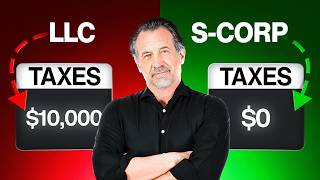
Mark Kohler, a CPA and attorney, explains why small-business owners should form an S corporation. With $100K revenue, taking a $25K salary and treating the rest as profit saves roughly $7,500 in FICA taxes. The structure costs about $200 to elect and $800 annually, breaking even around $30-40K net profit.
Chapters
Welcome back everybody. Today we are going to be talking about the power of the S corporation. When they make sense, when they don't, how you can implement one, and where business owners can save thousands of dollars by utilizing the S Corporation. Now I am a licensed certified public accountant, attorney, best selling author, owner of multiple tax and legal businesses, an owner of an S corporation myself, and I have been teaching this topic to thousands of business owners all over the country for the past 20 years. Folks, you're in the right place. Time and time again over my career I have had business owners come to me being given misinformation from tax advisors that really don't understand this topic. Asking just a few questions, I realized the business owner could have saved thousands of dollars and their advisor was wrong. The truth is most business owners would benefit from an S corporation and then even more so all of those S corporation owners now aren't even utilizing it properly. There is so much opportunity for savings here and I'm going to walk you through it in this video today. For first, what is an S corporation? The S corporation is an entity formed at the state level. It could be an LLC or a corp or an inc. You set up your ABC company and then you make an S election with the IRS to be taxed as an S corporation. So you could have an LLC taxed as an S Corp or an inc taxed as an S Corp. It's simply an entity with its own tax ID number, its own bank account, and it's what you run your business in. You may be a sole proprietorship and say, you know what, I need to be a corporation. You'd file for a corporation and then make an S election. Some of you out there are like, well, I have an llc. Well, let's analyze the numbers. You very well may need to make an S election. And then I have clients come in and go, well, I'm just an LLC and I'll look at the paperwork and I'll go, hold it. You've made an S election. Oh yeah, I guess I'm an S corp. Oh my gosh. If you have an S election, you are an S corporation. Don't confuse the LLC with an S corp. They can both be the same thing. Once you make an S election, you're an S corp and you're off to the races. So in summary, an S corp is a way of doing business. It's a company, it's an entity and you can own it 100% and be the president, the secretary, the treasurer, the head cook and bottle washer. It's your company that's an S corp. Now why would you want to be an S corporation? Now I've got three reasons why. First, you're going to save on self employment tax, the dreaded FICA. The F word of taxation. FICA. We don't like FICA. It's 15.3% on our profit, up to over $180,000 and it continues to grow each year. That's a lot of money to just be operating as a sole proprietorship or llc. So number one, we want to make that move to an S corp to save on fica. Number two, believe it or not, you actually reduce your chances of an audit by being an S Corporation. 15 times less chance of an audit by taxing your LLC as an S corp or just forming a corp right out of the gate. That's right. They are not high risk, they are low risk. The number three reason for being an S corp is because fundamentally you're a corp. You get asset protection for operating your business with the corporate veil. Now again, that could be an LLC taxed as an S or an Inc taxed as an S. But you get asset protection. So what more would you want? I'm saving taxes with less chance of an audit and have asset protection. Bam. Sign me up. Now I want to describe who would be the best fit for an S corporation. Then I'm going to go to the whiteboard and show you how it works. Works. So who benefits? Business owners that are generating ordinary income. Not investing in rental property or passive income or trading stock or buying crypto and selling crypto. We want to be creating active ordinary income. So think like a landscaper, an engineer, a realtor, contractor, a plumber, an electrician, a lawyer, an accountant. If I'm generating ordinary income, I'm going to be taxed with self employment tax on all of my net income. That's a lot and it adds up quickly. Again, I'll diagram this in a moment. But for those business owners that are generating ordinary income, there's a point where becoming an S corp will save them money because they're going to take spoiler alert here a reasonable salary and the rest is going to fall through as profit. That's why we want to be an S corporation. And those people again generating that type of income are the ones that benefit from an S corp. And I will repeat this over and over again as you get to know me better, we do not want to put rental property in an S corporation. We don't want to put stock or passive investments or syndications or anything that's an investment in nature. That's not what goes in S corporations. It's the operating business. Okay, so let's go to the whiteboard. And the best way to explain this is in the context of the trifecta. Now this is a tool I use. That's a picture that says a thousand words. So we can take a business owner and divide their life first in two sides and bring it all together with their tax return. It's a beautiful thing. So on the left side of the trifecta we would put operations, and over on the right side we would put our assets. Down here at the bottom would be your trust or your 1040 tax return. Now the trifecta comes together with just a simple example. Let's go back to the realtor for a good avatar, if you will. So here's my realtor, that might be an LLC or an inc, but they've made an S election, so they're an S corporation. All right, cool. So over here you might have an LLC to own rental property. LLCs are great for holding assets. And down here the LLC is owned by the trust and the S Corp is owned by the trust. The realtor's 1099 for commissions comes in here and then rent comes in here. Left side, right side trust. And it all runs down like river down a hill into your 1040. That's where all the money goes. That's the trifecta. So as I said before, over here is ordinary income and that's where the S Corp really comes into play. All right, now let's zoom in on the S Corp and do it while comparing it to just a regular LLC or sole proprietorship. Someone that just has opened a little small business and not even an entity yet they're taxed the same. And then on this side we have our S corporation. And that again could be even an LLC taxed as an S corp. We don't care. Now if I go out and make $100,000 and I have $25,000 in expenses and cell phone, travel, dining, electronics, cost of goods, marketing, whatever, so I bring in 100k in sales, I have 25k in expenses and I net 75 grand. Okay, that's my profit. Now this would be reported on a schedule C. Many of you might see that if you drive Uber or doordash or have any sort of small business, it's going to all go on in this schedule c. And the 75 grand is going to pay self employment tax of 15.3% that's $10,000 right out of the gate. Then you're going to pay your federal and state tax. Bam, bam, bam. No fun. But if I do the S Corporation and I get to work over here with the same type of small business, make this a little prettier here. So I've got my 100 grand in sales, I got the same 75 or 25 grand in expenses and I net 75. Well here's the beauty. There is no self employment tax, no fica, no corporate tax and no Obamacare or aca, that extra health care tax. Man, this is sweet. Oh, but there's a catch. We have to take a reasonable salary. Now you're going to see videos on this all over the web. And this is where it can get broke, ruined, broken. The S Corp can be actually misused or or not utilized enough. And this is where accountants can be scared of their own shadow and really screw up the S Corporation. So we've got to take this reasonable salary and it's got to be the perfect number. So in this example I might just use 25 grand is the salary which changes the profit to 50. So your salary comes out as an expense. So I've got my regular expenses, 25 grand. Let's make that look a little prettier there. So I've got 25 grand in expenses, 25 grand in salary and I subtract that from my sales. Now I have 50 grand in profit. Well like I just said, the profit is not subject to self employment tax or corporate tax or any of these taxes. So I just saved 15% on $50,000. That's $7,500 in savings. And the more money you make, the more you save. That's the beauty of the S Corp. Now I'm going to point out one other thing here. As we look at the example of the S Corporation, as we start to determine what are our sales and our regular expenses, the big question becomes what is this salary? How much should this salary be? And the term often is reasonable comp. Now this can be a very moving target depending on the type of business and the type of individual and the amount of profit. So we want to make sure that we choose the right number here. Now I'm going to use examples of sometimes a 60, 40 split or a 75, 25 split or I might even do a 50, 50 split. But it's going to depend on some variables. At the end of this video I'm going to suggest another video of mine that really breaks down this salary because that's how you're going to really take advantage of the S corp carefully and properly. So now let's talk about how we set it up and maintain it. The how is actually quite easy. As I said at the beginning, you're going to set up an entity and make an S election. Total cost might be around $1,000. And I know some of you are going to try to knock it out online by yourself. We have a whole service at our law firm of just fixing entities that got incorrectly set up. So make sure you get some support and advice with that down in the description. We have a law firm where you help clients around the country setting up their entities at an affordable price and make sure you use a licensed attorney to do it that understands business and tac law. There's people out there that often charge more than we do at our law firm and aren't even licensed to do it. So be careful getting that help to pull this all together. Now, for some of you that already have an LLC, 90% of the work is done. Let's make sure your LLC is cleaned up and all operating beautifully. You just make an S selection. Now hold on, hold on. It's really expensive. It's about $200. That's it. It's not bad at all. To set up and make that transition from an LLC to an S corp is by simply filing an S election. Now, you might want a consultation with one of our lawyers at the same time to ask some questions about how to maintain it. But the cost to make that S election is very, very affordable. You shouldn't spend any more between 100 to $300 to have a professional help. You make that election and do it right. You can scre. You don't sign the right parts or check the right box. Now, once you're up and running, you're going to maintain it like you normally do your regular business. Deposit revenue in the checking account, pay your bills, take out profit anytime you want. But every quarter you have to do a payroll report. You have to peg your reasonable comp. Now don't think that you have to write yourself a track every two weeks. And mark, I've got cash flow problems. I can't write myself a paycheck every two weeks. Don't, don't just do a quarterly payroll report looking in the rear view mirror and say, oh, I made 30 grand. First quarter, my payroll should probably be 10 grand. I'll do a 30% allocation. And then you go into second quarter. Oh, this quarter I only made 10 grand. I'm going to maybe take a bigger allocation because it's a lower amount or you get into third or fourth quarter and make other adjustments. Again, watch my other video on how to choose the right amount of payroll. But the point is, this quarterly report has to be filed. And you can use payroll companies to help you do it. I highly recommend it. And by doing that payroll report, you solidify the strategy. You're going to choose your salary and then everything else is taxed as a profit, not a salary. That's the split we're looking for. That payroll report should cost you. Yeah, maybe a couple hundred bucks a quarter at most. So that means you're going to spend about $800 throughout the year maintaining your S Corp to save 7,500 in this example. So let me do the math. Spend $800, save 7,500. I know this is hard math. Yeah, I think it's a good deal. Now, I want with full disclosure to tell you there's going to be another cost to file your S Corp tax return. But you're going to get rid of your schedule C on your personal return too. So by doing the tax return, maintaining your entity, and doing payroll, actually you might be out a couple grand. But again, remember, the more money you make, the more you save. So I know you've got a golden question here, Mark. When does it make sense to move to the S Corporation? We've been teaching for years. We've helped thousands and thousands of clients make this transition with no audits, no problem, and are running off into the sunset loving life. That break point is about 30 to $40,000 net. When you start taking home three grand a month, you call your mom and say, mom, guess what? I'm making three grand a month. And then you call our office and go, hey, it's time to make my selection. Two phone calls and now you're saving money. And your mom will be proud of you, too. That's the beauty of the S Corp. You can make that decision anytime along the process, and it's a very affordable transition. And it's just doing a payroll report quarterly and a new tax return at the end of the year. That's it. You still take money anytime you want. You don't have to wait for a paycheck. Now if you can work with a tax advisor to really eke out even more tax strategies with the S Corp. Oh my gosh. This is just strategy number one down below. I also have a link to my Tax Pro network. I have tax advisors trained to speak Mark Kohler all over the country and you can find a tax advisor to help you work directly with them. I don't make any money on that. I just want to give America Main Street America Tax advisors that understand this people, it's not that hard. Don't get ripped off with someone trying to sell you S Corp strategies at 2, 3, $4,000 a pop. People that aren't even licensed to do it or have training to do it. I've written books on this. I have an amazing podcast. I train advisors around the country. I am here to protect you. There's no one else that knows this as well as I do. I'm freaking killing it and I want you to kill it as well. So get that S Corp dialed in. If you're in those points break point of maybe 30, 40 grand or profit or more and you will be on your road to making more money as a business owner and enjoying life and living that American dream. Now wasn't that fun? Not that painful, right? And you've got more information to be equipped as a successful business owner. Now I gave a bunch of links down below and and I want to remind you, please watch the video on choosing the right salary for your S Corporation. It's going to help you immensely. And remember this, we're all in it together. Main street is the backbone of this country and we're all working hard and it's not easy sometimes. But I'll be right there alongside with you, working my tail off as well. So don't give up.
More from MARK




The secret to managing your family's future #financialfreedom #estateplanning #shorts



Moving Property to an LLC: What They Don't Tell You #realestate #investing #tips


