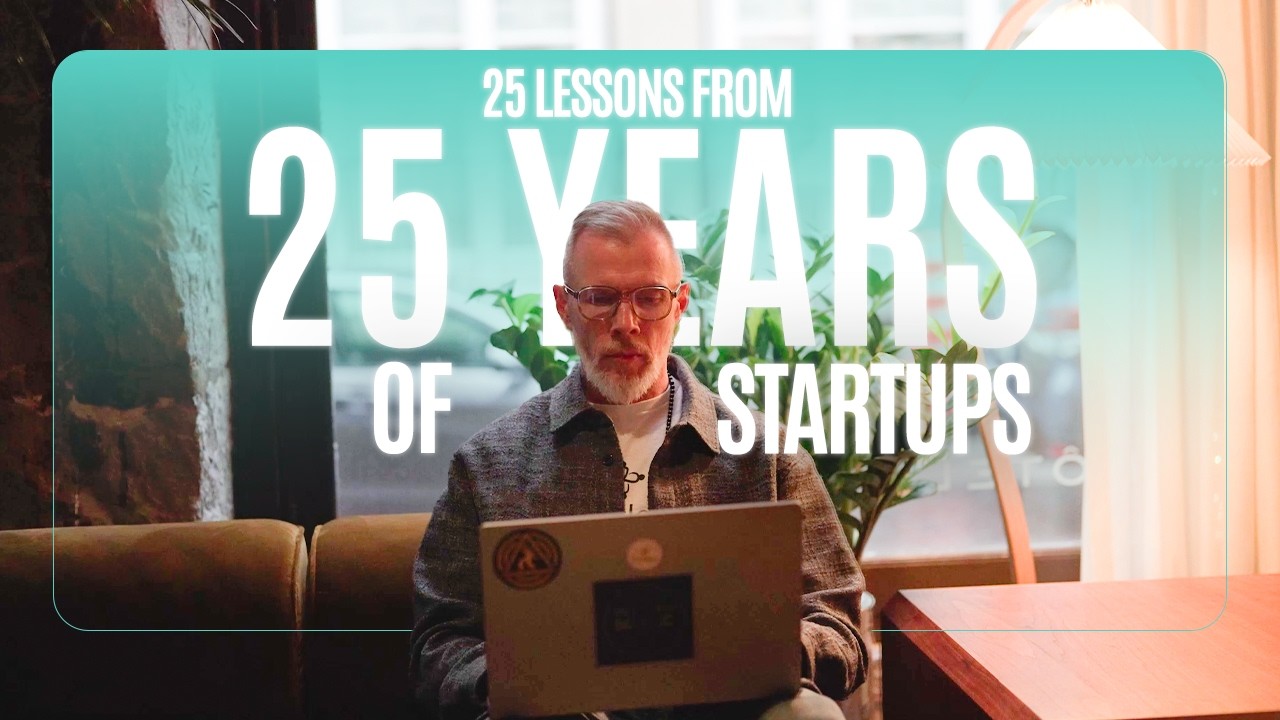
Mark MacLeod shares 25 lessons from 25 years in startups, covering timing, fundraising, market cycles, VC dynamics, product-market fit, exits, and CEO burnout. He warns against over-reliance on PowerPoint and emphasizes the importance of founder self-awareness and wellbeing.
Chapters
This year I celebrated 25 years in startup land. Here are 25 hard-won lessons I have learned. Some came easy, but most were hard. First, timing is almost everything. In fact, it's the single biggest factor in startup success. We closed the Series A for a company called Tungle 3 days after the Lehman Brothers crash in 2008. A week later, VC funding more or less dried up. We got lucky. One more week and that round would never have happened. Next lesson. Hot markets make life easy. That's good and bad. I showed up in 1999. I thought I was the world's best fundraiser. I had no idea there was a bubble going on. Two years later, it was clear. The bubble burst and I was not the world's best fundraiser. Startups that raised at nosebleed valuations in 2021 might regret that today. That's why these, you know, these hot markets are good and bad. Before I continue, please like and subscribe for more videos created only for startup CEOs. Next lesson. Sometimes the biggest opportunities are inside established markets. We had no problem watching movies before Netflix. It was a solved problem. Netflix came in and completely disrupted industry. Just one example. Next lesson: a poor market equals a bad market. The third company I was CFO for was a telecom startup named MobiVox. It was in the long-distance calling space. Things didn't go well. As I was deciding whether to stay or leave, I Googled "free long-distance calling services." I found hundreds of them. I resigned and the company died soon after. Next lesson: Big opportunities are often tiny markets today. When I was helping Tobi raise the Series A for Shopify, many VCs passed. Why? Because the TAM was too small. Wrong! Shopify now serves millions of merchants. It still feels like they're just getting started. Next lesson: The best startup investments are based on a simple insight, an insight that is unfortunately only obvious after the fact. For example, we know now with the benefit of hindsight that Uber is a fundamentally better experience for drivers and passengers. It's truly disruptive. But if someone pitched me on disrupting the taxi market when I was a VC, I would have a passed. It's a solved problem. What about taxi medallions? Who's gonna get into a stranger's car? All valid objections, all wrong. Next lesson: Sometimes great outcomes can come from near defeat. When I was a VC, I invested in a startup called Localmind many years ago. Despite lots of early hype and engagement, it wasn't clear how this could become a big business. The founder started looking for a buyer. He sold the company to Airbnb in a stock deal back when they were still small. That failed investment turned into a big 30x win by the time we sold the Airbnb shares. Next lesson: Most founders don't regret raising VC, but most regret how they spent it. The reason why startups fail is that they run out of money. Yes, there are underlying root causes, but you can keep trying as long as you have money. Next lesson: You can't A/B test the decision to exit. Tungle, going back to that, was in my humble opinion a better scheduling service than Calendly. We sold early, we made money, but what if we had stuck it out? Calendly is huge and a capital-efficient beast. Could that have been us? Who knows. Next lesson: being a VC kind of sucks. Shortly after entering the industry, my dream job was to become a VC. They had the money, the power, they had it easy, or so I thought. They got paid lots to learn and help founders. I was wrong. Most VCs don't make money. Most VCs are not as helpful as they could be. It's also a really lonely job. Next lesson. Founders are both the best and worst thing about their companies. I love founders. I've served them my entire career, long before entering the startup world, in fact. And it takes a certain amount of craziness to start a company, even more craziness to raise capital, and try and hit escape a lot. I've never met a benign, normal, purely rational founder. They would probably be doomed to fail. Anytime I was overworking with a founder CEO, I would feel that person was simultaneously the best and the worst thing about the company. Next lesson: great CEOs come in all shapes and sizes. Tobi Lütke didn't want to be the CEO of Shopify. Deeply introverted, technically gifted, this business stuff, it didn't interest him. Fast forward and he's one of the most successful tech CEOs around, a truly limitless CEO. Next lesson: the best CEOs lean into their superpowers. Let's stay with Tobi from Shopify. Tobi didn't try to become something he was not. He didn't try to overcome his introversion. He isn't the guy going up and down Wall Street. He leaned into who he authentically was and he hired his polar opposite, the force of nature known as Harley. Genius move. Next lesson. My base level expectation of VCs is do no harm. VCs get criticized a lot. Some of it's fair, some of it's not. A lot of it is sour grapes. After all, VCs hold the cards. There are some great VCs out there. So smart, so connected, so helpful. They are game changers. But there are a lot of not so great investors out there. Do your diligence. Next lesson: The slowest companies use PowerPoint a lot. When I started my investment bank, I banned internal presentations. I'd seen many examples of companies that had these elaborate internal presentations. Senior staff would spend hours and days producing slides that would get used once. Next lesson: Board observers don't just observe. Founders often concede this and let them in, and they don't just sit there quietly. You don't want the person, but you need to get the deal done, so you compromise. So here's the thing: observers don't just sit quietly and observe. They talk. They absolutely influence board dynamics. Be careful here. Next lesson: in fundraising, I almost never went for the highest bidder in the deal. Yes, price per share is important, but it's not everything. You want an investor who is aligned with you, someone that shares your vision and ideally your values. Next lesson. Self-awareness is the number one thing I look for in CEOs. How do you keep up with a fast-growing startup? By growing as fast as it. If you think your shit doesn't stink, if you believe your own hype, you'll fail. You'll miss the signs, not take or get the feedback that you need in order to grow. Faster than the business. Next lesson: We stress wondering what people will think about us, but people are too busy worrying about themselves. They don't care. For example, I decided not to be a VC. I left a fund where I was a general partner. I shut down a highly successful investment bank to become a coach. Both moves were highly visible. I thought about many things in making those decisions, but I didn't spend any time worrying about what people outside of those directly affected would think. Next lesson: overfunding masks crappy businesses. Amazon and Uber's market cap would suggest that they were always great businesses, but they burned a ton, especially Uber. By contrast, you know, Apple, Microsoft, Intuit all went public early, all were profitable. These were great businesses. Next lesson: humans have infinite potential. So many examples, but How does a high school dropout— I'm talking about Tobi from Shopify again— lead a 10,000-person company? He's the smartest person I've ever met. He's an illustration of our potential when we dedicate and apply ourselves to a problem. Next lesson: our gut always knows. I knew in 2019 that I wanted to be a coach. I just knew it. In fact, earlier I bought my first book on coaching in 2002. Still, I did all kinds of analysis before before making the call. I even mind-mapped it. Lean into your intuition. It has the answer to every question you have. Next lesson. The number one reason why founders sell is because they burn out. I've done over $1 billion in exits. I can tell you directly, this is why founders sell. Take care of yourself. Get enough sleep. Exercise. Eat real, whole food. Above all else, have fun. Enjoy the journey. Live today, don't defer. Happy, healthy humans build bigger, better companies next. Luck and timing equal half of startup success. Anyone who says differently is fooling themselves. That's it. Those are my lessons. I hope they resonate with you, and I would love to know what have been your biggest lessons in your startup journey.