Agentic AI: A New Era in SaaS with Daniel Saks The Startup CEO Show Podcast Full Interview
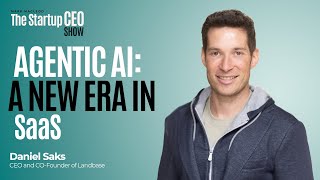
Daniel Saks discusses Landbase, his new company building agentic AI that takes actions on behalf of humans. The platform claims 4x to 7x conversion improvements for sales campaigns, starting at $3,000 a month, and addresses the fact that 45% of campaigns fail to generate a lead.
Questions this video answers
2009
Over 1,000 employees
$3,000 per month
45% of campaigns failed to generate one lead
4x–7x improvement (described as 400%–700%)
Chapters
This episode is brought to you by Fellow. Fellow is the only AI meeting management solution that covers every part of your organization's meeting workflow. Go to fellow app CEO to get 300 free minutes of AI recordings and start having better meetings.
AI will free us up from the manual repetitive tasks and the challenges around data and silos and and it will bring data to the forefront to allow us to make better, faster decisions, run more efficient businesses and ultimately free up people's time to either work smarter and do better things for the economy and society, or for some people who want to work a little bit less and spend more time with their family or doing the things they love, then it gives them a great life, balance and harmony.
Welcome to the Startup CEO Show. I'm your host Mark McLeod. In this episode I sit down with my friend Daniel Sachs. Daniel was co founder and co CEO of AppDirect, a company that he built to over a thousand employees. AppDirect is still going strong today, but he left in order to start his new company, Lambase. So we unpack lots of things in this episode. First of all, what it's like to be co CEO since that's not the standard model. Some of the key milestones in AppDirect. We spent a bunch of time on his new company Landbase and in particular around Agentic AI, a movement that he thinks is really going to be the next wave in innovation. Lots of really great stuff here. I hope you enjoy the episode and I hope you subscribe. Daniel, welcome to the Startup CEO show. How are you doing today?
Hey Mark, I'm doing great and amazing to be back on the show and great to reconnect.
Yeah, sure. It's been a long time. We caught up very recently and before that it had been many years and you know, you've been on a long journey that I'd love to unpack today. I'd love to spend, you know, a chunk of time kind of unpacking App Direct and the biggest milestones that you had in growing a thousand person plus company and you're back in the saddle with a new company. So let's make sure we spend some time talking about that. But I'd love to jump in right off the bat. Like when I first encountered AppDirect and first met you, the first thing that stood out to me was like, wow, they have two CEOs and that is not standard. It happens, but it's definitely not in the company building 101 playbook. And so I'd love to know just your Postmortem. Talk to me about the co CEO experience and what's your retro. What works well with that? What doesn't work well? Yeah. Over to you.
Sure. So when we co founded appdirect, myself and my friend Nicholas demaray, there weren't the playbooks that exist today on startups in university campuses. No one was talking about doing a startup. Maybe the Lean Startup book, Eric Reese, who is the person who wrote it, had started talking about it based on Steve Blank. So I don't even think the book had came out yet, but maybe that was one reading we could have. There was this book by Jessica Livingston called Founders at Work that profiled founders, a lot of them from the PayPal mafia. Yeah, like that was like this, it was like a bible for me. I was like, oh, finally I can hear about stories about these startups. And literally when we started, we knew nothing about startups technology. We were just doing everything based on first principles. And you know what we thought when we approached the problem is that with AppDirect, it was the emergence of cloud. And we wanted to distribute cloud around the world and create the commerce platform that would transform the way businesses find, buy and manage software. And what we thought that would take, which I think we were right in this regard, is like an extreme focus on the product and the engineering and kind of the internal elements, but at the same time an extreme focus on going out around the world and building partnerships that would therefore drive and proliferate the cloud sales. So you know, Nicholas was really focused in the early days around assembling the team, around building the product, the technology, the platform. And then I was living around the world on the road on planes, building relationships with software vendors as well as with distributors around the world. And therefore we thought, you know, both of us having a CEO title was important because we both could make the right strategic calls, but one of us could go out and cultivate the kind of external growth and the other person could be kind of, you know, keeping the, the, the, the focus of the platform. So we operated that way for a better part of 10 years. It worked very well. You know, I think it was a great way to drive the business for our specific business. And then ultimately as we scaled, it made sense to move to a single CEO model. And my co founder, Nicholas is just a phenomenal business leader. I was very supportive and felt like it made sense to move to that model. I kind of knew at some point that I wanted to start something again someday. So we had the discussion around multi year Transition had the opportunity to still stay very close to the business as board member and shareholder and I think App direction, the best shape it's ever been. But you know, gave Nicholas the opportunity to drive the business in a more unified way, which I think makes sense for App Direct at this time, and then give me the opportunity to start something new.
Wow, that's a wild journey. You know my, my reflex with respect to co CEO, not a judgment, just sort of like, hey, what do I think's going on generally is it's postponing an awkward discussion, but it sounds like in this case it was considered so that each of you could have I guess the optical authority. Right. You know, you're going out, concluding deals, especially with some of the big distributors, you had to have the title. And then meanwhile, Nick was actually kind of doing things internally. So it sounds like it was a kind of a well considered partnership. Would you say the two of you had very complimentary skills or was there some overlap?
Yeah, we actually had very different kind of passion areas and they played to our strengths, so. And I think we actually both grew over the years to, to kind of have more overlap. But at the time Nick loved the technology, the product being very hands on and didn't like as much the things that I liked which was more the marketing and sales elements and kind of being on the road. So I think that it was very complimentary at the time. You know, as part of this I always think like, you know, you don't know what you don't know and how do you learn. So there are a lot of successful Coco models and I spent a lot of time thinking about and learning, you know, many of them. Canada actually has, you know, quite a few, you know, with BlackBerry famously having that model and kind of the feedback that I had in general is that it works until it doesn't and as long as you know the purpose of it, you can make it work. So there's examples where at Salesforce or at Oracle it was about a transition and kind of grooming the next in line. You know, with BlackBerry it would have been more similar to ours, which is you have two complementary leaders with different skill sets that both want to co lead the business. So I think there's many reasons why it can work, but I definitely think that, you know, having open communication on it and understanding kind of the potential downsides of it is important. And I find that with anything like I feel like over my career I've gotten good understanding where my blinds are and kind of augmenting myself with people who have the skill sets that I don't have. And I think specifically like I always have this complex where I think the best technology companies actually were founded by technology leaders and engineers. And even though I love to call myself a technologist, I never coded from scratch, so I would always a compliment myself who I think are the best in the world at that trade. So andy Sen, our CTO at AppDirect at the time, had built the Salesforce App Exchange, which was really the first app store of its time and therefore kind of was probably one of the only people in the world that could do what we needed.
Yeah, that's totally relevant to what you were building at after it.
Exactly. And that's the same thing with, with us here at Landbase is our technical, you know, co founding team has extensive experiences, including our Chief Data Scientist Wa Gao, who is a Stanford PhD in Neural Networks that co founded EverString, which was a early machine learning startup for go to Market that got bought by, by ZoomInfo. But like you kind of look for what are the gaps along the table and, and how do you strengthen them with like the best people in the world. And I feel like if you can do that, then you can achieve great things. And I think part of my learning arc as a, as a CEO or founder or leader is embracing kind of the things that you're not good at and surrounding yourself by people that are good in those areas. And then I think also knowing what it's going to take for both you and your leadership team to always get to the next level, um, you know, I think you're a coach, so this is probably really pertinent to you, but I think that people can be coached in certain areas and they probably can't be in others. So I think having like a lot of self awareness of where you think you can, you know, improve or change and working on those development areas, you know, hopefully with a, a person that can, can push you and challenge you is so important. Um, but then also recognizing like, hey, there's some areas that just, you just maybe are not ever wired to, to like and therefore how do you build around that?
I love that there's so, so much that resonates in what you said first of all around kind of the importance of technologists, right. I always joke that you wouldn't hire a law firm run by CPAs. Right. And like I listened to Mark Zuckerberg on the acquired podcast recently, right. And you know, he talked about how important that is and how like a meaningful number of the people in the leadership team at Meta, including himself, are technologists. Right. Even if they're now running a business function. Right. Their background is techn. And even for his board of directors, he recruits people with technical expertise. Shopify just added Microsoft's CTO in the board. Like it makes a lot of sense, right? You know, disruptive products, I mean, go to market is massively important. We're going to spend a bunch of time talking about go to market, but obviously disruptive products are super important as well. And so, yeah, technology is definitely a thing. And self awareness. You know, certainly for me as a coach, the number one thing I look for in CEOs to coach. It was also no coincidence, the number one thing I looked for in founders to back when I was a vc. Right. And for the same reason, right. Like the only way, if a company's doubling or tripling every year, you have to double or triple every year, triple every year, you're going to fall behind. And it's only through self awareness that you go through that, that loop and make the course corrections to be able to keep up. Right. You know, if you think your shit doesn't stink, you're not open to feedback, not open to input, and you're just going to fall behind.
Yeah, it's a good point. I mean, one thing I'd love to get your thoughts on is like, I like to steal, man, different perspectives. So if I have a view, I'm thinking like, what's the opposite view and where My view is, hey, I can find the best people in the world to complement my weaknesses. I heard Parker Conrad, who's the founder of Zenefits and Rippling, recently on a podcast and he was kind of saying the opposite. He was saying, as a CEO, you should tackle the things you hate the, the most and like just go like zero in on those things. And like, I took that away as like, okay, there's an element of, as a CEO or founder, you should be willing to do the things that other people aren't willing to do because ultimately it's your responsibility to make this thing succeed. But I was just curious if you have like a perspective on.
I think that might be true early on, right in the beginning, you do everything. You build product, you sell product, you take out the trash. Whatever needs to be done, you do it. No one's got more motivation than you, nobody's got more context than you. But I think as the company scales, in an ideal world, you would build your role as CEO and therefore build your or your leadership Team around your superpowers, right? The thing that for you doesn't feel like work where you're just in flow, right? Like, I don't know. Number one reason why founders sell their companies is because they burn out. If you're just spending on. It's. You're not gonna. It's not, you're not. It's not Utopia. Obviously there's gonna be shit. But if you're intentionally designing your role around the stuff that you're best at, there's a lot less chance you're gonna burn out. The example I bring up all the time is Toby at Shopify. Right. Toby's highly introverted. What? He wants to spend his time on product and technology. I had him on this podcast back in September and he said, like, sometimes I kind of wish I was cto. Like, that's how much he loves product. So. But he's the CEO of a 10,000 person public company. How has he been able to do that? It hasn't been by doing the things that he hates. So as an example, he's very introverted. He doesn't want to be doing the quarterly Wall street bullshit. Harley does it. Harley absolutely wants to do that. That's him in his element. That, to me, is an example of really the opposite point. It's not doing the shit that you don't want to do. It's actually being selfish. And I mean that in the best possible way and designing the role in a way that is just like the best possible role for you. Now, maybe the last thing I'll say is, like, that doesn't mean you just get to do what you want. It means you get to do what you are best at, how you can best, you know, add enterprise value. So as an example, Toby would love to code, but he's been forbidden from actually committing production code for a long time. He'll tinker on his own time. Right. But like, he's not contributing code because that's not the best way for him to add enterprise value. Right. So it's not about just indulgent and let me scratch my itch. No, it's about leaning into what you're best at.
Yeah, it's a good perspective. And I've got to know Harley over the years as a friend and caught up with him recently and, you know, kind of shared that I'm, you know, transitioning from app direct, doing something new. And, you know, I think he said, like, look, he was super excited to recommit to Shopify under the lens of doing the things he Loves, which is, you know, storytelling and getting out there. And it's very complimentary. So I think for them that's an example of something that's, you know, worked really well in context of starting new businesses. I was just at a small event with Roloff, the head of Sequoia, and he was talking about a lot about like founder market fit. And I feel like the kind of undertones of this conversation speaks a lot to that, which is, you know, it's not just about assembling a team that's complementary to you, but it's about finding a business that you want to go into that really excites you. And it's funny because when I was thinking about, okay, what am I going to do next? There were a lot of businesses that I thought would be cool. You know, maybe I do something in music or entertainment or I love sports and fitness, so maybe I do something there. And I actually the initial exploration that my co founder Emily and I did was looking at, you know, the biggest pain point that faced insurance brokers. And it's just truly funny to think like by starting there and exploring, we kind of backed into the biggest technological shift, you know, B2B in my view, which is, which is agentic AI, the biggest one since SaaS. And then we kind of backed into a go to market business which I think leverages the skill sets of myself and you know, my founding team. But it's kind of funny how the world, if you, if you kind of let it happen and you have the intuition and you have people coming to you, you kind of find that businesses are shaped around people, whether that be your early customers, your early employees, your leadership, your co founding teams, your investors. Business isn't what's on paper, the business plan. It's what ends up happening because of people. And that's kind of something that I felt the first time and I see it just as much today.
Yeah, that deeply resonates for sure. And by the way, I'm so glad you didn't go into insurance. I've had a couple of clients in the insurance space and one of whom I coached through to a really successful exit. But when they look in the rear view mirror, that industry just moves slowly. It was so painful to hit escape velocity on that. Had an angel investment in that space. So the amazing founder and he just, again, the market moved so slowly that he just ran out of time and capital. He ran out at a bad time. After the downturn in 2002, 2003, he just couldn't keep going that's a limited number of data points. So I'm not authoritatively writing off the insurance vertical, but so far I'm personally batting zero on that one. Maybe last question, around the co CEO thing, did it create any confusion internally or did people know, Hey, I go to Daniel for one thing. I go to Nick for another thing.
I think, look, in the period we had the model for 10, 12 years and I think there are phases where it was very clear and effective and other phases where it was challenging. I think ultimately the reason why we, we moved away from that model wasn't necessarily because of us. It was because of the expectation of everyone around us. Right. It's easier for a seasoned leadership team to understand that there's one person accountable for a decision. It's also easier for an investor in the public markets to potentially understand that there's one CEO or person accountable. So I think eventually it made sense to move to the single model. At the same time, like, I totally get why, you know, Salesforce has tried it or why Oracle does it. So I think it's really just dependent on the time. I think like my belief in business is that there's so many variables and there's so many ways to do things right. You just have to do with what you're convicted in and it gives you the best edge. Forward to your point about Toby and Harley, about how you create the biggest enterprise value and if that is a co model, great. If it's not, then great too. And I think the key to make it less awkward, I think in the words that you put it, is just be very open around knowing, hey, we're doing this thing that's not standard. From a first principles basis, we think this gives us an edge. However, at what point does it become no longer an advantage but a disadvantage? Then let's be proactive about having that discussion. So I think it's just about like the ability to be open and mature and recognize that if you're doing something that's not standard, that's okay, but eventually, you know, it could be something you have to rectify.
Yep, that makes sense. So let's, let's switch gears and talk about go to market. Right. AppDirect was a company that facilitated go to market for its customers, but maybe more. And you're, we want to learn more about Landbase, but you're, you're doing something kind of in a similar direction now. Like I'll start off with a super broad question, answer it any way you want and then we'll Zoom in. What are the biggest challenges that you see businesses facing in go to market and how should they address them?
So I think it evolves depending on the time and I think just to set the context for everyone. When I started, when Nick and I Co founded AppDirect in 2009, it was the height of the Great Recession and businesses were struggling. And I actually had a family furniture store that was started by my great grandparents in 1908. And I grew up in the store and after a hundred years in business, we had to shut it down. And this was also the fate of many other businesses on Main street. And it was right when I was graduating I thought I'd go in the family business. So you know what we found when I coincidentally visited my friend Nick in San Francisco, got a free ticket to the Web 2.0 conference at the time, where I learned about the early days of crowdsourcing and software as a service and kind of was like, wow, my family's business would have thrived and survived if it would have had access to the tools and technologies that are kind of evolving in Silicon Valley. However, my learning from being a business, you know, coming from a business family, is that people buy technology or buy anything from people they trust. So there's no way my, my, you know, family's furniture store would go online and just subscribe to FreshBooks or, you know, Shopify or, you know, anyone for that matter. You want to have this kind of channel of trusted relationships. So the business that we built in App Direct was essentially enabling technology companies, specifically at the emergence of SaaS, to be able to be resold through local trusted providers. So, you know, as I mentioned earlier that the early days of AppDirect, I was going around the world brokering relationships. The business there was figuring out who could be a good conduit to resell technology. This was often telecoms that had a lot of small business customers already. It was other software companies that wanted to build their ecosystems or the equivalent of the Salesforce App Exchange. And it was also value added resellers. So these local IT pros or trusted providers that could resell tech. And that was what we kind of built over many years. And now it's the largest commerce platform for selling and reselling technology. And it kind of opened up a whole new tech channel. But the reason today I founded Landbase is that I found over the years like SaaS has made businesses much more productive, but it's also resulted in a lot of manual repetitive tasks and siloed fragmented teams. So it's very complex to execute a task without seven different software tools that need to be stitched together. And, and you know, that's way better than the way it was before with pen and paper, but I think now with AI and machine learning, and specifically not just generative AI, but enchantic AI, which is AI that takes action on your behalf based on data. So I think that just as I was convicted in 2009, that SaaS, which at the time was in its infancy, you know, companies were at their series seed A, I know you were working in that space at the time, but like the cumulative market cap was maybe a couple billion and now it's trillions. And, and I think agentic AI, which also is just in its infancy today, will potentially be bigger than, you know, five times bigger than the SaaS market itself. And I think there's a lot of businesses that will be building in stealth in the agentic world that will end up just, just being massive transformative opportunities for businesses.
I got more go to market questions, but let's pull this thread in agentic for a minute. Do you feel like it's going to disrupt the software market and replace it?
So I think that what's interesting is that like technology companies are innovative in their own right. So what I've been impressed by is that incumbent technology companies are very quick to adopt AI in general and, and leverage their strength. So I think that, you know, it's amazing to see what App Direct's done transforming in AI and I think they're at the forefront. It's kind of interesting to see. You know, I would have bet at the beginning of this year that Salesforce would be dead, but Benioff kind of at Dreamforce said we're no longer Salesforce, we're Agent force and agents are everything. And I thought that was like a very bold statement to kind of showcase, okay, they get it. So I feel like a lot of the incumbents definitely get it. Just as like, look, a lot of ISVs or old school software companies back in the day, like Microsoft and Oracle, didn't get the cloud, but then once they did, they were really able to turn on their engines and transform. So I think that the ones that are innovative and want to embrace the change will transform and succeed at the same time. I think it's an amazing time for a startup to start from blank slate and start with a different playbook and therefore become even bigger than some of the biggest SaaS companies today. And what I mean by that specifically is I think that with Any major technological shift, there will be new playbooks that are written. And in 2007-9, with AWS just emerging and the idea of cloud and multi tenancy, there was the opportunity for a new playbook that included moving from on prem to subscription business models that kind of introduced the per seat model. It included having a user experience on your phone that or on your computer that really engaged you in a user interface that people live in today. I think that agentic AI presents another opportunity for a shift. And my personal view is that while SaaS has made us more productive, it's also resulted in us hunched over our screens living in our software. I mean, if you're a salesperson on Salesforce, you're living in it. And if you're in HR and you're living in workday and what that kind of results in is kind of unhappy people who aren't doing their best things, they're not in nature, they're not spending time with their family, they're literally working for their software. And my view with agentic AI is that you shouldn't work for your software, your software should work for you so you can reclaim your day and do more of what you love. So my optimistic premise with agentic AI is that it can take action on your behalf to allow you to do the things that are more human. And I think people are afraid of, hey, AI is taking over jobs or AI is threatening the economy. And I can definitely see that perspective. But the optimistic side of it is that AI will free us up from the manual repetitive tasks and the challenges around data and silos. And it will bring data to the forefront to allow us to make better, faster decisions, run more efficient businesses, and ultimately free up people's time to either work smarter and do better things for the economy in society, or for some people who want to work a little bit less and spend more time with their family or doing the things they love, then it gives them a great life, balance and harmony. So I see it as potentially really, really beneficial for society.
This episode is brought to you by fellow Tell me if this sounds familiar. You wake up, you take a look at your calendar and you it's filled with meetings, stand ups, weekly check ins, one on ones, town halls. And those are just your internal meetings. Some are productive, but some are definitely slowing you down. Be honest with yourself.
How many times have you thought this.
Meeting could totally have been an email? Now consider that in the US alone there are 55 million meetings each day and 85 to 90% of those don't have an agenda Fellow is on a mission to solve the meeting problem by offering the only AI meeting management solution that that covers every part of your organization's meeting workflow. And As a startup CEO show listener, you get 300 free minutes of AI recordings. If you sign up today, go to fellow App CEO to start your free trial and start having better meetings.
So the pessimist in me would say that what you've just described has been the promise of all technological advances. The promises of that was the promise of factory automation, you know, probably the promise of the very original kind of computing platforms. Right. That we would work less and have more free time. And of course, that hasn't proved to be the case. So what do you think will be different this time?
Look, and my view is that all of those things did bring us forward on a global level from a GDP perspective and from a quality of life, unequivocally, for sure. So I think that it's really up to the individual to decide how they want to live their life. The reality today is that there are a lot of people that aren't working in productive situations and that's their choice. I think that there's definitely the potential for AI to take and disrupt a lot of jobs and hopefully there'll be economic creation that can supplement that in some way, whether that's universal basic income or another model in order to stimulate the economy. But I feel like, look, as a human being, I always feel better if you have something to work for and live for. I tried retirement for a few months in between the two businesses and I loved the fun of it, but kind of wanted to find something on a daily basis to give me purpose beyond my family and health and community. So I think that to your point, maybe it's just that people will always want to find work and it's kind of what stimulates them. And that's a personal choice, right?
For sure. I think that retirement is the beginning of death. So I'm glad that you didn't stay retired too long. I think you've got way too much energy to be just sitting on a beach somewhere. Yeah, that's for sure.
Well, I probably should try to do a five day silent retreat.
I highly recommend it. Yeah, that was good times. Yeah, definitely recommend that. The not being not a technologist, are you building on top of OpenAI or other kind of generalist platforms or are you having to build your own models from scratch here?
Great question. So there's been a lot of advancements in generative AI in the Last years, which have provided for language models that we can tap into. And the seminal transformer paper, attention is all you need, that came out of Google, enabled the transformer model, which enabled generative AI. And I think because of these language models, it's now made possible elements of machine learning that wouldn't have been possible a decade ago. And what we have found is that there's a concept in machine learning and AI called reinforcement learning with human intervention. And that is where if machines are fed with perfect data, they can get very, very good at optimizing for a reward or a goal. And the first example of that was the DeepMind team created a kind of AI model that could beat AlphaGo. So it was a complex human game like chess of checkers, but essentially the machine, through using this kind of reward model of reinforcement learning, was able to beat the smartest human. And I think that with AI and Go to market. Go to market in the past has been somewhat qualitative, subjective. You've had different marketing teams doing things to generate a lead. You've had outbound sales teams. However, the quantitative reward is generating a lead that converts into revenue, and you can find attribution for that. So the key is that if you are fed with a lot of data, both public data, but also private data, around the firmographic information of a business and their revenue and their contact data and their location, and different signals and triggers that could indicate buying decisions and performance data from campaigns, if all of this goes into a model, it can harness machine intelligence to drive outcomes through reinforcement learning. And that's ultimately what we've done. So we built the world's first agentic model for go to market. And it's actually a category that's emerging, which we'll call large action models, which are a series of smaller models that can take action based on data on a human's behalf, with a human in the loop. And our models consist of three things. One is a workflow engine that can understand and orchestrate actions that would have previously been done by humans in siloed ways and essentially automate that into a workflow. The second component is a generator model, which does prompt and use other language models. But this understands the context of every buyer and seller and can craft campaigns for any type of channel, whether it's an ad campaign, YouTube campaign, a email, or outbound phone. It can craft scripts for campaigns and drive these campaigns. And then the third, which is a real secret sauce in Datamote, is the prediction and scoring model. And what we can do there is using Reinforcement learning. With the performance data and with the human intervention of expert humans in the loop that have done these campaigns, we can have our AI brain predict outcomes that far exceed what would be possible with human intelligence. So one of the ways that I think about it is people ask me often, why do SDRs fail? Or like, oh, with AI, is that just spam and bad? The way I think about it is bad human performance equals bad results. Bad AI performance, which is just generic prompting, can be spammy and have bad results. Top human performance can generate really, really good results. So you've probably seen this. If you've ever had a sales team, there's a power law where the top sellers are far better than the others. Now, what AI or machine intelligence can be really good at is taking that baseline human performance and amplifying it. So with GTM1 omni, our action model, we can predict outcomes that can increase conversion rates between 4 and 7x, it's like 700% better than what human baseline could be. So if you're a company that's already succeeding with Outbound, we can far improve conversion rates and volume. Or if you're a company that is not succeeding with Outbound, we can actually tell you why. And we have a series of free tools. They're go to market intelligence tools built upon our model that you can go to our website, give us your email and we'll follow up with all we need to know is your URL and we can give you a score that predicts your likelihood of being successful with go to market and where you should spend your dollars to best drive go to market efficiency. And honestly, the industry that we're in, this kind of go to market focus, it lacks trust because so many tools don't work. So what happens is in general, whether you subscribe to a go to market tool as a SaaS tool or a, you know, use an agency or hire an sdr, there's a good chance that a lot of times it just doesn't work and then you get bad blood. So what we're trying to do is bring this data to the forefront so we only take on customers that we know are going to be successful. Therefore, hopefully we have longer retention rates and we have much better customer nps. And one of the things that this is an insight I'll give you know, for your podcast guests, but we did this mass machine learning exercise, billions of parameters in the model, over 40 million campaign performance data across tons of different businesses and we actually found is that 45% of campaigns pull out Fail to generate one lead, like sit with that as a second, that means almost half of all efforts just fail. And you know what, it probably correlates to the founders you're speaking to and it correlates to the business owners I speak to, which is sometimes they just, it's really hard. Now as a business, if you want to scale, you can't just throw it, you throw in the towel. You have to kind of brute force solve for it. So you know, the SDR didn't work. So then you defend our lead sales or the, you know, the event channel worked now and now it's not. So I have to move to an ad channel. And you just keep trying and trying, but you're flying blind. And with GTM1 omni and this action model, you can bring data to the forefront so you can much more quantitatively make decisions and drive actions that will help you generate leads that convert.
Wow, that's wild. So I'm very curious. Obviously everyone loves what they've built. It's your baby. But you're making some bold statements, some very strong 700x value propositions. How do you price something like that?
7X 700%. I misspoke. It's not 700x but 7x which is 700%. So in terms of pricing, so our belief is that you need to have skin in the game in order to be successful. So we're giving a lot of free tools for anyone who can kind of learn about their current state of digital trust and their go to market intelligence. But for paid customers, we have three paid products. The first is Outbound, which helps you orchestrate your omnichannel outbound campaigns. The next is a nurture strategy where we can track and engage visitors to your website and your content and we can help engage them to convert. And then we have inbound products which really help boost your digital credibility. And these are strategies that our model has uncovered that you could improve on. So those three products are built on our platform. And the way we're pricing is we're starting essentially lower than if you were to hire an SDR or an agency, but higher than a software tool because we're orchestrating what would have been done by many teams of software products. So our starting price is 3k a month. And that gives you a certain amount of capacity on our system, you know, or context that you can go after. And it's a pretty easy sales cycle for us, but also, you know, an easy, you know, onboarding for our customers to kind of get, you know, quick Value. So the two ways you can kind of engage with us is first of all, come to our website, put in your email, we can follow up with this, go to Market Intelligence for free, and if we find that you're a good fit for one of our products, we can then consult you on how to best get leverage out of that and get you up to speed. But if you're not, we can just continue to give you free advice and awareness.
Amazing. I coach the CEOs of a few AI companies and my observation has been like, I'm generalizing, But innovation in AI is nonlinear and I feel like all of my CEOs feel this huge pressure to disrupt themselves before someone else comes up with a model that just is a complete game changer. And so I've got one CEO who's on B4 of their product already and they've only been in market for two years. And so it's just like this constant, like you're filling this leaky bucket. You're just always investing more and more in R and D and you don't even recoup the investments that you put into v1 before you launch v2, and so on and so on. I'm wondering, do you, do you feel that pressure? Does that describe your reality at all?
So what resonates is this feeling of breakthrough where you're trying something and you're just not sure and then just out of nowhere it just gives you this like insane breakthrough. So I think like when we started we had some expectations, but the results are just boggle my mind, like far better than I ever expected. And then things like, you know, AI calling. I maybe thought, okay, in a few years from now someone's going to figure it out and maybe that will be helpful. But it's, it's years away, right? And then like a few weekends ago I was testing AI calling and it's better experience than a human. Like genuinely, I think in a few years we're going to prefer speaking to, you know, an AI agent than, than a human. I think that I truly believe in human to human interaction and trust. So in certain situations, human, human interactions can be critical. But I'm just like blown away by the advance, the technological advancements of what I wouldn't have thought would be possible is possible now. At the same time, I've learned the hard way over many years is that early adopters may tinker with things and there's a lot of risk. It's just not built for everyone. But to get to the mainstream, it could take A decade. So just because I think that there's this technological breakthrough, it's possible, doesn't mean that we're equipped to service a legacy business. So I do think that we have to be pragmatic that while there's these breakthroughs, you still need to figure out guardrails to establish trust and minimize, you know, fallout. So obviously with the language models, the potential results are amazing. But there could be a 30% hallucination level, which means it's not really practical for many business use cases. Now, I think with agentic AI, with our own training, so we've trained our models not by prompting, but with real human data. So we actually find that instead of a copilot model in which a human interacts and chats with AI to get to an approach, we think that the autopilot model is much better where you let the AI, you feed the AI human content, but then you let it give you suggestions and it predicts and scores outcomes. And then as the human, you can approve it. So give it a thumbs on, thumbs up, thumbs down, or you can edit it. But letting the machine do its work can actually be a better way to harness top human intelligence with machine intelligence and drive the best performance. So I think that these copilot models that people are releasing now, they'll have 20% better impact, but they'll be leapfrogged by agentic systems that may have like a 2x or 4x or 7x better impact, but it will take time to make that performant in all scenarios. Hmm.
I'm curious what importance you give to like patents and intellectual property. Like you're breaking new ground, you're doing real innovation here. Are you busy filing kind of big broad patents or not so much?
We do have provisional patents and we are filing patents. I think it's an important defensive strategy, but I don't think it's an offensive strategy. So in my view, I wish there was a world where we didn't need to think about it and we could just innovate and build great things. But you know, you kind of have to do it to be a good custodian and fiduciary duty for your shareholders.
Since we're on the topic of land base, when you and I caught up recently, I think you told me you started it in kind of like a non standard way. Tell us about that.
Yeah, I mean, I think like, look, any company is going to start under different pretenses and I think for me, Emily and I. So Emily, my co founder, actually this is a Funny story, but I first met her in 2011 or 2012 where there was a Harvard case study, Harvard Business School case study done on appdirect. And the case was do we go direct, like be the app store or do we go indirect and sell through channels? So we ultimately went the channel route. But the student that wrote the case was Emily and she went on to run some of the first AI and ML projects at eBay and then was early at Carta and was there from the really early days to their $8 billion round. And then she co founded Oyster HR which was one of the fastest growing companies. They went from a million ARR to 12 million ARR in their first year. And so, so kind of it started more with like who are the people that I want to work with? And you know, Emily came on board and then Rahim who is my CTO here and former engineering leader at App Direct. It was amazing. And we have, you know why, who I mentioned the chief data scientist and, and Yi, who's our chief growth officer. One's like a rocket scientist, you know, literally worked with NASA turned growth marketer. Like these guys all kind of brought together under the passion of how do we solve business problems. And really at the intersection of go to market and AI. And I think like it kind of just happened that way. Like we, like I said in general, the insurance idea came from being on a, I was on a flight from, I think it was like Greece to Italy and my wife was eight months pregnant and our daughter was back at home. We were there from like Two Weddings for friends and there was like this crazy like plane crash like going down scenario. The things come out and you know, literally the like life flashed before my eyes and I was like, shit, I don't have life insurance. That's what came to me. And I, so that's why I started uncovering like the insurance thing and started talking to Emily about it. But we ended up just talking to so many. It started with insurance brokers. We talked to a ton of business owners who were insurance brokers and they kept saying their biggest pain point is generating leads that convert. And then I went to, you know, my, my app direct partners and they all said, yeah, you know what, like just generating leads is so hard. It's like getting harder and you know, you just speak to enough people. And then Emily was at a dinner with Yi who, who, who was one of our other co founders and he had been working in machine learning, you know, for, for 10, 10 plus years in go to market and you Know, you just shape the business based on the team and, you know, now I think it's. We have a really clear vision and it's, it's kind of, you know, I hope, clear to, to what we're doing. But the way we evolved to get there was definitely parapathetic. Hmm.
I love it. I don't know if you remember this book years ago, Jim Collins. Good to Great. It's like over 20 years ago.
One of the seminal books. I really love that book.
Yeah. What was the very first thing that the Good to Great companies did? They got the right people on the bus. So it sounds like you're destined for greatness for sure.
Well, I appreciate that. Look, it's, you know, nothing's easy and every business is hard. The one thing that I find is like, okay, so I, you know, run technology businesses and have the, you know, the gratitude or fortune of, you know, being able to raise a lot of capital. But I've also worked with a ton of small business owners that have done it the hard way, you know, running it off cash flow and bootstrapping. And I'm impressed every day by, you know, anyone in running their business. And I feel like, you know, there's certain companies that kind of get on the pedestal or get attention, but I find whether your business is big or small or venture funded or not, or, you know, successful or not, it's just a hard, hard grind. So I think, you know, you're in that role probably of helping coach people who, you know, I think their psychology is most of what ultimately is going to drive the success. I feel like most of the founders that I know that, you know, so actually it's kind of cool and for the benefit of your viewers or listeners like Mark and I met in 2009. Ten, like, this was early days of cloud. And we knew some of the same people like Harley at FreshBooks in the early days or, you know, sorry, Harley, Harley, Shopify, or Mike at FreshBooks. Like, these were some of the original SaaS companies that were tiny at the time. And you know, Mark had the foresight and I think he worked with Sanir, who ran the small business Web. But like I remember there were these events in 2009 and 10 that we go to and it would be a hundred people in the room. And today they were the CEOs of Collective. Like, I think it's like trillions of dollars in market cap. But at the time, pretty much like they were just like, see random pioneers. But I think like bringing the conversation full circle, you know, the thing that I've seen that's caused people to, you know, quit early is ultimately burnout in their own psychology and their own, you know, fears. And.
Yeah, burnout is, is the thing. You know, it's. I've done over a billion of exits and it's the number reason, number one reason why founders want to sell. They can't. You know, you were able to separate yourself from AppDirect and you did. I actually do want to talk about your decision to leave because it's important, maybe we can talk about that next. But like, anyway, you were able to separate yourself and you had the means and the enthusiasm to start something new. But many founders, they're for better or worse, their identity is completely tied up in the company. They're unemployable. All of their net worth is tied up in the shares of the companies. They're just like, screw it, I got to sell it. When they hit that cliff of burnout. So it's a huge issue. But maybe let's talk about that decision to leave. I'm sure there's many folks who are listening or watching who've had that urge to start something new. Let's face it, it's always exciting to start something new. But, you know, it was a big, high stakes decision because you were many, many years into AppDirect. It's a big company. You had a co founder, you had stakeholders walk us through that decision.
I mean, ultimately business is about people. And I feel like, you know, my board was at my wedding and you know, my new investors, most of them I've known or were at their, you know, events and my co founder is, you know, one of my best friends. And I think it's the human part of it that's the hardest. I think that maybe it is due to the co model, but I knew in my heart of hearts that the best thing in the business wouldn't be running it as COS for another 10, 20 years. It made sense to have one. And ultimately, you know, I've been tremendously impressed with how Nicholas led the business and I kind of always did have that bug. I remember like, you know, maybe not the first five years, but there was a point where I kind of started having these different ideas and wanted to do more things on the side. And you know, I always kind of had that but, you know, resisted it for many years. And honestly, it was a multi year decision where, you know, first I had to sit with it in my head and you know, you couldn't talk to certain people about it. So it was something you just have to wrestle with. But those closest to me that I opened up to about it would all say, you're crazy to leave. Like, you started this huge thing. How could you ever think about leaving? And then, you know, ultimately, you know, seeing, I really had to believe, like, what's the best interest for both myself and my family, as well as, you know, the shareholders and stakeholders of appdirect and the team and people who have done amazing things. And my co founder and I felt that while I was proud about the impact that I made to the company, I felt that the company could run more efficiently and effectively with one CEO. And I believe that the sole CEO that I would back is Nick. And honestly, it's been amazing to see what he's done with the business over the last couple years. But it was a long transition. The first year I sat within my head, the next year started to have conversations. Ultimately we decided for me to move to president for about a year in a different role. And then eventually I took time off to kind of be a board member. The reality is I'm still very tied to epdirect. I'm still a huge shareholder, still the board member, still friends, and I do anything. I can just see it continue to succeed. I feel like it's in amazing shape. But maybe I am really fortunate in that I did have someone that could take it over, who I think is the best in the world to take it from the amazing company it is and make it ten or a hundred times bigger over time. And that gives me the opportunity to start something new, which I'm actually super excited about. And it's been really fun doing it a second time.
Amazing reaching the decision. So it sounds like you sat with it for a very long time, but did you like. I don't know, did you mind map this? How did you reach clarity and be like, yes, no regret. This is the move.
A lot of emotions. To be honest, I remember certain points in my life where I. It actually was, honestly, it was being in nature like we. For the first 10 years of app Direct, I rarely took vacations or if I did, it was more like someone's wedding or something. But when I met my wife, we went on our honeymoon for the first time and it was a real reset. Like we. I didn't check my email. It was like I was out. And then when my daughter was born, same thing. I took like an extended period of time and I think that opportunity to. To kind of reflect and it's Funny, because all the seminal moments of these decisions were actually ones that I remember. I was alone, but in nature. One, we would be like, on the water in Indonesia. I did this boat trip in Raja Ampat, Indonesia. I totally recommend it, but it's like the secluded area with amazing biodiversity. And I was looking out over the stars and nature. I was just like, okay, it's telling me like, I should. I should follow my heart. Another one was like, yeah, on a hike in the Santa Monica Mountains. But I think, you know, I think that, like, to your point, and this is so much of what you stand for and what you believe in, and I've seen a lot of the content you're generating, but in order to be most effective, you know, at work, you have to be really even more effective at yourself, and you have to figure out what works for you to, to kind of think about things. And I'd say now I feel like I have some of the tools to manage the stress and make those decisions for myself, but at the time, yeah, definitely wrestled with it for a long time.
Yeah. Well, I love that nature played a big role in that. Certainly. I live in nature, go for walks. We have this forest trail in our backyard. I go for walks all the time. And many of my insights just noodling on a client issue come to me when I'm walking in the forest. I had Josh from Gusto on the podcast recently, and he makes his biggest decisions on hikes. He, you know, when he's interviewing C level leaders that he wants to hire, he takes them on a hike, you know, so, yeah, nature's. Nature's a huge thing.
I'm gonna see Josh on Monday. He see, this is why, like, Mark was really og. We know all the same people, but at the time, you know, these were like tiny companies, and now it's wild. But I met Josh when he was actually still at Stanford. I think it's starting. It was called Zen Payroll at the time.
Payroll. That's.
That's the biggest regret, actually. Josh, if you're listening to this, like, I hope you. You hear this and empathize with me. So he sent out an email to probably a lot of founders and said, do you want to angel invest in Gusto?
Yeah.
Or it was. Yeah. And I, I honestly, I felt at the time, I didn't angel invest. I didn't have a lot of liquidity. I thought maybe it would have to be a big amount. But I just felt with App Direct 2, like, maybe it biases my ecosystem because I work with other SaaS companies, but essentially I just like, kind of set up like, no. And it's really not about the money. It's that being part of, you know, doing having your own story is cool, but if you can help other people be successful, that's even better. And I'm so excited to see so many people I know have such success, such as, you know, Josh or even like Max Rhodes, who was one of my first team members. He came there out of Bain, he went to Square and then founded Fair. And Fair is a $10 billion company. So, like, a lot of people just have done amazing things and I'm so excited about that. But I do think not investing in that round was the biggest regret because I feel like angel investing is just a great way to pay it forward, even if it's a small amount and to build a community. And I'm so proud of Josh. I always thought he was going to do amazing, but there you go. I'm just vocalizing that regret.
I can feel your pain. My biggest anti portfolio was Clio, the legal SaaS platform.
Jack, another great guy. Yeah, I love Jack.
I first got introduced to Jack in 2008 and my biggest concern was like, would lawyers trust having client documents on the public cloud? And like, I don't know. Anyway, that obviously turned out to not be a thing. And it's a billion dollar company, you know, just. And no signs of stopping. So I feel your pain. Well, I gotta say, Daniel, this has been amazing to reconnect. I can literally feel your energy and enthusiasm coming through the screen here with respect to your new company. And yeah, Agentic AI sounds like a really, really big movement. I appreciate it.
Thanks, Mark. And I really appreciate what you're doing. I mean, I think like, like I said, when we started in 2009, there weren't books or text or people that were around to kind of help support people, founders. And I think, you know, the. Not only am I, you know, impressed and amazed by that you're coaching and who you're coaching, but also that you're engaging in people's content and you're sharing some of these learnings in this podcast and on LinkedIn. It's. It's truly a gift, you know, for founders to hear this and so grateful that you're doing it. And I'm a big fan of the people you've had on your podcast and the insights. So, so super. This was great. So, so fun to do this.
Amazing. Very kind. Thank you. Listen, I get paid to learn, right? I learn on every coaching session. So it's perfect and I learned on this conversation. Thank you so much. Hey, thanks for listening to the Startup CEO show.
If you'd like to connect with me.
Be sure to visit my website at markmcloud me or follow me on LinkedIn @the Mark McLeod or Twitter arcmcleod. And if you want to tune in again next week, be sure to subscribe. Subscribe on YouTube, Spotify, Apple, or wherever you get your podcasts. We'll see you next time.
More from Mark





The Burnout Breaking Point - How Strategic Breaks Actually Increase Productivity


Emotional Debt - How Avoiding Hard Conversations Compounds Into Company Killing Resentment


The Death of the Specialist - Why AI Is Creating a New Professional Class Called Scalers