AI's Impact on SaaS: Why Software is Changing Forever
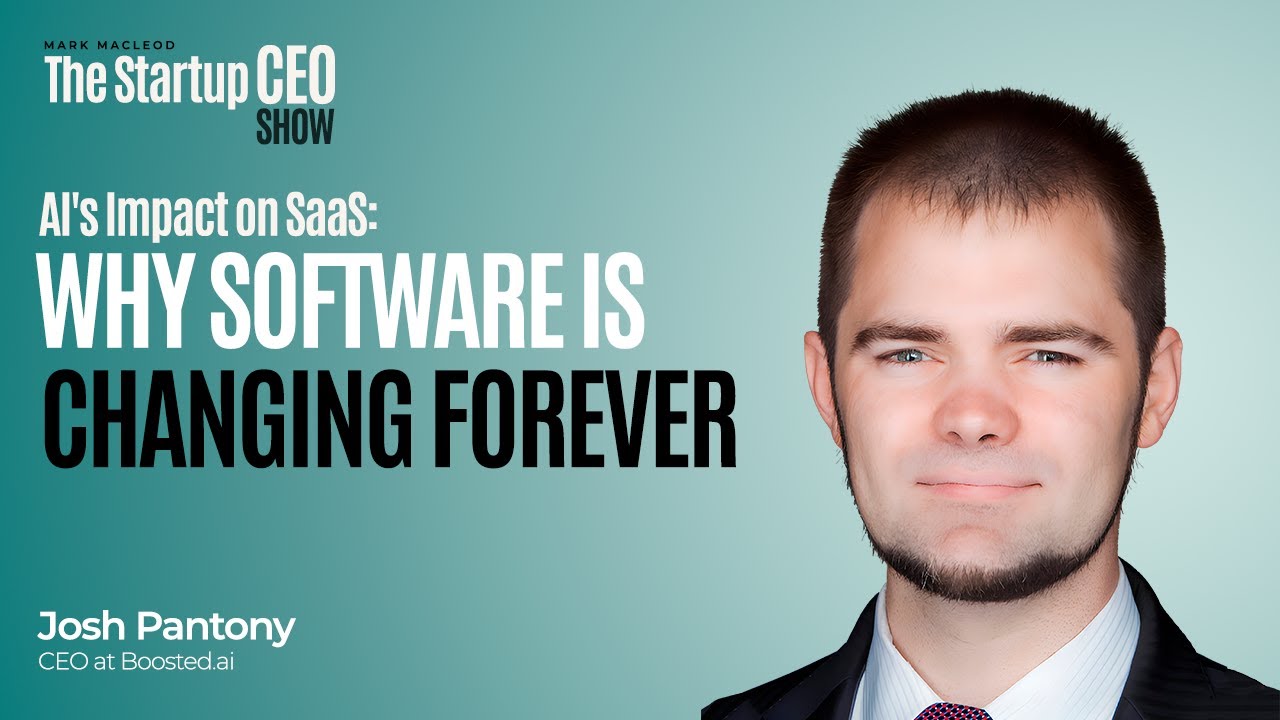
Josh Pantone, CEO of Boosted AI, built AI workers that automate finance workflows like earnings-call analysis. He traces AI's breakthrough to the 2017 "Attention Is All You Need" paper and argues generative AI is collapsing traditional software moats through code generation and UI auto-generation.
Chapters
What is Wall Street? Ultimately, what is the stock market? It is actually one of the most important collective intelligences that's been built in human history. It's the system that decides the most efficient allocation of capital. It's the system that decides what technologies, products, companies should be developed in order to effectively create the maximum amount of wealth for society as a whole. And so fundamentally, when I started this company, the idea was if we could make Wall Street more efficient, we can make the capital markets more efficient, it can have a fundamental effect on all of society. So 10 years from now, I would like to be a company that is incorporated into every professional manager's workflow. I'd like to be a part of the decisioning system in which everything is made. And the sort of net effect to that for society as a whole is an even further acceleration of effectively wealth creation. I want to be the sort of cyborg element of the brain that is guiding the best decisions on where to allocate capital and how to grow the economy. Welcome to the Startup CEO Show.
I'm your I'm your host, Mark MacLeod. In this episode, I sit down with Josh Pantone, co-founder and CEO of Boosted AI. When I think of founders who are just born for the role that they're in, Josh comes to mind. Josh has been in the AI space, specifically in financial services, for a really long time. He's worked at Bloomberg, which many consider to be kind of the default tech player in the space. In this episode, we unpack his journey on his prior company. He's already had a great exit behind him. His decision to leave that company to go to Bloomberg. And we spent a lot of time talking about AI generally. He actually gave me a big education on AI and why it's kind of such a big deal now and his thoughts on SaaS. Uh, punchline: if you're a SaaS CEO, you better be figuring out AI. And just talking about the impact that his company is having on the financial services market, which is of course one of the richest markets in the world. I really hope you enjoy this episode and I hope you subscribe for future episodes. Josh, welcome to the Startup CEO Show. It's a true pleasure to have you here. How are you doing today? Excellent. All right, cool. I got lots of questions for you, Josh, but maybe just to set the stage for what we're going to talk about, just tell people what it is that Boosted does.
Yeah, so Boosted AI is a system that makes it easy to build these sort of little AI workers. Specifically in the investment management space. So hedge funds, portfolio managers, analysts, large banks, ETF providers basically use our system to create these little AI workers where they'll teach them to do some kind of work and then it'll do that work on a continuous, continuous basis. I think one of the biggest things that's maybe different between this and other agentic plays is there's a lot of workflows in finance that really repeat. You know, every time there's an earnings call that comes out, there's a specific set of work you're going to do. Every time there's an update to an 8K, there's a specific set of work you're going to do. And so we basically help users build these little workers that just automate parts of their daily processes.
Right. Oh, that's fascinating. I have lots of questions about Boosted, but let's maybe, let's take a step back and actually talk about, I mean, I want to get into all of your history, but let's, you know, when I used to be a VC, and I would look for, you know, this was a lesson I learned kind of after a little bit. I didn't enter the industry with this insight, but like founders who were like uniquely qualified to build this company, right? Like I always found that the best investment opportunities were based on a really simple, crisp insight. And so often that, that the ability to create said simple, crisp insight came from actual deep domain knowledge. And so when I think about you and I think about kind of founder problem fit, it seems like it's bang on. So maybe you can just like talk about that and just like, uh, maybe even just the origin for this and just, I don't know, I feel like you're uniquely qualified to do what you're doing, but yeah, maybe let's talk about the origin. Yeah.
So I'm, uh, I've been in AI for actually a relatively long time given the current crop of AI founders. Um, I really got started back in 2008, 2009 as one of the co-founders of Maluuba. Um, for those who haven't heard of Maluuba, uh, we were basically like a Siri competitor. We powered LG, Samsung, uh, BlackBerry, Windows Mobile devices back when that was a thing. Um, and eventually got bought by Microsoft and turned into what was called the Turing team. And that team eventually went on to actually build the first version of Copilot, a bunch of other really cool things. I was actually the CTO at that company, not the CEO. And that was really, really fun. I built a lot of cool technology there. I was there for a number of years. I eventually got recruited by Bloomberg to help Bloomberg start one of their earliest machine learning groups. And at the time, they had basically no AI. You know, I've been talking to a few companies, been talking to Google, Amazon, a few other folks, but what really intrigued me about Bloomberg was it was this massive data terminal with huge amounts of very difficult data. Uh, very, very hard to use. You can take an entire MBA course on how to engage with the terminal.
Oh my God.
And, um, the goal of the team that I ultimately helped build was to make it simple and easy. It was like, come in, ask a question, get an answer. So it was kind of what I'd done at Malooba, but really, really supercharged for the finance space. Uh, we ended up building this really advanced search engine, a bunch of other question answering stuff. It was a lot of fun. So I did that for a number of years and after the Microsoft acquisition, you know, started thinking a lot about what I wanted to do next. And I guess to like kind of rewind on that a little bit, I'd actually left Bluba before they got bought.
Oh, you did? Okay.
Yeah, yeah, yeah. So I had been, I helped build it up until we got our, you know, first, let's say, 20 million customers, something like that. 20 million users, I suppose you should say.
Um, and sounds like a non-trivial amount.
Well, especially back then, actually. Um, you know, these days I feel like you get those numbers fast, but back in 2012, 2013, it took a lot longer usually. Um, and, uh, so when I ended up at Bloomberg, um, it was actually kind of a, let's say, a challenging tax situation. Um, uh, anyone in the world who, uh, ever has a Canadian CCPC and then goes to the US, I'll just say, uh, do your homework. It's a little more complicated than you may realize. Um, and so kind of long story short, uh, I ended up back in Toronto with a whole bunch of liquidity. Uh, I had to actually leave what had been a really awesome growing career at Bloomberg, and, and I had to think really quickly what I wanted to do next.
Sorry, you were forced to leave because of the Malooba exit? Yes. Okay. That's a champagne problem.
Uh, it, it, it was, it was kind of funny though, because it was like, when I was there, my bonus was like 40% my comp or something like that. So I actually walked away from that, um, to get Canadian, um, residency and a whole bunch of other stuff in time. Um, and, uh, uh, you know, sort of walked away from what had been this developing career, suddenly had a whole bunch of cash and I was kind of thinking about what I wanted to do next. Um, And we thought about a lot of different things, uh, just some folks I'd known at Bloomberg. Um, but it was actually my old boss at Bloomberg, a guy called Jonathan Durando, the same guy who'd convinced me to join Bloomberg, uh, who kind of forced my hand. Uh, we'd been talking offline about a bunch of different stuff and he calls me up one day and he basically says, hey Josh, great news. I'm like, what? And he's like, I quit my job. I'm like, what? Um, he's like, yeah, I'm ready to start building that company we were talking about. And that was really where—
You're like, I was totally joking. What are you doing?
I still bug him about that to this day. And so it really started off with the two of us and we thought about a lot of different things. I think kind of right after Malooba sold, I think it was the year 2017, the paper Attention Is All You Need came out. Um, and I don't think we quite realized just how important it was going to be yet, but there was this general sense that a lot of the kinds of approaches we'd used at both Bloomberg and that I'd used at Malooba were about to fundamentally change. And there was about to be types of work that could be unlocked that you really couldn't unlock, uh, in the past. Um, and in particular, after spending all this time at Bloomberg, I saw just how sort of behind the curve finance was and investing overall. Um, And it's this really interesting space where, you know, I think today maybe as much as 50% of what analysts do could be automated. Um, but it's also like one of the absolute biggest total addressable markets in the world. It's one of the most high value and high impact types of work that you can apply automation to. It's also a space where, you know, people are constantly bombarded by information and just giving them even marginal ability to absorb more information than their peers can have a really high impact. And so it seems like a really interesting space to get into. So John basically forced me at gunpoint to start this company with him. We started looking at the space and in the beginning I think we actually went about it all wrong. We started thinking about it as more of like, could we do a better robo-advisor?
Oh, nice.
We had some success there, but the robo-advisor thing had already kind of played out a little bit at that point. There was already a few people that had raised a bunch of cash on it. And I think VCs were starting to figure out that just because you have $1 billion in AUM doesn't mean you should have a billion-dollar market cap. Uh, um, so then we started kind of play around a few other spaces. Uh, we started interacting actually with, um, uh, credit unions and groups like that. Um, and then finally, uh, I met who eventually became the third founder of Malooba, uh, a guy called, sorry, of, um, of Boosted AI, a guy called Nick Abe. And Nick had actually been a former portfolio manager himself. He was working sort of middle management at RBC when I came across him. Um, and he suggested the idea that if you're going to make the most powerful weapon in the world, you should sell it to the people, uh, who need the most powerful weapon, who use those things. And so we started going out and actually talking to a few portfolio managers. Um, very quickly found some folks that were willing to pay reasonably large amounts of money for a competitive edge. Um, you know, had this really wild thing where, you know, we'd spent years in the kind of like R&D space exploring and trying it out. Um,, and then late 2019 went from like $0 to $1 million in revenue, basically overnight, uh, in a 6-month period, uh, raised our first venture check from there and was off to the races.
You wanted to avoid a poor market, like you wanted markets that could afford to pay for your product. So definitely sounds like you're, you know, you're, you're obviously the choice of kind of your vertical, very rich vertical, clear ROI, anything that gives you alpha you're going to pay for. So yeah, definitely checking all those boxes. Maybe let's, and, and, you know, also thinking about your timing, like, so AI is, everyone's obsessed about it now, but of course it's existed for a long time. It was just called machine learning. 2008, 2009, that strikes me as like, I don't know, peak Web 2.0. So you were ahead of of this new curve. So I'm going to ask a completely technically dumb question. Like, is it just Moore's Law that has made AI so possible now, given that, like, to your point, you were working on it kind of a long time ago, and of course, as a concept, it's existed for decades?
So it's a combination of two things. Certainly Moore's Law is an element of it, but I actually think we had enough compute as early as 2013 or 2014 to start making the kind of models we have today. Um, and so it's not just Moore's Law. Um, you know, I think the other thing, of course, is the amount of data you could train on, but arguably we also had that amount of data in 2013 and 2014. I think it's actually two fundamental unlocks that have massively changed it. Um, the first is we got really good at what's called unsupervised training. Um, so to give a little bit of context, when I built my first company, Maluuba, um, we were one of the first companies to start figuring out how to get large amounts of effectively annotated data. So, so we trained our systems on maybe 300,000 examples of, uh, basically think of like queries. And we'd sort of teach the machine, okay, this is a query that's talking about restaurants. This is a conversation that's talking about movies. This is a conversation that's talking about, I don't know, purchasing a retail product or something like that. And before we had done that, you'd had a bunch of basically only the really big corporations to be able to do it. Like the really big corporations like Google, AT&T, this company called Nuance. And they were paying like millions of dollars.
Are you still taking your own meeting notes? Let me tell you about an AI tool that I'm using to take meeting notes for me.
It's called Fellow.
It's an AI meeting assistant. It takes human-level AI notes. It tracks my action items and decisions and keeps everything in one place. Built with security and privacy at its core, Fellow is the only AI meeting assistant that leaders trust to capture meeting notes and recordings while keeping your data safe. Thousands of organizations are consolidating tools and relying on Fellow to capture their meetings. The team at Fellow is so confident that you'll love it, they're offering an insane deal to Startup CEO listeners: 90 days of unlimited AI-powered note-taking and recording completely free. Visit fellow.app/ceo to sign up today and experience the AI meeting assistant trusted by leaders everywhere. Nuances like natural language processing?
Yes. Yeah. Yeah. Um, arguably Siri. I mean, Siri started as like a DARPA project, right? So, so Siri was basically like, they had, um, a ton of people, uh, that were basically like hand coding, uh, different systems. Um, we made two fundamental unlocks at Malooba. Number one, we were the first to start using in, in mass scale, I think, or one of the first to start using in mass scale. Crowdsourcing, where we would go out, you know, pay people a penny to do an annotation, um, and then, you know, track hundreds of thousands of annotations that way. And before we even did that, we did another interesting thing where, like, we were trying to find a way to get hundreds of hours of data to train on. We couldn't afford anything. We had zero dollars. We hadn't raised any money. And so what we noticed was TED Talks. TED Talks had, um, audio clips and then They were one of the first to try to transcribe it. So they'd actually have humans transcribe it. And so they had this massive set of data. It was like hundreds of hours of someone giving a TED Talk and then the text that went along with it. And then we started thinking about, well, can we get subtitles from movies and things like that? And so that was one of the first really cheap annotated datasets, was we'd go out to stuff like that and we'd start training our models on that. And we were one of the first to do it. And we just did it because we fundamentally could not afford to pay the huge prices that big companies were doing. And we built a really quick dataset that way and we built something. But you still needed some form of annotation. You still basically need something where it's like, here's a piece of data and I'm telling the machine what this means. And there was this period of time where people started thinking, well, could I just give it the entire web? Could I just give it like literally every piece of text? And, you know, in 2012, 2013, 2014, the kinds of techniques we used to get value out of that data, the sort of what we call unsupervised training, just only worked for abstractions. It was like trying to understand how similar two words were or trying to understand the general context of what something meant or trying to understand the sentiment, right? It was like really, really like basic kinds of embedding models that we were doing. Um, so one of the inventions that was necessary for modern AI was this concept of next token prediction. Given a sequence of words, can I predict what the next word should be? Um, and, and interestingly enough, we call these things large language models. Um, but they actually come out of like these old hidden Markov model systems that were trying to basically do the same thing, but in a much, much, much more basic way. So, so step one was learning to train a model from all data through this concept of next token prediction, which was a very novel idea, at least in the way that attention networks articulated it. And then the second thing that attention networks did that was really revolutionary is really prior to that, we had these sequential models where you'd use this thing called backprop through time. Which basically meant that if I was trying to predict a sentence, I'd have to kind of like predict the whole sentence in sequence. So I predict this word, this word, this word, this word, this word. And you could not parallelize that really. You could not run it across multiple GPUs. You just had to have one really powerful GPU. And so what happened with Moore's Law really was we got to the point where you could get much more powerful compute if you could figure out how to spread the compute across like a million computers. And I don't exactly remember what year, but at least in 2015, 2016, everything was still these sequential models that you could only really train on one or two computers. And you could take a pedantic argument that there was, uh, you know, these like averaging techniques that would kind of do it across different computers, but they weren't truly independent, and there was a limit to how much you could scale. So the other thing that attention networks did that was really, really smart is they created a way to train every word independently, every token independently, if I was to be a little more pedantic. That meant you could train a model like 1,000 times faster, 1 million times faster. I mean, just take your context window. I can now, if I have a context window of 200,000 tokens, that's 200,000 times faster that I can train it. That means, sorry, 200,000 times more computers I could use. Let's put it that way, than like an old sequence-to-sequence model.
That's a complete game changer.
Massive, massive game changer. So number one, Now I can train on the entire web. And number 2, now I can use all the compute in the world I want to train this. Those are the 2 things that fundamentally led us to the modern era of generative AI. And in 2017, Attention Is All You Need, you could kind of detect that those things were maybe possible. I think what shocked most of us was just how much intelligence you could unlock. Uh, if you jump all the way back to like 2010, there was a general belief that feedforward neural networks were the smartest thing that you could do, like the old-school nets that we had back then. There was this fundamental belief that like everything else was just people playing around with stuff. Attention networks really completely fundamentally changed the game and made things possible that frankly I didn't think would be possible in my lifetime. So sorry, that was a very long answer.
Yeah, no, I feel like we could do an entire podcast on this. And for me as like A buzzword-compliant neophyte. I'm like drinking from the fire hose, but maybe we'll move on. You know, you glossed over what feels like a really important decision when you were talking about just your journey to Boosted, which was your decision to leave Malooba. Can you talk us through that?
Fundamentally, I think the biggest shift happened there was, was actually the, the sort of founder's journey. So we started that company, we were really young, I think like I might have been 22, 21, early, early in life. Um, and you know, we, we spent a few years before we were an official corporation kind of working out the prototypes and thinking about it. And we went through a few different iterations there. Uh, we were, um, at one point, uh, going to build like a mall kiosk kind of product. Um, at another point we were thinking we're going to replace cashiers.
Um, Very wide set of ideas. I like it.
Um, eventually someone said put it in a phone dummy and then we were like, oh, that's actually a great idea. And that's how the first version of a eForRemotely consumer app, uh, got, got built. Um, fundamentally, I think the biggest difference between me and the CEO at the time, uh, was just a belief in how big it could become. Um, the interesting thing is, so Sam was the CEO, I was the CTO. Sam believed that he could become what OpenAI eventually became. That was really his dream. He fundamentally wanted to build a multi-billion dollar company. And the ironic thing, as an aside, is if he'd waited a year, he might have been able to do it. Um, um, I, after we got Samsung, BlackBerry, and, um, uh, and Microsoft as customers, I don't know if we'd quite landed Microsoft yet, but we were in conversations. But after we got BlackBerry and Samsung as customers, Um, you know, we got to really high revenue very quickly. Um, but I didn't see much more room to grow. I was like, well, we could try to go into call centers. We could try to go into cars. Uh, we could try to go into TVs.
This was strictly like an OEM play, white label, you stick it in your device and off you go.
Exactly. Yeah. Yeah. Yeah. So we, we used to get money basically based on every BlackBerry that was sold. It was, it was a great deal. As an aside, if you can get an OEM business, very long sales cycles. Um, but if you can get into a situation, yeah, exactly. And they tend to be like 7-year-long contracts. Revenue. Um, great arrangement. So we'd already done pretty well at that point. Um, we had a few folks offer to buy us and, you know, all of us came from like, let's say middle class, lower middle class backgrounds. So when you're like 22, 23 years old and someone's offering you like $100 million for the company, um, we would have been life-changing for all of us. Yeah, it was extremely compelling. And, and I got to give huge credit to Sam. Um, he had no interest whatsoever in doing that. He wanted to build a billion-dollar company. He was very convinced he could do it. Um, I fundamentally, uh, at the time did not agree. I, I thought there's a limit to how far this technology would go and there's a limit to how big the market can go. And we know nothing about selling to call centers. The only reason we were successful selling to these big carriers, because we are engineers, we know how to talk to engineers. Selling to call centers is going to be a different process. We didn't even know how to approach them. We didn't, we had Didn't know the first idea on how to sell into that. Um, and, uh, you know, we'd started the process with selling it to cars. Um, anyone who wants to be in automotive, it's like a 7-year sales cycle. Like by the time we were landing our first auto deals, we'd already sold to Microsoft. Um, so, you know, we hit like in the range of $10 million in revenue and then I just saw no path to go past it. Um, and by the way, I was right. Uh, you know, whoever it was, 4 years later, we were still at $10 million in revenue. But, you know, he was right that the premium on AI would go up. We sold for north of, well north of $100, I'll say that. And I think the other thing that ended up being somewhat prophetic is like, again, if he had actually waited a year, Attention Network, SoliDID, would have come out. Moova would have been the best NLP company in the world. And we actually maybe could have been OpenAI. It might have been a realizable vision. I just didn't see that technology coming. Um, so that was my lesson.
Did he call you up and be like, I told you so?
No, we, uh, we, we, we are, uh, he's actually eventually started his own company. He's raised capital. Uh, I don't know if he's out of stealth yet or not, but he's doing very well. Uh, there's another founder, uh, Jiwoo, started a company called DebtMind. I think he's also doing well. So all of us went off and, you know, I talk about, uh, trying to be the Malooba Mafia. Um, um, and you know, I think the great thing about having that kind of success in life is it lets you sort of play in a bigger sandbox. All of us are thinking big this time. All of us are aiming for a multi-billion dollar IPO someday. And I think it'll be easier to do than if we tried to do with Malooba.
100%.
I think the other thing we didn't anticipate way back in, you know, 2012 was back then when we trained models, uh, we would spend $5 in compute training a model, something like that. Even $5. Like cents. You know, it cost a lot of money to get the data, but once you had the data, you were like training it on a graphics card for 10 minutes, right? Um, I think the thing that none of us anticipated was to become what OpenAI eventually became, you needed hundreds of millions of compute. And that, uh, that need and that discovery of the scaling law, um, was something that probably would have taken another 2 years, I think, even after the acquisition. So, um, you know, I like to joke that we could have done if we waited a year, but I think in actuality we sold at a good time. So yeah, I mean, long story short, I left fundamentally because I didn't think the company could go where the CEO thought it could go. And I had an opportunity to make a life-changing amount of money at a different job. And I took that opportunity.
Fair.
And, you know, it was a positive ending. We still keep in touch and, you know, converse every month or two. Obviously huge overlaps in network. But, uh, he was just a little more aggressive in the first run than I was.
You know, there's two things you need to succeed in business and in life: alignment and shared values. This is a line that Mike, co-founder and former CEO of FreshBooks, beat into my head all the time. And you two just weren't aligned in terms of what the terminal kind of vision of this thing was.
Yeah, I always tell, uh, I guess younger— I don't know how to say that— newer entrepreneurs, um, to treat having a co-founder is very similar to having a marriage. Um, you know, you may in fact actually spend more time with your co-founders than your wife. Um, and it's oftentimes very high impact, very stressful scenarios. Um, and so yeah, I, I totally agree with you.
Talk to me about, um, how you transformed yourself from a CTO into a CEO.
Okay, so this was, um, this was really interesting. Uh, I actually just between you and me, and I guess everyone listening to this podcast. I really enjoy the CTO job. I'm happiest when I'm tinkering, when I'm playing around with new tech, when I'm thinking about where the technology is going. And I think it's a good thing that John was my old boss, because otherwise I'd probably drive him crazy with the amount that I get involved in the technology stack to this day. But I wanted to try something new. Um, I, you know, I built up the first company as CTO. I also felt like with the kind of background I had, I couldn't think of a better CEO. That's not hubris. It's just I had an interesting combination where I knew the technology really well. I knew the base we'd be selling into really well. Um, and I also thought as CEO, I'd be better able to use my network that I built between Bloomberg, um, and, uh, and Luba to recruit some of the best talent. Um, So there was a lot of things that were different. Um, I would say the biggest challenge was hiring sales. Uh, when coming as an engineer, there's so many different things about managing sales that are just fundamentally different. First of all, how do you identify a good salesperson?
Especially because they're, if they're good at selling, they're going to perform well in an interview and then that's a false positive often.
Tons. Yeah. And I also think you can, like in the early days, like you're kind of fighting a little bit for product market fit. Um, and so is it that your PMF is bad or is it that you've done a terrible job hiring? Uh, turns out for our first 2 years it was both. Um, um, but it took a long time before I got a person that was good at sales. Um, and I did not hire through a standard practice at all. Uh, what actually happened is eventually when we got the first version of the product we were able to sell, uh, we started getting some portfolio managers who wanted to invest in the company. Um, and, and there was a gentleman, uh, actually Michael Priest, uh, who's still with us, who was an early angel investor. Uh, he, he was a portfolio manager. He was, he was a co-founder of, of, um, a hedge fund out of New York called Mira. They were like a $3.5 billion hedge fund. He wrote a check and then he got really excited about what we were doing and he said,, do you mind if I join the team? I said, that sounds fantastic. He was my first real sales guy and he wasn't really a sales guy. He just knew the space, you know, got us some of our first clients.
You know, a $3.5 billion hedge fund, I can run the math on the management fees on that, let alone the carry potential. So he walked away from that?
He walked away from an absolutely insane comp package. I don't know if I'll talk about it online because I don't have his permission, but—
Wow.
Yeah, he, he was both really convicted in our mission and I think honestly he had more fun here, but Um, that's an endorsement. Um, he was the closest thing to, to a proper sales guy that, that we actually had. Um, and then really quickly there was someone else who had actually been a portfolio manager, um, who started off as a client and then got excited and then joined us at sales. So those were my first two salespeople was basically an angel and, uh, and a client. Um, everyone I tried hiring before that just, it went terribly. They didn't know how to sell or, you know, they misrepresented themselves and also like for me personally, there's a lot of times in my past where I've hired someone and actually gained mentorship from that person that I was hiring. Um, I would— I'm a little bit— we were really selling to engineers and we were selling engineers on an engineering problem. I think like one of the other biggest adjustments in selling to this space is most engineers until recently didn't really have much budget power. They weren't really the decision makers on where to allocate. Whereas when you're selling to a big tech company, Everyone up the entire stack understands technology, and you can sell based on the technology itself. So that was one adjustment, is like just learning how to sell value in a different way. The other adjustment was like learning the kinds of personalities that can sell. Um, and then I really just did that by kind of getting lucky with an investor, learning from them. And then after I'd seen them sell to a few folks, uh, then I learned enough to understand, okay, here's the kind of people I need to find. Then I started getting a few others. And at that point we started to build a proper process. You know, today I've got a CRO who was the ex-CRO of Blockdaemon, has built a bunch of very large, very high-impact organizations. I'm learning a ton and he's awesome. But in the very beginning, building a sales org was just very, very challenging. Something that was fundamentally different. I also think the other big difference between CTO and CEO is like you have to learn so many other parts of the business. You need to be good at making financial forecasts. You need to understand the concept of, you know, client acquisition cost to lifetime value. You need to understand the idea of actually doing marketing. What does marketing look like? How do you think about product positioning? Some of those things I'd kind of learned in my first business, but many of these things were fundamentally new skills. And I'd say if I was to like condense all that into like one coherent piece of advice, get as many mentors with as many different disciplines as fast as possible because you No matter how smart and intelligent you are, there's going to be things you're going to need to learn. And there's a lot of things that you just, I think, fundamentally can't learn in a textbook. You have to encounter the problem in a real-world situation and then get advice on how to navigate it.
Yeah. That, by the way, this could also be an entire podcast. So we'll, we'll skim the surface on this one. Maybe let's talk about disruption. And there's probably a few different ways we could approach that. You know, back in my operating days. It's actually gonna be 10 years this week since I left my last CFO gig. Like the world's changed a lot, you know, back when I was helping run SaaS companies, we had these product roadmaps that went out 6 quarters with great certainty and we'd just, you know, slowly twist a knob here and turn a lever here and just gradually move up and to the right. And it feels like this long-term planning is kind of a luxury and maybe a thing of the past now with AI. And so I'd be curious on your thoughts, I guess, um, maybe let's come back to your thoughts on SaaS afterwards, but just tell me, like, give us a view into like running kind of an AI-native company today. Like, I just get this impression, like, if I'm a CEO of an AI-native company, I'm like trying to disrupt myself before I get disrupted. Is that, Is that your world?
That's such a great description. You're like constantly almost trying to like cannibalize the product you had 6 months ago. This is the biggest difference, I think, between when Luba really hit its stride in like 2012 versus where we are today. When, when I first got started, I think my biggest superpower was like learning what was possible in academia that hadn't been applied yet. To a commercial setting and then learning user needs that could be unlocked in a fundamentally new way. And I'd say like I did that at Bloomberg, I did that at Maluba, I did that for many years. And in an environment like that, it's possible to have a technology mode that can be years ahead of your competition. Um, ultimately we hit a point with Maluba where if you wanted the best NLP technology in the world, there just was nowhere else you could look. Um, anyone else trying to build it, it would take them so long to figure out how to formulate the models, to figure out the method we had for getting our annotation for, I mean, just all these different things that sort of lead into creating this really valuable LLM product. Um, the new 10 years is like 6 months now because things are moving at such like an insane exponential gradient. Um, I don't believe it's possible for any company to have a moat that big. Um, actually, I think the incumbents are going to be the most smashed by this because I think there's many incumbent companies where their moat is like billions of lines of code that have been written by humans And I think the cost of producing that code is going to reduce like 80 or 90%. And so small little startups that can iterate fast are going to be able to smash the incumbents in a big way. But that also means if you're a high-growth startup, it's fundamentally easier than it's ever been, uh, for someone else to come in and smash you. And so the kind of like durable moats that we used to have are just very, very different today. And I think that's the biggest challenge about being the CEO of a startup is your pace of innovation. Has to be insanely high just to keep a few quarters ahead of your peers. Um, and there's some fun elements of that. I mean, the sort of flip side to that is like every quarter we build technology that did not feel possible to me when I was younger. Every, every quarter we're seeing something new get built that is just absolutely insane and beyond anything that, uh, you know, we do things in a week that I think fundamentally would have taken us like a year back in the day. Um, the flip side is like you always have to maintain that pace and it creates a very interesting dynamic. I, like you, remember having a nice predictable forecast. It feels very step functiony these days where you make these ginormous breakthroughs both on a revenue side and on a product side. But then you're also seeing that happening with your peers and you're kind of, I like to call it like riding the bull. You're constantly riding the bull. And that makes it a very different dynamic than the old days.
That's fascinating. You know, back when I was a CFO, it was easy. I'm thinking about like annual budgeting, right? It was easy to kind of sit down with your go-to-market leaders and figure out costs because there was like a known determined result and ROI and payback period and all of that stuff. And I'd always have a bit of a bunfight with R&D. As to how much we would spend. And I typically worked for product-oriented CEOs who were just like, we're gonna spend X percent of revenue on product and engineering, and that's just what it's gonna be. I, I feel like in this world today, this is the temptation to just continually amp up the spending and therefore continually postpone profitability. Does that feel right to you?
There's some truth to that. I'd say the flip side is It's also possible to build highly scalable organizations on a smaller amount of, uh, with higher talent density, but also a smaller number of bodies than it used to be. Um, there's lots of examples of companies. I mean, I don't remember exactly how big Cursor was, but like a relatively small team that really quickly got up to like $300 million in ARR. That's bonkers.
Yeah.
I mean, um, even when you think about like the number of employees to revenue at like an Anthropic or an OpenAI, I mean, OpenAI OpenAI was making billions of revenue with like a few hundred employees or something like that. Right. Um, so, uh, there, there definitely any situation where you have a huge amount of venture capital pouring in is a situation where there's huge pressure to effectively expand at all costs and not care about capital efficiency. And we certainly feel that very directly. I'd say the flip side though is like you can build so fast with a smaller set of people, um, that if you're strategic enough in thinking through the direction you want to go, what you want to build, the market you want to capture, uh, that it's possible to capture absolutely massive upside with way less capital than you used to use. So you've got both things happening at once.
Maybe you've seen the clip where the CEO of Microsoft talks about how SaaS is dead. And, uh, you told me something once that scared the crap out of me, which is you felt like UIs would auto-generate in a few years. I don't know, what's your prognosis on On SaaS?
Oh, did I say a few years? That was way too conservative. It's happening now, like, by end of this year. Yeah, it's interesting. I mean, you're starting to see this a little bit with like Replit and Lovable and some of the other products like that. But fundamentally, where we kind of see the world going, it's going to get like 80 to 90% cheaper to produce code. You're going to increasingly see these agentic systems that can kind of generate code on the fly. It's going to mean the cost of software is going to go down to zero. And I think fundamentally the kinds of SaaS products that we're used to, um, are either going to change or just go away. Um, I'm obviously highly focused in my industry. So if we just for a second there think about finance, what is the biggest player in finance right now? It's the Bloomberg Terminal. What is the Bloomberg Terminal? It's 15,000 screens. That have all been hand-coded, specific front end and a specific back end. Mm, these screens are probably using anywhere between 5,000 to 10,000, uh, lines of code on average. Um, collectively across all of them, it's billions of lines of code, but already with the technology we're building, I think about 20 to 30% of those screens can basically be hand-generated on the fly as the user wants it. I think honestly, in the next 3 months, we'll be able to do about 80 to 90% of it. Um, and you know, by year end, you're, you're, you're talking like the majority of the terminal. And I think it'll be quite obviously a better experience because, uh, with the terminal, you have to learn the exact screen. You have to learn the UI. It's this thing that's been around since like the '80s. Our systems like ours will be able to generate the screen you care about. It'll learn who you are as a personality, figure out what you care about, generate on the fly. And it'll be an intuitive experience because it'll all be the exact same thing. You wouldn't even have to think about it. You just kind of show up and there'll be a UI with whatever you want. Generated. And so today you're starting to see that technology applied, you know, for the product managers or for the engineers. There aren't too many that are like going out to the end users yet, but it's really, really close. Like literally, I think in the next few months. And by the way, I'm describing what's going to happen in our system. I don't think it's very long before you start seeing OpenAI and Anthropic and systems like that basically generating software on the fly for everyone. Again, they already do it a little bit, right? If I go into Anthropic, it'll generate a little piece of code, it'll generate a little UI, they create those cool little artifacts, um, to give it a few more months. And I suspect all of those are going to generate whatever code you care about, whenever you want, and just host it. And yeah, I see that basically consuming the entire software ecosystem, um, in some way, shape, or form. Um, I, again, there will be all kinds of like little cool things that'll come out of it. Um, but I fundamentally agree, SaaS in the form that it existed before is dead. And we almost see it kind of going in a different direction. Service as a software. Totally, totally different from what came before.
That is truly fascinating. I think, I don't know what the aggregate market cap even of just publicly traded SaaS companies is, but it's in the trillions. Like, they better figure this stuff out. That's really, really fascinating.
Some are, by the way. There's definitely some that are being really intuitive and ahead, but I think mostly it's gonna be startups disrupting incumbents because startups could just move so much faster.
You know, I had Tobi from Shopify on the podcast last year and a couple of things come to mind. One was, you know, you talked about how much you just love playing with technology and Tobi told me like, there's days where I wish I was still just a CTO. It's just like the thing that he loves so much. And then I had Glenn Coates on the podcast recently. I had helped Glenn sell his business to Shopify and now he leads product for Shopify. Shopify Plus, and he told me that Toby is just spending inordinate amounts of time in AI. You know, any new model comes out, he's figured it out, and then he's like the very next day, hey, why haven't we implemented this? Like, I guess that's just what a SaaS CEO needs to do these days is become very, very intimately familiar with AI and figure out how to disrupt themselves.
I actually, against the advice of many people, uh, started coding one week a quarter.
Oh, amazing.
Primarily to understand what was possible. Um, and then in some cases to build prototypes to sort of show my team what was possible. Um, I, yeah, I, I think it, it must be very challenging being a non-technical CEO, uh, navigating the environment right now because the, the pace of change is so high. And, and like I said, when, when things are moving as quickly exponentially as they are, when they're accelerating as fast as they are, a single quarter misstep can fundamentally ruin your business. Um, and so it's challenging for me as an AI native who's been operating in the space for years. Um, I, I can't imagine for someone who's not a technology native trying to keep up with it. It feels like it'd be very hard.
I know you're vertically specific, so I, I think I know the answer to this question, but I'll ask anyway. Like, what is your, uh, frame of mind when OpenAI or Anthropic are releasing a new model? Are you nervous, excited, or indifferent?
I think it's really important for anyone building a business right now to set themselves up in such a way where 99% of the time when Anthropic or OpenAI or someone else releases a model, you're excited. If you're getting existential dread every time there's an improvement to their system, um, you are probably not have a durable business. Um, and so to the best of our abilities, we try to understand where do we think the technology is going over the next 3 to 6 to 9 to 12 months. Um, I actually don't believe anyone, uh, including, uh, the OpenAI and, and, uh, uh, other large leaders, uh, know where it's going to be a year from now. Um, because all of us were seeing crazy disruptions we didn't expect. Um, but I think you can kind of understand where it's going over the next 9 to 12 months. And I think it's really important that when you're building product, uh, I always ask my product team this: does this still make sense when LLMs are 10 times more intelligent than they are today? Um, and so I, I get excited mostly for us. We've got a reasonably good mapping of what our user needs are. We've got a reasonably good mapping of where the gaps are. Uh, we've got a reasonably good mapping of what kind of intelligence we need to unlock those needs. And when a new model comes out, there's a new set of user needs that have been unlocked. There's a new set of things we can do. And we're able to sort of like step into that. The way I like to describe our technology, fundamentally, we believe that the people in finance using the best technology are going to win, and we provide the best technology in finance. So at all times, we need to make sure that when a new model comes out, we're able to sort of surf that wave. And encapsulate it in some way, shape, or form. Um, there are ways to build moats. I don't think they're going to be as durable as they were 10 years ago, but there are ways to build moats here. Uh, and there's ways to think about things in a way that's fundamentally different from what the big providers are doing. And I think we've been reasonably successful at doing that.
Amazing. So, so let's take that statement, like, the players in your vertical will win based on the best tech. You have it. So what's your vision for Boosted? When you're done and you look back in the rearview mirror, what impact have you had? What have you built?
Okay, that's a big question. I think the easiest way to unpack it is to actually ask a question of what is Wall Street ultimately? What is the stock market? Um, and to me, the stock market, if it's functioning well, is actually one of the most important collective intelligences that's been built in human history. It's the system that decides the most efficient allocation of capital. It's the system that decides what technologies, products, companies should be developed in order to effectively create the maximum amount of wealth for society as a whole. And so fundamentally, when I started this company, the idea was if we could make Wall Street more efficient, we can make the capital markets more efficient, you can have a fundamental effect in all of society. So 10 years from now, I would like to be a company that is incorporated into every professional manager's workflow. I'd like to be a part of the decisioning system in which everything is made. And the sort of net effect to that for society as a whole is an even further acceleration of, uh, effectively wealth creation. Um, I want to be the sort of cyborg element of the brain, um, that is guiding the best decisions on where to allocate capital and how to grow the economy. Wow.
I love it. Now let's say you have that impact. We talked about moats earlier. You talked about moats. In a world where every investment manager has you, does that mean alpha goes away or does it mean they get more alpha or it's just like a race? I gotta get, I gotta use the alpha before it disappears.
Yeah. Yeah.
Yeah.
Yeah.
So I love that question.
Um, and probably one of the earliest questions I was asked from the very first time I had the first germ of the idea. And the way I've always thought about it is the early users of technology in this space gain an alpha advantage. Eventually, though, it reaches a point where it's no longer an alpha advantage. It just becomes a high watermark. You need it to be a professional. If we were to again use the Bloomberg terminal as an analogy, I did work there for 9 years, so I use it for a lot of analogies. In the early days, the Bloomberg terminal gave gave unprecedented visibility into the bond market. It gave you an alpha advantage because you could better understand the pricing of the kinds of things that you were buying versus your peers. Today, nobody thinks of the Bloomberg terminal as an alpha advantage. It's just fundamental to how you do your job.
It's table stakes.
Table stakes, exactly. I see our technology going the same way. 10 years from now, it'll be so ubiquitous, so common in how everyone thinks about the world that you just won't even consider doing your job without it. Um, I think the kind of advantage you'll get will be less than the early movers. The first movers get a huge advantage over everybody else. Um, but I think when it becomes ubiquitous, you just need it to even function.
So that's a giant vision, right? Giant opportunity because you have a very large, rich TAM. So how do you think about fundraising for this company, right? You know, it used to be again, SaaS businesses, it was sort of meat and potatoes, right? There was some correlation between the amount of capital you raised and your valuation and your revenue, and it was step functiony, but not, I don't know, like not exponential. Whereas with some AI companies, there's almost, in the early days, no correlation between the revenue and the capital that they raise. And it's just, absolute arms race. So how do you think about that?
Yeah, I actually like the analogy of an arms race here. So I talked about earlier about, um, how I see software getting 80 or 90% cheaper. And I also talked earlier about how, you know, if you look at something specific like the Bloomberg Terminal, I think there's going to be agentic systems, uh, they're gonna be able to reproduce like 98% of what the terminal can do, um, in the next like 6 months. Like it's happening imminently. Our system will be able to do it imminently.— and I don't think we'll be the only system, there'll be other systems that can do it too. So that's observation number 1, is like the incumbents are going to get massively disrupted. Observation number 2 is I'm very convicted it is going to be a startup that does it. The reason I'm convicted it's going to be a startup that does it is because we do releases twice a week. We are constantly iterating, constantly learning from our users, and so we can grow exponentially. When I was at Bloomberg, it was like 1-year development cycles. We'd build something in a cave, show it to users, Uh, sometimes we had good releases, sometimes we had bad releases. We'd go back and iterate on it and then build it again. Right? Um, there was tons of projects that went 5 or 6 years without getting released when I was there. I just don't think companies like that are going to be able to keep up with the sort of pace of technology that you're seeing. So observation number 1, the incumbents are going to get smashed. Observation number 2 is probably going to be a startup. So then how do I think about my company in relation to that? Um, the third observation is we noticed that when people get used to using our product, it's really hard to get them to switch. But the same is true of a competitor. If someone is using a competing product, we have to be exponentially better to get them to use our product. This is probably one of the most conservative spaces in the world. People do not like changing their workflows. And so that leads me to the conclusion that there's going to be sort of one company that's going to be a leader and capture the entire space. And that company will be the most important company, one of the most important companies in the world. And then the second company might get, you know, 13%. The third company might get 10%, and by the time you get to company number 4 or number 5, they're just eating crumbs, which is kind of how it works today with like Bloomberg, S&P, FactSet, etc. Um, and so for me to earn the right to raise large amounts of money, I need to show a credible path to being that leader, to being that one who's going to capture the entire space. And of course, revenue is a part of that story. Um, but I actually think user adoption growth, um, the ability to capture as many people and the ability to actually build differentiated offerings. Those matter just as much, if not more. And I think the situations in which you've seen these really large valuations, um, in some cases, like in a pre-revenue situation, it's because they were able to sort of capture the imagination of the VC about this is what the future can look like. And this is how we are that future. Um, One of my favorite examples is actually Devin AI, um, where, uh, you know, at the outset, I think a lot of people in my space were a little bit critical of the amount of money they raised, but the reason I think Devin raised so much capital was because they showed what an agentic system could look like. They were one of the first ones to sort of unlock that UX and credibly show, here's how an agentic system could credibly do some of the work that a coder does. Um, I think there's going to be lots of other products like that where the power of the product, the ability to sort of capture the imagination of the ability to capture an entire space, that will create a massive incentive to buy a discount relative to future valuations. And that's how you raise money right now.
Amazing. You know, I wanted to touch on that conservative aspect of your market. And so maybe this is a great final question. And by the way, I feel like this could have been a 2-hour conversation. So we might just have to have you back another time. But, um, I think about I realize there's many different ways to slice and dice your market, but you know, the, at the, the biggest end, right? The, the JPMorgans, the Bank of Americas, the BlackRocks, huge trusted brands. Like what is their readiness to embrace this kind of innovation? Yeah.
So it varies. I'd say the, the really interesting thing about the space is they can be a little bit conservative on the starting gun, but when they start to move, they tend to move all at once, all very quickly. Um, and that's something we've seen, uh, you know, I'd say in, in Canada, actually, ironically, like, all the big banks seem to be moving all at the same time in a very big way. Um, you know, in the US, it really has—
very un-Canadian.
It, it is, and it's something I find interesting. Um, I'm, uh, yeah, who What did I just say on air? Uh, that, um, there, yeah. Um, in, in the U.S., it really, I think, has been the very large hedge funds, pod shops, uh, groups like that. But I think what happens really quickly is, um, you know, the, the hedge funds have a huge amount of pressure to move fast, be ahead, think about information asymmetry and other things like that. And then once you get ubiquitous enough, it creates more momentum and pressure on the rest of professional managers. Um, So we saw kind of in the beginning a lot of these internal AI committees pop up. We saw a lot of extensions to the kind of procurement process and things that you would need. I'd say, you know, kind of over the past 6 months, a lot of those firms have finalized those processes. And if anything, we started to see kind of the opposite where there's now top-down pressure to adopt. And it's the top kind of trying to force the more conservative portfolio managers and analysts to use it. And you know, where before, if you were a sort of tech-forward portfolio manager or tech-forward analyst, uh, that was seen as a sort of risky thing to do. Now it's the opposite. If you are someone who's more, let's say, tech reticent and AI reticent, that is seen as the more risky move. And so I think that's really fundamentally shifted the adoption curve and what we're seeing in the market.
Fascinating. So do you think, uh, I don't know if I'm a young business grad looking for an analyst job, that's going to go away in a few years or?
I think the job's just going to get way more fun, way more fun. Uh, you know, I'll pick on a few things here, right? But like, if you're starting as like a young investment banker, you're spending like 80 hours of your week generating, uh, let's say not the most interesting presentations that have been made in history, right? Um, that kind of work is going to be like 80% automated. If you're a young analyst, uh, the kind of job of like writing a squad analysis or reading through an 8K or trying to build a financial model, these are all examples of things that are going to be automated. So then what's left of those jobs? Well, there's a huge part that can't be automated, and that's the human-human interaction, right? A machine will not be able to have a conversation with management as well as an analyst will. A machine will not be able to sell or pitch a deck to a set of clients as well as a junior investment banker will be able to. A machine will not be able to eat the latest pizza from the company you're covering. Computer AI will not be able to attend conferences. There's this huge amount of information that doesn't exist in written form that really is like human to human communication. And that's going to be the new bottleneck. And so I'm actually super excited. If I was a young grad, absolutely get into this. Just be the first guy to start using AI on your floor. Because AI will do all the boring work that you didn't want to do before. And the things that are going to be left are the most delightful, awesome parts of the job. And people go into IB banking because they love meeting executives. They love, you know, flying different locations, right? That's the glamorous part of the job, and that's the part that's gonna be the main focus. So yeah, if anything, I, I, I double down on going into it.
Very cool. Well, Josh, this has been fascinating. I've learned a lot. And like I said, it could have been a lot longer. Thanks for educating me on some of the technical aspects, and I'm sure that our listeners are really gonna have enjoyed this episode. Thank you so much. Awesome.
Good to be here.
Hey, thanks for listening to The Startup CEO Show. If you'd like to connect with me, be sure to visit my website at markmacleod.me or follow me on LinkedIn @TheMarkMacLeod or Twitter @MarkMacLeod_. And if you want to tune in again next week, be sure to subscribe on YouTube, Spotify, Apple, or wherever you get your podcasts. We'll see you next time.
More from Mark





The Burnout Breaking Point - How Strategic Breaks Actually Increase Productivity


Emotional Debt - How Avoiding Hard Conversations Compounds Into Company Killing Resentment


The Death of the Specialist - Why AI Is Creating a New Professional Class Called Scalers