Beyond Profit: Building Soulful Corporations in Tech with Shrad Rao
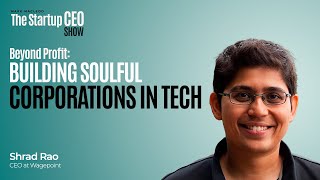
Interview (Startup CEO Show) with Shrad Rao, co-founder of Wagepoint, reflecting on stepping down as CEO after a private-equity transaction and on leading a "soulful" tech company that blends Eastern spiritual practices (intuition, non-attachment, compassion) with Western operational rigor. Major themes: creating space for thinking/intuition instead of constant busyness; designing company structures that elicit care from employees; compassionate approaches to hiring, mentoring and parting ways; and applying tech/AI to meaningful social problems (notably education).
Chapters
And then like, there's this idea of doers and thinkers, right? It's like hands or brains, like, what do you need? And the truth is you need both. That's the. That's the reality. Both. Every person has the ability to be fully both things.
Welcome to the Startup CEO Show. I'm your host, Mark McLeod. In this episode, I sit down with Shraddh Rao, co founder and CEO of wagepoint. I've known Shrad for many years, and I've been a customer of wagepoint for many years as well. Shrad and his team recently led the company to a private equity buyout, and he made the really big decision after over a decade, leading the helm to step down as CEO. So in this episode, we unpack that. But we also took a bit of a tangent from the normal episode. Shrad has kind of an eastern spirituality background, and we went pretty deep into that as well. And I really hope you enjoy that because we really. What those kind of more contemplative conversations provide for us is an opportunity to build self awareness. And that is the number one key success factor for CEOs. So a little bit of a different discussion for what you might be used to. I truly hope you enjoy it. Shrad, welcome to the Startup CEO show. It's a real pleasure to have you here. How are you doing today?
I'm great, Mark. How are you?
I am perfect, honestly. Both of us have spent some time in Canada, but are not currently in Canada. I'm currently in Barbados. There's a giant temperature difference between home and here. Yeah. So I'm perfect and you're like in the Atlanta area, is that right?
Yeah, yeah. It's like 16 degrees Celsius here. Like, I'm. I feel bad for all our Canadian friends right now.
That's right. That's right. And so you and I have known each other for some time. There's lots to unpack here. I want to jump right in. You just stepped down from the CEO role of a company that you've run for over a decade. I want to talk about the transaction that led up to that. But first of all, like, how does it feel to be able to have taken that step?
Well, you know, kind of a. It's more emotional than I thought it was going to be. And that's saying something because I think I'm generally fairly sensitive. But the. It's sort of like right after it felt like, you know, I was sort of on a train that was going like a hundred miles an hour or maybe like a Eurofin Train that's going like 360 kilometers an hour, you know, and then I just thought overnight, right? And then I was kind of like, like I, it's like I went out of the train window and I continued to go for like, like for the first couple of days afterwards I couldn't sit because it just kept so much energy that wasn't being directed anywhere. And I'm not saying that's a good thing. I actually think, you know, it's good that even by, by day two or day three, I started land and then the emotions kicked in, which was interesting because what you really experience is a profound sense of exhilaration and loss and grief almost around the same time because you are losing, you know, sort of your place in that problem, whatever that problem is. Like for me there was a bunch of reasons why I started the business. It wasn't just, it's never been monetary. Like I'm more of a how you do something than a, you know, like a do it for the purpose of like, you know, material gain kind of thing. So anyway, it's been a, it's been an interesting experience. Like I would say that I don't think I've ever had an experience quite like it because it both feels like heartbreak and that person's still alive. So it's kind of not at the same time. And even though I, you know, were precipitated by my own decision in many ways it still never, it doesn't, it, it doesn't actually. You don't understand the feeling of caring for something and then just stopping overnight. Like if you have a child, for example, you don't just stop loving it when it turns 18, right? You just kind of, you don't go like, all right, well I guess that was all right, you know, So I think those are all the sort of the main emotions. But now past, I'm past like three or four weeks almost. So I'm getting into the new habit forming stage. And now I'm having the best time I've ever had, Mark. Like now I'm enjoying every single minute because as they're telling you now, I can become a free thinker. Like my mind is open and expansive and I can look at any part of the equation of how we live in society and go, I think I might be interested in solving some of these problems. So yeah, that's a complex answer to your question, but that's generally how it feels.
I'm curious how much of your identity was wrapped up in being Shrad the CEO?
Not much And I'll tell you why. Because when I was a kid, and I say kid, but I just mean, like, when I started the journey with WagePoint, I was 29 when I began, I had $18,000 in my bank account. And I said that, that I'm doing that because I've always been, I was always going to be an entrepreneur. Like it was, I knew it even as a kid. And so ever since I was young, I read a quote from, I think it was the IBM CEO, and he said, if you think it's hard getting 200 emails a day, wait till you get to.
Wow.
Yeah. And immediately I was like, yeah, okay, you got to be careful because you can't attach too much to the, like, you got to, you have to view it in a way that, where it's separate from you and you view the responsibilities of the role, but you don't get enmeshed in it. Like, you don't actually become it. So I, I was always careful. Even, like, if I go to parties and stuff, I just say, I run the business. I started a business, but I try to stay away from the CEO kind of jazz just because it, it just, I feel like it's encumbering. And I didn't want that encumbrance because I knew one day it'll be over. And I just don't want to have to deal with all of them, like, killing all the layers off. So I, I managed it the whole time. That's why I'm here. Three weeks later, I can talk to you. Because I, I, I'm like, actually like, thank God.
You know, the part that's amazing sounds so healthy, to be honest. You know, I don't know how many CEOs truly would have that detachment from their business. I saw it particularly during COVID Right. You know, so prior to Covid, the CEOs were used to being kind of masters of the universe, flying here, fancy dinner here, board meeting here. And now they were stuck at home and, like, still trying to be captains of the universe, but then at the same time being asked to, like, I don't know, can you fold the laundry? Can you walk the dog? Like these cool, quote, unquote mundane things, right? And like, they really struggled, like, what the hell, I'm this really important person, you know? And anyway, so it sounds like you had a really healthy relationship with your role.
No. Yeah. And generally, like, the older I'm getting, the more I realize what an idiot I am. So I don't have, I don't have any delusion And I think as I mentioned to you, like I grew up with a very different philanthropical system than if I had grown up maybe on the western side of the fence. I think my outlook and so the way I like to think about, at least the way I approach things is that I'm an intersection of eastern, Western culture like in terms of like, you know, like the beating spirit of our company has always been more Eastern. But then our operational execution, which is where I think like really Western culture has done an excellent job obviously scaling to incredible heights as a civilization. So it's like really taking the best of both worlds. And that cross disciplinary kind of intersectionality, whatever you want to call it, that had come to my help, usefulness, it helped me my whole life. So one of the Eastern philosophy principles as you know, is about not attaching to the outcome. And that would be an example of where like I, I learned it as, as a very young child and I more or less practiced it most of my life.
Well, let's dig into that a little bit. So if I were to generalize, I would say maybe Eastern principles would center around being present compassion, like a calm company. And Western principles would be about achievement, striving more, more, more this, deliverable that. Deliverable. More emails, the better. More dopamine. So they seem. How did you make them compatible? I guess is the question.
It's really where you want, it's where you use what. So for example, in the like let's call the operationalizing of some of the work, you really do need to have, you know, sort of more of a logical lens, if you will. And so then you're like the way you. I think another way to think about it is an intuitive lens, which is what an Eastern lens tend to be and a analytical or logical lens which is what, you know, most of Western culture is built on. Socrates, you know, Greek philosophy. Right.
I think therefore I am, which is you're now attaching to the thoughts in your mind which is so deeply unhealthy.
Yes. But even that like you know, Shakar says know thyself so and there's lots of recorded like if you look at the history of the world, there's a lot of recorded interaction between Greece and India just as an example. So there's a, you know, so the thing is that ultimately our, the world is a blending of cultures and a blending of ideas. So really the point is to take the best out of everyone as opposed to, you know, saying this is good or this is bad. Everything has a place and to Use them in the right place. So I'll give you an example. You know, when you're dealing with employees, okay, here's kind of the reality of where we're at in society. The employer employee relationship is an actual relationship. It's like the relationship that you have with your spouse, your kid, your dog, your friend. It's like an actual relationship, but it is very conveniently treated as a relationship when it is a, you know, when you're interacting with the employee. And then it's a legal relationship that has boundaries and, you know, like all of these legalese, essentially when it's convenient. Again, there's a really, there's been very little to no dialogue, talk, talking about what is it? What does the relationship mean today? Like, what does it need to become? Because if you remember what it used to be like for our parents or our parents, parents generation, there really wasn't an idea of empowerment, right. Like you couldn't really ask people to, you know, you wouldn't ask them. What do you think you'd say? Here's what you need to do, right. If you extrapolate the relationship where it's at today, right? So what you're going to find is that people, employers in general are asking employees, they basically say, I'm going to give you direction. You meet me there. Okay. I point to place X, you meet me there. Employees are saying, okay, but can you give me instruction for how to get there? Okay. So there's this, there's this, there's this battle between the two sides or this tension between the two sides because actually both of them don't know what is the real expectation of the person. Both sides are actually misaligned, or not even misaligned, but just wrong about what they both want. And so that would be a place of intuition, right. Like you. Because jobs by inherent nature, the kind of work, the knowledge workers that we are, we're actually just trading information and knowledge. There's no material, tangible things I'm talking about in our types of business, like tech businesses. So you need to almost use that, the intuition to guide you in those relationships. So I would use that as an example of where you have to apply like more Eastern philosophy, like when you're, you know, when you're thinking about dealing with inside of that relationship, that's a great place to think about that. But then on the side where you have to do performance marketing, for example, you know, you'd want to be more, I'd call it, you'd be more and more analytical about it.
Yeah. A little more scientific. Yeah, yeah, exactly.
So that's kind of how you think.
I think intuition is deeply underrated. You know, I'm a Kundalini yoga guy and been practicing it for a long time now. Started teaching it. I actually taught a class to my wife right before this. And one of the things that, that has really drawn me to Kundalini Yoga is I think it really increases our potential as humans because we tap into this kind of dormant energy and kind of channel it through our chakras. And I won't get too woo woo. But like, suffice it to say, like, what, what Kundalini has brought to me is all the things you get from yoga. You're flexible, your spine's healthy, all that stuff. But a true getting past the rational mind. And like, my teacher tells me that our rational mind is maybe 10% of our potential and our intuitive or subconscious mind and actually tuning in not to our brain, but to our hearts is actually the real wisdom. And so you look at all these CEOs, right? Like, and God bless them, right? They're learning machines. They're reading all the books, all the blog posts, all the podcasts, right? They relax from work by reading, listening to podcasts about work. They got coaches, they got advisors. It's all good. But the thing that they're not doing is tapping into their intuition, and they can't because they've given. No, like, intuition needs space, right? You can't go from zoom meeting to zoom meeting to zoom meeting and then pound email and pound slack messages and expect your intuition to speak. It needs silence to be heard. So I'm curious, like, how did then, like that, how did you create space for intuition and then at the same time create a company that had the success it had and was sufficiently interesting to private equity, right? You achieved from the outside what every Western focused CEO wanted to achieve, but you did it with this balance. So for folks who might be inspired by that, I'm just curious how you did it.
Yeah, that's a good, good question. You know, that's another. Reminds me of another story. So I watched Bill Gates and Warren Buffett talk a few years ago on Charlie Rose. And Bill Gates was telling Charlie Rose that, like, I used to go to all of these meetings. I feel like every, every day was back, like, you know, every 15 minutes. But he was meeting with Warren Buffett once and he's like, listen, I don't have a lot of time. I, like, I have to go pretty quickly. And Warren Buffett says, why are you so Busy. Like, why are you in so many meetings all the time? And Bill Gates was like, what, what do you mean you don't have a lot of meetings. And then Warren Buffett shows him his diary and of course, you know, he took writing it and it's almost nothing in it other than like, you know, a few little one thing here or there. And, and Warren Buffett's like, if you're always in meetings, when do you have time to think? And that's the main thing. The, the point of the job is you are like the chief thinker of the company. You are thinking about what needs to happen next. And man, when I'm telling you about this thinking thing, Mark, the thinking problem is curvaceous. It's not the CEOs who are acting like that. The entire company is like a busy beehive.
Busyness is rewarded.
Yes, because action is rewarded. Like the whole thing is biased action. I want to tangle whoever came up with that because you should be thinking first and then acting because then you will actually expend less energy. Like if you think about it right, like at cave people, if all we did was go and like kill everything and we didn't really think about the the like, we didn't think about the the like we used to like as a thesis, we used to burn down a forest to get all the tubers and like all the, you know, like that was our most efficient way to get energy. Like we had to do no work, let the fire do the work and then we'd have the thing. So this idea of like, you know, like really spending time thinking about what you should do next and then pick the most elegant thing actually saves you energy and saves you all of that busyness. But boy, I tell you, I don't think I've seen many companies and ours look pretty much the same where you could get everyone to slow down enough to think deeply about what they're doing before they do it. I would argue that that's the difference between an Amazon and a Google and a, you know, like these hyperscale companies and everybody else. I would argue that that's fundamentally the difference is that like one of the things they do is they go out and they, why do they pay like people all of the, you know, $200,000 at entry level job? It's because they're going to get thinker, they've gone to get thinkers. Like all, all they do is go stop with thinkers. So, and then there's like this. Sorry, I like you've touched a Bit of a subject. Let it go.
This is, this is good.
And then like there's this idea of doers and thinkers, right? It's like hand or brains, like what do you need? And the truth is you need both. That, that's the reality. Both. Every person has the ability to be fully both things. And it's because of the way our, like you talk a little bit about like Western, like especially like work culture. It's actually, it's actually more like a war. It's actually built more like a, like an army. Companies are built more like armies. Like you send your battle, you know, your soldiers out to battle on different front. But really what companies are. Community are communities, right? Like they're, they're, they have to, it's like they have to drive from flourishing ideas and. But you have to channel and direct all of that. That's the job of. It's like almost like you build the pipes in the company that allow the thinking to flow through the company. And that is something like as time passed and you know, like I could never. The vantage point of my life when we had two employees and 200 employees, that vantage. Those vantage points just changed how I saw the organization of people. Like, and how do you actually. So the thing is, I, what I'm most proud of is that I actually cracked the formula on getting people to care.
Tell me about that.
Well, it's very simple. It's very simple. See, when you pay an employee and they deliver a service, they will tell you, you've, you've hired me. You need to tell me what to do. Okay, we'll tell them in return. No, you, you said you know how to do this job. That's why I hired you. And this is what I mean when I say this is the, this is sort of that, that thing that no one can talk about, which I'm like kind of blown away by because they're both right. We just haven't agreed on anything. Right. Like, so, so anyway, and then when you sort of get into the sort of the nuts and bolts of it, the. Because the legal agreement, there's an actual physical legal document between you and the employee. Right? And by the way, I view myself as employee as much as I view myself as the employer. Like I, I'm as much with. Because I grew up in a middle class household. So for me, like, I'm very much with the people. Like, I don't see why we have to trade one, you know, for success. Like, why we have to like trade people for like success. Like I Just don't get it. Anyway, so when I think about that legal agreement, that's the fulfillment of the obligation between both sides. You come, you've done whatever, whatever it looks like.
Where.
That's the, you know, both sidekicks shook hands. So where does caring come into this? Right? So caring can only happen. You can only get your people to care about what they do if you care about them. That's it. That's the entire. The formula. There's no other way to do it. There's no. There's no way to fake it. There's no way. And the thing is, they watch your action, right? So if you say, oh, you know, like I said, people used to tell my tell like, we're a family. And I'm like, stop it. We're not a family. If that was true, we wouldn't be able to part ways with each other. I can make. I can make the decision, and you can make that decision. We're a group of friends who are choosing each other. And just like friends, we may also unchoose each other. So you have to keep retraining everyone's mindset on what they're actually doing there because, and I don't blame them in any way, but people in general want to feel close, they want to feel connected, they want to feel together.
It's a core, core human need.
Yes. And I don't know if you've realized it, but the world is actually like, if you look at the pace of change and I mean, I know you realize this, you know, all of this at the pace of change in the last 30 years is so, so fast. And like now, like, I hear people like, you know, even the super smart people are usually able to keep up with everything, say stuff like paper, change it too fast. Well, what about all of the people who have been left behind? Every single, every single time there's been a change, there have been people who have been left behind. And I'm telling you, like, it. It's unbelievable to me that we don't talk about this stuff. We just kind of go, oh, well, you didn't, you didn't climb on board with like this new train. So, you know, I see you later. That's basically how people are treated. Now, again, I'm not saying that we don't have agency and individual responsibility. Of course we have all of those things. But my experience at working with a company is, first, you can absolutely get people to care if you care about them. Two, it's up to you as the leader or you as A leadership team to create the structures that actually to bring out the potential in people. If after you created those structures, they don't do it, then it's on them. But until those things have been put in place, it's on you. It's on you as a leader. And because we don't talk about this stuff as leader, we just all pretend. Everyone's just in a great pretense.
How do you part with people who just can't keep up? You've told them what's expected, you've enable them, but they just can't keep up. How do you part with them in a caring way?
It's not easy. Like, there's only been a couple of times when I really thought someone really deserved it. And I couldn't. I just couldn't wait to kind of move away from that relationship. But generally, no one really deserves it. Like, that's the truth. What happens is that we. It's all an expectations issue. Usually, like, that's where it. That's where you kind of have like, somebody's like, I didn't think I had to do that. And then you'd be like, no, but that's what you have to do, right? So there's no real great way to do it other than being really honest with people. Like, so one of the things that we started doing is we talked like there was a time, and we would, like, you know, people would come to a call and then we'd basically like, give them the news and then we'd sort of shut down the act. That. And I sort of feel like that very traumatic for people like, that there's not an easy way to like, say goodbye to something they were doing for like even a year, for example. So we started doing more working notices where we just said like, you know, like. Because we just started trusting people. This one person is really funny. Like, I'm the one who made the. I parted ways with him and I told him the truth. I could. Dude, you are way over your head here. Like, you. And we talked about kind of company he'd need to be at to be successful. I obviously talked about giving him references. And then I hung up. And then I. Two seconds later, I called him back and I said, actually, dude, would you like to stay and like, just get working notice instead? And he said, absolutely. He stayed. And he was one of.
He.
He was so. He was so upstanding the whole time. So this is the thing, right? It's like you have to like, really take every individual ad on their own. Merit and say, is this person really going to be a Rick? If not, then just do it like the compassionate way. It's just much better for everybody. So that would be an example.
Are you still taking your own meeting notes? Let me tell you about an AI tool that I'm using to take meeting notes. For me, it's called Fellow. It's an AI meeting assistant. It takes human level AI notes, it tracks my action items and decisions and keeps everything in one place. Built with security and privacy at its core Core Fellow is the only AI meeting assistant that leaders trust to capture meeting notes and recordings while keeping your data safe. Thousands of organizations are consolidating tools and relying on Fellow to capture their meetings. The team at Fellow is so confident that you'll love it. They're offering an insane deal to startup CEO listeners. 90 days of unlimited AI powered note taking and recording, completely free. Visit Fellow App Startup CEO to sign up today and experience the AI meeting assistant trusted by leaders everywhere. Now, you said one thing that maybe I'd love to peel back, right, which is that, you know, they don't deserve it. And even though it sucks in the moment, I don't know if it's ultimately a bad thing. And then they're. And so I don't know if deserving comes into play. Like we spend most of our waking hours working and when we're not doing a good job, we can feel it like if we're falling behind, right. There's just, you know, you know, you're not crushing it and so you're actually freeing them to go to a place where it is a better fit and it's not. I'm not rationalizing in my head like I've seen this, you know, like I've removed people before who just couldn't keep up and they've gone on to roles where they go home every day feeling like I fucking crushed it, you know, So I, it was a positive thing.
Yeah, I think, I think that word is probably a bit too loaded for it. You're right in the sense that, you know, there, there's sort of like a, an environment that's right for somebody sometimes. And like, and that how I typically tend to think about it, like building a company. It's like you're, you're creating the fertility of the soil, you know, like you're actually like creating the environment where somebody can thrive. That's your core job as a leader. And then it's up to them to actually. Because you cannot make it. You know, I don't know Like I can't make anyone do anything. Like that's what I learned. They have to choose to do it. And so for that choice to become even like manifest and inside of their own mind, they have to be in the right environment. And in some cases no matter what you do, that environment is just not right. And so by all means that true. But I saw you this like, so I think you might know this. One of the things I did, which I don't know how many other CEOs have done, but I had a cultural call with every single person who was about to join the company that was in the final stage of the interview process and on very rare occasion that they joined without me being able to talk to them right after they joined. So I can actually, I was making a joke the other day that I might even write a PhD thesis on this because it's a 12 year journey of doing these calls. And I would say at this point I probably did about 4, 50, 450 of these calls. And I have like, I have an actual, like I'm going to write an essay about this very soon because the sum of the things that I discovered as part of this call is actually is mind blowing, right? Because you are just talking about culture and what culture means. And I had a specific way that I would go about the call but then I broke it up into key, different. Like I did experiments basically. So you should know, Mark, my entire time at wagepoint, I've been running experiments like a sociologist. Like I've done it with social experiments. Not just like you know, a B split testing, but like actual social experiment because I delete that. The entire, the entire value chain, whatever you want to call it inside of a company needs to get innovated. Everything like it's, there's, there's no innovation in how companies are structured and built. I think that the few companies that have done that really well are companies like obviously Google and you know, Apple and stuff like that. But generally speaking, everyone else just kind of sticks to some sort of best practice format functional department like all this other stuff. But anyway, long story short, this culture.
Call, can I interject a little something there? I could think of one particularly successful CEO who also ran lots of social experiments and that's Toby from Shopify. Long before they were remote as an experiment, he decided to announce to everyone with no notice that we're going remote for 30 days. I basically, tomorrow there's no office, you're just going to figure it out. And you know, a lot of his decisions that he arrived at for how they worked were based on experiments like playing with different team sizes to figure out what was the ideal kind of, you know, size of a, of a development squad. And through that experimentation realizing that decisions should be made by the people closest to them. So he didn't like intellectualize all of this. He just tried it. And every time he was trying something, you know, you see many CEOs, they announce this new initiative with fanfare and a big rollout and a lot of their ego is attached to it, which just creates pressure. Like now this has to work, right? Whereas every time he tried something it was just like, we're going to try it for 30 or 90 days and if it works, great. If it doesn't, we'll learn and move on. Like completely dispassionate. So I really, I really like that approach. Sorry to have interrupted, but you just reminded me of him.
You're 100% right. I've, I've, I've observed a lot and Shabbat is a great example. And I think specifically Toby is a great example. I don't know him personally, but I have a lot of respect for him. I think he's exactly the kind of person that we need. I'm a hundred percent. This is what I'm saying. Like I'm going to be building the next Shopify when I do this because I'm so sure that the way to do this is exactly like that. Like that's how you got to do it. So the, this, this culture call as an example of that simple, that experiment. And the way I did it is I tell the entire company expect experimentation, the companies. And so like performance reviews look this way one year, next year it's another way. And we're going to try a few different things. And I used to, we should talk about how, you know, like it's going to feel uncomfortable, but just let learn together. Let's just, let's just figure this out together. Like in any format. Because the thing is, nothing stays the same. So the thing you have to prepare everyone for is the change, right? So it's like most of what I think about is philosophical and very often metaphysical because at the end of the day, like what I think Toby has done very well, although I don't know him. Let me call. I don't know if I should take Nick Crotoldy, but what he's done very well is he's identified that human beings are a combination of behaviors and essentially their mindsets and their spirits, if you will. And it's kind of interlocking those things correctly like a Rubik's cube. You have to kind of turn, make it desired algorithmic changes to get all four sides to show correctly. And I'd say he's an excellent example of that. Another, another really good example. Although he's somewhat more maligned these days than I think is necessary. But it is Steve Job, right? So he, you know, he was actually very into spirituality, like extremely into spirituality, particularly Zen Buddhism. Zen Buddhism. And also like on his, at his deathbed, like during his funeral, he just left everyone with one book. That's basically what he asked to give people a take home or whatever. And it was the autobiography for Yogi.
Oh yeah, yeah, yep. Yogananda.
Yeah. By, by Paramahanta Yogananda. And. And so the, the thing that I'm telling you, the reason that's so interesting is because it's. Even if the first page of his autobiography it literally says that he believed that it's the intersection of creativity and. Which typically come from intuition and technology which you know, let's call it. We know what that is. It's a combination of the two that actually created all of Hypnocrat.
I'll probably include this in the show. I'm going to share at the risk of scaring off some listeners, a big insight that I had over the kind of the year end break. So I came back from finishing yoga teacher training super sick and didn't practice for two weeks, which is the longest that I've gone in, I don't know, well over a decade. And was completely disconnected from the practice. Had no desire to teach. It's just miserable. But that I deeply believe everything happens for us, not to us, even though it doesn't feel that way at the time. And even that did because it created space. And two insights came out of that. First was a realization like, oh, my brain's actually tired. I need to create more space for intuition to show up. I need to stop striving. I need to simplify. I've been so I'm looking for ways to simplify in every aspect of my life. But the second insight was like what could be more important than realizing God? Consciousness. While I'm in this human form now you can decide what God means. I'm not talking about like a white dude in a beard, to use the Christian reference. It could be anything. For me. It's all of nature, it's all of creation. It's on creative consciousness. And you know, I practice every morning. But my life will be profoundly Changed if I tap into that more like more regularly. Right. So I've been kind of reorienting my life to create more space for practice, more space for devotion. And I can already feel it showing up just a few weeks in and like more energy, more gratitude. I've had a daily gratitude practice for years, but now I just feel it deeply, like much more deeply. So yeah, anyway, just absolutely life changing experience.
I mean that, that's kind of how it goes, right? Like, you know, there's like four stages of, of human, of a human life. And really you're on the stage where I think it's called bana pratta. And like in, in Indian philosophy or really culture, the idea is that people are go from students to essentially young adults to householders to then people who essentially eschew material things and you know, go to the forest and meditate or. But just. It basically means like giving up the worldly pursuits and starting to like move more towards like a spiritual center. And you know, it's funny, like you, you said two things already. First you used the word woo woo a while back and then, and then you use, you said the word God. And they're both actually things that are very like. The reason that all of it has to come with a caveat is because there's almost been like a hijack of the word God by again like Western in western culture.
Right? Which is.
And don't get me wrong, like I love everybody. Like I don't see, like I don't care where you come from, but it feeds ideologies. Like we have to be. There's some things that you get from really a great blend of understanding of how the world work and how we work as human beings and really recognizing that we, we do have a spirit when we mix that word with the soul. That's the problem, right? But when you actually think of the fact that there is a universal spirit that is obviously in everything, like it's like it's literally in the atoms, right? Like there's a time when we thought that atoms was the last thing. Now like dark energy might be the last thing that we've ever found. So we just. The thing is that instead of like worrying about what it is, just knowing and starting to pay attention to the fact that it's there and that everyone has it and it's in everything that we do. That's pretty much a good start point in my opinion.
It sure is.
Yeah. It's just so interesting that we like. It becomes such a loaded topic that even though you are not talking about religion at all. You're talking about the idea of the subject, object, experience that we have, you know, like where we know that our thoughts are not really ours or there's an owner to the thought that is not the thought itself. And so just being able to think like that, being able to separate that, to observe your thinking as opposed to being your thinking or to observe your emotions as opposed to being your emotions, that's mostly what you and I are discussing here, which. And I think it. Sometimes it, you know, it can get lost a little bit.
Yeah. Well, I love this topic. I'm very curious. Did these kinds of conversations ever show up inside your company? Did you ever. Yeah. Did Eastern spiritual actually just ever spirituality ever just show up in, in the dialogue?
Yeah, like I, I meant like I. We had a mentorship sort of thing that we did and every. Anyone could mentor anyone on any subject that they thought they had some expertise or specialization in. And so I mentored a few folks on eternal philosophy. And sometimes when people are going through a hard time, for example, like I remember we have this one of our. I'll give her a shout out here. She's our community manager for bookkeepers. Her name is Bianca Mueller. And she, you know, I told her about sort of this, you know, sort of not getting too attached to the outcome and just sort of focusing on the inputs, trying to ignore the output or not ignore, but just kind of have it as a, as a marker in the future for like what you want to get to, but not to get obsessed with it because the end, just focusing on the, on the end or the destination let you focus on the journey.
Right.
So I would talk like that and I remember her telling me just about a few months later, she said that that had changed my life. And the thing is like after I left, the number one thing I got from folks and different emails basically, you know, so yeah, they said that you've changed my life and it's because of that, those types of things that I would teach them. So yeah, it did show up. But again, like I want to be very careful and you know, I don't want to, I don't want to offend anyone or so like if people had a specific faith or whatever, I'm very happy. Like I, I don't, I don't. There's no, there's no need for me to talk about this unless in context. Add to work essentially. So that's what I would. Typically I'd contain it to that. Yeah. Other than in the mentorship session when we really talk about it more fancifully.
So I'm curious. I feel, I. First of all, I wish this conversation was two hours versus one, but we're just gonna have to do around two sometime. But I'm curious. This sort of Eastern approach that I don't wanna say it's better, but you know, it's kinder, more compassionate approach. Do you feel that it ever led to people trying to take advantage of you? They saw this openness as actually vulnerability and tried to kind of jump in there. What are your thoughts on that?
I would say not the people who work, like, not the people who came on board and helped me build the company. I would say no. But I definitely think that people who like, like people who are around the company. One of the big lessons that I learned, like, I mean I learned so many lessons, Mark. I made so many mistakes. One of the things that I learned is like I just started realizing I was building companies with people I didn't know. Like, I don't know the co founders that well. I don't know the financiers that well. And I'm like, what am I doing? Like, why am I working with people I don't actually know that well? And you know the common refrain, right, is like, don't work with your friends and family. So that means you have to work with changer and that actually harder to do because you don't know them and they don't know you. So I think that I've had many times, like this is an example, like, you know, when I was, when I was younger, I like the way I got equity in the companies. The, you know, the, the gentleman I was working with at the time, he asked me what do I want? And I said, whatever you think is right. And that's not how I would operate anymore. That's the naivety because you know, I thought, okay, he's a lot older than me and like he's going to make sure that, you know, he takes care of bulk of us. Because again, at the. How I was brought up. But that's not true.
He's like licking his chop like, oh yeah, here we go.
You know, he's not a bad guy. That, yeah, not, not, not, you know, the good and bad in all, all of this situation. Right. But, but the thing is like, those are the types of things I wouldn't do again. So yeah, I do think that there is a. And like, let's call it like the hardcore money people really for them, some of the stuff it to Boo. Boo. You know, they just like, brother, let's just make them cash here. Like, you know, do we really need to create a soul, soulful corporation or. But they're not. Again, it's their sort of way of looking at the world and framing it. So I say that that has like. But at the same time, I think they recognize that there's something interesting about it because, you know, I would hear a comment like, you know, we don't have any other CEO like you. And I'd be like, I'm really hoping that's a good thing. This is. But that's what they meant because like one of my executive who, you know, they, they, they told. He told them that I would go through a wall, I would run through a wall for that guy. And they were like, we just don't have a lot of people who inspire people like that.
That's what happens when you care about your people.
This is as simple as it gets. Now it's hard to do it, obviously. It's hard to put into practice and it's hard to like. And again, like, I've also this. I'm sure the people listening to this and going like, he wasn't all that great. And I, I'm not trying to make everyone happy. I'm trying to make the most amount of people happy, the most summersome. That that's the best I can do. I'm not trying to get to a hundred percent. So. Yes, yeah, Yes. I think it was. It's both a gift and in some ways it's. It is a bit of a. Can be a little bit of. There's a learning curve, I think, in relationships and how to deal with somebody who like I made, like I made the least amount of money in terms of compensation for like multiple years in the early days, like three, four years almost. And I was okay with that. But it was like I had to kind of stand up for myself eventually because I realized that because I had said, like, if we do a comp change, let's talk about it as a group. But again, like, we didn't have that, we didn't have that relationship or that culture built because we came from such different ways of thinking about the situation. So when I do this again, my plan is to be very cautious about everyone that's around the business. Not just. And here's the other thing. I'm in this situation now where like, I'm what you call a zero to one founder. And you know, I'm one of those guys who built a company well over $10 million, right, in revenue. So the reality is that, you know, according to some stat online written by some AI, I'm like in the 1% bracket or whatever of people who get there. So I'm going to get to choose all of this, you know, coming up next. And that's one of the things that, on top of my list, work with people I actually know or get to know them before I actually work with them.
No, you truly are like, we see these giant headlines, right, and this company raises some huge amount or sells for some huge amount. Revenue is not always disclosed, but we assume 10 million is common. But it's actually very improbable. You're in pretty rare air, and I know you're well north of that. But most companies and most CEOs never get there. So, yeah, a real accomplishment.
The thing is, the question that really comes to my mind all the time is really, what are we all doing here? What are we actually up to? Because the way I'm sort of looking at it, obviously I'm very connected, looking at AI constantly, who isn't? It's like the next sort of big gold rush. But really, ultimately the question for me, can we use it to solve real problems? Not can we just keep inventing solutions and look for problems, or can we run genetic solutions, look for problems after the fact? Can we actually apply the real problems that we have in the world? And one of the biggest things that I'm worried about or just kind of, I think about a lot is I've actually seen the result of our education system in the workplace. I've actually seen it firsthand. And we started to do like, regular teaching in the company because really, companies are school. Like, they are. They're schools and like, your leaders are teachers. And that's how I'm. That's how I'm going to build another company going forward. And for me, too, just, just because I, I want to make sure that I say this. You know, so many people are going to be left behind on this next ride, on this ride with AI. And I just like, these are, these are thoughtful, caring people. Like, people like, they are not like some people say stuff like, oh, you know, people have to help themselves and like, get lazy. And I don't even know all kinds of shady stuff. But my experience of all of this has not been that. My experience of this has been people are genuinely interested in helping themselves. They want to do the right thing. They want it. What we, the institutions around them are typically failing them. And so I'm Very interested. Like, I'm looking at the education, education space very seriously because I'm kind of fed up of it and I might go like, you know what, I'm just going to fix it. I just, I, yeah, I, I'm, I've, I'm, I'm done sort of talking about it at this point. I'm just going, I'm just gonna do it. So I'm building conviction on that at the moment.
Wow. Well, that's a huge challenge. That may be a great place for us to wrap up. You know, I feel like we could have. There were episodes within episodes here and you know, I don't think we fully unpacked the WagePoint journey, but I hope some of these more philosophical topics and just the importance of intuition and you didn't use the word self awareness, but ultimately I think that's kind of what it's about and that's actually a superpower for CEOs. It's the thing that enables them to, to grow all the way. You called yourself a zero to one person and yet you scaled to 200 people, which means you had to have some self awareness to go through this learning loop to keep growing. And so I really hope that people will, even though this might be a different conversation than they're used to, I hope they, they take a lot of value here and I certainly did. And Shad, thanks for, you know, for a. Making the time and congrats on all of your success and I can't wait to hear what comes next.
Yeah, thank you. Mark, I just want to say you are. I said this to you when we just started the call. You have really blown my mind, honestly, in your own journey. I was so impressed and I can't tell you, I think there needs to be more thinkers like you that are putting out content of this nature. And in reality, most of what we do is we have content that's related to like sort of like, you know, sort of a functional thing, like how do we, how do we get more customers or, you know, how do we engage employees better? But really we don't. We don't spend enough time on the meta thinking of like, again, what, what are we doing here as a species? And I think, I think you, your, your current spiritual endeavor I think will bring more and more of that to light. So thank you.
I appreciate that. Thank you, Shradd. Hey, thanks for listening to the Startup CEO show. If you'd like to connect with me, be sure to visit my website at markmcloud me or follow me on LinkedIn at the Mark McLeod or Twitter arkmcleodore. And if you want to tune in again next week, be sure to subscribe on YouTube, Spotify, Apple, or wherever you get your podcasts. We'll see you next time.
More from Mark





The Burnout Breaking Point - How Strategic Breaks Actually Increase Productivity


Emotional Debt - How Avoiding Hard Conversations Compounds Into Company Killing Resentment


The Death of the Specialist - Why AI Is Creating a New Professional Class Called Scalers