Breaking Gender Barriers in Tech: Alina Vandenberghe's Inspiring Story with Alina Vandenberghe
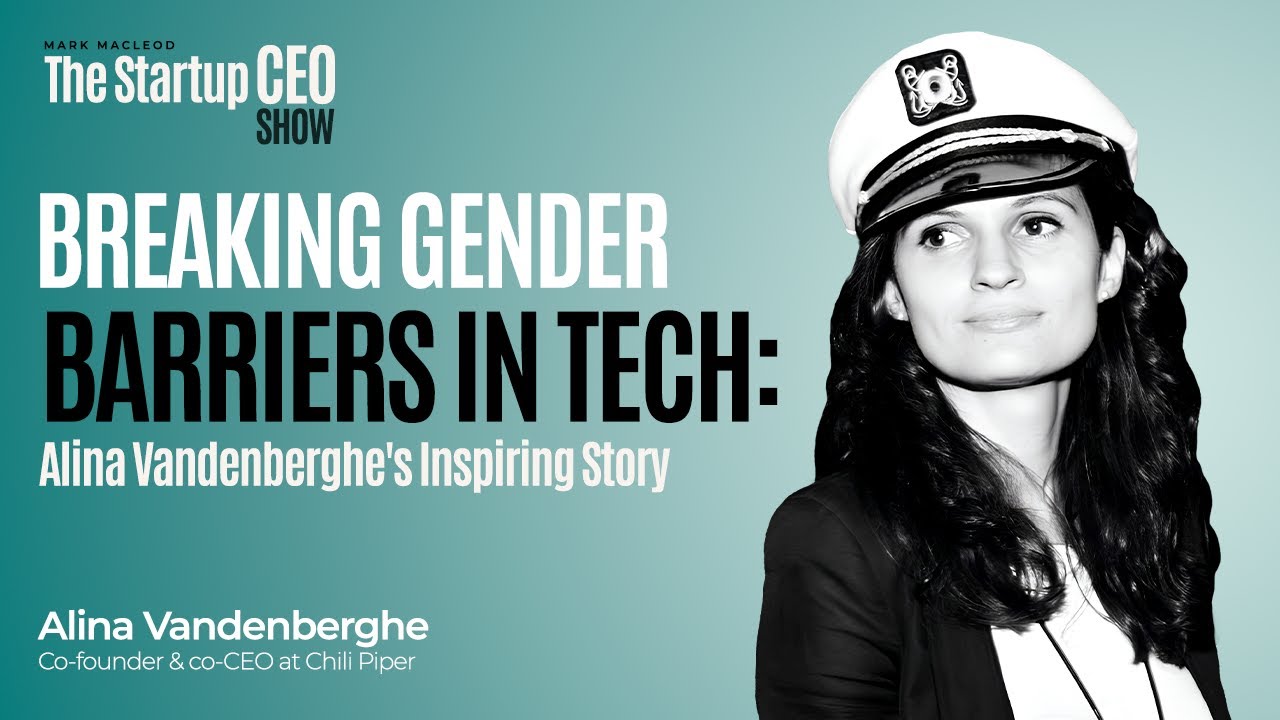
Alina Vandenberghe, co-CEO of Chili Piper, built a go-to-market platform that generates roughly 50% of its pipeline through personal branding and speaking. She runs the company with her husband in a flat structure, credits her resourcefulness to growing up in communist Romania, and uses her platform to inspire women founders.
Chapters
Because for instance, for founders that betted everything on SEO, these days their traffic is being wiped out by Gemini and all of that. So we do a lot of tactics. The most important piece is getting attention, no matter what tactic and what growth play you pick is getting attention and getting attention is really difficult. So for any entrepreneur that starts from the beginning and they don't have that kind of lever to already owning an audience and getting attention, The easiest is to get an influencer in your space, somebody who really people look up to, to buy your product. And they are a lot better evangelists than you. So if you get lucky enough to get one of the evangelists in your space, then you just snowball because then you're renting out their audience. They're going to talk about you naturally if they really like your product. That's how we actually did it at the beginning as well. When we started, we targeted the influencers in our space and we still continue to do that. Like the playbook is also to go towards brands and people that have audience.
Welcome to the Startup CEO Show. I'm your host, Mark MacLeod. In this episode, I sit down with Alina Vandenberg, co-founder and co-CEO of Chili Piper. First of all, I love that company name, Chili Piper. Alina and I met and when we were both in Scotland in May at Turing Fest and we had a great discussion. I thought it'd be great to have her on the show. Alina stands out among many founders because she— there's just one Alina. She's completely open and authentic. She shares everything, all the ups and downs about her company and her life. And in an era of personal branding, I thought it was fascinating that she takes that to another level. And really interesting stat that she brought up on the show, like 50% of their leads come from her social media and speaking work. So it's a big investment on her part, but it's paying big dividends for the company. So we talk about that. We talk about being remote. Her other co-CEO is her husband, so we talk about that. Importance of values. When I went onto the company website to research for this episode, the about section of their website is their values, so they're really important for them. We talk about a whole bunch of other topics. It was a really fascinating conversation. I hope you enjoy the episode and I hope you subscribe for more. Alina, welcome to the Startup CEO Show. It's a true pleasure to have you here. How you doing today?
I'm very happy to be talking to you today.
Okay.
Even if my body is a little bit jittery today.
It's all good. It's all good. Uh, so Alina and I met, we were both speakers at Turing Fest in Scotland recently. Uh, I'm actually Scottish, so it's always a true pleasure to go back there. And I was waiting to go into the speaker's dinner and I turn around and there's these really loud pair of cowboy boots. I was like, who's that? And then we ended up sitting beside each other. So, uh, first of all, kudos on the cowboy boots. Those are particularly impressive. And, uh, thank you.
That was a very fun dinner. Very fun dinner.
It was. It sure was. Uh, which is funny because I can tell you from deep personal experience that, uh, Scotland is not known for its cuisine, you know, but that food was, was really good. You know, I, I, we chatted about potential topics beforehand, and I would love to just jump right into the personal side because you stand out. And first of all, maybe before we go there, let me take a step back and let's just tell folks what Chili Piper does and set the context. But then, yeah, I want to dive right into this first topic.
So Chili Piper is into the GTM space, so go-to-market. We sell software to mostly marketing and sales. But also our main user is ops, in the ops space. We have a product that we're most well known is when somebody comes on your website and fills out the form, they usually get to thank you, somebody will contact you soon. That's because the organization wants to see if they're qualified, et cetera, and that's how they lose a big chunk of their pipeline because then people forget that they fill out the form and they go to a competitor or they get distracted with other things. So what we have is like a very simple solution to immediately qualify and get to the right sales rep, either via a call or conversation. But we have evolved a lot from that first product and now we have in the market an AI bot as well. We have also workflows, orchestration in the, in the, in this space.
I'm sure you've answered this question literally a thousand times, but I assume there's a really interesting story behind the name Chilli Piper, so I'm very curious how you arrived at that company name.
Yes. So it's actually my husband, the one you're hearing that he's making coffee right now. I don't know if you hear him in the background noise. He said that he really loved this brand of champagne called Piper and he saw an ad with it and he saw it was chili, which is hot, and Piper, which is pipeline. Feels like perfect, but it actually comes from the Piper champagne.
Got it. Okay, perfect. Our default drink at home, by the way, is champagne. So when I kind of reinvented my life in 2019, my first marriage ended. It was kind of a big deal. It's like a 16-year relationship, 18, 16-year marriage, 18-year relationship. And I resolved to redesign my life so that every day was great. And one of the parts of that resolution was like champagne. I'm like, why is it just for special occasions? Every day is worth celebrating. I'm gonna drink it every day. And so when I met my now wife, I looped her into this plan and said, hey, if we're gonna be spending time together, FYI, you need to drink champagne. Anyway, she's, she's taken the mantle to a whole other level. Uh, so kudos for naming your company after champagne.
I love champagne too.
Yeah, it's good stuff. You can't, you can't be unhappy with bubbles unless you have too much, obviously.
Unless you have too much. Yeah.
Yeah. So I want to talk about the personal side. You know, you stand out among many CEOs and founders generally because you put all of yourself out there. It just feels like, you know, I haven't been following you for that long, but there's just one raw, authentic Alina and the good, the bad, and the uglies out there. You know, there's so much bravado in our industry, right? You know, you meet CEOs and you ask how they're doing and you're like, yeah, we're crushing it. You meet VCs, how are we doing? We're crushing it, which is impossible because most startups fail. And I feel like you put out the good, the bad, and the ugly. And I wonder if you could just talk about that and how you how you arrived at that and like, how is it like, I don't know, is it therapy for you to just kind of release that? I don't know, just open, open mic to you to just talk about, yeah, that philosophy and that approach.
So I do have a therapist.
Okay.
In case it was not clear.
Yeah, couldn't I recommend that?
But I do write about anything and there's nothing that scares me to approach online and I've had that kind of approach to open sourcing of my thoughts ever since I can remember, because, um, I figured that I always wanted to have a mind that if somebody would access with a microchip or whichever, uh, form, form, and now we can have these tools that, that, uh, start to, to do that, I would feel comfortable. With having that being done to me. And I would be in a room and I would be comfortable to just like propagate all my thoughts. And I know it's, it's a little bit crazy, but when I was very, very young, I think that I would have probably been labeled as autistic because I was very sensitive to very loud noises, to lights, to special kind of fabrics. And I would be very comfortable in being in deep thought for a very long period of time and analyzing a lot of things all at once. And I was curious to see why we might like something, we might not like something, why we get angry, why we get upset. And I would always hyper-aware of my thoughts and how they get formed and the same for others. So as it became a curiosity to try to understand myself better, I also wondered if it's possible to just open source our thoughts in a way that makes us feel comfortable. And that's how I've become more, I'm okay with publishing whatever comes through my mind as well online.
Amazing. And have you always done that? Like, would you, I don't know, write a personal blog before the company or you've more done that in the context of running this company?
No, no, I would be terrified. I was terrified of getting attention for it. I would feel comfortable with talking about in a smaller scale with things that are happening to me, but not on social media. It only, I only became comfortable with it in 2022 at the beginning of the year when the war started in Ukraine and I just wanted to do more to help. And I noticed that me speaking up did help. We managed to help a lot of refugees by just me showing up. And making sure that people are aware of what's happening in there and raising money, going on, creating all sorts of documents that were helpful at that time to get to the right place at the border, get to shelter and get blankets and all those things. So I felt that I could just be quiet or I can have a positive impact. So I picked the second path. Madonni, because of that trigger, I don't think I would've otherwise felt comfortable with it.
I'm curious, you know, you're in the go-to-market space and kind of, I don't know, in marketing attribution's the holy grail. I can connect a customer to an activity. And I'm curious, are you able to connect positive benefits in your company to putting yourself out there either in terms of attracting customers, employees, investors, you know, whatever the case may be?
We actually do measure, and right now my social posts influence about 50% of OpenPipeline.
Wow.
So it's a pretty big chunk, yeah.
Wow, that's really impressive. Hmm. I've seen a trend, you've probably seen the same thing, you know, I think more and more CEOs are investing in this thing called personal branding, and I guess it makes sense in a way, like we follow humans more than we follow companies, so I'm guessing probably You and the company could post on the same thing, but your post is just gonna get way more engagement because you're a human being and you're more interesting than a company.
Very much so. Very much so.
Is that true? And if so, do you recommend generally like, hey, CEOs should probably do more of this?
So our company account has double my followers and it gets, oh wow, less than a quarter of my reach. Less than a quarter. Um, And for sure, my, my social engagement is, is deeper with the right ICP and we have the right conversations and we form the, I form the right kind of relationships on, on LinkedIn where the only platform where I'm active these days. Well, I'm actually experimenting a little bit with TikTok as well, but mostly LinkedIn. I don't think that all founders should do it. I don't think that all CEOs should do it, only if it brings them joy, because if they do it in a forced way, it comes across that it's forced and it doesn't work. They can always find an evangelist in the company or someone who likes it and just let that person kind of do the evangelism. I think that in my case, it only works because I still enjoy it. If I wouldn't, I don't think I would have success with it.
And are you on the speaking circuit as well?
I am.
I am.
I do want to add that At the beginning, it was really rough for me and in showing up. So it was a period of time where the, I would feel a lot more pain than I felt the joy of posting for a period of time. I think it was like 8 months or so because I just didn't have the muscle to press publish and I didn't feel, at the beginning, of course, like everybody else, I would not get any engagement and It was really crude and it was like a, it was a mechanical process just to get me press the post button. But after 8 months or so, I started learning a lot more. I started learning with my audience and that's where I became a lot more excited about it. But for the 8 months, first 8 months, what kept motivating me was this idea that I can have a positive impact and I can help people. That's what kept me going. But afterwards, it actually became like a nice fun game. And I do pair the events as well with my social media profile as well. So every event that I speak at, there's a QR code, hey, connect with me on LinkedIn and we can continue this conversation. So I do both, yes.
Okay. So that's a big investment on your part.
Yes, it is.
Does it take up a big chunk of your time?
Yes, it does. I would say about 40% of my time is spent on both social media and speaking, which is a big chunk.
Wow. Yeah, it is. But like you say, the, you can see the results are there. I mean, if half of your pipeline is coming from this, that's a big deal.
It's not only the pipeline, but for me, when I go to these events, I learn a lot more about the market than I can in any other format because yes, there are people that are posting on Reddit, there are people that are posting on LinkedIn, but not everybody feels comfortable in just writing, uh, what's happening in the market. So I get a much more real take of the realities when I'm in person, especially in in the evening at happy hours where people feel less guarded. And I know a lot more about my competitors. I know a lot more about how our product is perceived, like about the buying process, than in this kind of real-time setting than I can ever in any virtual form. Even if people show up on Zoom, they will not tell you the truth as much as they would in real life because it's because the cameras are on, they're much more self-aware. So for me, like the market intelligence and the pulse on the customer is very much worth for me to do these trips and to speak to customers in real life.
Got it. I love it. This brings up for me another topic I wanted to discuss, which is the co-CEO thing. And I guess how you divide the world between the two of you, the Chili Piper world and Separately, I'd love to just explore your, you don't just have a key co-CEO, your co-CEO is your husband. So I'd love to learn more about how that works as well.
I feel extremely grateful that I have a co-CEO. I think that those that don't is really, really difficult because you go through different stages and you enjoy different things. And having someone who you can just balance the things that you enjoy and not it gives me the kind of ability to pause that many CEOs don't have. And I think that leads to burnout as well, which is less spoke about, less spoken about in a public setting because they have to show that they're the leaders, they're there to support their team and they can't show any cracks about themselves. But I do know for a fact that many CEOs do experience burnout and they experience a lot of difficulties as well.
They sure do.
So for me to have someone who I can share my burden and my, uh, all the challenges, it makes a huge difference. Um, and it also helps that we are also quite different from one another. So we can really trust and, and then look up to one another to, for, for certain things. So it's, there's no tension in co-responsibilities, but there's a lot of relief in the difficulty of it.
Yeah. How do you divide up the CEO tasks between the two of you? Who does what?
At the beginning, he was handling all the GTM stuff, so sales and marketing, and myself, I was doing the product and the engineering and customer success and support. And— That's a lot. And afterwards, when, and I was the CEO and he was the president. Afterwards, I gave birth to two babies and I stepped down and I was just the chief product officer, just managing the product and the tech. When I came back, we decided to split and do co-CEO and as of June, right now I spent about two years as the acting CMO, just doing the marketing piece and he was doing everything else and now we're redistributing our tasks, but it's, it changes every, every year or so on what we take on to have most lever— most leverage.
Got it. Okay. Yeah. Interesting. So it's a fluid, it's a fluid collaboration.
Mm-hmm.
I'm curious how that works then. I don't know if you have like a full-blown leadership team, but if so, I guess how, How does it, like, the two of you kind of morph your roles over time, then the other people, and then of course the two of you are married, so you're kind of like this unit in some way. This is probably a question I should be asking to your management team leaders, not you, but like, does that create sort of two classes of leadership? There's like this founding duo and then everyone else, or do you work to kind of make sure that doesn't happen?
We have a very unique culture in that all the decisions are transparent and documented, and anybody can make a change, a decision about, change anything about Chili Piper, inclusive of pricing, strategy, roadmap, through this decision-making process. It's, we've been using it for 8 years now, and it helps a lot with rationalizing when we go on a direction or another and not rely on, oh, because Alina said so, or because Nikola said so. Nikola is my co-founder, which creates a very different hierarchy as well. So our company is quite flat, even though we have 150 employees, we have very, a few, we don't have mid managers. We, it's quite flat, but it's because of this decision-making process and it forces both me and my co-founder to be very intentional about how we change things and why we change things. And it's very different than in most companies.
That's fascinating. And my understanding, you were remote by day one. You weren't remote because of COVID Tell me about that decision.
2016. The fact that we are remote forces us to have this kind of document for any decision that we make as well, because we can't make decisions in one country and forget about this other country because we're in 38 countries. And the first decision, the reason why we are remote is because I love traveling. That's the simple answer.
Okay, perfect.
Although I don't love to be a It's my company.
I want to travel. We're remote. Yeah.
Yes.
I love it. Okay. It's fun. I mean, I, uh, many of my CEOs have a love-hate relationship with remote. It obviously works. Uh, continue, you know, companies continue to grow during this forced remote period. I think they get a lot of energy from being in a room with people. Are you like completely asynchronous or is there some kind of time zone overlap and there's some kind of synchronous aspect to how you work together as well?
So all decisions happen async in documents. We, and the reporting of things also happens async of like we have all sorts of systems in place for that. So we don't really need to get together, but we do just for checking in on each other, making sure that we are alive. And we encourage people to, when they go to work, to go into a remote office with other remote workers so that they don't feel isolated. And we do pay for fancy dinners if they do get together with other people in our team. We used to pay for their Airbnb. We stopped since SaaS cost structure has changed. We stopped that perk, but we used to have that as well. And we do meet, once a year with everybody and quarterly we meet with certain teams just for training. So we are together, but less often than other teams. Yeah.
That's fascinating. I've never worked at a remote company myself, but I, I really see the benefits. First of all, just commute time seems like a complete and utter waste of time, but now I live in the country, so the commute is zero. I'm curious, just going back to, to you and your husband co-running this company, Have you explicitly established boundaries? Like, hey, there's a period of time where we're not CEOs, we're just husband and wife, and we're not gonna talk about work, or does everything just sort of intermingle?
In our case, because we really love what we do, it doesn't need this isolation. It doesn't need boundaries. If it would, if we would hate it, then it would need it, but we don't. So no, it's all intertwined. And my kids come to my work and they participate in it as well. So it's, uh, very fluid.
Amazing. Wow. That's really cool. I'd love to talk about values. You know, I think most companies do a poor job of living values. You know, back when all companies were in offices, you'd have these posters with a value and it kind of just rang hollow. And like, meaning it wasn't really lived. It was just like this cheesy poster on the wall. And I actually think the root of any disagreement, lack of alignment in a company is a value that isn't being lived or a value that is in somebody's head that hasn't been articulated yet. And something that stood out for me when I was just doing a little prep for this is I, I was on your website. I go to the about section and your about section is your company values. So I thought that was really cool. So I'd love to just open the floor to you to talk about the role that values play in, in how you built this company and, you know, offer up maybe some suggestions to others, you know, about how they should be thinking about values in their own company.
I think it's really difficult to thrive in a company if the, there's no true alignment for sure, because, um, those values are going to be ingrained in the culture and then the culture is going to drive the brand of the company as well, because how employees show up with your customers and with your prospects, is how people perceive you as a brand. And in our case, we have been recognized in the space for being, for building a very strong brand and it's all tied to those values. The way I see it is that the words are kind of useless if the actions are not there. If you don't, as founders especially or the CEOs at the top don't embrace them and live them and take the actions to show that they're real, then it's kind of just like you say, just like a poster. So for instance, I'll give you an example. A big thing for us is celebration and having fun, like the way you decided that you want to drink champagne every day. We also think that life is short and yes, we can come to work, but that doesn't mean that we don't celebrate all the moments that can be celebrated. And sometimes having fun means you add humor in your work, even though it's not expected. So for instance, I was just working on a landing page and I was thinking of maybe it's a very bad idea, but that's one of the ideas that came to me is to say that the agents in your workflows always have a human in the loop and the human in the loop decides if the agent should go in that route or not, unless you pay for God mode where the agents take over and that God mode is $10 million.
That might scare your prospects a little, just a little bit.
Maybe, but it's part of the value. So that's like the trade-off that you have to make that sometimes, yes, you might scare some customers away because you're a bit quirky, but at the same time, that brazenness, that ability to be brave enough to show up who you are is what drives a strong brand. So it's a matter of trade-offs.
To be honest, when I see a company name like Chili Piper, I expect quirkiness. Like if you were, I don't know, like IBM and very straight-laced, I think I'd be disappointed. So yeah, that makes a lot of sense.
Yeah, true, true.
And my, my last operating role was a CFO of FreshBooks, and that was another kind of values-driven company. And our annual, like our performance reviews were 2 pages. One was about our goals, OKRs, did we hit them? And then the other was literally each value and the extent to which we did or did not live them. And so, and then we would, every time in a management team, if there was a gap, an issue, we would bring it back to a value that's not being lived. So I'm curious, yeah, do you, do you have, I don't know, tools or just different ways in which you make the values come to life in your company?
So we do something similar in that all our assessments for career progression or for salary increases also are done based on 360-degree evaluation of your peers on those values as well. So that's part of the process as well, yeah.
And how do you hire for values?
Well, for, we have, for each role that we open up, we have a list of skills that are required to do the role and we have certain assessments on the skills. And when we're assessing the skills, we also have things that measure against those values. So I'll give you an example. I might ask a question around, How did they work with other team members when they have a problem, which is like, that's their conflict resolution capacities. But when I ask that question, I would also ask things like, and how did you, what actions did you take? And if I observe that when they're listing actions, they talking about things that bring them joy around helping. Helping others, I notice that they have some sparkles in their eyes around those particular areas, and that's how I know that they're actually passionate about it, and that's the kind of thing that is much harder to fake in a live interview. It's hard to fake the enthusiasm. So I do look at their body language around their answers to make sure that it's actually true and not just robotic.
I love that. That's really great. So you need a big, since you're remote, you're not in a room, you need a big screen so you can really see every detail of the person. Yeah.
And I, and I asked them to like, we're, we're gonna have a discussion without ChatGPT in it. We're gonna be both available. Here's my hands. I would love to see your hands as well. 'Cause it, it's very difficult if I'm just talking to someone who's like ChatGPTing the answers. So I want to see the real person.
Is that a thing? Do people do that? I haven't hired anyone since ChatGPT came along. Is that a thing? Are people doing that?
Yes. Yeah, very much so. Oh my gosh. Very much so. And it's funny to listen how they respond with generic answers back, because you know if somebody knows their shit or not, but ChatGPT allows them to be better, and I can understand why they're using it, but it's difficult for me to assess someone's knowledge if they're not just talking to me without aid.
Let's, uh, maybe let's switch gears. I was about to go down this whole rat race of like AI and are we losing our ability to think independently, but let's park that for now. But, um, you know, let's talk about go-to-market, right? If I had like a pie chart of all the different elements of value creation over the life cycle of a company, by far the biggest single slice of the pie is go-to-market and your company helps companies with go-to-market and you bootstrapped to $3 million in revenue. So clearly you've, you've figured some things out along the way and I would love to just, you know, I realize there isn't one go-to-market recipe or someone would've written the book and everyone would just implement the book, but I don't know, what are there things that you do differently at go, like at Chili Piper as an example that are maybe defy conventional wisdom or are there just best practices that you've seen over time that other folks could benefit from hearing about?
So I definitely, I counted 34 growth plays, like potential ways to go to market. So as you say, there are different tactics. We employ, I don't know, maybe 14 out of the 34 ourselves, because I don't believe it's a good idea to put your eggs in one basket. Because for instance, for founders that betted everything on SEO these days, their traffic is being wiped out by Gemini and all of that. So we do a lot of tactics. The most important piece is getting attention, no matter what tactic and what growth play you pick, it's getting attention and getting attention is really difficult and especially if you don't have already the audience built in. So for any entrepreneur that starts from the beginning and they don't have that kind of lever to already owning an audience and getting attention, the easiest is to get an influencer in your space, somebody who really people look up to, to buy your product. And they are a lot better evangelists than you. So if you get lucky enough to get one of the evangelists in your space, then you just snowball because then you're renting out their audience. They're going to talk about you naturally if they really like your product. And that's how we actually did it at the beginning as well. When we started, we targeted the influencers in our space. And we still continue to do that. Like the playbook is also to go towards brands and people that have audience.
Can we talk maybe about segmentation? You know, you may have a vision where ultimately a very large cross-section of the market can use your product, but I personally believe that companies are built sort of one segment at a time. Like you go super narrow, crush the needs. That also means you're building less, you're thinking about fewer ICPs, like, and then you, you slowly expand. Do you agree with that or did you, have you gone broader kind of right from the gate, right from the get-go?
So the account makeup for us that we go after is, has evolved over time for sure. We have about 3,000, 3,000 data points in each one of our accounts that gives us intelligence of whether to prioritize the account or not. A lot of people prioritize signals if somebody comes to our website and that's an interesting account, but we don't do that. We look at the characteristics of the company to make sure that if they buy Chili Piper, they stick with it. They don't churn. So I look at the profiles of my accounts with high LTV and the common characteristics of those and make sure that top of the funnel, I also acquire only the customers that stick. And I have quite complex tiering in place on how I do that. I have like 6 different tiers and for my top target accounts, which are about 900 of them, both my marketing and my sales work on those particular accounts to make sure that we have better chances of succeeding, but we're very intentional about everybody that we're going after, very intentional.
Is this dogfooding? Is this using your own platform?
Part of it, yes. Part of it, uh, we are using other tools. Um, but, uh, yeah.
What are your thoughts on Salesforce? Like I hear people say, so like, first of all, I hated using it. I feel like Mark Benioff talked about reinventing themselves as Agentforce or something. He hasn't rebranded it, but like, it just seems to me like an ancient monolith. Like, is it a foundation as part of your go-to-market or, or not so much?
I think Benioff is brilliant. I think that his playbooks are creating a lot of value for the ecosystem and we're deeply integrated with Salesforce. I do think it's a lot harder for them to move at a certain speed to kind of catch up with the trends and I feel guilty of the same thing right now that we are 150. I can see that we would be a lot nimbler with just like 5 people than we are with 150. I have to convince people, I have to make sure that they were all on the same page, et cetera. And for him, it's even more of a difficult challenge 'cause he has so many employees and, and then the publicly traded, the public opinion is always on him and their stock price depends on whether he executes well or not. So it's just like more pressure for him.
Sure.
And these days, because software is built so fast, like with vibe coding and with Cursor and Lovable and all the Replit and all these tools, everybody can build even like their own CRM pretty easily on just on top of something like a Snowflake, Databricks, et cetera. So it's just like a very strange time for all the software founders in trying to activate themselves really fast to get the first to market, but it's a very, it's a very strange time in tech. It's a very strange time in tech.
It sure is. You know, I was just down in the city for Toronto Tech Week and met with all kinds of CEOs and it's the very first time where I've seen founders being afraid of technology. Like I was around for, The first internet browser for the internet, for mobile, Web 2.0, all these different kind of developments. And AI is the first one where I'm seeing being people like they're excited, they're leveraging it, they, but they're also afraid. So I'm curious, you know, you mentioned you're working on kind of some bots, like, yeah, tell me about how you're approaching AI and leveraging it.
I used to be terrified for a while at the beginning, wherein I would see that I'm completely behind of all the advancements and I would see, uh, all the robots, uh, doing things that I never thought that they would be possible. And LLMs the same way. Um, I've changed my mind maybe in the 6 past 6 months or so because I'm realizing that it elevates the skills and capabilities of each one of us. So I think we will accelerate at, uh, solving big problems that, uh, were really hard to crack before. I do think that the tech ecosystem is gonna change a lot. There will be a lot more companies and they will be a lot smaller. Eventually it's going to be a good thing because when you work in a smaller team, you are generally more happy because you contribute more and you learn more. But it's just in the process of this shift in company size and more companies and like more mental load, it's gonna be difficult for the next few years, but after that, it's going to normalize and overall it's gonna look, uh, the space is gonna look much healthier.
Do you watch the movie Terminator? Do you believe in that? And like that AI could be, you know, fatal to humanity?
I don't believe that it can just all of a sudden, uh, take over and decide that, uh, it has, uh, different things to do and we are just like a, a species that they want nothing to do with. But I, I think it's a very unlikely scenario. More likely is that we will just work alongside to solve big problems and get ourselves to a better shape. But, um, there is the risk of bad actors utilizing it in strange ways, and that's for sure is going to happen. I don't know to which extent, and I don't, I'm not that deep into that industry, but with any powerful tool comes danger. So I would hope that the right people are on top of it.
Yeah, I don't know where I stand on this topic, to be honest. It's probably above my pay grade. One of the guys who was, this guy Geoffrey Hinton, he's a Canadian who was very instrumental in developing, I guess, the foundational technology for LLMs. He was speaking at this Toronto Tech Week and he's very concerned about the long-term impact on humanity. But then there were other people on stage taking the exact opposite argument. So it's It's hard to know. I mean, I know that people were concerned about cars and what it was going to do to the horse-drawn buggy market, right? So we've had lots, we've had lots of technology disruption over our lifetime and we're still here. So hopefully this will all turn out and say—
It's funny because when I grew up, when I grew up, there were a lot of reasons to worry. So I grew up in a family where we would spend a lot of cycles around, there was communism and and there was a revolution and then we were in a period of time where we were extremely poor and we had like nothing to eat. And I realized that at any point in time you can spend very long cycles worrying 'cause there are like a million things to worry about. And I found that I had started to train my brain to not spend any cycles on it because I was so tired of, of living in fear that I just don't have the normal cycles that my mom, for instance, has to spend on worrying. I just spend time on the positive things because I just like feel like it drains me, just drains my energy. And as a result, I didn't even spend mental cycles thinking about robots killing me at all, like zero. Okay.
Yeah, fair. That's good.
It's just not been in my mind. Yeah.
Well, you're, you're wiser than me. Not that I ruminate on it a ton. It's only because it came up in conversation this week that it was on my mind. I'm curious. First of all, I'll say, um, the Dalai Lama has a really interesting take on worry, uh, which is basically like, if you can do something about it, why worry? Just go and do something about it. And if you can't do something about it, why worry? Because worrying will literally achieve nothing. So easier said than done, but you know, wise words and there's wisdom in that simplicity. I'm curious, that background, you know, if you think about the prototypical tech entrepreneur, they don't come out of communism. You know, they don't come from your background. So I'm curious how that background prepared you, like what, in what ways did it shape you to be the entrepreneur that you are today?
I think the two things that came with it that make me maybe a little bit different, uh, one is that I'm a lot more, um, aware of how people are willing to, uh, barter because in communism time we were all kind of earning the same. That, that was the, the whole purpose. And there was a lot of bartering, um, because there were, couldn't be exchange of, uh, of other things other than, than services and goods of, uh, intangible. And I can understand what takes someone to want to do something in like a true sense of how they choose to part away with their money. So I became a lot more aware of that. And, um, something else that also came with it is the ability to do a lot with very little, uh, because also everybody has very little resources. You have to do things that are probably a bit unusual to survive. So the creativity of it forces you to be more resilient and more resourceful. So in the early days, that's probably one of the things that saved me, saved us. Yeah.
When you left Romania, how, like, how old were you when you left Romania?
I was, so I left in 2007. I was 23.
Oh, okay. So you, yeah. So you lived there for a long time. Okay. That's a big move. Going back to Salesforce, right? Like we like to bash incumbent companies in startup land and talk about how, you know, corporations are bad. You've actually worked at some incumbent companies like Thomson Reuters. I'm just curious. Now that your company's getting bigger, are there any, is there any goodness? Is there, yeah, good practices that you've taken from those more established companies and, and imported into your own company?
The company that I was impressed with the most that I've worked at was Bloomberg. And the reason why I was impressed with the most, uh, is because everything was also very transparent there. Uh, nothing was guarded. Everything would be documented. Everything would be on our profiles. There will be a lot of documenting of processes. And I really, really liked that because I was a lot more aware of what's happening around me and I was a lot better at making decisions. So I really loved that. There were a lot of smart people also everywhere working around me, so I felt a lot more motivated to do my work because I felt like we were all elevating one another and that's such a beautiful feeling. Bloomberg is one of the most profitable private companies out there, and it's very well run. That's why I really liked it. I really liked that. Obviously, there were things that I also didn't like at Bloomberg. For instance, there was a lot of pressure, peer pressure to stay in the office like 20 hours a day, and I would not see the sunlight for a long time, and I had to beg to just get married to get outside of that office. So, I didn't, I didn't enjoy it all, but it was, it was still a very well-run company. And I think that's probably because they're not IPO'd that they managed to keep themselves still nimble.
Fascinating. Yeah, I, you know, I know they're a giant company. I have no idea how much they make, but clearly getting you to work 20 hours a week means that they're still interested in making more and more money.
That was very, I was very well. I was very, very well. I was, yeah.
Yeah. Yeah. Um, last topic, Alina, I'd love to talk about, uh, gender. You know, you were in a male-dominated industry. I was just like at all these tech events this week and it's just a bunch of dudes hanging about for the most part. And you really leaned into your identity as a woman, but you're like a mom entrepreneur. You're not hiding it. You're inspiring others to do the same. I really love that. I, I'm a limited partner and an advisor to a fund called Stand Up Ventures, which only backs women-led companies. And interestingly, the stats on women-led companies, like they actually have a higher success rate than male-only-led companies. I also note for what it's worth that during COVID the countries that got their shit together the most were women-led, like New Zealand and Germany. So I feel like there's something there and, you know, I don't know, once again, I'm just gonna turn the mic over to you. Just talk about that experience and why you're being so open and vocal about it.
First of all, Startup Ventures, I hope they're not US-based because the government will shut them down.
Yeah, they're not.
This is so bananas what's happening right now. It's banana. So I think in my case, the reason why I feel a lot more comfortable than most people to just talk about it plainly and openly is because when I grew up, I never even knew that there were any differences between genders. I really didn't think that there were any, and I think in Romania, So for instance, there's no difference, like a super minimum difference between how much men earn versus how much women earn. So the pay gap difference is almost insignificant in Romania, which is one of the top countries at that. So because I was brought up in a country where there's no difference in how much you can earn or what you can do, I didn't feel that there was anything holding me back. And that's how I didn't even think that there was an issue with like how I grew up. There is still some, there's still the patriarchy is still very much alive in Romania. Like if you work as a woman, you still have, you're still seen as the caretaker as well for the house. You still take care of the children. So you do double the workload in general, but the identity of like you're a man or a woman, but there's no like difference. Maybe yes, the men can like open more pickle jars than I can, but there's no, there's no true difference. So as a result, I didn't even think that there was anything wrong with me showing up as I am. And I feel a lot more comfortable than, than most people talking about it.
I love that. I'm curious, do you hear from other women founders about I guess the impact that you're having on them by being so open?
Oh my gosh, very much so. I didn't realize how different really US is with genders or even in other cultures, like for instance, in Muslim countries or in Indian countries, there's still this belief that woman is, but very strong belief that woman is secondary and they should be caring for the family and they should be at home. Me, I would be like a terrible homemaker. I would be like the worst homemaker ever. I don't know how to cook. I can barely cook an egg to save my life. And it's such eye-opening to me that all these people, they come and they tell me about their, how their culture perceives them and how different I am and how brave I am to just show up and talk about all the things that I'm doing because it's unusual. And me, for me, it's a surprise. It's always a surprise, even though I've been told many, many times that they think it's brave for me to show up the way I am. For me, it feels just normal. But it does, it does give them more strength and it gives them more power to maybe try things that they would have otherwise not have tried. So that makes me very happy.
I love that. Yeah, I love that so much. And like the, the theme that showed up a few times here is like, it's almost like beginner's mind. You're not held back by these preconceived notions that the world should be a certain way and therefore you just do what comes naturally. So I love that. Right. That's probably how, that's probably how a great many startups get started. If you knew how hard it was, you wouldn't do it. You need a certain amount of naivety, right?
So yeah, I think I'm naive every day. That's how I show up. Yeah.
May, may that continue for a very long time. Yeah. Well, Alina, it's been really great to reconnect again. I loved the dinner we had with everyone. A Turing Fest and yeah, I'm gonna be cheering you on from the sidelines. Thank you so much for coming on the show.
I appreciate very much inviting me and I think very much so that I'll be doing this until I'm 150 years old. So I'd be happy to do a redo this in 5 years and see how the world looks like. Okay.
We'll have more to talk about.
Yeah.
Perfect. Awesome. Thanks, Alena. Hey, thanks for listening to the Startup CEO Show. If you'd like to connect with me, be sure to visit my website at markmacleod.me. Me or follow me on LinkedIn at The Mark MacLeod or Twitter @MarkMacLeod_. And if you want to tune in again next week, be sure to subscribe on YouTube, Spotify, Apple, or wherever you get your podcasts. We'll see you next time.
More from Mark





The Burnout Breaking Point - How Strategic Breaks Actually Increase Productivity


Emotional Debt - How Avoiding Hard Conversations Compounds Into Company Killing Resentment


The Death of the Specialist - Why AI Is Creating a New Professional Class Called Scalers