Building High-Impact Leadership Habits with Aydin Mirzaee
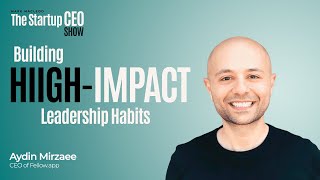
Aydin Mirzaee, CEO of Fellow, talks bootstrapping through 2008, selling Fluidware to SurveyMonkey, and pivoting Fellow into a meeting productivity platform. He shares concrete habits: no meetings before noon, no-meeting Wednesdays, canceling meetings without agendas, and aiming for 15-20 meeting hours per week. Shopify used a recurring-meeting purge to reclaim time.
Chapters
If you think about it, you know, what I learned from Shopify from a cultural perspective is like, they're always rethinking the way things should be done, and they don't care about what the conventional norm is, if it's okay to do that or not okay to do that.
Welcome to the Startup CEO Show. I'm your host, Mark McLeod. In this episode, I sit down with Aydin Mirzae, CEO of Fellow Fellows. Goal is to make meetings suck less. We know they've got their job cut out for them. Aydin bootstrapped his first startup to a really successful exit. We talked about the pitfalls of bootstrapping and bootstrapping versus venture capital. Aydin's based in Ottawa, hometown of Shopify. We talked about what he's learned from them. We talked about lots of practical CEO tips like setting schedules and boundaries, being open to trying new things, doing energy audits. Lots of great lessons here. I really hope you enjoy the show. Aidan, welcome to the Startup CEO Show. It's a true pleasure to have you here. How are you doing today?
I'm doing great. Thanks for having me on.
Yeah, no, it's a real pleasure. Last time I saw you in person, you were walking through startup or SaaS north in that really crazy sport smoking jacket. Do you wear that all the time or is that just once a year for MCing duties?
Yeah, I have a thing for those types of jackets, so I don't very often wear a suit. I have, I think, something like 30 different. 30 black shirts that all look the same. So, yeah, basically that's my attire. But then every now and then when we're doing something fun or unusual, I'll wear a jacket. And the minimal amount of work is just to put on the jacket on everything else, which is just like the black attire. I see that you're also complying to the uniform for those watching the video.
I don't always actually, but.
But I'm glad for. For me being on the show, you decided to comply. So, yeah, yeah, I do that. And then, yeah, I like it because it's. It's different. And so if I'm gonna wear a suit, might as well wear something different. I don't like conforming in general, and so if it's different, I like it.
Well, I gotta say, this is not why we're here today. It's not why people are tuning in, but I actually wish the world wasn't as casual as it was. If you set aside the alcoholism and misogyny, I actually love how people Dressed in Mad Men. And that was actually my favorite part of having my own investment bank is like I would wear suits every day and every time I closed a deal, I'd get a new suit made. So now I have a closet full of really fancy suits gathering dust.
Oh, very nice. Yeah. And nobody should take fashion advice from us. But I will say one fun fact, which is I used to run a men's fashion blog because we had an online suit selling business. This was quite a while ago and it was my introduction to the world of content marketing because I would write this blog. I know nothing about fashion, but we had passionate readers And I think 30 to 50,000 page views a month, people reading our fashion advice and we know nothing about fashion. And so it kind of don't, don't listen or trust everything you hear and listen to.
So that's fascinating. I love it. Well, other fun fact. And then we're going to get to the agenda. But back in my VC days, I was the original seed investor in what became Frank and Oak. But at the time it was Motor Suite and it was made to measure men's clothes and had much more of a focus on formal fashion than Frank and Oak ended up having. As it turns out, it's actually really, really difficult to get people to take accurate measurements online. So we moved away from that. But anyway, yeah, I've always loved fashion.
Very cool.
Yeah. But on to you and I want to jump right in. You know, you are one of the rare founders who's had a great exit and onto the next thing and then you've experienced both worlds. You bootstrapped the first company to what I have to assume is a life changing exit and now you're back at it, raising venture for your current company. I would love it if you could just talk to folks about what's your take on the pros and cons of bootstrapping versus not. Did you. Was it a forced bootstrapping path the first time? Anyway, just walk us through anything and everything that comes to mind when it comes to bootstrapping versus not.
You know, when we started the last company, I think I was 21 and my co founders were, you know, second year university going to McGill and it wasn't our first startup. So we had done something and failed doing it. And the year was 2008 when we started our last company which was called fluidware. We made this product called fluidsurveys and again, year 2008, everything's going to hell, right? Nobody's buying anything, there's no VC funding out there. And we had tried another startup prior to that, and we had an experience where we tried to raise money, but it didn't really work. And we just assumed that nobody would invest in us, and so we didn't really try. I think I had something like $18,000 in savings that I figured would both fund the company, but also last me for maybe 12 months at the time. And through a fascinating series of events, I had to make that last more than 12 months, maybe closer to 24. So, yeah, it was an interesting time. So it was mostly because we just assumed that we would fail if we tried. And the other thing was we weren't really in a sexy business, if you will. We were. We were building online surveys. And if you asked us what our competitive advantage was, I would have said, I don't know, like, we're just going to do it and it's going to be good. And we figured all that stuff out later. So if you were a smart investor based on anything that we told you, you probably wouldn't have invested. So I would say we were mostly uninvestable. Like, our first target market in that, in fluidware, was basically the federal government of Canada. So we made online survey software for federal government customers. Like, that was the. And if you ask us what, what the total market for that is, I might have said, I don't know, maybe like half a million dollars. Maybe a million dollars. Nobody's buying SAS. It's 2008, at least, not in the government. And so it was kind of like a different world. And so we just didn't know better.
When you said no one was buying SaaS where you literally just took installing on their premises.
No, but they wanted us to. And so, you know, we were trying to say, yeah, this is an online survey tool. And yeah, the way it works is your data sits on our servers. And they were like, what do you mean? Like, how does that work? Do you mean, do we give you our firewall? Like, they were. They weren't necessarily understanding. And so it was a. It was a gigantic amount of work to get that first customer to actually agree to. And, you know, once we had one customer agree, then the rest of them agreed. So I would say, like, it was a combination of we didn't know any better and we didn't necessarily, you know, have, like, the way that people build startups today is they have this grand vision of they want to build this gigantic thing and, and they want to change the world and they want to do all these things. And so we were just like, no, we're just trying to start a business because, you know, we, like, from an early childhood, we loved the idea of building businesses, and entrepreneurship was fun, and we just loved the idea of building businesses for the sake of it. And so we just started doing this thing. And yeah, that's basically how it started. But I think we were. Yeah. And the company did really well, so we were always profitable because we had to be. We just, you know, we're very scrappy. We did all the super scrappy things that you will. And, you know, when we sold the company that, you know, basically there was no investors to share the profits with. So it was. It was a very. It was a very good outcome for. For everybody involved.
That's so great. And so counter to the narrative of, like, you have to raise. You got to burn your way to greatness. You know, we celebrate raising capital even though we're just building more and more of a prep stack. And obviously there are many, many success stories of that working. But. But I think it's. I think it's. The bootstrap story is not celebrated anywhere near enough. I will say, as a brief aside, there must be something about the survey category, because Survey Monkey, who bought you was also bootstrapped for a long, long time. And the PE investor who originally invested in them told me it was the most profitable SaaS company that he had ever seen. And they didn't need the money. They just needed. They raised money because they needed management support. They needed accountability. They needed, you know, grownups, if you will. But every penny that they raised just went to the founders. Right. Like, the business itself needed nothing.
This was a long time ago, and I might get the numbers wrong, but something crazy, like, Maybe they had 30, 35 million ARR. And maybe there were like 15 people. And a lot of those people were customer support. So. So it was. Yeah, but I don't know that necessarily. Like, it's as easy to do those things these days. Certainly. Like, there are examples of, you know, mailchimp famously bootstrapped. Like, there are definitely stories like that. And it can be done. It was very difficult. I will say that. Like, it was very, very difficult. And I don't know that I could do that again. Like, it's. It. I feel like it's one of those things that when you don't have a lot to lose and you can tolerate a lot of pain, it comes easier. And when you don't know better and when you think that's how it is and that's how life is then you can do those things. But it is definitely. It can be very taxing, but the stories are really fun afterwards. So when you tell those stories, they're crazy.
Talk to us about the decision to sell. You know, there's no one right answer when it comes to choosing to sell. The example I always bring up is Yahoo, rest in peace, when they made an offer to buy Facebook for a billion dollars. And Facebook was a super young company and it would have been a giant win. A fund returner for Excel who led the series, A Mark Zuckerberg would never have had to work a day in his life. And it was really tempting, but. And when he polled all of his executives as to whether to sell or not, the ones who said he should sell, he fired them. And then with the benefit of hindsight, obviously it was a bad decision to sell. Yahoo's dead and Meta now is a giant company. You know, like, how did you think about it? What was your calculus? You know, talk us through that.
Yeah, you know, I think the. It was really, really good offer. Like, I'll just say that it was like you said, life changing and certainly a very good offer. And I think that's a large part of it. But the second part of it was that we were still very early, I think when we sold. I was 29 and my co founders, I had three co founders, but two of them were, I don't know, maybe 25 at the time. So basically call it three years out of school. And this was a, you know, big, big opportunity. But the other part of it was that we, we always admired SurveyMonkey. They were like the, I want to say the original or one of the original, maybe after Salesforce, one of the original SaaS companies. And we always admired them. And they were always like. And it was very funny. For a long time they were the enemy, right? We, we, we would, we would rally the troops behind the idea of crushing SurveyMonkey. And so then they became our best friends. And it was a very interesting. But yeah, we were definitely, I would say, love the idea of seeing the inner workings of a larger company that we really admired. And I think even at that time, the thing that we were most excited about was the opportunity to learn all the things we didn't know. We, for the most part, like, we made stuff up as we went. Like, we didn't really. It's not like it is today, where there's so much information like, what do you want to learn? Just, you know, there's so. It's so easy. It's so easy to find people, talk to people, learn stuff. We were just like inventing stuff as we went. And it was an opportunity to, we thought, you know, work with a bunch of people that could teach us things. And you know, for us it was okay, this is one company, we're going to do other companies. And so really it was, it just seemed like a natural place to go. And then there was upside too. Right. So it was, you know, when we did sell, it was a cash and stock deal. And then, you know, later on SurveyMonkey did IPO and so it was, there was still opportunity to have upside do a bunch of learning. And then the other part of it I would say is that at the time we weren't necessarily thinking about this company like our startup was going to get to $1 billion in revenue. Like we weren't really thinking in those terms. And part of it was that we just underestimated how big the survey market market was. And you know, by the way, we also underestimated it when we started. We didn't think it was going to be that big. And then we kept learning that it's big, bigger than we had ever imagined. And then when we got acquired into SurveyMonkey, we learned it was even bigger than we had thought after having been in the business for so long. And so, yeah, part of it was that we just didn't necessarily see that this was going to be an enormous company on its own. But now seeing afterwards and learning a lot more about how big the survey market actually is, I'm sure if we sold in 2014, it's now 10 years later. I mean, it's impossible to predict what would have happened, but I definitely see a path to more than 100 million in ARR for sure. Like during that time we just kind of underestimated what, you know, how big the market was and also how much more the demand got over the course of time. But yeah, don't regret it. I think it was amazing decision. We learned a lot. Yeah, we learned a lot. Made amazing friends, got amazing mentors, saw many things that we wouldn't have seen and those lessons we're going to take with us for a long time. So yeah, all in all an amazing experience.
Yeah, that's so cool. So many follow up questions. I'll try and condense. So we're not spending the entire time just talking about this, which we could. But I guess my first question is how did the, you know, my experience, buyers don't just show up and give you a great offer. There's maybe some dating process. Maybe you partner together, which you probably wouldn't have done in this case because you were in the same category. Like, how did it get to that point where they dropped the offer on your. On your lap?
Yeah, it's very interesting. So a couple of interesting things. So we were starting, like, we were getting towards pretty significant revenue, and we just. Things were getting more serious, but somehow we were becoming more conservative. It just, like, we kept hiring more people. We were getting close to, like, 100 employees and all bootstrapped. And it's very different. Right. So it's funny, these days, we talk about, you know, burn rate as an example or like, sorry, how many months of Runway you had. And when I think about back in those days, we at any point in time, maybe had three months of Runway. It's just, you know, we kept three months of cash and roughly three months of receivables. And that's kind of how we. We operate it. And so we were. We were starting to get more conservative, I found. And one of the things that I had heard is that, you know, there was a way where you could raise money. You know, today, you know, we're talking about the secondary process. And so we thought, oh, maybe there's a way where we can raise some money and, you know, potentially take some chips off the table and put some money into the business and basically de risk. Right. So that. That's kind of the. What we were thinking about is, is there a way to de risk? So we started to look to raise money and, you know, took a trip to the Bay Area, started meeting with some venture folks, and. Yeah. And then I guess in that process, someone told SurveyMonkey, hey, there's this Canadian company, and they're doing the kind of things that you're doing, and they're focusing more on enterprise, and that's the space that you guys want to get into. So maybe you should meet with them. And so, yeah, we got an email and then did an original initial discussion. We didn't know if they were friends or foes. And it was a very interesting process. It was probably a year in the making. It was a long time, because I think they were interested, and then they weren't interested. And then nobody talked to each other for three months. And then they came back. You know, part of it was that in their plan, SurveyMonkey wanted to get into the enterprise space. They wanted to compete with Qualtrics, which was the bigger enterprise player. We really saw Qualtrics as being more of the competitor to Fluid Surveys, which was our product. And so, yeah, and I think, like, they tried some things on their own, but then, you know, time is of the essence. And so they thought it was a good move, and then they became more serious. And. Yeah, and it took a long time because this literally was kind of our competitor, right. And when a competitor is talking to you and they say, hey, why don't you share some of your numbers? And it was really funny. One anecdote I remember was at some point they said, we want to send us some information, and, for example, send us your employee list and what everybody does. And we said, well, I mean, can you sign something like maybe an NDA or, you know, a non poach agreement so that you don't. We don't spend a bunch of time telling you who the best is. Right. And who are the key people. And then we see that they disappear and they're like, oh, no, we can't do that. Why can't you do that? Because then we would have to tell more people in the company, you know, like our recruiting team about us looking into this deal when we're not sure we're serious. So, sorry, we can't do that. And so it was just a bunch of stuff like this that made this deal, like, take a very, very long time. There was. There wasn't a lot of trust until I think we officially signed an LOI and it seemed that they were serious. And, yeah, there was just, like, a lot of mis. We. We didn't know it was serious until probably, like, you know, like two or three months before the acquisition actually started to happen.
Wow. What was your state of mind like through all of this? Like, you know, this period where you don't speak for three months? Are you, like, are you freaking out? Are you cool? Because, you know, you weren't counting on it anyway. Like, you know, what was your headspace like?
Oh, no, it's super distracting. Super distracting. Yeah, it is super distracting because, you know, it changes your plans. And also it's a lot of work, right? There's all this information requested, and you've got to keep it quiet. And, yeah, it's very distracting on the business. Like, you get to a point where you start to think maybe they're trying to wear us out, and then, you know, at the very end, you know, change their minds and give us, like, a lowball offer or something like that. And so, yeah, it was very distracting. And when it was over, it actually felt really good for it to be over because it was just such a. Yeah. Distraction. Sick.
I love it. Did you even have like a finance leader or you were just having to figure this out yourselves?
No, we didn't have it. Again, like we were very bootstrapped. So we. Again, no board of directors. No.
What a luxury that is.
Yeah, no. No executive team, no finance plans, no one in hr. Like it was a very, you know, scrappy company of close to 100 in staff and. But it worked, right? Like I think it was, everybody, it was a great, great culture. Everybody just wanted to build really cool things and that's what the culture was like, building really cool products. And that's what everybody cared about. And yeah, all in all, remarkable experience.
I love it. So you got back in the ring with Fellow. First of all, please tell folks about Fellow. But you know, you've chosen a different path this time. You have raised vc. Maybe talk us through that decision as well.
You know, I would say we had a really good outcome with fluidware, but I always wondered, could it have been bigger? Could we have done things differently? And so my co founders and I always wanted to experience what it's like to raise money. And so that's the thing that we always wanted to do. And yeah, so that was part of the motivation. So we came up with the idea for fellow while at SurveyMonkey. So the original idea was, imagine again, there's this group of really scrappy, you know, startup people and we get acquired into this other company where we learn all these interesting things. So for example, I had never done a one on one meeting in my entire life. I didn't know what that was or why you should meet with someone only on a one to one basis. You know, we didn't, we didn't really have staff meetings. We didn't really have quarterly business reviews. Like, we had no structure at all. Like it was, it was a completely different thing.
You were doing clearly work.
It worked. Yeah, it was all about just building cool things and satisfying customers. And that's like, those are the only two things we cared about. And so all this to say is we get, you know, get into SurveyMonkey and then we're there for a few years, kind of see the path to an IPO. When we were acquired, maybe we were approximately like 25% of their staff. And then it kind of grew and they grew to, you know, at IPO time, maybe close to 1500 or so employees. So we just saw a lot of things. And so seeing all of this structured management of like, how do you actually organize groups of people in this way was really interesting. And one of the anecdotes that we had in the early days of Fellow was that, or in the early days of building fluidware was that because we didn't know how to build companies, sometimes we would use software tools, and based on the software tools, we would learn stuff about how to build companies. I'll give you an example. So if you know nothing about sales at all and, and you use something like a salesforce, you can kind of like piece it together, right? Oh, I see. It's a contact, then it's a lead, then it's an opportunity, and there's a funnel and you optimize the stages. Oh, I see how this stuff works. And you can kind of piece it together, right? And so that's how we would, you know, that's how we would figure out how to do things. And then one of the questions we had after being exposed to all these, like, structured management things of how to organize groups of people, you know, the question we asked is, like, how come there isn't software that helps you do that? Like, that would be cool. How come there wasn't something like that that we could start to use? And so the original idea that we started with was this idea to build a manager's copilot. So we just wanted to build a tool for managers that would teach them how to do these sorts of structured management things. So that was the original, original concept. And so we left SurveyMonkey to do that. We wanted to start a manager's copilot. Now, if you said, did you know what that was? I would say, not necessarily. We're just going to start to do things and then figure things out as we go. There's a bunch of things I learned from the fluidware experience that I would not do again. And then there's a bunch of things that we knew that we would definitely do again. So one of the things we used to do at fluidware is even before we built anything, we would create these mockups and then we would show people and we would say, hey, would you use this? And before we ever wrote any code. And so we did the same thing with Fellow. We just went across and started showing mockups and screenshots to potential customers. And we were very fortunate in that we showed some of these screenshots to some people at Shopify, and they really liked what they saw. And so they said that, yeah, if you build this, we'll be a beta user. And that's basically how that started. And so the original idea, build a manager's Copilot and, and I'll kind of fast forward a little bit because you know, we started doing that and then the pandemic happened and we had built all these different things, all these different components of what, what would be a manager's copilot. But once the pandemic happened, everything changed and people started to meet a lot more. And we noticed that what people were using in our software more than everything that we had built was everything built everything on, on meetings. So they were just using our meeting functionality a lot. And so we decided to make a pivot and so we changed from being a manager's copilot to being a meeting productivity platform. And so that's what FELLOW is today. So I would say like chapter two of FELLOW was, I'm saying chapter two because it's, we're about to go into chapter three. But chapter two was mainly to build a tool to help people spend less time in meetings and make meeting time productive. Everybody complains about their meetings, FELLOW solves meetings. You use FELLOW and you no longer have a meeting problem. And so that was the, you know, that's what FELLOW became. And the new wave of where we're going is we're going to incorporate a lot of AI. So, you know, FELLOW will be your AI powered meeting copilot.
I love it. Yeah, I'm sure people universally feel that meetings suck. What is the meeting problem?
Yeah, so the meeting problem is multi pronged, but I think the root of the meeting problem is that people start to meet for a given reason. I think the biggest aspect of the meeting problem is that a meeting is just a process. So when you think about a QBR or you think about a one on one meeting, or you think about a staff meeting, all these things have a purpose. But what happens with companies that stay around for longer and longer periods of time is that there's all these processes that get created and over the course of time, whether or not you need them in the same way changes. But people don't necessarily take those processes away. They don't morph their meetings, they don't remove them, you know, and they don't rethink them. So I think like this is a large part of the meeting problem and there's a lot of just hygiene things. So if we start to talk about things that you need to do to run a great meeting, we can definitely do that. But the problem is things like obviously always have an agenda. Only people who are going to speak should show up to the meeting. There should be clear action items. You should know what you talked about last time, all these different things we can talk about, but it's really hard to do. So everybody knows these things. I don't think I'm going to say a single thing that would surprise people. But the hard part is to actually get everybody to do that and to do that en masse within your company because it's behavior change. And so that's what Fellow does. It makes a behavior change possible and simple so that everybody does it. In any company. There's going to be some people who run great meetings, but most of people who don't. Fellow makes it easy for everybody to run great meetings. And so that's the way that we think about it.
I love it. As an aside, what did you think about Shopify blowing up recurring meetings in everyone's schedule?
Yeah, I think it's actually very, very smart. So little known fact. So Shopify is a customer, has been a customer for four or five years now and they have been doing this for a long time. So it's just that as they become more and more, I guess, known by everybody. So now whenever they do something like this, everybody finds out. But yeah, no. All this to say, is this a practice that they've been doing for a very long time? And I think it's very smart because it's very easy to add things and it's very hard to remove things. And I challenge any person to be able to say like, oh yeah, we're just going to remove this meeting. Someone in your team is going to say something like, yeah, but it's, you know, we do get the side benefit from having this meeting or you know, at least we get to see everybody. We don't get to see everybody. And so by having this meeting we get to see everybody. Or you know how hard it is if you do anything for enough of a period of time, it becomes a habit. And we all know how hard it is to get rid of bad habits. Now I'm not saying all meetings are bad habits, but some of them are. And so by, by making it okay and saying across an organization, we're going to have this period of time where all of our recurring meetings are going to get removed. Then it becomes okay, and it almost becomes a forced function. And then after that two week period, you can decide which ones you want to add back. And I think that's a very smart thing. We do it at Fellow. As a matter of fact, it's so good that we actually have built this as a feature within Fellow so you can do this, you know, across your company. And we built all sorts of functions. Like if you, if there isn't an agenda to the meeting, it automatically cancels. So we're all about these. Yeah, we're all about these little things that again, make the behavior change interesting or easy across the company.
Oh, I love that. So good.
So what I love about that and specifically Shopify is that they a, it is a really good idea to do this kind of purge and do it collectively so that it's okay across the board. But also like, if you think about it, you know, what I learned from Shopify from a cultural perspective is like they're always rethinking the way things should be done and they don't care about what the conventional norm is, if it's okay to do that or not okay to do that.
You know, I was only involved with Shopify for a brief time, kind of pre series A and leading up to the battle. And I was brought in by Toby because I knew about SaaS and you know, new metrics and stuff and they were trying to figure all that out. But I come in as like, you know, a black and white finance guy. Like, this is the way you do things. And to the extent that he and I had disagreements, it was exactly what you just said. He completely bristled at the notion of like, this is the established practice. Everything had to be defended on first principles and had to have merit. Otherwise he didn't even want to hear about it. So I'm not surprised to hear that he still operates that way. And you know, a couple of follow on things here. Like for my CEOs today, I'm always encouraging them to ask literally in every meeting, how, how can we go faster? Because speed is everything, right? All else being equal, getting to the same place faster is more valuable. The rate at which you grow is the largest driver of your valuation, right? It's the magnet that attracts talent, customers, investors, strategic buyers, you name it. And speed is not necessarily about doing more. It's not about working 10 hours if you're working eight. It's actually what you're talking about. Often it's about removing things, things that no longer deserve to exist. I've actually encouraged, I don't know if this is a functionality inside fellow, but I've encouraged CEOs to ask after a recurring meeting to poll the people in the meeting, does this meeting deserve to exist? Will we hold this meeting again? Because it's such an expensive use of time, right? It has to, in my books, has to be justified.
Yeah, and these are like. I mean, these are the things that are. Again, the way that we think about building software is common workflows and good, you know, good things to do. We just make it easy for everyone to do it. So, yes, you can. You can get that type of feedback on a recurring basis and you kind of set what the recurring cadence is. But I think, like, these things need to be done, and I think what's hard about them and as we're talking about building companies, is this is not the only habit. I mean, we're talking about meetings, but there's a lot of other good things that need to happen within companies. And the hardest part is that most people know, most people would agree that, but it's just really hard to get people to do it. So I think good software is about making it easy and making it so that everybody can become a great meeting host.
Yeah. What is your personal meeting reality? Like, I know some CEOs who are just back to back to back to back, and then they pound emails at night and, like, eat during a meeting. But others actually have changed altitude and have lots of time for reflection and deep diving. Like, what's your reality?
I change my reality depending on where we are in the business and what's required. But, yeah, generally speaking, I would say that my daily workflow kind of looks like. I try to have no scheduled meetings before noon. And I remember the first time that I did that, I was like, there's no way I could do that. Someone's gonna, like, people will complain. And. And then. So what I did is I do this often where whenever something feels controversial, even to myself, I say, hey, I'm doing this experiment where for the next two weeks I'm going to operate like this. And so I did it. And so that's my kind of flow. So my meetings with others will only occur between the hours of 12 to 5. And we also have a no meeting Wednesday. So basically it's either Monday, Tuesday, Thursday, or Friday. And only between the hours of 12 to 5.
20 hours a week.
Yeah, but then, even then I. So the absolute maximum is 20 hours a week. But generally speaking, like, I like to keep it closer to 15. And that's an active process. So what that means is, like, there's a lot of stuff that I'm involved in and I start to be involved in. I just have to make sure that I'm not. I don't continue to be involved in them over the course of time. So there's a lot of things like from technology Perspective that makes this stuff easy. So, for example, at Fellow, we record all meetings, and again, it might sound controversial, but we record our one on one. Like, I record my one on one meetings. And the reason that I do is because, again, obviously because Fellow offers the functionality, but also because it makes it really easy for me to share clips of things to other people. It just makes communication way easier to do.
So every. Every meeting is a podcast.
Every meeting is a podcast. We basically put on a show. And so the other nice thing about it is that for the things that I don't want to be involved in, again, it's a way that I can stop being involved in it. So my favorite meeting in the company is our growth team meeting. I love it. Like, it's the thing that gets me the most excited is every time I go to this meeting. And. But I know that I need to stop going to it because, you know, it's that phase where now I need to shift my focus to other things. But the way that I wean myself off of it is I say, well, the meeting is going to be recorded, so I get to watch it afterwards at double the speed. And so I can get enjoyment doing that. And so maybe I'll do that, you know, while driving or, like at the gym or, you know, in another place. And so it just becomes content consumption for me, and it enables it. So I think that there's a lot of practices you can do. What I find is that for me, generally speaking, like, I like to keep the maximum number of meeting hours to 15 per week, and that includes, like, if I do a podcast or something like that, I need to leave enough creative time for me to be able to. I think the analogy I like to think about is, like, I need to be on the date deck, looking out, making sure we don't hit an iceberg, but also seeing where the promised land is and making sure the ship points in that direction and then explaining what the promised land looks like to people on the ship so that they, you know, in the engine room, so that they can get excited even though they. They don't have a view of what. What that actually is.
That's a great analogy. Speaking of analogy, so this notion of you stopping doing things brings a thing, a thing up for me, a concept for me that I talk about a lot, which is like the barbell approach to management. When I think about a CEO, a CEO needs to be like a project, right? You need to be involved up front to define, well, first of all, why are we doing this? How does it tie to our broader mission and vision? So to give the context and to define success, right, you're the ultimate judge of quality. You have the highest bar, no one cares more than you. So you define this is what success looks like for this project and then you should be involved at the end to be that judge. Did we hit the success criteria? Is this a go? But in that messy middle, you should be largely not involved, right? Other than for exceptions and issues. But so many of the CEOs that I meet kind of before coaching, a lot of times why they come to coaching is because they just can't keep up anymore. But when I look into their schedule, they're in that messy middle. They're in those growth meetings, they're in the marketing meetings. So I just, I love that you're actively curating and thinking about what to take out of your schedule.
The only thing that I would say is that again, it's a, you have to have enough people in the company. So it's hard to do that when you're three people, right? There have to be enough people. But yeah, at scale, definitely that's the idea. And there will be exceptions. And one of the things I like to do is, is let myself get hands on with at least one thing at a time. So I usually have some passion project where I'll say, like this particular project I'm going to take a liking to and I'm going to get my hands dirty with that one. But that's it, I'm not allowed to have two. And so that's, that's the way that I like to think about it. But yeah, it's an active process because the natural state is for you to take things on and the business grows or it takes different forms and if you don't actively curate, this is a very basic one. And it's, everybody talks about it. I had, would also like I had never done it, but the super basic principle of the energy audit, just, you know, print your calendar, you know, what's energy draining or what gives you energy and you can't do anything in the middle. It's either one or the other. And then actually doing it. Everybody talks about it, but I actually challenge you to really do this. And then it's really funny, like the first time that you're thinking, you know, and rule of thumb, like if you can get to 75, 80% of, you know, only doing things that give you energy the first time when, when you have that thing in the red and you want to say, like, I Don't want to do this anymore. And you feel guilty and you're like, no, there's no way I could like not do that. And then I go back to my, hey everybody, I'm running an experiment for the next two weeks where I'm not going to do. And then it kind of like eases into it. Even some basic things. Like when I think about my one on one meetings, one of the things that I used to think about was, you know, my one on one meetings used to be, you know, one hour every single week with, with each person. And you know, there, there was some, we did some organizational changes and like there was a brief period of time where I had to have our entire marketing team reporting to me. So I had some ridiculous number, like 12 direct reports. And so I just said, hey, well I'm doing my one on ones on Monday and I can only do five hours. So everybody gets crammed down to half an hour each. And so we proceeded that way and it worked well. And so now I don't have that situation. We have a marketing leader in place, but I'm keeping the half an hour idea because it tends to work. And again, I think like these things, it depends on how long you've been working with the people on your team. If someone just started, when an executive starts, I meet with them every single day for the first 30 days. There's a lot of things that. But if you've been working with someone for three years, you don't have to spend that much time. But if you have it blocked, you will spend the time.
Yep. Oh, it's so true. On that kind of related to energy audit. I wanted to ask you about superpowers. My belief is, you know, like in a utopian world, every person in a company, their role would be based on their superpower. And like your yin would be offset by my yang, you know, and that, that the world doesn't work that way, obviously. And startups especially are dynamic. But I really believe that a CEO's role should be built around his superpowers. And then the way you design your leadership team is based on that.
Right.
And so I'm wondering, you know, to what extent do you know what your superpowers are and to what extent have you built the company around it?
Yeah, there's this like. Have you read the book the Big Leap?
I have not. I've heard of it, but I've not read it.
Yeah, it's Gay Hendricks, the author, and he talks about these, you know, four zones of the zone of Incompetence, competence.
Is that where Zone of Genius comes from?
Yeah, that's where Zone of Genius comes from. Now, here's a super interesting thing about that book for the. For a long time. I first learned about this concept from Matt Muscheri, who's another CEO coach. Yes.
The Great CEO Within.
Yeah, Great CEO within, which is a great book. And I first learned about this from him, and I was like, I don't need to read that book because I already understand this concept. But the book actually has a lot more in it, and I strongly recommend everybody read it because of all the things outside of the zone of genius, it's actually really good. But on the zone of genius thing, I think the tricky thing is the zone of excellence is the. Is a zone where you're good at the thing. You may even be the best person at your company to do that thing, but if you do it for enough time, it just drains you, and so it's not fulfilling. But the zone of genius is you can do it, you can be great at it, and it also fulfills you. And I think it's just like the figuring out over the course of time what are things that are in that zone of excellence. And I think the zone of excellence trap is where it is. And by the way, I get into that as well. And then I think especially we're recording this in December, especially during these times, this is the moment of reflection where I think about what's in my zone of excellence. And when you go through this process, you start to realize that there are actually people who get energized and fulfilled by those sorts of things that don't necessarily give you those feelings. And so, yeah, it's just an active process of being able to go through that.
Yeah, I love it. So you're based in Ottawa, Canada, and even though they're no longer headquartered there, it's hard to think of Ottawa and startups and not think about Tobi and Shopify. And you guys started your companies around similar times. And so I'm just curious, you know, what influence has Tobi and Shopify had on you and. Yeah. How you built the company.
Yeah, there's a Globe and Mail article about this, the original Fresh Founders Group. So it was a. Yeah, so we all. Yeah, we did build the companies at the same time. And so we all used to meet together in this group called Fresh Founders. And, you know, I make it sound very official, but, you know, at the time, again, there's like maybe two, three, four people. And then it kept growing A little bit. And we used to meet Friday nights at 8pm Once a month at Second cup, you know, in downtown Ottawa. Right. Like, this is what we do. Yeah, but think about, like, we met at a coffee shop on Friday night at 8pm nobody would miss this meeting, Mark. Like, nobody would miss it. You would change your travel to make sure you went to this meeting. And again, like, the year is. You know, we're talking about the. You know, the year. I think when I first started going, maybe 2006 or 2007, even before I started Fluidwear. And we used to meet and just chat and this was like our. It was a peer group, but it felt like more than that to our other friends. We were the abnormal ones, like the super weird people that call themselves entrepreneurs, but really, maybe they're just unemployed. And it wasn't cool. It was not cool to be a startup person at that time. And you would go to this group and then everybody else was like, you. And so, yeah, Toby was there and Harley was there and Luke Levesque was there. And, like, there's a bunch of people. Paul Lem was there and so there. Yeah, we basically would meet. And so one of the things that we would do is that anytime anyone would discover something really interesting, we would all be excited to come and share with everybody else. So I remember in the early days, you know, one time, you know, Toby had figured out how to do Google Ads. You know, this is like. And he's like, yeah, I'm doing it and it's costing me. Like, I'm going to make up a number, $300 to, you know, acquire a customer. I'm like, whoa, $300, that's a lot. And he's like, no, it's not a lot, because the average customer pays US$700. And I was like. And so again, we're very novice, right, like, at that time. But this is like a huge discovery for all of us at the time. So. And then, so he does a class where he shows us, you know, how he does that and like the app. He's doing a class that happened in the office, but it was kind of like an invitation that, like, hey, let's go back and, you know, we can show you how this stuff works. And it was the same thing for sales. So I think, you know, my company at the time, we were the first people in the group to do things like demos, you know, online, where you would use webex and show the screens. And then when we kind of figured that out, then, like, I was teaching Everybody else in the group how to do that. So it was a very sharing kind of environment. And anyway, so that's how we originally all met. And yeah, I mean, there's a lot to learn. I think the things that I've learned over the course of time and the things that I'm most impressed with is their, I would say their ability to like be ahead of the time and make really, I guess, bold decisions and do them very quickly. I mean, a very recent example was there, you know, when they went from, you know, just being an all office to an all remote company, like making that decision and then burning the bridges too afterwards and selling the property and making those kinds of like very, I guess, bold decisions. So that's something that I've definitely learned from them and for a long time. But yeah, I mean, in addition to that, I would say that they're very big thinkers and the like, there is no limit. And so this concept of like just thinking when you're building a company, that there really is no limit. And yeah, I mean those are probably some of the things that I've learned in hanging out with those guys.
Those are great observations actually. I actually attribute those big decisions that you talked about to their first principles. Thinking they're not bound by convention, they're not bound by should. Right. Just think of the old cfo and me is just thinking of all the leaseholds they just wrote off their balance sheet. You know, they spent millions on each of these facilities and they just burnt it. But it didn't matter because they're not bound by convention. And yeah, no question they think big, that's for sure. So, so this Fresh Founders was, was a peer group and all of my CEOs have either a formal or informal peer group because the CEO role, it's like the toughest role. It's the only one that doesn't have a gradual path to get there and only other CEOs really get it. So do you have something like that today?
Fresh Founders still is thriving and strong and now there's a lot of companies there. I am a part of two, two or three other ones as well. It is super, super valuable. I think the, you know, the groups. Nothing comes to the magic of what Fresh Founders was. And I think part of that was it was such a formative time and like we were all building and discovering at the same time and it was all in person and we got to see and hang out. I'm part of other ones that are very, I would say I learn a lot every Time I go and it feels like you're learning even when you're learning about other people's problems. These are all case studies and you're just increasing the number of things that you've seen and your pattern recognition keeps getting better. But I think hanging out in person actually makes a very big difference. And so there's something I go to in Ottawa as well that Investottawa organizes, which is also really good. But yeah, I definitely try to do at least something once a month.
I love it. I know we're getting close to the finish line here. Maybe I'm going to ask you just one final two part question. What's the best part about being CEO for you and what's the hardest part?
Yeah, so I think the parts that I enjoy the most is I love the entrepreneurial aspect aspects of it. So, you know, basically being able to dream into the future, dream really big, and then convince everybody else that what you think is actually possible and to encourage people and rally the troops. And that's the stuff that I love the most. And when I'm my best self, that's the stuff that I spend a lot of time doing, really focusing on, focusing on vision, direction, strategy, rallying the troops, encouraging everyone and making it a really fun place to work. Like, those are the things that I love doing. The challenging stuff is the. I think a lot of operational things, if I'm speak very candidly, a lot of the operational things probably lie in my zone of excellence, I would say, in that I do them, I can do them, I can be really good at them, but they don't fulfill me in the same way. And so I just, I think the, as CEO, you always have to do a little bit of both, right? Like maybe when you're at super scale, you know, that that kind of changes. But so it's just a matter of I just have to be careful to balance these two things to make sure I get enough of the thing that's super energizing. And it turns out that when I spend time there, the company benefits the most too, which is the interesting part. So I think like the challenge is to always like, think that way and make sure that I spend the most time and what I think is my superpower.
I love that. Well, you know, so many great lessons here for other CEOs to hear and I really love all the little anecdotes and stories you shared along the way. I've been in that second cup many times. I can like literally picture you guys there on a Friday night. Geeking out. Thank you so much for taking the time with us today.
Yeah, this was really fun. Thanks for having me.
My pleasure. Take care. Hey, thanks for listening to the Startup CEO show. If you'd like to connect with me, be sure to visit my website at markmcloud me or follow me on LinkedIn @the Mark McLeod or Twitter arkmcleod. And if you want to tune in again next week, be sure to subscribe on YouTube, Spotify, Apple, or wherever you get your podcasts. We'll see you next time.
More from Mark





The Burnout Breaking Point - How Strategic Breaks Actually Increase Productivity


Emotional Debt - How Avoiding Hard Conversations Compounds Into Company Killing Resentment


The Death of the Specialist - Why AI Is Creating a New Professional Class Called Scalers