Building Relationships: The Key to Successful Company Acquisitions
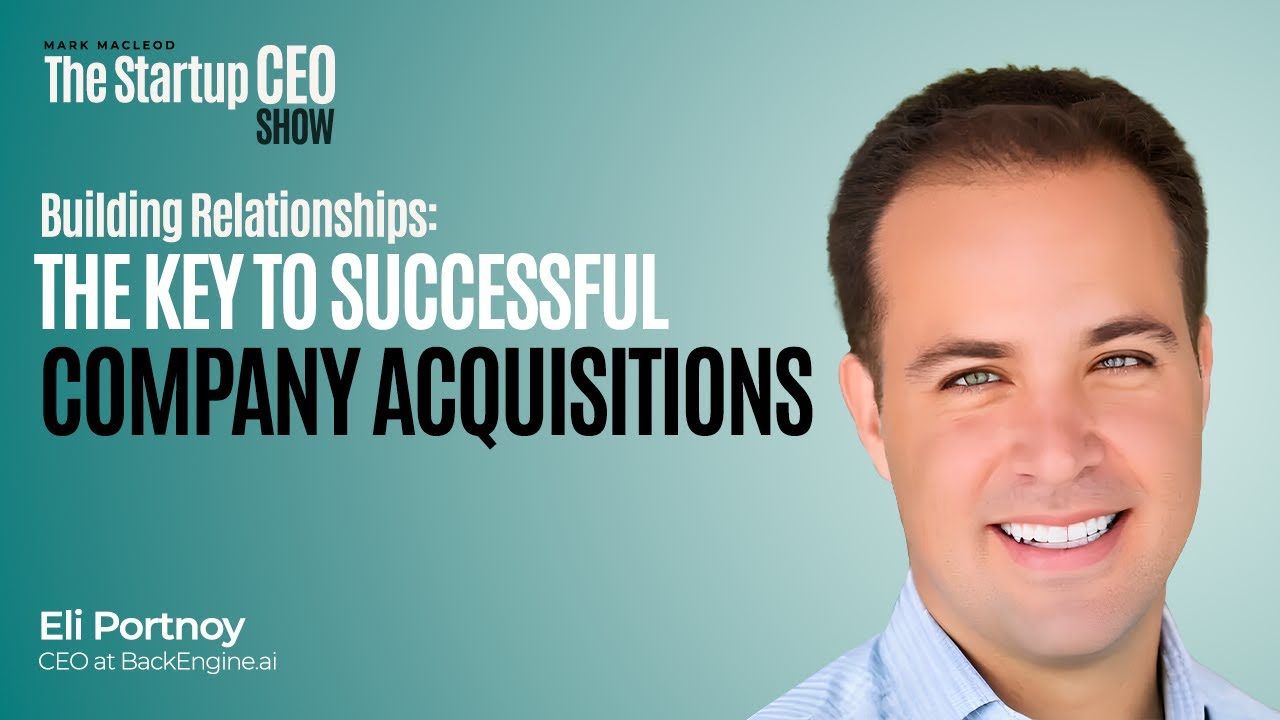
Eli Portnoy, CEO of BackEngine, discusses his two prior exits and why most deals are bought, not sold. He emphasizes cultivating internal champions at acquirers early, shares lessons on partnerships and LOIs, and explains how BackEngine uses AI to extract customer feedback at scale for B2B teams.
Chapters
We've been building a back engine as an automated system that automatically scans every single customer interaction, whether it's a video call, an email, a support ticket, and finds the things that matter to the different folks of the team and makes sure that the product team is seeing all the feedback that matters to them, that the executive team is seeing all the feedback that they need to see, the marketing team is seeing all the things that they need to see. And in that way, we're basically creating a high-velocity feedback loop where everything the customer says is processed, analyzed, and understood by the company. And we're finding that it's leading our customers, the improve customer satisfaction. They're improving net revenue retention. They're improving their win rates. They're improving the agility and the speed at which they operate. It's almost like a superpower that we're— we've basically turned into a turnkey sort of like operating system that just makes them so much better.
Welcome to the Startup CEO Show. I'm your host, Mark MacLeod. In this episode, I have Eli Portnoy, co-founder and CEO of BackEngine. Eli and I actually go way back. When I was a VC, I backed his first company, ThinkNear. He's actually batting 1,000 on his venture-backed exits. He's had 2 prior exits, and so we spent a bunch of this episode kind of unpacking how he got there, how he created those exits. He gave really great actionable insights, also walked kind of through his psychology. There's a huge psychological aspect to the decision to sell your company and the process of selling. And then we also spent time talking about what it was like to be in a company afterwards, 'cause he stayed for 2 years in each of those acquisitions. So this is really in many ways kind of a masterclass on exits and full of actionable insights. I really hope you enjoy the episode. Eli, welcome to the Startup CEO Show. It's a true pleasure to have you here. How are you doing today?
I'm doing great, Mark. I'm really excited to have an opportunity to chat with you. It's gonna be fun.
Yeah. So, uh, Eli and I actually go way back. Uh, long, many, I think it's been at least 12 years since we spoke. I had zero white hair at the time, no beard. Uh, but back when I was a VC, I backed, uh, Eli's first company ThinkNear. And, uh, anyway, you've had not one but two exits and now you're onto your third company. And so I thought for folks would really learn a lot from, from having you on the show. Maybe I'll just, I'll tee up the first topic and then I'll, I'll stop talking. But like, there's so much written about fundraising and yet many founders struggle to raise. There's very little that's valuable written about how to exit. And, and of course it's just like this black box for people until they go through it. And so I'd love to just spend a bunch of time. I definitely wanna talk about your new company, Back Engine, but I would love to spend a bunch of time upfront. Like, I don't know, just give us like your take on the two exits you did have, kind of how did they come to be? How did you make the decision? What was the process like? Um, I'm sure I'll have lots of follow-up questions, but turn the floor over to you to maybe kind of tell us about those.
The two exits actually were very similar. They followed a very similar trajectory. So in both cases, I think Near and AdSense 360, we were building a company that we were very excited about and we're building something that we thought was valuable. And I think that that's baseline. You're not going to sell a company if you aren't building something that's worthwhile. But the things that I think were more interesting were that throughout the entire journey, we, I was talking to a whole bunch of different potential partners that ultimately became potential acquirers, but I was looking at partnerships. I was looking at BD deals. I was getting to know them. And most importantly, I was evangelizing my view of the world and where I thought things were going. And this turned out to be super important because I didn't know this at the time, but I've since learned that companies are rarely sold. They're almost always bought, at least at the stage that we were at. So, you know, once you get to a certain size and, someone might buy you for the financials, in which case you can sell that. But when you're really selling more around the growth and the vision and the team and the opportunity, those tend to be bought rather than sold, which means that someone inside of the acquiring company needs to know you, needs to believe in your vision and understand your vision, and needs to basically advocate internally that this is where the world is going and that they need you because that will be a faster way to get there than trying to build it themselves. And in order for that to happen, you really have to know those acquirers and you need to be working with them and getting to know them and evangelizing your view of the world. And so we, I was doing that across ThinkNear and also at Sense360. And at some point, one of those companies that we were doing a partnership with sort of like woke up and said, hey, this really is compelling. This is too compelling for us to do it as a partnership. We need to acquire them. And then they reached out and said, we want to acquire you. So a lot of lessons for me in the journey. One is, you know, throughout the entire lifespan of the business, when you're starting something, like get to know the potential acquirers, get to know the market, the industry, the leaders, be an evangelist for your view of the world. Don't get super protective about your idea and your IP and like worried. Like at the end of the day, I've never seen a big company be able to move fast enough to keep up with a startup in something that's adjacent to what they're doing. And so, Yeah. And, and build relationships. And I think that, that leads itself to being bought at some point if, if the stars align.
Love that. That's like such an actionable playbook right there. And you know, back when I was at Real, I would suggest to my CEOs that they spend like from the beginning, I don't know, 10% of your time just building these relationships and, and starting with biz dev and corp dev because they, they want to be contacted and maybe those are one-way dialogues to start, but then over time they become two-way dialogues. And, and so were you doing that with optionality in mind from day one or you were just doing it to potentially just sell more and build a channel?
Yeah, I mean, for, I think near was just to build a channel. It was, we were really early. I really believed in what we were doing. I thought the world was going to shift pretty quickly in the direction we were looking at. And I didn't have a sales team and I didn't have distribution and I felt like it was going to be a market share grab. And so I was trying to find other ways of getting in front of customers. And so it was very much a channel play, which very quickly morphed into more than a channel play, but that was my intention going into it. With Sense360, I'd seen how the dynamics had played out. And so I had a little bit more of an inkling that there was, there was real value beyond just an acquisition, but there was real value in building these partnerships and these relationships and exploring. I found that I learned a lot in doing it. I found that the acquirer sometimes, I mean, at the end of the day, an acquirer is a company, but it's made up of a whole bunch of people and those people don't stay at the acquirer forever and they tend to go to adjacent spaces and they pull you in. And so it's led to business for us. It's led to really interesting marketing opportunities. It's led to hires, it's led to a whole bunch of stuff. So I just knew it was helpful and important. And I also knew that there was an optionality that it might turn into something. And so it was less the primary reason, but it was definitely in the back of my mind. That's something that was valuable to do.
And you were doing this personally, right? Like you didn't have a biz dev rep. This was, you were the biz dev rep basically.
Yeah, it was just me. I find it's much easier as a CEO and a founder to get in front of these folks. It was also—
I agreed—
really hard to delegate the evangelizing piece of it. So yeah, it was, it was me.
You know, back when I was a banker and we were trying to prepare companies for exits, we were trying to, you know, to your adage around, hey, companies are bought, not sold. I agree with that. Doesn't mean you sit back and just wait for the buyer to show up, but you know, you gotta build relationships and in some cases you have to integrate. But of course there's, one of you and you're small and there's a giant pipeline, hopefully, of companies, you can't integrate with them all. How did you decide kind of where you were going to invest beyond just building a relationship, if at all? Like, did you have to do integrations or co-marketing or any kind of formal partnering?
Yeah, it's a really, really great question because you're right, like there's not enough time to go really deep with everyone. And my experience actually on the BD side of things is that oftentimes the places where you put the most work in don't actually materialize into anything. And so it's a very risky proposition to go and really dedicate resources. I remember at ThinkNear, we had two BD partnerships that we were working on in addition to Telenav, which is who ended up acquiring us. And one of them, we spent, I don't know, probably 1,000 to 2,000 hours of engineering time building out integrations and building out all the piping and getting everything really set up. And we spent all this time trying to figure out how to make sure that they would co-market us and get us in front of their customers. And we generated zero revenue from it. Zero. Not a single dollar from it. And then we had another channel partnership where it was very, very lightweight. It was kind of like, well, let's see if this works. I tried this, like very MVP. And that ended up representing about 35% of our revenue within the first year. So it was a massive, massive partnership for us. And if you ask me like, what was the difference? I can't tell you why one was successful and why it wasn't. I think there's so many different variables that go into these partnerships that they're really hard. So my, my, I'm very happy to have conversations. I'm very happy to try stuff. I'm very happy to do things that require very, very little effort, but I definitely been burned when I've tried to do deeper level of integrations. And so most of what I'm talking about is more soft stuff than hard stuff. It's more conversations and more getting to know them and more kind of like jointly pitching, if you will, and less about the integration until I have a lot of conviction that they're going to put the resources and like that it's going to work. And I've done a bunch of MVP type testing to know that the channel is going to work.
There's a timing aspect to channel as well, right? Like I think most of the time you don't build channel right out of the gate because the channel is going to be like, what, you have no customers? You haven't sold this yourself? Like how the hell am I going to sell it? So like, was that a factor as well?
Yeah, for sure. I think, um, one of the things that was really interesting for me to learn is that almost every founder I've ever met, myself included multiple times, makes the mistake of thinking, okay, I'm a founder. I figured out, I sold this 5, 10 times. I've got those first early customers. Now I'm I'm just going to get a salesperson and they're going to be able to sell this for me in a coin-operated way. And that's just not how it works. Like you actually have to figure out how to build a repeatable sales model that someone else can take over. And that's very different from the way most founders sell. And you have to go through this transition period, multiply that times 100 if you want a channel to sell for you, because a, you know, if you hire someone, they're in the office with you, you can train them, you can work together, you can join a bunch of pitches, you can do a whole bunch of stuff. You have a lot more control around what that looks like. And even then it's really hard to go from founder to professional seller. In a channel partner, you're disconnected. You're not in those meetings. You're basically building a partnership with someone on the BD side who's then taking what they're learning from you and trying to train a huge team of sellers. And the likelihood that that's going to work in the early days is very, very low. Once you've got like a really like dialed-in motion and it's like very, everything is keyed in and it really is something where you could just be like, hey, here, here's the playbook, go operate it, then maybe it works. So there's definitely an element of timing and an element of just getting, getting the sale to a place where it's, it's ready to be sold. I think actually, as you're saying that, or as you're asking that question, one of the differences between those two partnerships that I mentioned, one that worked, one that didn't work, was that the first one, the one that didn't work, was very complex. Like we had done all this integration, the product was complex, they needed to go out and sell something complex. And the second one, because it was so MVP-ish, like the, what they were selling was like 9% of our entire product. It was a tiny little sliver of it, but it was super simple. It's super clear, super easy. Like you could put it on a one-pager and explain what it was. And that, that probably was the biggest difference actually.
Yeah. So the first one, lots of friction. The second one, no friction, right? And exactly your job as CEO, just period, full stop. Like not just in this context of a partnership, like just your job as CEO is to remove friction, right? So that you can grow as fast as possible. I call it like clearing the forest. You go out ahead and you clear the forest so your team can come through as quickly as possible. Yeah, so that, that makes a ton of sense and like, You know, I had Bryn Jones who runs a company called Partnerstack on the podcast a few weeks ago, and they help B2B companies like yours build partnerships. And, you know, I was sharing my observation about partnering, which is like everyone partners, but most partnerships don't come close to meeting their on-paper potential. But, you know, a few of them work and I can't think of any company that's achieved real scale without building, you know, channel. Like you become a victim of your own success if you're purely direct and your incremental cost of acquisition goes up and your unit economics compress. So it's, it's really important to figure this out. Uh, I think in both the, just the biz, the biz dev case and definitely in the exit case, it actually comes down to a few things. One, removing friction. Uh, but two, having a champion, someone who's going to advocate for you internally. Do you agree with that? And did you have a systematic way to find that champion or it was, it was just luck?
I definitely agree. I agree with everything you said there. Um, both that you need to have channel at some point, it becomes essential and that you need a champion internally. Finding the champion is really hard and the champions have kind of emerged organically after lots of conversations, lots of evangelizing, someone somewhere raised their hand and said like, I think this is really fascinating. I'm excited about this. I want to do, I want to see where this goes. And at Telenav, it was basically the corp strategy team. So I guess if I was a little bit more mature at that point, I would have identified that they were thinking acquisition pretty early on, but I didn't. I really thought it was partnership. And at Sense360, it was actually the general manager of their restaurant team. So our product was very restaurant-focused. Extra on focus and it, or like she raised her hand, she wanted to do a partnership. She saw an opportunity and she really spearheaded it. And also the other person who was probably even more vital was a solutions consultant, a very, very tenured person there, a very, very big strategic thinker. And he saw the potential in what we were doing and he got really excited. And so between the two of them, One of them sort of like the big thinker evangelizing us internally to the CEO and the corp dev team and the restaurant GM evangelizing us on a day-to-day sort of like, let's build a partnership. And the combination of the two turned into basically the champions that we needed.
All right. So you mentioned, okay, I reached out, I'm trying to partner. At some point they're like, no, this is too strategic. We want to buy you. Walk us through like your next steps after that. Are you like, what the fuck? Are you like, I'm going to be rich? Like, tell me about your state of mind and what you did after that.
Well, so, so to answer that question, I probably have to go back to my very, very first company. This is like right after school in 2005. I bootstrapped this little thing. I was trying to grow it and we were approached by an acquirer. Also actually a very similar playbook. I had gotten to know them about some potential partnerships and they, they came and said, we want to acquire you. And it was going to be a very small acquisition, but at that point in my life and given where I was, it would've been life-changing money. And I looked at it and I said, I can do better. If I got an acquisition offer today, I'll get one tomorrow and I'll get one the next day and I'll get one the day after that. And I still have more room to grow. And I turned them down. And turns out that acquisition offers are very fickle. They don't happen very often. There's a lot, a lot of like serendipity. And I didn't give it the level of respect that I needed. And I ended up not being able to build a business and I never got another acquisition offer. And I lived with a lot, a lot of regret throughout the next several years. And so when the first acquisition offer came for ThinkNear, I had seen this movie a little bit before and I knew that it didn't mean that I needed to take this offer, but it did mean that I needed to really consider it and make sure that I wasn't just pushing it to the side because, you know, I thought something else was coming. So I, um, I really got to know them and I got to understand what they were trying to do. I also had a lot of conversations with my team. I had a lot of introspection. I spoke to our investors. I tried to really understand. And, and the, the folks at Founder Collective actually gave me a very, very good framework for how to think about it. They said you're either a buyer or you're a seller. And most of the time, like with your own company, you're a buyer. You want to keep building. But if someone puts a price tag in front of you that's paying you for the future growth and taking a lot of risk off the table, and it's at a number where you can't imagine paying that much money for the business, then you really have to consider it. And their offer was really attractive. They were paying us 22 times revenue. And I knew there was still a lot of risk and I, I knew what would happen, what could happen based on my previous experience if I didn't take it. And so I came to the decision that I was a seller, not a buyer at that number. And then, and it was the right thing for the business. And then it became a matter of figuring out the details and making sure that all the stakeholders and shareholders were in alignment. And then the actual process to sell it, as you know way better than I do, is it's complicated and it's fragile and there's lots of things that have to happen between the LOI and actually closing. And at that point, at that point I was starting to think, oh wow, if this closes, I can't even imagine what my life is going to be like. And then all of a sudden the anxiety starts to appear around how do you make sure this closes and how do you de-risk all of the process? And one of the dynamics that I think is fascinating is, you know, before you sign the LOI as a company and as a CEO, You have the leverage because you can walk away. But once you sign it, the acquirer gets all the leverage because now you've signed an LOI that is part of your record. If this LOI doesn't turn into an acquisition, every investor's going to have lots of questions around what did they see during diligence that prevented it? Like you, you can't be fundraising, you can't be doing all these other things. You're distracted from the business. And so if it doesn't close, you're actually in a materially worse position than you were before you sign the LOI. And so once we did sign the LOI, my entire focus, and this one of our investors from iAventures, Roger Bate told me this, he's like, as soon as you sign it, every ounce of your body has to be focused on how do you close this thing? Because the option to not close is not a good one.
I love this so much. And you brought me back in the Wayback Machine when you mentioned Founder Collective there. I actually remember a blog post from Eric Paley many, many years ago outlining that exact framework, right? If I can get basically tomorrow's value today, if you think it's gonna be years and/or highly risky to get there, maybe you take it. And also to your point, you know, when I was a banker, many of my clients had this false comfort in creating a Google Sheet with lots of names on it for a pipeline. But in reality, there's just a small number of natural acquirers. For any business, right? That's like, I can put 30 names on a sheet, but really there's like, I don't know, 3 that really, where it's just the fit is there. And so yeah, when one of those 3 reaches out, you, you gotta pay attention.
Even within those 3, like there's so many variables that impact whether they're in a position to acquire you. Like, did they have a good quarter? Did they not have a good quarter? Are there org changes? Is it one of their top 2 priorities? Are they dealing with another acquisition? Like there's just so many different reasons why even if it's a perfect fit, they won't buy you. That when the timing aligns, like it's, it's rare. It doesn't happen often.
It's hard. Now I would say it's a credit to you and the investor syndicate that you were able to pull together that like Founder Collective, I dealt with them a bunch at Real Ventures, like David, Eric, just really great. I spent time with Roger. He tended to be more doing more technical data-centric companies back then, and I was a little, I was not technical, but I had a huge respect for him. But I think it's helpful that both of those were smaller funds, particularly Founder Collective, right? Like, I don't know if I'm an Andreessen Horowitz, they weren't really a thing back then, or an Accel Ventures, and you come to me and like, Hey, I'm selling my company for tens of millions. Like they don't even get out of bed, you know? So it's helpful. I think that you had some alignment there, right? Like your exit, we only put in a small check at Real Ventures, but your exit was our first return and we had a tiny fund. And so it was nice. We had a little check in the win column. We're like, yay. You know? So, so what I'm hearing from you is your investors didn't try to push you to go longer. Is that correct?
It was very, very helpful that we had funds that were smaller, but also really entrepreneurial friendly. I do, I did get some resistance. I definitely got some resistance around the idea of selling so early, 'cause we were only in for about a year and a half when the acquisition happened. So it was very, very fast and the growth trajectory was really, really fast. And so we had to have a lot of discussions to understand like, why are we sellers at this moment? But you know, everyone, it was healthy discussion, it was healthy resistance. It was pushing me to really think through it. But ultimately, because of the alignment that you talked about, everyone was totally fine with it. And I have friends who have been in different situations where, you know, they, the sale gets blocked and that doesn't, That doesn't help anyone. That's not good for anyone.
Are you still taking your own meeting notes? Let me tell you about an AI tool that I'm using to take meeting notes for me. It's called Fellow. It's an AI meeting assistant. It takes human-level AI notes. It tracks my action items and decisions and keeps everything in one place. Built with security and privacy at its core, Fellow is the only AI meeting assistant that leaders trust to capture meeting notes and record recordings while keeping your data safe. Thousands of organizations are consolidating tools and relying on Fellow to capture their meetings. The team at Fellow is so confident that you'll love it, they're offering an insane deal to Startup CEO listeners: 90 days of unlimited AI-powered note-taking and recording completely free. Visit fellow.app/ceo to sign up today and experience the AI meeting assistant trusted by leaders everywhere. I think any investor who's been an investor for some amount of time knows that if the seller, if the CEO wants to sell and you block, they're checked out. Like they resent you for it. They have regret. They, uh, like the relationship's kind of shot. You're not aligned. Like it's really hard to recover from that. So even though you might have a contractual right, like In my 26 years in this space, I haven't seen anyone use it, you know, 'cause it's really the nuclear option. Yeah. And you know, it's funny, we, if you read TechCrunch all the time, you think that these giant hundred millions, billion exits happen all the time, but they're so rare. Like the vast majority of exits are too small for the buyer to even bother disclosing. And what that means in math terms is like the vast majority of exit activity is sub $50 million. And that doesn't even begin to register for all of these funds that are out here managing, like, I don't know, Andreessen Horowitz just raised a $20 billion fund. Like, I don't know how you make the math work on that. You know, like I was literally, you know, you and I were talking before we went on air about, uh, just catching up since I was at Real. And one of the reasons why I wanted to leave is like, I was stressing out about how to turn a $50 million fund into $150 million because that's the, that's the threshold. That's how you make the math work and hit your target return. And that's like a tiny fund. That's, I don't know, that's like a seed round for an AI company these days. Like it's ridiculous. Yeah, so super stressful. Hey, tell us about the Sense360 process. Was it similar or, you know, how did it differ?
It was pretty similar in that the Medallia, which is the acquirer, is someone I'd known for 3 or 4 years before they came to acquire us. I had these 2 champions that we were working on a BD partnership with. I'd met the corp dev, the SVP of corp dev, couple of years before, and the timing was just not there at all. There was very, very little interest. It was not something that either of us were really considering, but at least I knew who he was. He knew who I was. And as there was a groundswell internally around what we were doing and the fit, he reached out. And then it was incredibly fast because there was so much comfort between the two companies because we had done all of this work together. We negotiated the LOI in maybe a 2-week timeframe, and then we closed maybe 30 days, 28 days later. So it was a really, really fast exit. And it also meant that once we were part of the acquirer, we, it was much easier to get up and running because we knew a lot of the people because they knew us because we'd thought through how to integrate and And yeah, it was really smooth, surprisingly smooth in my opinion. And this was in the midst, midst, midst of COVID So we started discussing the acquisition in July of 2020 and we closed it September 10th or 11th. And so we never met in person. We went through the whole process in sort of like remotely, and yet it still felt incredibly smooth.
Wow. What a wild time that was. Like, I shut my investment bank down in March of 2020, so I only, I kept one deal, actually a company I invested in at Real Ventures called Unbounce. And I was in love with that team. So I actually kept a couple of my team members on to close up private equity recap of that. But otherwise I shut the firm down. I didn't have to go through this. Like, I don't know how you buy a company without beating someone in the eye, you know, and just really taking their temperature, you know, like that's, it's hugely risky to buy a company anyway. And now you're like, are you going to the board? Like, have you met them? Like, nope. Never been in the same room together. That's just, that's just wild.
And it really was wild. It was crazy.
You sort of alluded to this when you were talking about the Think Near process, but like the psychological aspect and, you know, one of the reasons why I became a coach is I reflected that actually my favorite part of all of my roles, but especially the banking role, was that kind of one-on-one coaching and advisory aspect. And when I was a banker, I had these two, like the world's most comfortable chairs with like a decanter of really badass single malt whiskey. And CEOs would come in and like, it was like a psychology You know, like a, it was like a therapy session, but with, with whiskey. And then we, 'cause there's no right answer, right? And then the ups and downs and you're thinking about maybe a life-changing outcome. You're, you know, you're trying to close this thing rapidly 'cause time is the enemy of all deals. I don't know, just walk us through your state of mind and how it ebbed and flowed during that process once it became an acquisition deal in both cases.
It was a very, very complicated period for me because on the one hand, we were in the midst of COVID like fully midst of COVID still trying to figure out our business within COVID and the team within COVID and the fundraising environment at that point looked like it was completely dead. The, um, we, we had some cash and we, we'd done a lot of work to make sure that we could sustain a prolonged period of time if COVID, like if what looked like the depth of COVID persisted for a while. But it wasn't clear to me that we'd be able to raise at any point again. And it wasn't clear to me how this business would work. And the, I was in a fragile state of mind. I was very nervous about the future of where things were going. And then this acquisition opportunity comes in And I kind of look at the landscape and I'm like, oh, acquisitions are so fragile to begin with. And on top of that, we've got sort of like this crazy COVID thing going on. If I'm going to do this, and I think I should do this, I'm very nervous that this isn't going to close. Like the market goes down a little bit more and they back out. The, you know, 50 different things can happen. The board looks at it and says, you're going to acquire someone without meeting them. And like, I just felt like it was very, very fragile. And so I had the stress of figuring out how to continue to run this business in a very, very difficult time and also try to close this acquisition in a time where we're all trying to make it up and figure it out on the go. I was pretty stressed. I was definitely very, yeah, I had these emotions that are just hard to describe because I was excited. Like I would go on walks and I would think like, like, if we close this, that'll be like a huge coup and like the team will do really well. We'll do good by our investors. It'll be a good thing personally. But then the flip side of it, like on the same walk, I would be like, oh my God, like we may not even make it. Forget like closing this thing. Like it just, it was this very turbulent sort of extreme up and down that only founders can relate to. Yeah, my anxiety levels shot up. Like it was, it was really, it was intense.
How did you manage that? Like what tactics did you use?
Not very well. The, um, no, unfortunately not. I like the, the way I dealt with it is I just tried to outwork it. So, oh, like, and it wasn't healthy. It wasn't good. It, it, I wasn't my sharpest because of it. I just didn't know how else to deal with it. So I basically did two things. I started to work. Insanely, insanely long hours. We, we, I remember there was a, we had a vacation. This was like coming into August and I like, there was no way I could go on vacation because this was like the midst of a deal. Like you can't take a vacation during that period anyway. But I remember my wife and kids went to Yosemite and I stayed back and I was just like, it's actually good that they're not here because I need every waking moment I could have. And I was, you know, sticks to 1, 2 in the morning every single day and having calls at 2 in the morning. And then on top of that, the other thing I did was I started shorting the market as a hedge against like the market churning and this thing getting derailed. And that was actually comforting for me. It was not a good financial move, but it was very, very, because I mean, everyone knows that the market started to rip and all of that, but it was fine because it was the only way that I could, sort of like create some level of hedge for my emotions around like what was going on.
I'm curious what we're gonna talk about your current company, but with that experience, which was really tough, like, are you doing things differently this time? Have you surrounded yourself with a support system or you just, you have that experience and so, you know, hey, actually that wasn't healthy. I'm not gonna do that this time around.
Yeah, no, I, I've definitely been doing things differently and, and one of the things is just my mindset going into this business has been different and the perspective I have has been very different. And so I've been able to implement a whole bunch of practices. So I definitely, I have a support network that's really, really helpful and people that I talk to that I can really like lean on and that's been amazing. I've also done a lot of personal work just to better understand myself and better understand the how I'm wired and why I do certain things and how to manage that. I've also learned just the importance of sleep. So I'm extremely protective of my sleep. I'm very protective. I just don't think I can be a good leader if I'm not getting sufficient sleep. And I've also found timeboxing to be a really critical element of what I do. There's always more to do. There's always, always more to do. But by timeboxing my time, by having very, very religious, I'm going to work from this hour to this hour, it forces me to prioritize and it forces me to be efficient and it forces me to just focus on the things that matter. And I'm finding that I'm actually more impactful in that time than I was in the longer sort of never-ending time. Also, I'm happier, I'm a better leader. And obviously, yeah, so it's been a very important transformation for me. People ask me a lot, like, how has it been this third time around? And I tell people all the time, like, this is by far the most enjoyable, happiest, funnest experience I've had professionally. And I think a big part of it is, if not the biggest part, is just the different approach I've taken. And I think I'm executing at a higher level. So I think it's not one or the other.
I love this so much. I, uh, first of all, I'm with you on the sleep. I'm completely obsessed about sleep and like we're meant to sleep for a third of our lives. And if it wasn't important, like evolution would have gotten rid of it because it's fine for you and me because we're asleep in our house and we're safe. But like animals in nature also need lots of sleep and like they're totally vulnerable and yet evolution hasn't gotten rid of it. So it's super important. Um, I had Jason Fried from 37signals on the podcast quite a while ago, but he talks about his system as 8-8-8. I work for 8 hours, I sleep for 8 hours, I do whatever the hell I want for 8 hours. And you know, he's not venture-backed, but he's built a real business. It spits off meaningful cash, like, and he's living his best life. Uh, and it's that discipline of like, I've got 8 hours for work forces focus. And I think also just acknowledges the reality, like you're building a company, you're creating from nothing to whatever end state. It's, it's really hard to create when you're stressed, when you're doing calls at 2:00 AM, like, and you're living in fight or flight and you're cortisol and adrenaline are pumping, like really hard to create. So I actually think it sounds like you're experiencing this, like you get more flow. Uh, um, you, you're actually more effective by just acknowledging there's only so much I can work before it has diminishing quality. Is that fair?
Oh, 100%. I think that's absolutely right. I think it's, uh, Jeff Bezos talks about, uh, how his job is to only make 1 or 2 meaningful decisions a day, and he just has to optimize to make those really, really well. Startups are different. Like, you're not operating at that level of scale. You don't have the infrastructure to be able to say, as a CEO, I'm just going to focus on 1 or 2 things. But like, you still have to make sure that you're making those decisions as, as, uh, as best as you can. And to do that, you have to be in a really good frame of mind.
Yeah. Mental clarity, right? That's what it takes to make really great decisions is a clear mind. So you can synthesize the inputs. Uh, most importantly, I would say, so you can access your intuition, your gut. Like we seem to think kind of decision-making is crunching algorithms, like it's using our rational mind, but Actually, the best decisions come when we can tap into our intuition as well, which in my experience is far more powerful than our rational mind. And it's that intuition's not available when you're really stressed out.
Yeah.
Before we talk about your new company, just tell me, in both of those prior exits, you spent like 2 years with each of those acquirers. Tell me about kind of that, because I have many clients back in my Banking Days who didn't make it through their earnout, left money on the table, just felt like caged animals. Like, so what was that experience like? And did you regret selling because each of your companies kind of did really well afterwards? Or it was just like, that was the right decision to sell. And then also tell us about your decision to ultimately leave those to start something. Sorry, that's a lot of questions, but.
No, it's perfect. I'll start with like what the regret, I never had any regret and Even though like financially it probably would've been prudent to stay longer, like I can't live with regret. I lived with so much regret when I didn't sell my very first business that it just like, I couldn't feel regret on the other side of it. Like I knew I went in clear-eyed, I understood what I was doing. I understood the risks of selling and I felt like it was the right decision and I was very comfortable with that. I'd say the what it felt like to be at the acquirers. I, it, the, at Telenav, it was actually very, very difficult for me. And, and Telenav was an incredible acquirer. They, I, it was still led by their founder and he was, he understood me as a founder and he tried to create an environment that was really very aligned with what I was trying to do. I couldn't have asked for a better acquirer, but it is so jarring to go from I run this thing, I call all the shots, I'm gonna do what I think is the best thing to do without having to slow down in any way to make those decisions to, I'm now part of a larger organization where there's a lot of context that I don't have and where there's a lot of constraints and a lot of different moving pieces that all need to align and I need to be part of that system and operate within that system. And that is a very hard transition, a very, very hard transition. It, it doesn't make sense when I think about it in retrospect, like, why was it so hard? And it doesn't make sense when people talk about it and I listen to them, but it just is a very difficult transition to go make. I remember the, like one little thing that happened was we was maybe 3 or 4 days into the acquisition and we had a credit card payment that was due. I couldn't figure out how to pay it because we turned off our bank account and we switched over to their bank account, but there was like a whole process to get these things paid. And I was just like ripping my hair out in frustration being like, I have so many things that I could or should be doing that are gonna be more value creative than this, and yet I've gotta go deal with this. And those little things just add up and they become very difficult. And also it just like, there's a sense of loss because it goes from being your company to not your company anymore. And that's a very hard transition to go through, especially as a founder who you put so much blood, sweat, and tears into this thing. And this baby is all of a sudden not your baby. And like rationally, you understand it, you've got money to exchange and give them this thing. But like emotionally, it's very hard to go through that process. So I thought a lot about leaving and I had really good mentors and advisors who really told me to just like use it as an opportunity to learn and to experience what it's like to operate at scale and all of these things. And it ended up being an incredible 2 years of learning, of growth, of fun. It was interesting. I ended up really respecting why things had to be the way they were. And it also gave me a lot of perspective when I sold Stens360 into Medallia. I had that perspective. I understood what I was signing myself up for. I understood what it would look like. I just had a much better frame of reference going into it. And so it was a much easier transition and it was a much more enjoyable first few months where Even though a lot of these same feelings surfaced, I understood them and I was able to deal with them in a much better way. So yeah, it's, I honestly, what I tell founders who are going through their first acquisition is as uncomfortable as it gets, as much as you're going to want to leave, it's actually an incredibly helpful experience to go through and see from the other side. And I really encourage people to stay because forget like the money they're leaving on the table. Like how often do you get an opportunity to be required and to learn a business from the, from the other side and the inside. And also even just like getting to go into all hands and see the CEO speak and be on the other side of the table and see what does it feel like to, to receive this message rather than to give it, and how can I give my message differently. And everything about the experience is helpful as a CEO, and it's, it's been incredibly valuable to me, um, going back into the startups and doing this again. Yeah, the, um, I mean, typically like these deals are structured to be 2 years, maybe 3 years. And so, um, I, I, it wasn't a coincidence that when my deals ended, I, I left. Um, because I don't think it's I mean, it's awesome, it's great, it's helpful, it's insightful, it's all of the things I said, but I don't know that you need to do it for a prolonged period of time. I think in 2 years I was able to sort of pay my part of the debt for helping them transition the company that they acquired and also learn a lot and also feel like it was mutually beneficial. After 2 years, I felt like, you know, my real calling has always been startups. It's what I'm super passionate about. So it was when the 2 years were up, it just felt like time.
Love it. Last question on the past and then let's talk about your new company. So you had 2, what would be considered early exits from the point of view of an investor, but clearly great for you. Like you said, they were great for your employees. You know, your common shares were in the money, which is actually pretty rare, unfortunately. Like without prescribing, I mean, do you think that's just a great path for founders? Like preserve optionality, preserve the ability to exit early. Is that the advice you give founders these days?
It's a really hard question for me to answer when founders ask me, only because there's so many different dynamics that are at play. And I think there's a real personal question that founders have to ask themselves, like, what are they trying to do? And what are they— why are they ultimately in it? And where's the business? And are they buyers or are they sellers at that specific moment? And what does the acquirer look like? And, um, but what I do tell people is these, these acquisition opportunities are exceedingly rare and they become harder and rarer the bigger you get. And so if selling is something that you're thinking about and you'd want to do, and it's just a matter of like optimizing for the outcome, definitely sell. Like if, if the reason you're saying no is because you think that in a year you're going to get 25% higher, like that's just optimizing. And these things are so fragile, you should just go for it. If like your motivations are such where like what you're trying to do is build something really, really big and something exciting and like you're in it for the journey, then I think it's a very, very fine path to go down. But you really have to understand what your motivations are and how you're thinking about it. I can tell you this time around, my motivations are very different. Like if someone came in and offered me something now, I do feel like I have to respect the process, but it's really not something that I want to consider. I am really much more in it for the journey of building something big and trying to build an organization and trying to define a market. And so like the advice I would give myself now if someone came in with a similar offer is like, am I really a seller at that price? Probably not. And it wouldn't take like a 30% bump for me to become a seller. There, there's just a lot more journey I want to go through. But in the absence of that, I think it's, I think it's something that people have to take really seriously because they just don't come often.
Is it different for you this time because you've had those exits, like financially you're good, so you're, you're thinking differently? Or is it because of just the nature of what you're working on and it's just a big vision, or both?
I think it's a combination of the two. I definitely think the, the, uh, The comfort that comes with having an exit makes it easier for me to be in this mindset. I also feel very, very blessed for the team that I have and the speed at which we're operating, and it's just been an incredibly exciting, thrilling ride that I just don't, I just wouldn't want it to end.
Yeah. So tell us about what you're working on now.
The basic idea around Backengine comes from a a phenomenon I felt at both ThinkNear and Sense360, which is when we were a tiny little company and it was just a few of us in a room, we had a superpower, which was that we all knew exactly what our customers were telling us, what they needed, what they wanted, where things needed to evolve. It was really a superpower for, because we were so incredibly aligned and everything we did was focused on how do we make these customers happy and how do we get more customers like them? And as we started to grow and scale, we started to bring on more customers and we started to bring on more team members and more teams and we had more systems and all of a sudden what those customers were saying was getting lost through the shuffle. I wasn't hearing it directly. My product leads weren't hearing it directly. Our CTO wasn't hearing it directly. And we started to find that as a team, we started to get misaligned. We started to work on the wrong things. We started to lose sight of what really mattered. And no matter how much we tried, getting that customer feedback in a systemic, like programmatic way became increasingly hard. Like we did all this stuff. We had the CS team log stuff in their CRM and just like Slack us different feedback that they were getting. And we had like these weekly and monthly meetings where we would sync, but like it just wasn't the same and it was so time consuming. None of us ever felt anywhere near that level of connection to the customer that we did in the early days. And with the advent of large language models and the ability to be able to systematically basically process and analyze every single customer communication, it just felt like there was a better, a better system to be built. And so what we've been building at Backengine is an automated system that automatically scans every single customer interaction, whether it's a video call, an email, a support ticket, and finds the things that matter to the different folks of the team and make sure that the product team is seeing all the feedback that matters to them, that the executive team is seeing all the feedback that they need to see, that the Marketing team is seeing all the things that they need to see. And in that way, we're basically creating a high-velocity feedback loop where everything the customer says is processed, analyzed, and understood by the company. And we're finding that it's leading our customers to improve customer satisfaction. They're improving net revenue retention, they're improving their win rates, they're improving the agility and the speed at which they operate. It's, it, it's almost like a superpower that we're, we've basically turned into a, a turnkey sort of like operating system that just makes them so much better.
Is this a new category you're creating or kind of who gets disrupted if you achieve your vision?
Yeah, it's interesting. It's one of the big questions we ask ourselves. I do think it's a new category. I think right now the way like customer feedback has existed in B2B, right? You have like voice of the customer. Usually it's done as a survey. Medallia does a lot of surveys like that. They're a voice of the customer, but most of their business is in the B2C space where you have hundreds of thousands, if not millions of customers, and you can survey them and get a low response rate, but you're still gonna get enough data that you're gonna have something meaningful to do with it. In a B2B setting where you have, you know, hundreds, maybe thousands, maybe, maybe, maybe tens of thousands of customers, like surveying them and getting a 5% response rate once a quarter is not really gonna give you anything meaningful. But yet these B2B businesses are talking to their customers all the time. They've got the entire team set up to talk to them. And so I think it's, it is a new category only because like voice of the customer and surveys just, they fill a very different need and it's just a, it's just not the same what you can do with our system with what you can do with them. But it does create challenges because we have to evangelize an entirely new category and we have to evangelize a new the, you know, stakeholder and budget and all of that stuff, which is tricky. So we're figuring it out.
And I'm guessing, you know, you're selling to, I guess, a mid-market or a larger company that has enough complexity and is therefore sufficiently detached from the customer that they need you. Is that the case?
Yeah, we're finding that as soon as a company gets to 50 customers, 50 B2B customers, at that point they probably have 2 to 3 CSMs and they've got a couple of AEs and they've got maybe an implementation manager, like at that point, that, that level of disconnect starts to emerge and we start being helpful. But I do think we get more and more valuable as the company gets bigger and the complexity gets larger and there's more distance between the customer and the rest of the organization. But we're seeing it work even at 50 customers.
Wow. I'm curious, I don't know how far you are along in the journey, but like, do you try and directly spend time with your customers so that you, well, you don't need to be your own customer with this. Like you just, you're intimate with your customers. Is that a thing for you?
There's one consistent theme around my, around my career. If there's like one, one thing that I think defines why ThinkNear and Sense360 were successful is that I spent an enormous amount of time with customers. It's, I'm obsessed with their feedback. And I think that's why I'm so drawn to this business. And I, I continue to do that. We actually did a research study where we found that CEOs that talk to their customers on a monthly basis or more frequently significantly outperform CEOs that don't. And so I definitely take that to heart. At the same time, I now have an entire engine that helps me collect all of this. So even at my best, if I'm dedicating many hours a week to talking to customers, I'm still only on 5 to 10% of the conversations and there's 90% that I'm not hearing. And back engine is making sure that I know exactly what's happening across the, Yep. All the blind spots I have.
I love that. Maybe a final question. It's a long career now that you've been building startups. You and I last spoke over a decade ago and the world has changed, particularly with the advent of AI and which again, it's not a new concept, but now it's really powerful. So I'm curious, and your URL is AIs. I'm curious how AI has changed how you build and how you lead a company.
It's changed it in every possible way. So. I'm rethinking every operational principle that I had and operated from who we hire, how we hire, to how we work together, to how we build, to how we design, to how we market. And the reason for that is, you know, I started my career at Amazon and one of the things that I was so intrigued by at Amazon is that every decision was intentional. Every piece of how they build and how they operate is intentional and thoughtful. And I was, I was looking at the way I'd done things before and I said to myself, if I'm really going to be thoughtful about these things and I have this thing called AI that can basically reason and help and support, like, why would I replicate any of the things I've done? So we're rethinking absolutely every part of it and we're so much more efficient, so much faster, so much better because of it. And yeah, I think the playbook of the past is pretty much obsolete at this point.
Yeah. Yeah, I agree. Hmm. Well, this is, it's, first of all, it's been really great to see you. I know there's 3,000 miles between us, but really great to see you virtually. And, uh, you know, I've been following the trajectory and, you know, kind of, you're batting 100 here on your venture-backed startup so far. So I can't wait to see what you do with this one, but it sounds like I will be waiting for a while because, because you're not in a rush on this.
So, uh, Not in a rush, but thank you, Mark. It's so nice to see you again, and this was a lot of fun.
Awesome. Thank you.
Really enjoyed it.
Hey, thanks for listening to the Startup CEO Show. If you'd like to connect with me, be sure to visit my website at markmacleod.me or follow me on LinkedIn at The Mark MacLeod or Twitter @MarkMacLeod_. And if you want to tune in again next week, be sure to subscribe on YouTube, Spotify, Apple or wherever you get your podcasts. We'll see you next time.
More from Mark





The Burnout Breaking Point - How Strategic Breaks Actually Increase Productivity


Emotional Debt - How Avoiding Hard Conversations Compounds Into Company Killing Resentment


The Death of the Specialist - Why AI Is Creating a New Professional Class Called Scalers